#122 Roast Pheasant

The Roast Pheasant was obviously the star of the meal – not just because it is a meat we don’t eat enough of, but also from my point of view because to tick it off I had to do lots of accompanying dishes, so some organisation was required. If you want to have a go, you can have as many of the elements as you wish, though try to do as many as possible as they do go so very well together as a dish. The trickiest part was getting hold of pheasant giblets – however, the nice game butcher at the Farmers’ Market got me them when I asked. Make a point of ordering them as they are routinely thrown away. So, the roast pheasant is made up of five individual parts:

1. The pheasants themselves
2. The game chips
3. The giblet gravy
4. The browned crumbs
5. The bread sauce (dealt with separately as #123).
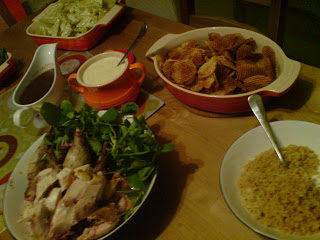

Most of this can be made in advance and reheated, that which is not, is easy and quick to prepare and will not keep you from your guests for very long.

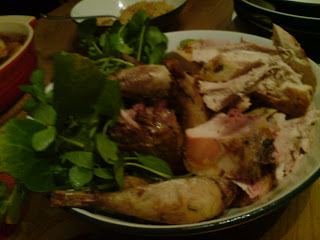
To prepare the brace of pheasants, begin by removing the giblets and setting them aside for later on. Stuff each bird with 2 ounces of butter, plus the liver (make sure you remove the green bitter gall bladder) and a good seasoning with salt and pepper, then lay a thin sheet of back pork fat over them that is large enough to cover the beasts and legs. Secure the back fat by tying string around the pheasants. Place them in a roasting tin and set aside for when you want to roast them – they should be roasted at 190°C for 20 minutes per pound plus an extra 10 minutes. You calculate this for the heaviest bird; in my case 2 pounds, so 50 minutes in all. For the final 10 minutes of cooking, remove the back fat and dust the breasts lightly with seasoned flour. Remove from the oven and allow to rest. I did this just before the guests arrived so that the birds could rest as the leek tarts were cooking. To serve it, I removed the legs, then sliced the breast meat and placed on a bed of watercress.
When the birds were prepared, I started on the gravy: first place the giblets (minus livers) in a saucepan along with a sliced carrot, a sliced onion and a bouquet garni and enough light beef stock to cover everything generously. This was simmered gently for two hours before being finished off later (see below). Next job was to get the game chips sorted. Game chips are basically crisps cut very thinly on a Chinese mandolin using the ridged blade to produce a lattice, or gaufrette, pattern. Peel 1 ½ pounds of firm potatoes. Put the mandolin at its thinnest setting and slice downwards, turning the potato a quarter-turn as you bring it back up to make the next slice to get the lattice effect. Put the chips into a large bowl of water to remove starch and then dry thoroughly. Deep fry in batches at 200°C until golden brown, and drain on kitchen paper and salt them well. This can be re-heated in the oven whenever you need to use them.

Once the starters had been eaten, I put the game chips in the oven and got to work on the buttered crumbs and rest of the giblet gravy. For the crumbs, 3 ounces of stale white breadcrumbs were fried gently for 5 or 10 minutes in 1 ½ ounces of butter until golden. They were placed in a serving dish and kept warm with the game chips. For the gravy, the stock with all the lovely the giblet flavours poured into the roasting tin. The stock was boiled hard and all the nice sticky bits that were found on the bottom of the pan were scraped off. When reduced, a glass of port was added, there was a quick seasoning, and the gravy was strained into a sauce boat.

So that there was a bit of green, also served some peas and green peas, but also Bread Sauce (as instructed) and (#124) Creamed Celery – Grigson says that either celery or mushrooms should be eaten with roast pheasant.

#122 Roast Pheasant – 9.5/10. What a brilliant meal! It was well worth the effort, I cannot fault it in any way really, and will definitely make it again, though maybe not with all the required elements. The pheasant was juicy and just-cooked, the gravy was beautifully rich and luscious, the breadcrumbs provided a nice crunchy texture and the game chips were tasty, some crunchy and some soggy in the gravy and bread sauce. For me, pheasant is the king of the game birds, and after this, it is going to be very difficult to knock it off the top spot.

FYI: to be a bit thrifty, I made soup from the carcasses and left over veg and trimmed celery etc and it was lovely – I’ll put a recipe up for it. I am never chucking out a carcass again!

#121 Little Leek Tarts

The first thing to get ready was the Little Leek Tarts. These seemed very simple to make – a leek puree baked in puff pastry (bought, I might add) plus a bit of salad of my own doing. I imagined them to be quite contemporary actually – many restaurants seem to have some kind of tart as a starter these days.

This recipe makes between 12 and 24 tarts, depending how much filling you put in each one:

Begin by trimming and cleaning some leeks – you need 2 pounds trimmed weight (this may seem a lot, but they melt down and concentrate). Chop them up and add them to a heavy-based pan that has 2 generous ounces of butter melted in it. Cover the pan tightly and allow to stew slowly for about 10 or 15minutes. Check inside and stir – the leek should not have changed colour, just reduced in volume. Cook for a further 10-15 minutes with the lid off so that the leeks lose their wetness. This is important to concentrate the flavour. Whilst this is happening cut out circles of puff pastry to line small tart tins and heat the oven to 220°C. Liquidise the leeks and season with salt and pepper and stir through a couple of tablespoons of double cream. Divide the mixture out between the pastry cases and sprinkle a teaspoon of grated Cheddar or Wensleydale cheese over them. Bake for 15-20 minutes and serve immediately. To look a bit more swish, I added rocket that had been dressed with a simple vinaigrette.


In reality, we made them first, but actually baked them when everyone arrived and the pheasants had finished cooking.

FYI: the leek became the national ‘flower’ of Wales after a Welsh King called Cadwaladr (c. 633–682) apparently ordered his soldiers to wear them on their helmets in a battle against the Saxons that took place in a leek field! This story is probably nonsense, but the best ones usually are…

#121 Little Leek Tarts – 8.5/10. Absolutely delicious! So often are leeks just used as a stock or soup vegetable; this recipe let them shine. The leek puree was light but creamy and went very well with the rich pastry. The only problem (and it was my problem, not the recipes) was that it was very slightly gritty – I obviously rushed the rinsing of a few of the leeks. Oopsey! Oh well, I have learned from my errors and have therefore become a better person because of it. Whatever.

An Eighteenth Century Feast

I’ve got a bit of catching up to do – this weekend was a Grigson frenzy; 5 in one day!! I had been toying with doing a reasonably elaborate meal – and in particular the roast pheasant that appears in the book. It was meant to be the 100th recipe but I couldn’t get hold of pheasant giblets, but look and ye shall find.

So basing a meal around this I came up with a loose theme – the Eighteenth Century. It was quite a time-consuming set of recipes, but none are particularly complex. Plus I had lots of help from my sous chefs Iain (Butters) and Charlotte (Charmolian). Also, in the times of the credit crunch, the whole meal was actually pretty good value, so it won’t burn a hole in your pocket. Anyways, here it is:

~Starter~


Little Leek Tarts served with a rocket salad (the latter, my own addition, obviously)

~Main Course~

Brace of Roasted Pheasants


Served with: Game chips, green vegetables, buttered crumbs and a rich giblet gravy

Accompanied by: Creamed celery and bread sauce

~Dessert~


Whim-Wham


Not a mean feat, but we started well ahead of time so that we never seemed rushed, plus much of this could be made in advance. Paddy, Kate and Pete came over, so there were no heirs and graces and if anything did go wrong it wouldn’t matter (nothing did!). So if you fancy making any elements of this meal, I shall naturally be adding the recipes alongside any wee factoids I may find over the next couple of days.