#343 Oyster Stuffing and #344 Oyster Sauce

Oysters are rather expensive in the UK and it can be a rather arduous task shucking them, though in the US, they are much cheaper and often come in tubs preshucked in their own liquor ready for cooking. It is for these reasons that I have been trying to finish all the recipes in English Food that include oysters before I return to England in a little over a month’s time. These two are the final oyster recipes. Not only that, by cooking these recipes I have completed the Stuffings section of the Stuffings, Sauces & Preserves chapter. This might sound impressive, but if you clicked on the link, you’ll have seen that there were only five in the section, and one of those was a sauce!

These are two recipes that were made very popular during the Victorian era that put together shellfish and meat. I have grown to love this combination and so I was looking forward to cooking these. Past recipes on this vein are Chicken with Mussels, Beefsteak Stewed with Oysters as well as the classic Steak, Kidney and Oyster Pudding (and pie!).

I’m not going to blog the two individually because they cannot really be made separately. The first is a light stuffing made with classic stuffing ingredients like breadcrumbs and suet. The second is a simple béchamel sauce flavoured with liquor collected from the oysters used for the stuffing.

The quantities in the recipe are for a large turkey and it requires rather a lot of oysters – 4 to 5 dozen! You can halve the number if you are using the big Atlantic ones; it’s the equivalent to 2 tubs of the preshucked ones you see in supermarkets in the US.

If you do have to shuck your own, I have heard of a method that takes the pain out of it, though I have never tested it myself. Apparently, if you put your cleaned oysters in the freezer flat side facing up, they should magically open their shells after 10 minutes or so. The reason for this is that they go to sleep and relax their strong adductor muscle which you usually have to fight against with the shucking knife when you open them manually.

#343 Oyster Stuffing for Turkey and Other Poultry

Grigson says you can halve the quantities if using a large chicken, which is what I did. Even then, I found I still had plenty left over so I cooked it separately in an ovenproof dish.

First of all shuck 2 or 3 dozen oysters should you need to; do it over a sieve in a bowl so you can save the liquor for the oyster sauce. Chop the oysters, keeping the pieces large. Mix them into the other stuffing ingredients: 10 ounces of white breadcrumbs made from stale bread, 5 ounces of suet, 2 heaped tablespoons of parsley, the grated rind of a lemon, 2 heaped teaspoons of thyme, ¼ teaspoon of both nutmeg and mace, a good pinch of Cayenne pepper, 2 large beaten eggs, salt and pepper. It is important to mix these together rather loosely; there should be no dry breadcrumbs but at the same time it should not be mixed into to big ball of stodge.
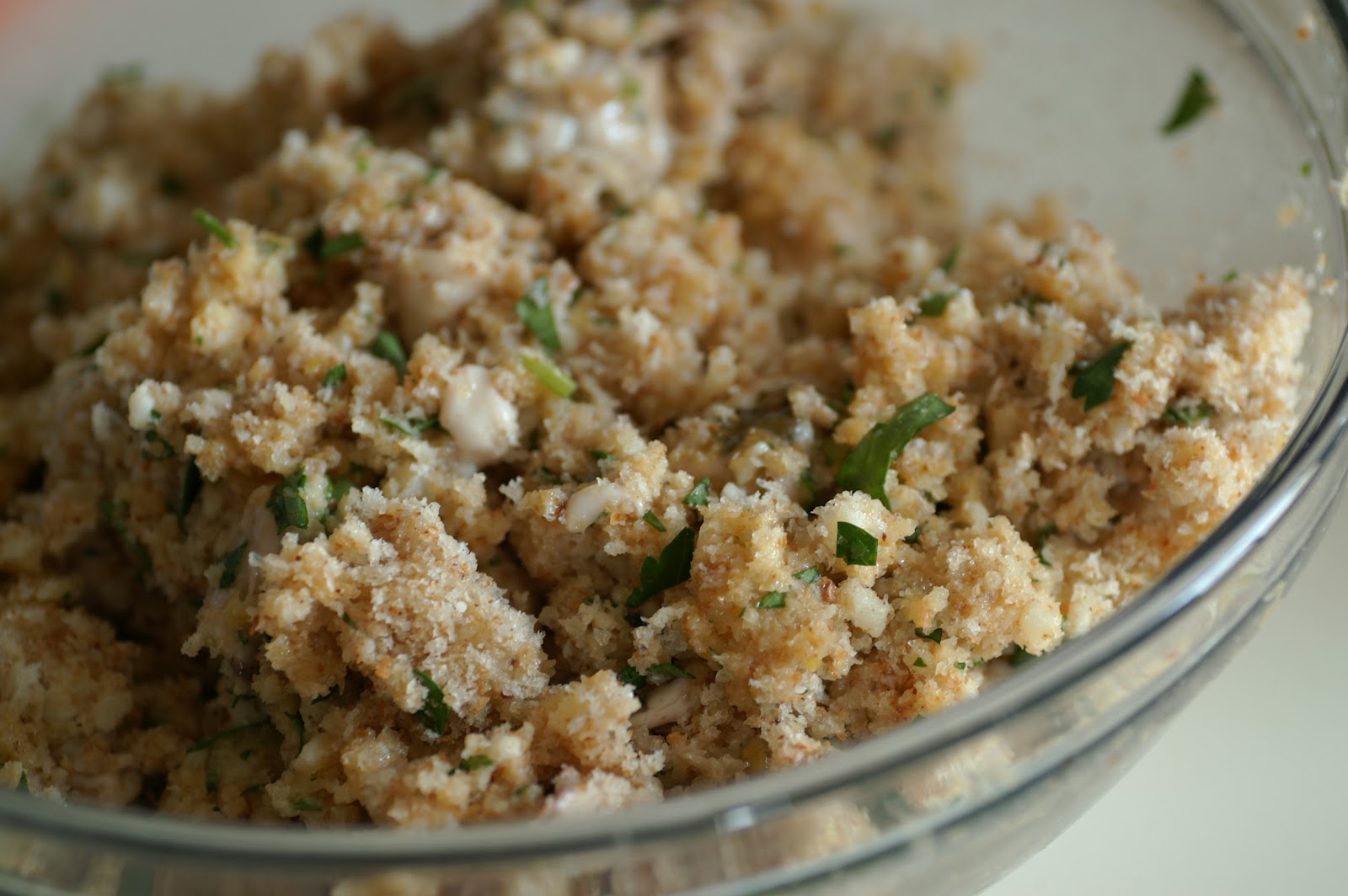
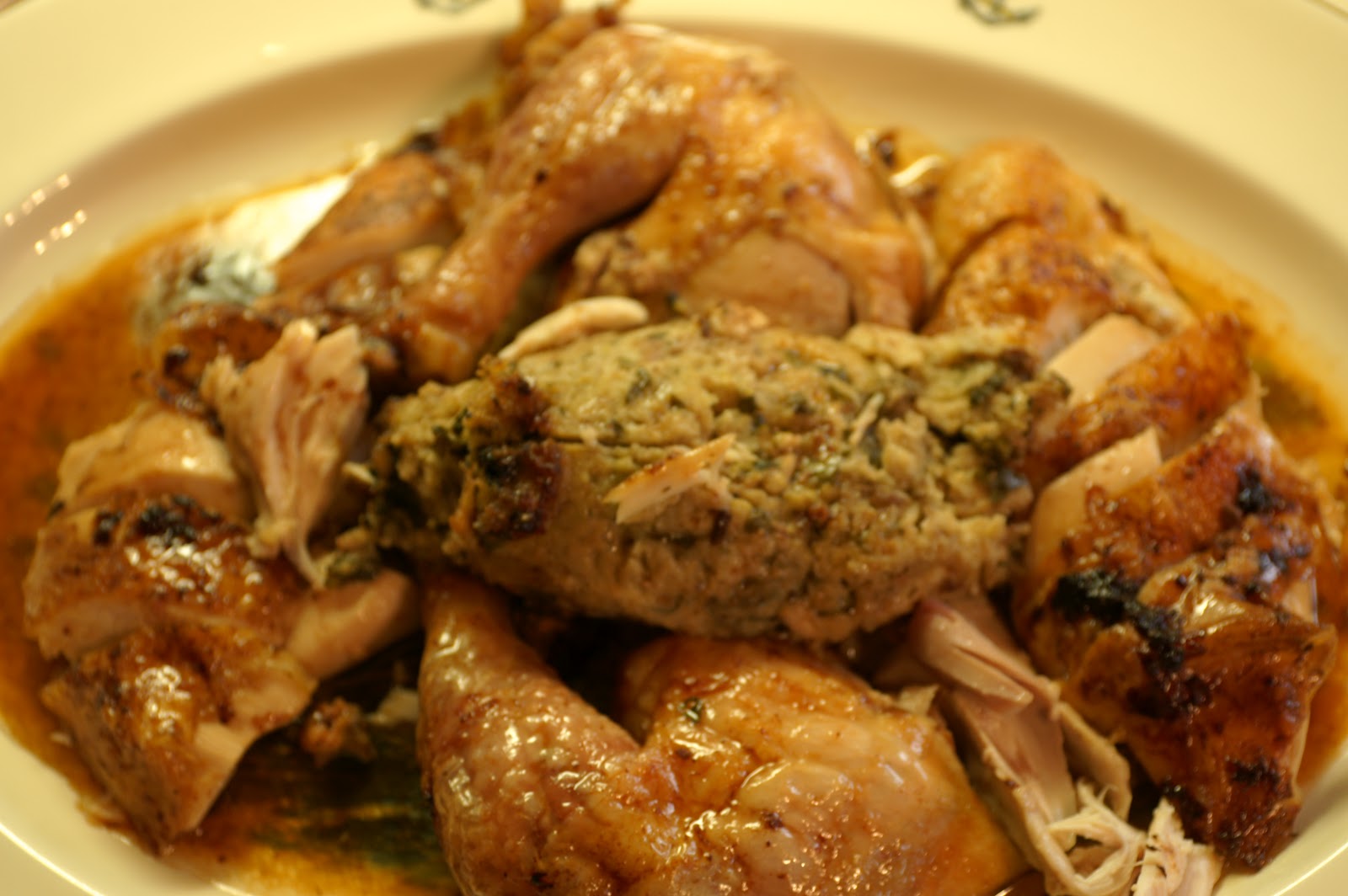
Stuff the cavity of your poultry rather loosely – it will expand as it cooks – and truss the legs with some string. Also stuff it into the neck end too, if the flap of neck skin has been left on your bird, securing it with a couple of short skewers (I have noticed that the neck skin is usually removed in America). Any left over can be baked for thirty minutes in an ovenproof dish.

Roast the bird as normal, taking the total weight including stuffing when calculating the roasting time.
#344 Oyster Sauce

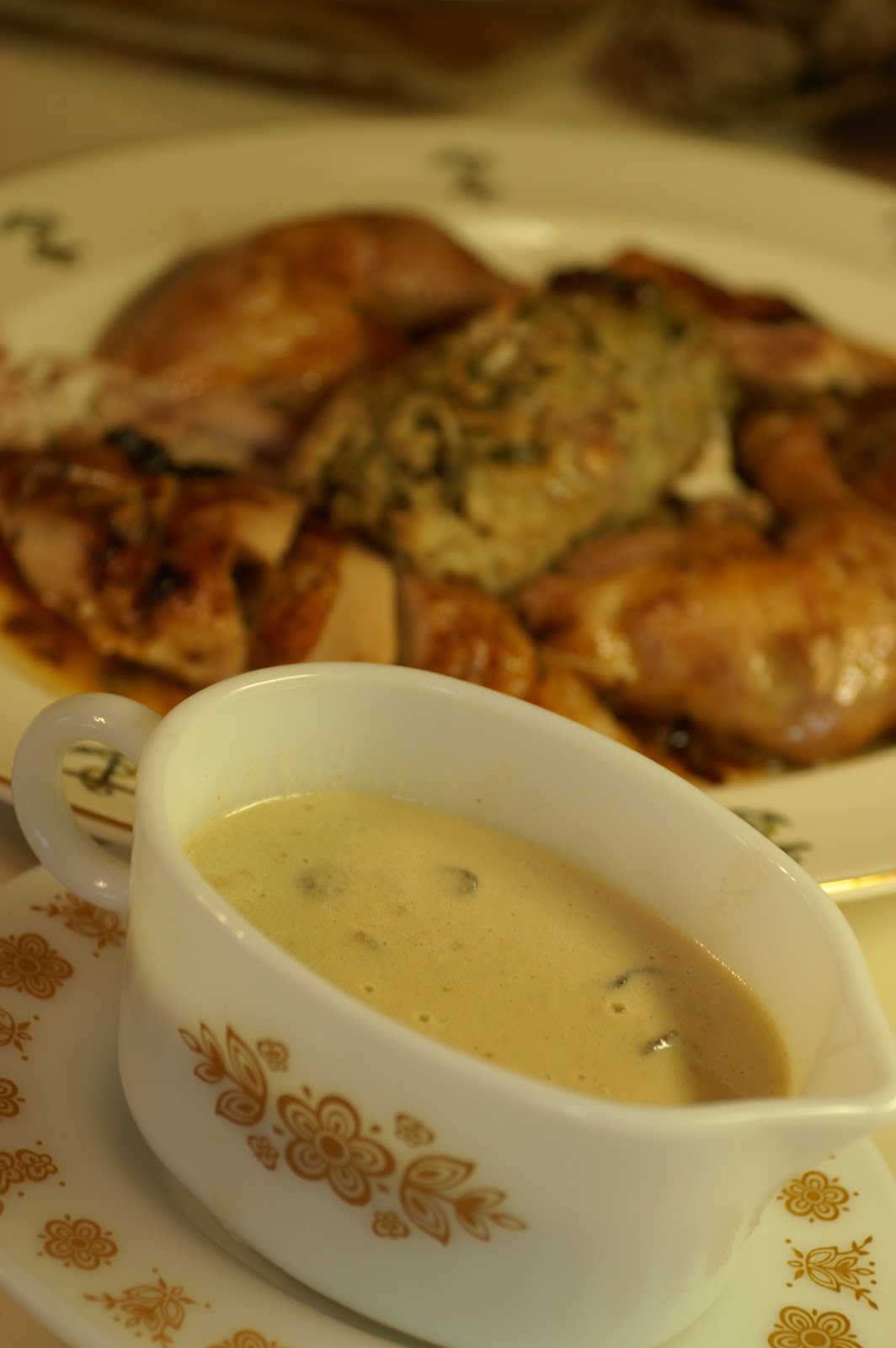
Open 2 dozen oysters, saving the liquor. Make a béchamel sauce by melting 2 ounces of butter in a saucepan then stir in two tablespoons of flour. Mix together with a wooden spoon to make a roux and cook on a medium heat for a couple of minutes. This is a white roux, so don’t let it colour. Add ½ pint of milk in 3 or 4 parts, stirring until the milk is absorbed and the roux smooth before adding more, then stir in ¼ pint of double cream and the reserved oyster liquor from the sauce and stuffing. Simmer for 20 minutes, stirring everyone now and again. This part could be done in advance if you need – make sure you cover the pan with a lid because a thick skin will quickly grow. Chop the oysters into good sized pieces and add them to the sauce. Heat through then season with salt, white pepper, grated nutmeg, Cayenne pepper and lemon juice. The sauce should be the ‘consistency of double cream’, says Griggers.
FYI: Mrs Beeton suggests using left-over oyster sauce in a fish pie which I think is a marvellous idea.

#343 Oyster Stuffing for Turkey and Other Poultry. This was amazing – the oysters were tender and the stuffing was light, the flavour being lifted by the fresh herbs and the aromatic lemon zest.

#344 Oyster Sauce. This was a beautiful white and well-flavoured sauce mildly spiced with a wonderful iodine tang from all that oyster liquor. Absolutely delicious.

I can’t score these separately as they would never be made separately; that said this one is a no-brainer: 10/10.

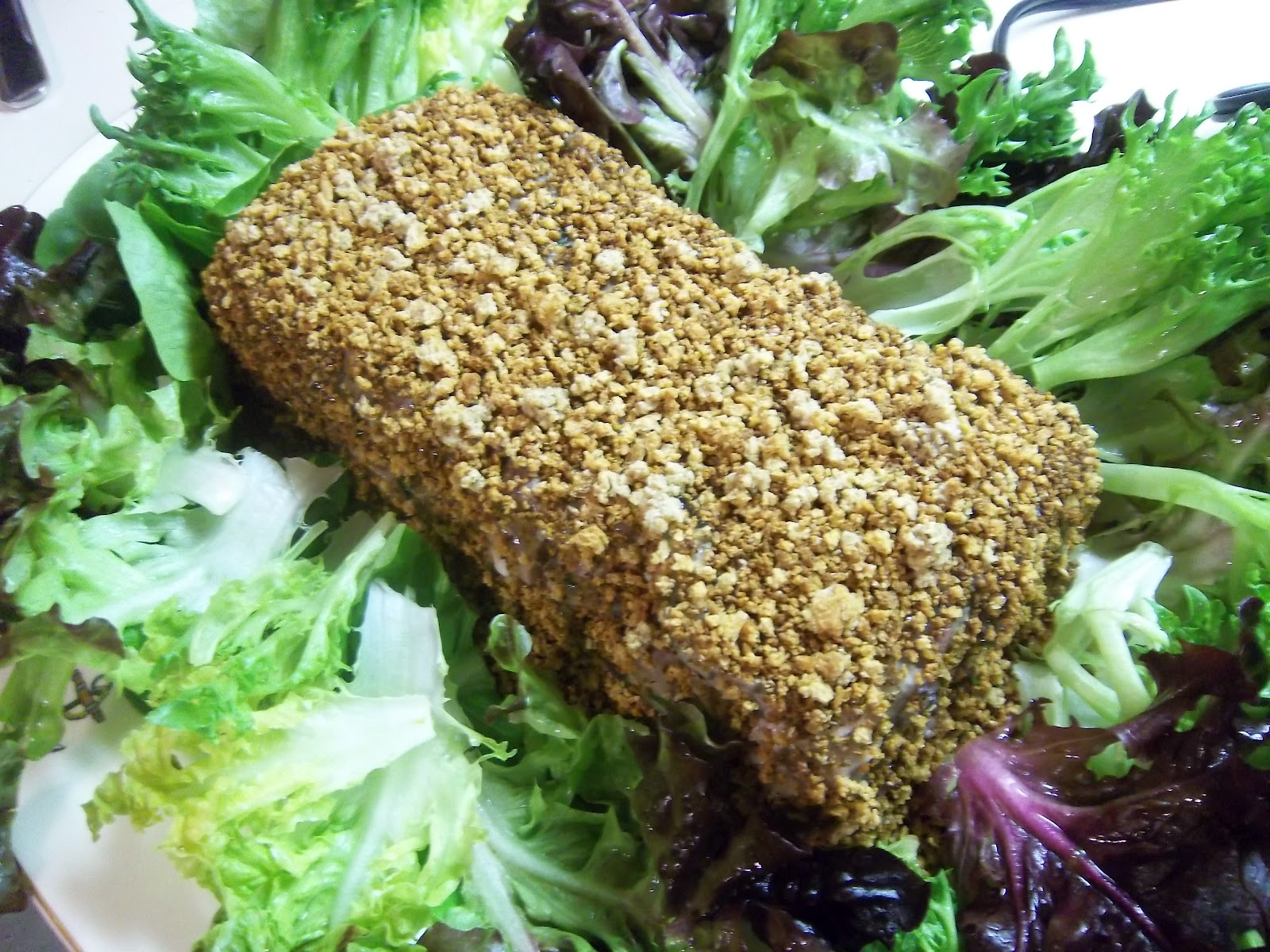
#342 Halibut with Anchovies

It’s always nice to add an extra species of animal or plant to my list of foods I have eaten. Halibut is reasonably pricey so I have typically avoided them in the fishmonger’s shop. They are also beasts – the largest flatfish to be found in European waters. Check out this one caught off the west coast of Iceland in 2010:

It weighed an impressive 34 stones (that’s 476 pounds, or 220 kilos)!

This recipe is from the Polish novelist Joseph Conrad’s wife. She was and Englishwoman called Jessie George, who obviously had a flair for cookery. She wrote a book called A Handbook of Cookery for a Small House, and I assume (for Grigson doesn’t say) that it is this volume from which the recipe comes.

The recipe includes an unusual ingredient – Patum Peperium, otherwise known as Gentleman’s Relish. It is a highly spiced potted anchovy spread, and was a Victorian invention – click here for a link to the other blog for more information on this delicious savory.

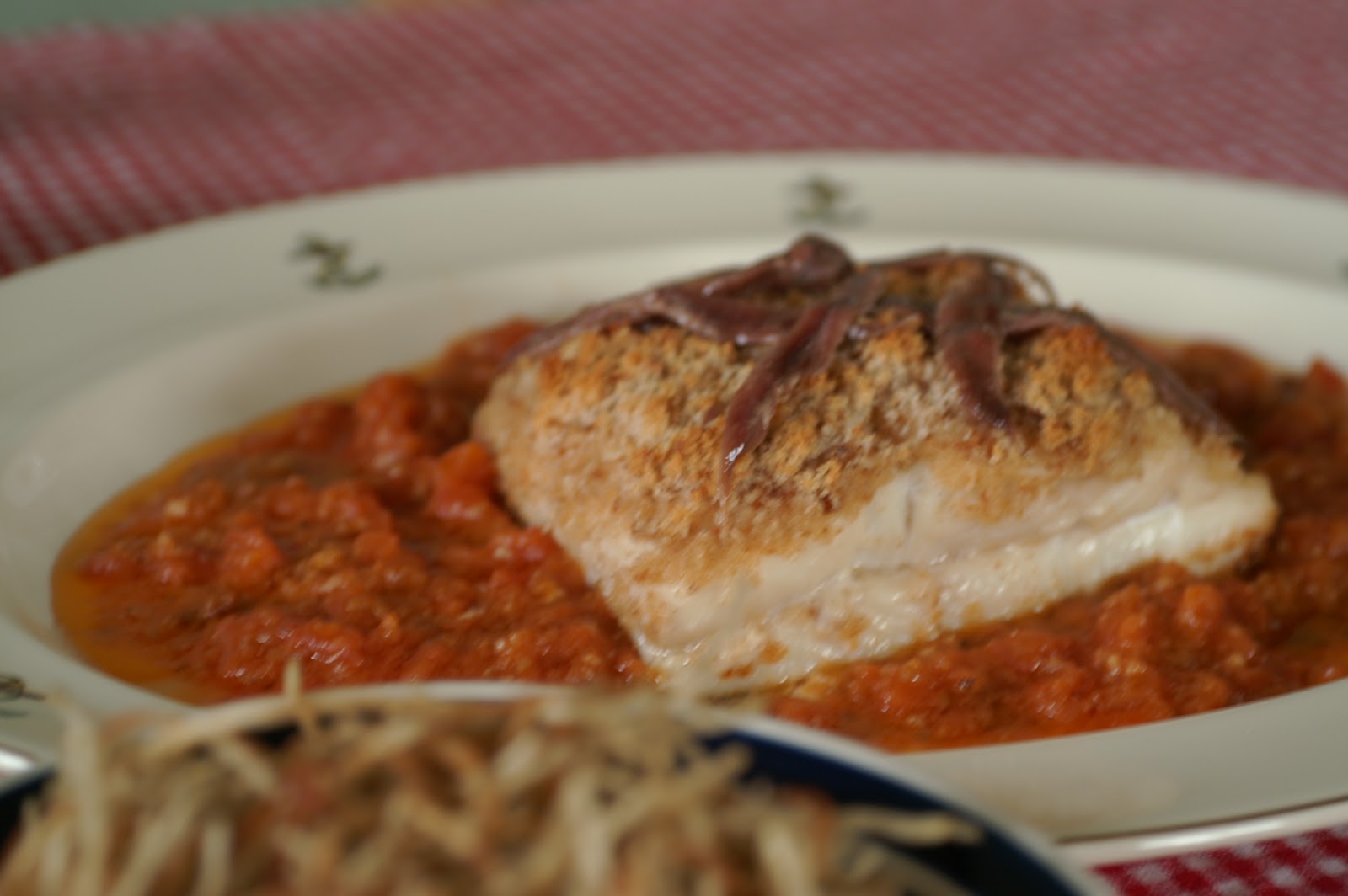
This will serve 3 or 4 people, depending upon the size of your piece of halibut, which should weigh between 1 and 1 ½ pounds. Try and get hold of a steak, if you can only get fillets buy two pieces and sit them on top of each other. Make the spiced butter by mashing together 4 ounces of softened butter and a very generous heaped teaspoon of Patum Peperium and smear it over the halibut, including the underside. Sprinkle over 6 tablespoons of white breadcrumbs and bake in the oven for 30 minutes at 190⁰C (375⁰F) until the breadcrumbs have browned.

In the meantime make the tomato sauce that accompanies the fish. Peel 8 ounces of tomatoes by cutting through the skins in a cross shape on their undersides. Place in a jug and pour over boiling water. After 1 or 2 minutes, remove the tomatoes and the skin should be easy to peel away. Chop the tomatoes and cook them in a saucepan with a good sized knob of butter. Gently cook until the juices are reduced to just 3 or 4 tablespoons. Season with a teaspoon of Worcester sauce and some salt, pepper and sugar.

Remove the fish from the oven and place on a serving dish, pour the buttery juices into the sauce and spoon it around the fish. Finally, add 6 split anchovy fillets and place on top of the fish in a criss-cross pattern.

Jane suggests serving with matchstick potatoes. She does not let us know how to make them, but luckily I knew anyway: peel some potatoes and cut into 2 or 3 millimetre matchsticks – julienne as the French say – use a food processor or Chinese mandolin to do this (if you don’t have one, then don’t even bother and boil some potatoes in their skins instead). Plunge the potatoes into a roomy bowl of water so you can rinse away the start. Then drain them in a sieve.

Heat up some cooking oil such as sunflower or groundnut. When a piece of bread goes nice and brown in about 30 seconds, it is hot enough to add the potatoes in batches. Fry for 2 or 3 minutes until golden brown, around 180⁰C if you have an electric deep fat fryer or cooking thermometer, then drain on kitchen towels. Salt and serve.

#342 Halibut with Anchovies. What a delicious dish! The fish was firm, flaky and moist and the butter was seasoned with just the right amount of the Patum Peperium. The tomato sauce was rich yet fresh; a great meal for a summer’s evening. 8.5/10.

#341 June Pea Soup

I haven’t been on the ball with my blogging recently, I do apologise (though there are reasons for this that you shall soon be privy to). I shall get my arse into gear.

Here’s a recipe that I have meant to make every summer, and every summer I have forgot. I did not expect to be making it here in America as you don’t see fresh peas in their pods very often here; I happened upon them at Soulard Market which is great for fruit and veg.

This soup is “a soup for midsummer when young peas are at their freshest and sweetest”, says Jane. In fact that is all the she says on this one. This soup has very few ingredients and it contains no stock – and no seasonings – and can be served either hot or cold. It’s not very often that you come across vegetable soups being made without stock, though the great French chef and restaurateur Marcel Boulestin knew all about the benefits of making soup in this way:

The chief thing to remember is that all soups – unless otherwise specified – must be made with plain water. When made with the addition of stock they lose all character and cease to be what they were intended to be. The fresh pleasant taste is lost owing to the addition of meat stock, and the value of soup from an economical point of view is also lost.

The French gastronome Brillat-Savarin made similar comments.

Marcel Boulestin

Well we get to put this theory to the test in this, the penultimate recipe in the Soups chapter…

Start by shelling your peas – you’ll need to buy three pounds – and stop shelling when you get to about 1 ¼ pounds. Reserve five or six of the greenest pods. Next, chop six ounces of spring onions and sweat them in three ounces of butter, along with a very finely chopped clove of garlic. Cover the pan, and let them stew for five minutes; mind you don’t let them brown though. Add your peas and the reserved pods along with a little less than three (UK) pints of water. Bring to a boil, and then simmer until the peas are nice and tender. Liquidise and sieve the soup, reheat and stir in 6 fluid ounces of crème fraîche or whipping cream. If you want to eat the soup cold, you are essentially done – all you need to do is chill it and add a flurry of chopped mint leaves into each bowl when you serve them. If you want it hot, stir in three more ounces of butter. Again, serve with some finely chopped mint leaves.

#341 June Pea Soup. Well, well, well, I have to say I was pleasantly surprised my this delicious soup – the sweet peas and the still very slightly acrid onions worked so well and did not require anything else to make them delicious, just the touch of aromatic mint and the silkiness from the cream. I tried it cold; there was none left to try warm! 7/10.

#340 Veal (or Lamb) Cutlets

Here’s a simple recipe from the Beef & Veal section of the Meat, Poultry & Game chapter. I am trying to get through all of the veal recipes before I move back to England later this year; it’s not because it is cheaper here, it’s just that it is much easier to get hold of.
A cutlet is a chop (rib) from the best end of neck, just above the shoulders. I went for veal, though they were called ‘Tomahawk Chops’ in the shop, I don’t know that’s typical in the US or not. Anyways, it’s a very tender cut of meat that needs very little cooking, what is nicely done here is the meat is breadcrumbed so it is protected from direct heat, keeping it juicy, but with a crunch. Jane says that the thickest the cutlets should be is an inch. You need one cutlet per person (or two, or even three, if doing lamb). Jane also mentions that boned loin can be used, but the slices should be half an inch, maximum. That’s us told.
You need some breadcrumbs first: I use a blender for that job and then scatter them over a baking tray and let them dry out in a cool oven. If the bits are too big, you can always give them a very quick whizz in the blender again. Mind you don’t turn them into dust though. Take the meat out of the fridge so it can warm up to room temperature.
To the breadcrumbs add some grated lemon zest and finely-chopped herbs: parsley, thyme, marjoram and my new favourite herb, winter savory. Coat the cutlets in flour, patting off the excess, then into some beatenegg and then into the herby crumbs.
Heat some clarified butter in a heavy-based frying pan and fry gently on both sides. The amount of time depends on the thickness of the meat and how ‘done’ you want it to be. I did inch-thick cutlets, cooking them around 3 or 4 minutes a side. The crispy crumb protects the meat, so if you do accidentally cook the meat right through, it won’t be dry.
When cooked, take out the cutlets and let them rest while you get on with the job of making a sauce: on a medium heat, stir 2 teaspoons of flour into the pan juices and then whisk in ½ pint of stock– veal, lamb or chicken, it’s up to you – simmer for a little under 10 minutes to cook out the flour. Take it off the heat and then whisk in a good-sized knob of butter. Taste the sauce and add salt, pepper and lemon juice to taste. “The sauce should be well seasoned, and not too copious or thick”, says Jane.
“Lemon quarters, mushrooms, watercress, a few boiled potatoes, are the right kind of setting for a meat cooked in this way”. I did the same, though I swapped watercress for broccoli. I think you always need something on your plate, perhaps that’s why she included watercress.
#340 Veal (or Lamb) Cutlets. These were great; everything was all very subtly-flavoured so the slightly piquant lemon and herbs didn’t mask the wonderfully tender veal. What else can I say? Great stuff. 8/10.

#339 Hindle Wakes

Where do I start with this one?

Hindle Wakes is a cold chicken dish for buffets and the like and has a long history. It is essentially a chicken stuffed with a prune mixture, simmered in a stock made of vinegar and water, cooled and smothered with a lemon sauce. Other variations include simmering in lemon juice stock and roasting the stuffed bird as a hot dish, which sounds much nicer.

The origin of the dish is obscure; some think it originally came over to England – Lancashire to be precise – from Flemish weaver immigrants in the 1330s. Others (including Jane) think it is a typical English medieval recipe; it being heavy on the herbs and dried fruit is suggestive, but I cannot find anything similar in my old facsimiles. I suppose it will remain a mystery.
Did the Flemish bring Hindle Wakes to North-East England?

The name Hindle Wakes is equally strange. Several modern cook books say that it comes from the name of the Lancashire town of Hindle Wakes. This all sounds good until you check an atlas and find there is no such place as Hindle Wakes in Britain, never mind Lancashire. A friend of Jane Grigson’s reckons that the name is a bastardisation of Hen de la Wake. “No etymologist would support a folk explanation of this kind”, says Jane.

I find no mention of the phrase Hindle Wakes in literature searches until the late 1910s where there is suddenly a glut of them because in 1912 a playwright called Stanley Houghton wrote a play entitled Hindle Wakes which was set in the imaginary Lancashire town Hindle where wakes would occur at certain times of the year. A wake in this context means the lookouts people would set up the night before a large church festival at their parish, presumably to catch thieves. How it got attached to this strange dish I do not know.
It’s still going strong…

Anyway, on with the rather long recipe…

For the stuffing:

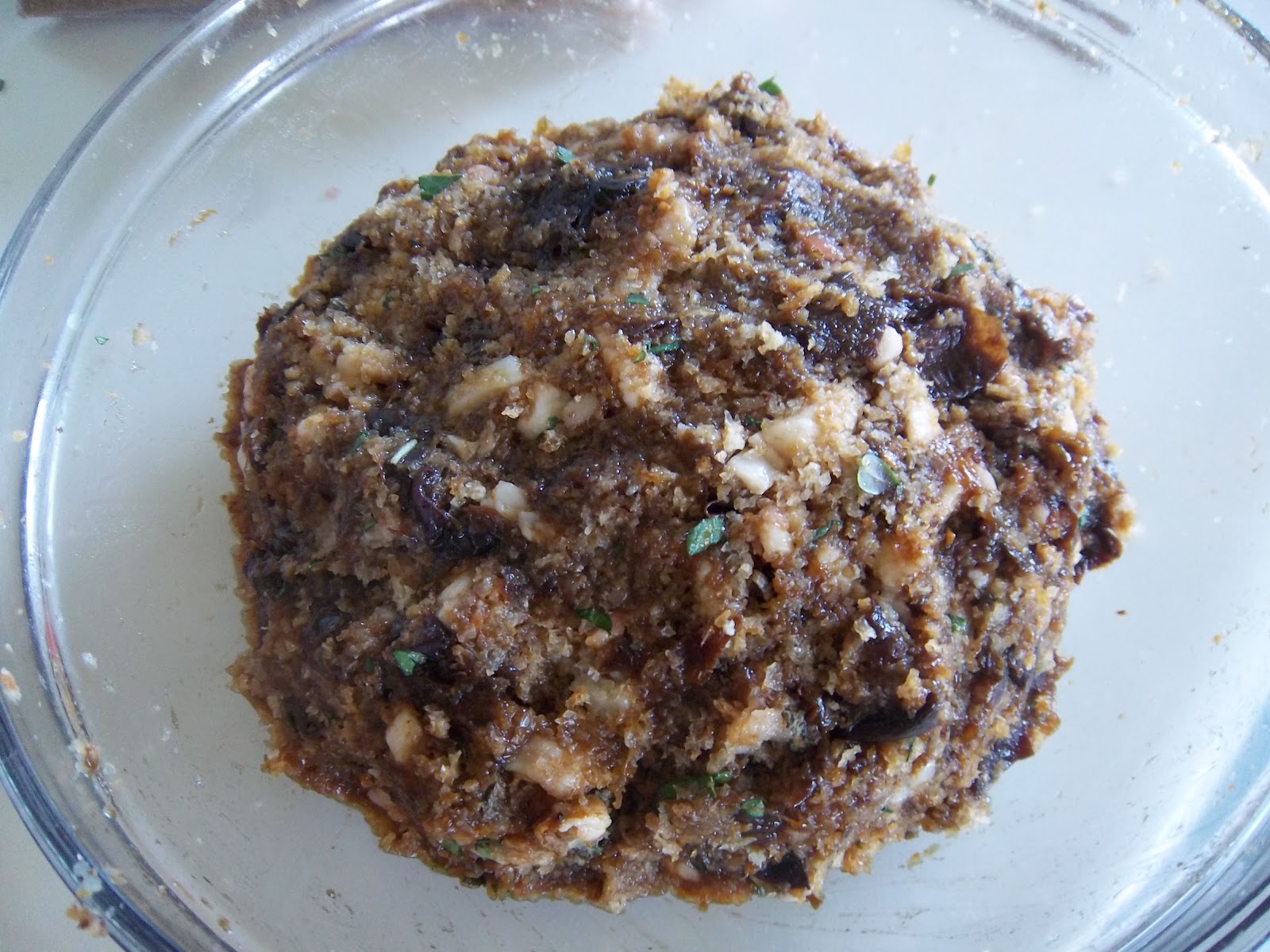
Soak one pound of unstoned prunes in water or tea overnight. The next day remove the stones from the prunes, setting the neatest third aside for later. Now you need to crack the prune stones to get to the almond-scented kernels. I have found the best way to do this is to place around a dozen stones in a freezer bag, squeeze the air out, seal it and then crack the stones sharply with a hammer. This stops the sticky stones and precious kernels from pinging around the kitchen. Chop the kernels and the rest of the prunes and put in a bowl along with: 8 ounces of slightly stale breadcrumbs; four ounces of chopped fresh beef suet; and half a teaspoon each of finely chopped sage, parsley, marjoram and thyme. Mix them well with your hand and season withsalt, pepper, a tablespoon of brown sugar and one or two tablespoons of malt vinegar. Mix again.

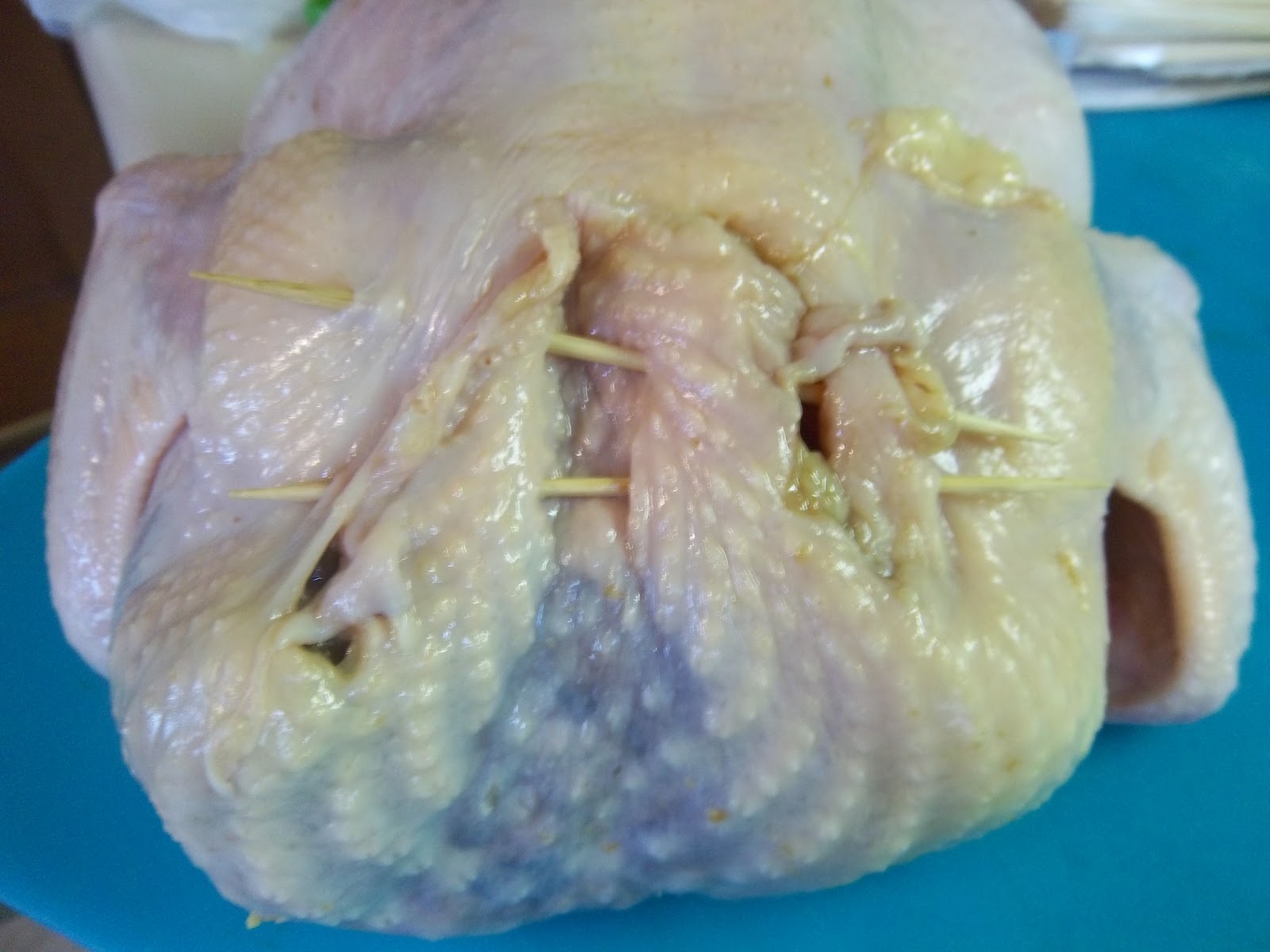
Stuff a five to six pound roasting or boiling chicken (you could also use a capon) both inside the body cavity and the neck. Using cocktail sticks, close the two ends of the bird. I found that I could only fit in around half of the stuffing so I rolled the remainder into balls and froze them for future dinners.

To cook the fowl:

Put the bird in a good-sized stock pot that will fit it reasonably closely and add the following ingredients: 2 level tablespoons of salt, a stick of celery, one large unpeeled onion studded with three cloves, a bay leaf, four parsley springs, four thyme sprigs, six tablespoons malt vinegar and a tablespoon of soft dark brown sugar. Add around 6 pints of water – you can leave an inch or so of chicken above the water if it’s a roaster; you’ll need to cover completely if a boiler.

Bring slowly to a boil, skimming any scum that may rise to the top. Cover the pot and simmer the chicken very gently for between 1 ½ and 3 ½ hours “according to its antiquity”. Mine was done after 1 ½ hours. It is very important you cook the chicken on a very low simmer indeed; scalding might be a better word to describe the water, you should only see the barest of gulps and bubbles.

When cooked, remove from the stock and allow to cool, covered with a layer of foil. You’ll need the stock for the sauce, so don’t chuck it away…

For the sauce:

In a small saucepan, mix together five fluid ounces of double (heavy) cream, the juice and grated zest of a lemonand a seasoning of white pepper. Bring to a boil and let it simmer for five minutes or so. In another saucepan, make a roux by melting ½ ounce of butterand when it had finished sizzling stir in a healthy tablespoon of flour. Cook for a couple of minutes. Whisk in five fluid ounces of milkand half a pint of the stock. Simmer for twenty minutes until the sauce is very thick (I couldn’t get the sauce to go thick even after thirty minutes). Season with more salt and white pepper if needed, then cool covered to stop a skin from forming.

To arrange the dish:

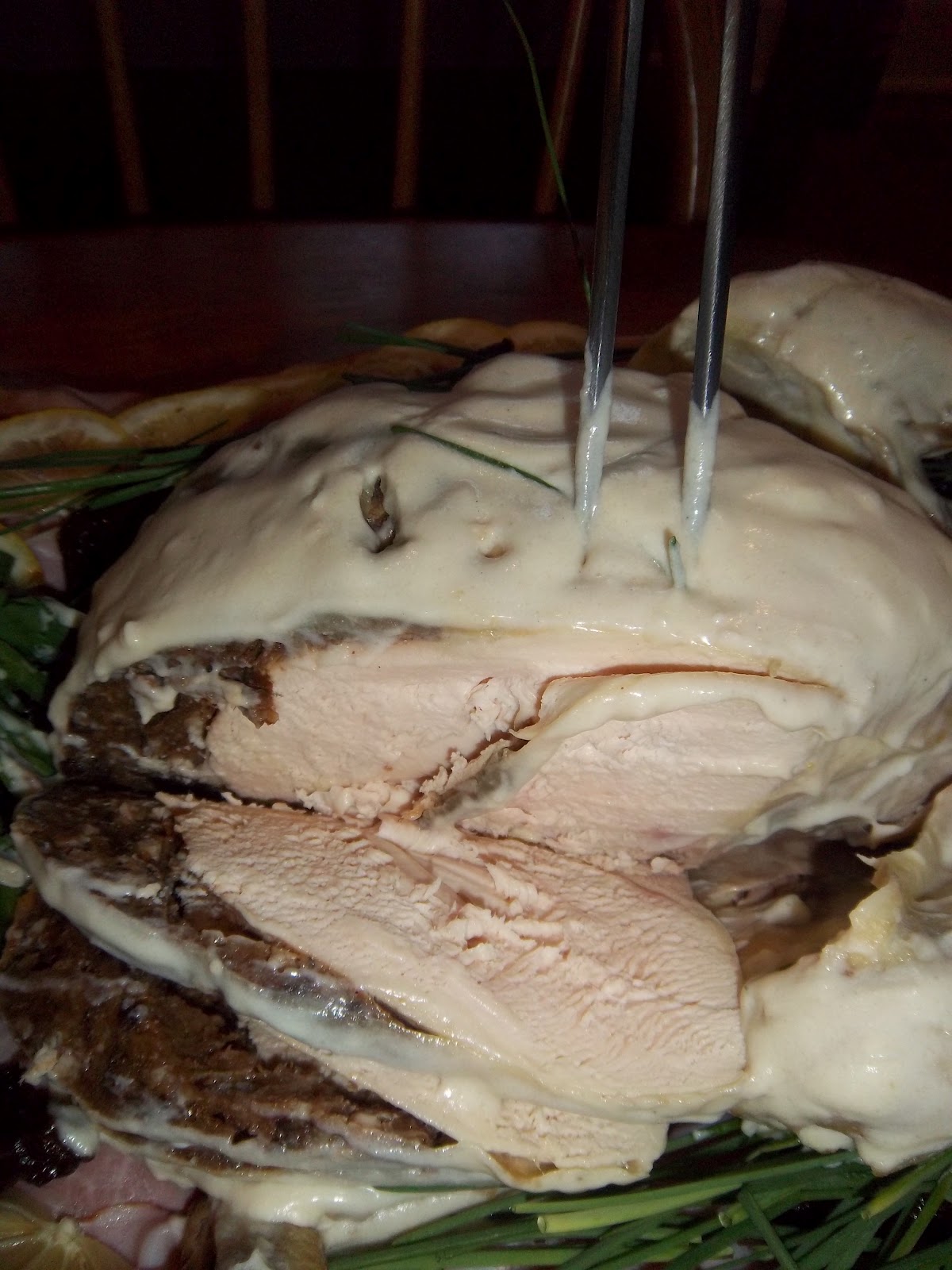
Place the fully-cooled chicken on “a wire rack over some greaseproof paper. Reheat the sauce slightly – it will be solid when cold – so that you can spread it right over the chicken smoothly and evenly. Use a palette knife…” says Grigson. This was impossible for me with the rather runny sauce, so I just put the chicken straight on the serving plate and used a knife to spread the sauce over the chicken. Next, surround the chicken with around eight ounces of thinly sliced ham. Cut a lemon into halves and cut into thin slices. Arrange the slices around the chicken along with the reserved prunes. Finally, a couple of herbs: take a large bunch of parsley and stick it in both ends of the chicken, then scatter with some chive stalks.

#339 Hindle Wakes. What a monster I created! It looked like a cross between something from Fannie Cradock’s 1970s repertoire and the centrepiece to a medieval feast. I have to say, once sliced up it didn’t look too bad. The chicken was cooked to a turn – I think the vinegar in the stock help to tenderise it – and it went wonderfully well with the lemon sauce and prunes that were dotted around the bird. The cold stuffing was rather stodgy though. Mid-way through the recipe for this “superb buffet dish”, Jane does mention that she makes a stuffing from just prunes, kernels and herbs, as the traditional stuffing is too heavy. I felt like it was eating a dish that should have been hot but had cooled down. It’s a tricky one to grade due to the mix of sublime and ridiculous. I’ll sit on the fence with a 5/10.

#338 Beefsteak Stewed with Oysters

This is the third and final recipe that uses the classic combination of beef and oysters. I was so dubious about it at first but now I relish and look forward to recipes like this. This one is a simple stew that is easy to prepare and uses few ingredients. It probably was at its peak of popularity in Victorian times – I have mentioned before a few times how oysters were so cheap they were used as a seasoning. The final product isn’t overly fishy as one might expect.

This will feed between 3 and 5 people depending upon greediness.

Start with your oysters; you need to prepare 18 of the buggers. However, this is only if you are using the small British ones, if you are using the large Pacific or Atlantic ones, you can get away with half or even a third of the amount. Luckily, being in the USA at the moment it is pretty easy to find the little bivalves pre-shucked in tubs in their own liquor. If you can’t get hold of the pre-shucked kind, I hear you can easily open them by putting them flat side up in the freezer and when the oysters fall asleep they open up. I have never tested this so it may all be nonsense. However you get your oysters, make sure you drain them well through a sieve and keep the liquor.

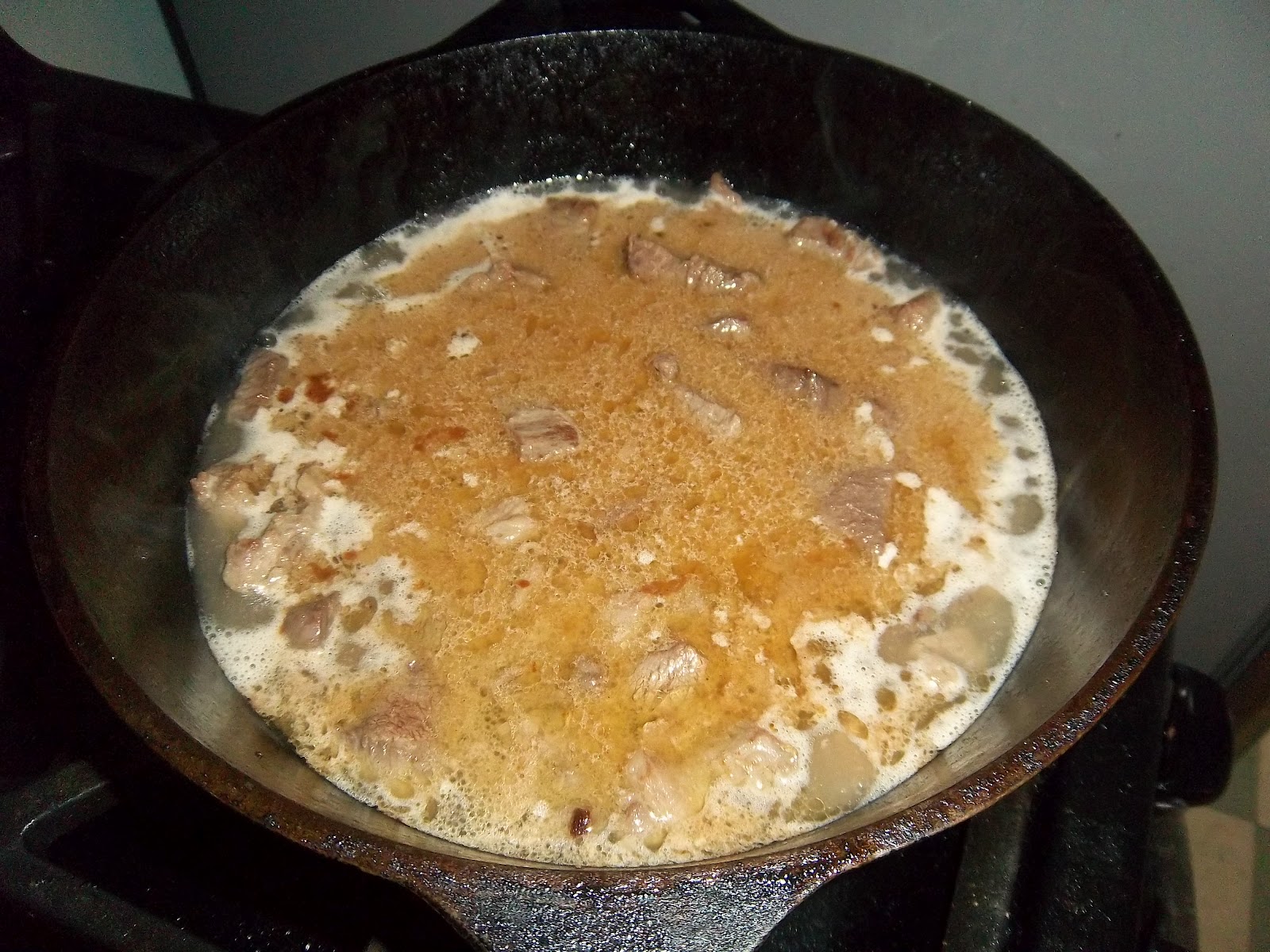
Next, the beefsteak – any kind ‘will do for this recipe, from chuck to rump’ – you need 1 ½ pounds in all. Cut it into large neat pieces and season well with salt and pepper. Melt 2 ounces of butterin a large deep pan with a lid and brown the beef, in batches if necessary. Once that job is done, add around ½ pint of water and the oyster liquor. Cover, bring to a simmer and cook until tender between one hour and 90 minutes depending on the cut of meat.

Whilst it gently bubbles away, mash together ½ ounce of butter with a rounded teaspoon of flour.  When the meat is ready, add 2 ounces of port and stir the butter and flour mixture in small knobs until the sauce thickens. You might not want to add it all. I like a sauce on the thick side so I did. Don’t let the sauce boil hard though. Next add the oysters – if large, cut into two or three pieces – and season with salt and pepper. Heat the oysters through for a couple of minutes – no longer, or they’ll be rubbery.

‘Serve very hot’, says Griggers, with triangles of bread fried in butter‘tucked around the sides’.

#338 Beefsteak Stewed with Oysters. I love this combination so much! What a shame there are no more recipes left like this. The water had become a rich but not overpowering sauce that goes so well with the iodine-scented oysters. The fried bread was a great contrast in texture and the recipe is so easy and quick compared to a pie or pudding too. It is such a shame that oysters are so expensive. I am wondering if mussels could be used as a substitute. This one is going to remain a staple whilst I am in the USA where oysters are cheap! 10/10.

#337 Eel Pie

This recipe puts me three-quarters of the way through the book! Who’d have thunk I’d still be ploughing through it!?

The fourth and final eel recipe from the book just in time for Good Friday, hopefully it will be better than the third which was a disaster…

Eel pies or pasties are a food that has a very long history in Britain. Sometimes they were just simply unskinned eels, herbs, spices and water covered with a ‘coffin’ of pastry, probably eaten as a stew rather like water-souchy; the pastry simply serving as a vessel within which to cook the fish. The earliest mention of eel pie I have found comes from an article by A. Peripatetic in a 19th Century periodical called London Society:
East-Farleigh lies in the hundred of Maidston, and was given to the prior and monks of Christ-Church in Canterbury, by Ediva the Queen, mother of the two kings Eadred and Edmund in the year 941, and was…to find the convent with eel-pies.
Eels are associated the most with London and there is a great old proverb that I discovered is used in Shakespeare’s King Lear, which I can really relate to:
Lear:     Oh me, my heart, my rising heart! but down.
Fool:     Cry to it, nuncle, as the cockney did to the eels, when she put
Them i’the paste alive; she rapt ‘em o’the coxcombs with a stick,
And cry’d, Down, wantons, down!

In other words, she  was so squeamish about killing the eels for her pie, she tried to bake them alive, making the whole situation worse and much more stressful than it would have been had she killed them. The first time I made eel I had to do away with them myself and it was pretty distressing (see here).

King Lear and Fool

I’m quite glad to have come to the end of the eel recipes to be honest because I was starting to feel rather guilty about eating a fish whose numbers have been in sharp decline. Anyways, if you do come across an eel for sale you may as well purchase it and turn it into a little piece of history as I did:
The first thing you need to make is the pastry – an unusual one using grated butter and cream that is somewhere between a flaky pastry and a shortcrust.
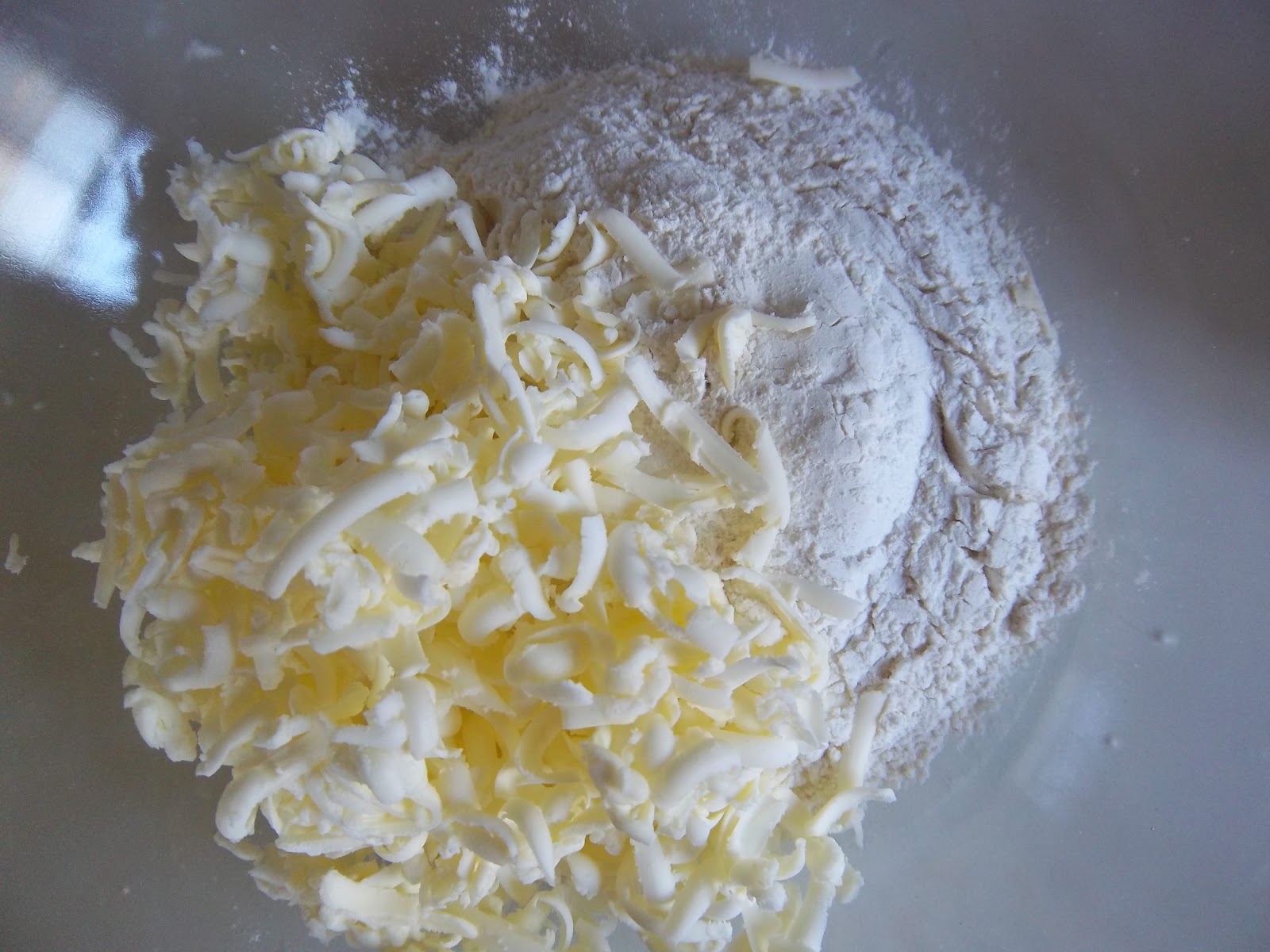
Place a block of butter in the freezer until it is well-chilled, but not frozen. Meanwhile measure out 6 ounces of flour and mix in a good pinch of salt. Next grate the butter over your kitchen scales until you have 3 ounces and add this to the flour.
Add enough cream – use either single or soured – or water to form a good soft dough, stirring in your liquid of choice at first with a knife then bringing it together with your hands. I noticed that the flour required more cream than it would have needed if using water. Cover and chill in the fridge for at least an hour. A note to Americans:  Soured cream in the USA is far too thick as an option, so go for something like half-and-half or heavy cream.
Peel and finely chop four shallots and soften them slowly in butter in a wide shallow pan. When cooked, tip them into a shallow pie dish or plate with a capacity of around 2 pints.
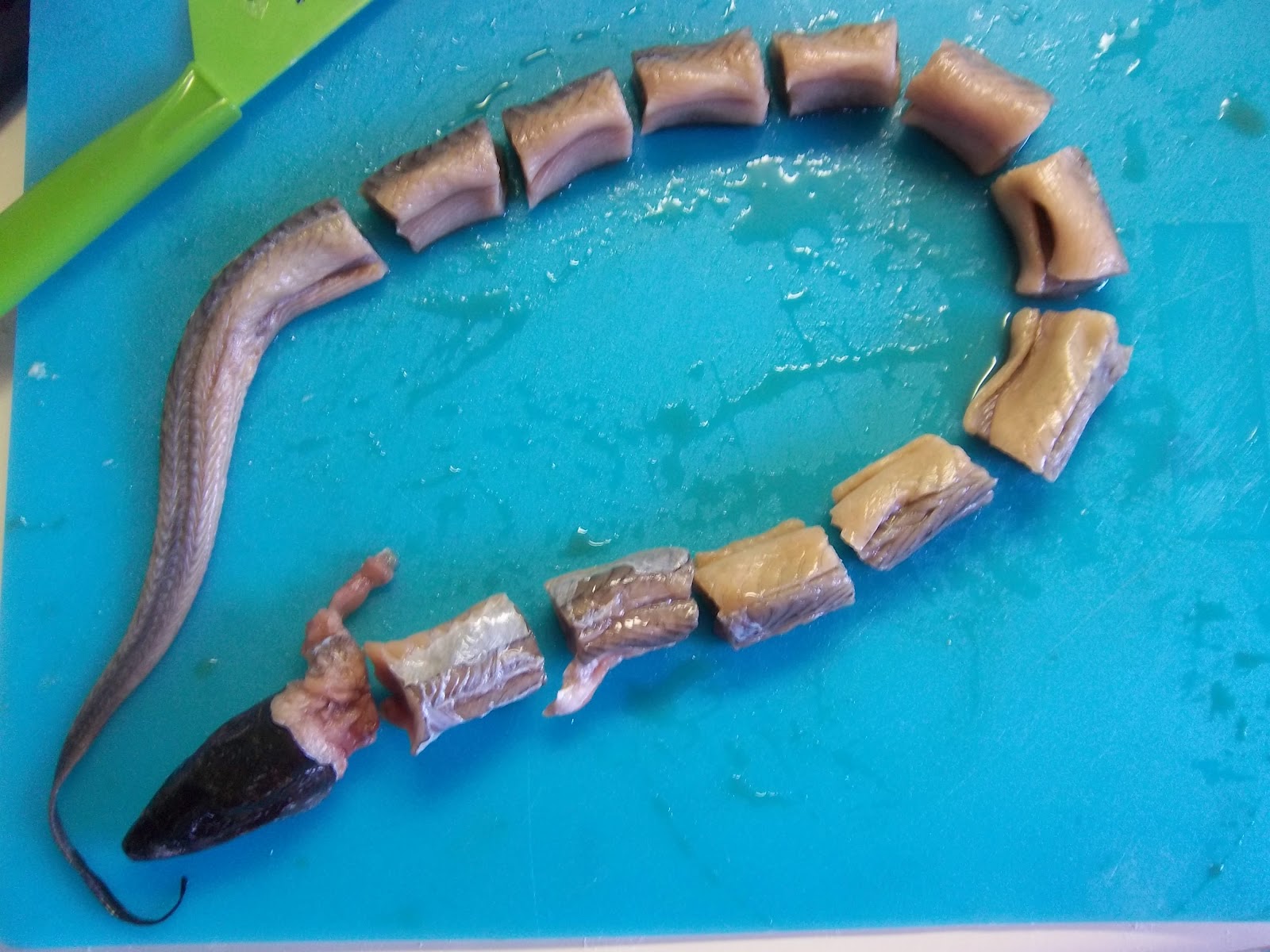
Now prepare the eels, you need 1 ½ pounds altogether (if your eels are alive, have a gander at this post and also this one, for the good it’ll do you). The best way to skin them I have found is to cut around the base of the neck, then hold down the head firmly with a dry cloth and pull the skin off in one long piece with a pair of pliers like a slender stocking. Trim the thin ends of the tails and add them to a pan along with the heads to 18 fluid ounces of chicken or fish stock, and simmer them together for around 20 minutes. In the meantime cut the eels into one inch pieces.
Coat the eel pieces in seasoned flour and fry them, in batches if necessary, browning them well. Add more butter if need be. Scatter the eel pieces over the shallots and deglaze the pan with the eel-flavoured stock, and reduce it by about a half, then add 2 tablespoons of medium dry sherry and 5 fluid ounces of double cream. Boil for 2 more minutes before adding ½ teaspoon of thyme and 3 tablespoons of chopped parsley. Season with salt, pepper and lemon juice. Add a further tablespoon of sherry if you fancy. Pour the sauce over the eels and allow the whole thing to cool.
Peel and slice two hardboiled eggs and scatter them over the eel, then roll out your pastry, gluing it to the rim of the dish with some more cream. Add a hole or a slit for the steam to escape and decorate with the trimmings – I went with a very complex eel motif of my own design. Glaze with cream and bake at 220C (425F) until the pastry has turned an appetising shade of brown – around 10 or 15 minutes, then turn down the heat to 180 (350F) for 20 minutes.
Grigson suggests serving the pie with peas or a chicory salad, though I just went with a mixed salad.
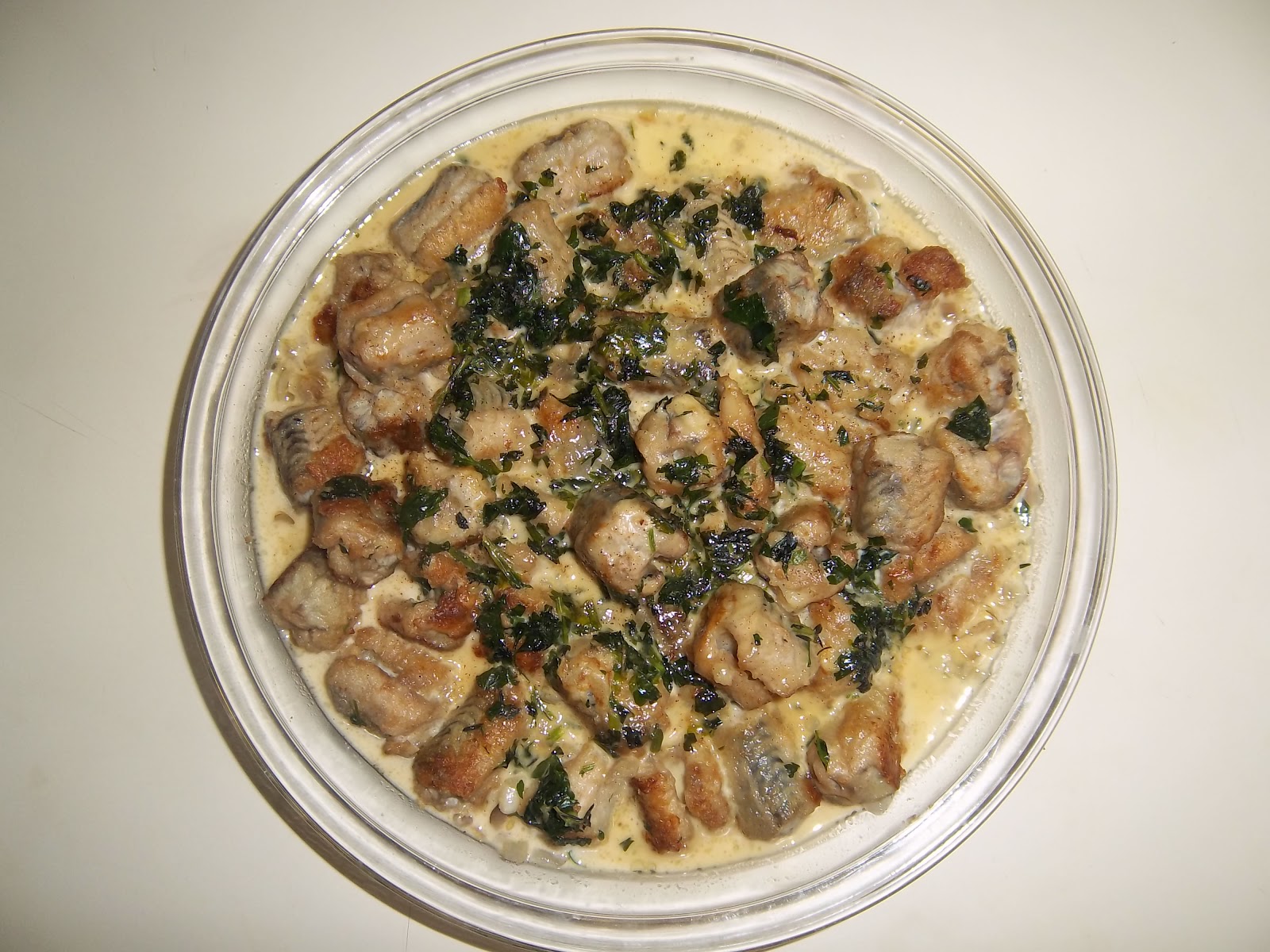
#337 Eel Pie. A very good recipe this one – especially if you are a newcomer to eel. The sauce was nice rich, and the eel tender. The good thing about eel is that it has a very simple anatomy so the bones are fairly easy to find and remove. The sauce was a little too thick and overpowered the delicately-flavoured eel a bit. It deserves a healthy 6.5/10.
#336 Brawn or Headcheese

At Christmas time, be careful of your fame,
See the old tenant’s table did the same;
Then if you would send up the brawner head,
Sweet rosemary and bays around it spread.
William King, Art of Cookery 1709

Brawn, which is also known as headcheese or pork cheese, is essentially a terrine made from the head meat of a pig. All European countries have their recipes for it and appeared sometime during the Middle Ages as a peasant food where the head would be boiled to make a soup. Not that many people seem to eat brawn anymore in Britain, but it seems pretty popular still in America, maybe because of the influence of so many European countries there.
Sports Fan: Queen Elizabeth I
In 1571 Queen Elizabeth I breakfasted on “brawn, mustard and malmsey” on one of her Twelfth Days, so it had obviously reached higher status since its invention. It might interest you to know that after her breakfast in the hall, she watched some hounds kill a fox and a cat beneath the fire for sport and later, during the Twelfth Night play, a fox was let loose so that it could be chased by dogs.
The word headcheese baffled me a little. Where does it come from? Obviously, brawn is nothing like cheese in appearance or taste, but then  I found this recipe from The Compleat City and Country Cook by Charles Carter, dating back to 1732 which seems to solve the mystery:

A Hog’s Head Cheese Fashion.
You must bone it and lay it to cleanse twenty-four Hours in Water and Salt, and scrape it well and white; lay Salt on the Inside, to the Thickness of a Crown-piece and boil it very tender; then lay it in a Cheese-Press, cover it with a Cloth, and when cold it will be like a Cheese; you may souse it.
Brawn is a great thing to make ahead of time for a meal, but beware you don’t make it too soon; most of the references I found to headcheese concerned food poisoning. The problem with jellied stocks is that they are the perfect food for microbes; indeed we essentially use stock in the laboratory to grow many microbes. You don’t want to use brawn, or any kind of stock more than three days since it was last boiled.
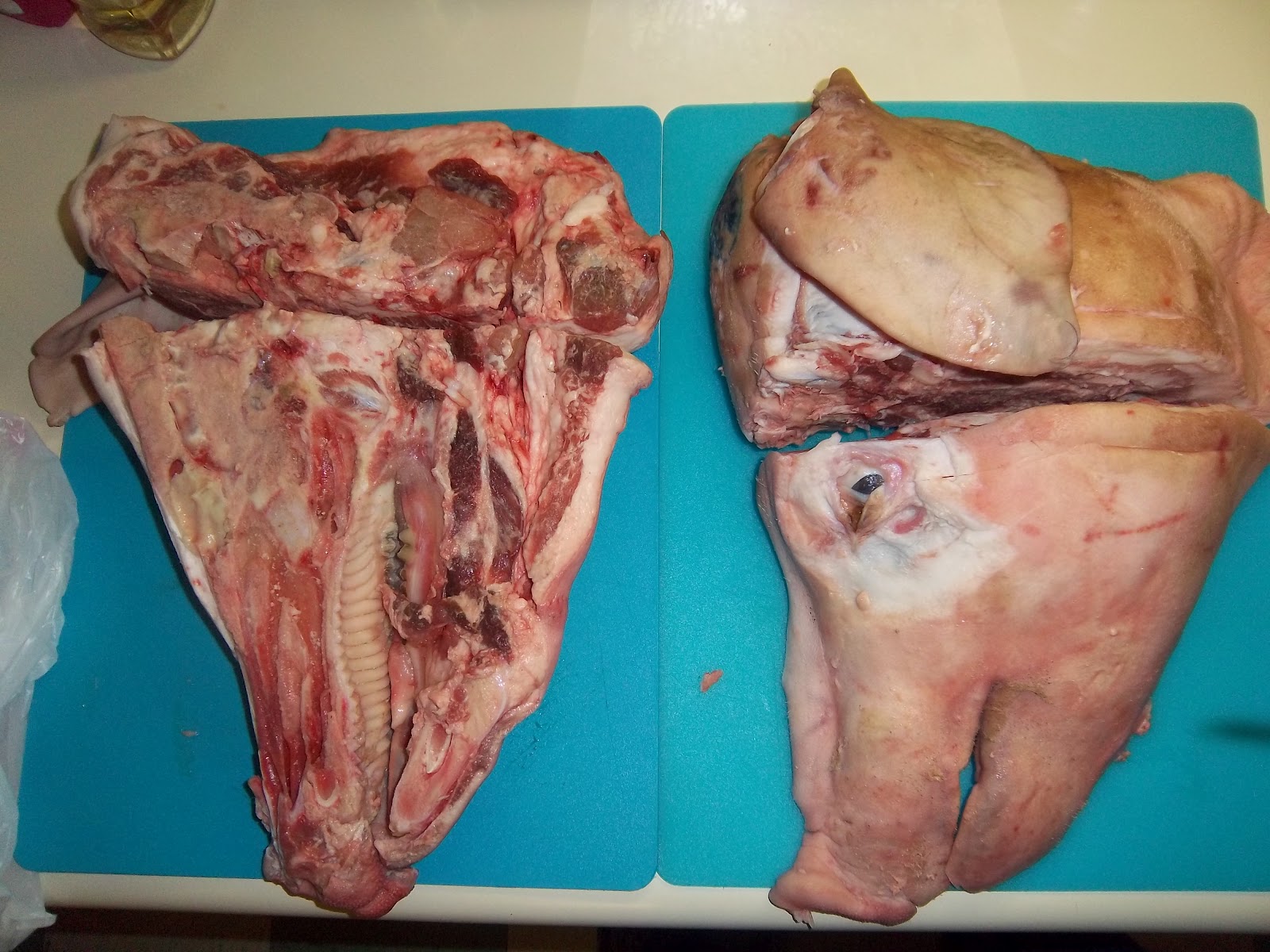
First of all you need to order half a pig’s head from the butcher, you want the tongue too, but not the brains. Ask him to chop the head into two or three pieces for you (I learned my lesson when attempting to chop that lamb’s head in twain with a now blunt meat-cleaver and a hammer a month or two ago). Whilst you are there get yourself two good lengthy pig’s trotters and ask him to chop those in two aswell. Lastly, you need a pound of shin of beef with the shin bone too.
Bundle your meaty horde back home and if you can put the pig bits (not the cow bits) in the brine tub for a day, or at least an evening. See this post right here if you want to try and make your own brine.
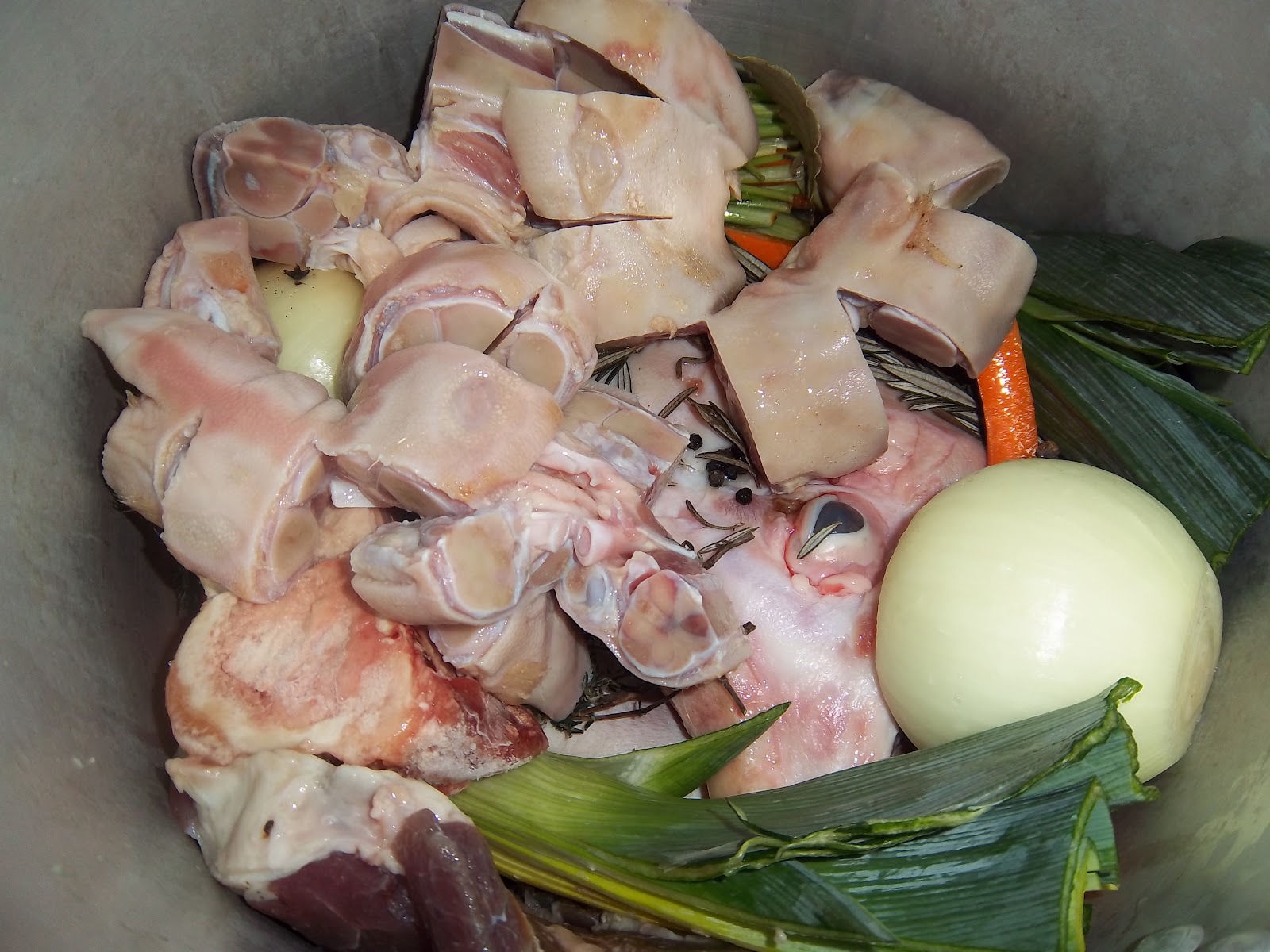
Place the meat in a large stockpot, cover with water and slowly bring to a boil. This slow rate of temperature increase is important in order to achieve a nice, clear jelly because the albumin proteins are let out from the meat at a steady rate, which becomes grey scum that floats to the top. Fast boiling makes a murky, grey stock. Skim the grey scum until it runs white and then add the stock vegetables and aromatics: 2 chopped cloves of garlic, a good sized bouquet garni, 10 black peppercorns, 2 tablespoons of red or white wine vinegar, a teaspoon of salt, 2 onions that have both been studded with 2 cloves, 2 quartered peeled carrots and 2 leeks that have been split lengthways. Phew! Bring back to the boil, then cover and simmer very gently for 2 to 2 ½ hours.
When the meat is tender and can be parted from the bones, extract the head and get on with the task of rifling through the head to find all the meat. When cooked, this is not the gory task it may sound. Leave the stock simmering as you do this, adding back any bones to the pot as go along. You should find a good amount of meat with a good variety of colours and textures. Chop the meat into good-sized pieces and cover, adding a ladleful of stock so they don’t dry out.
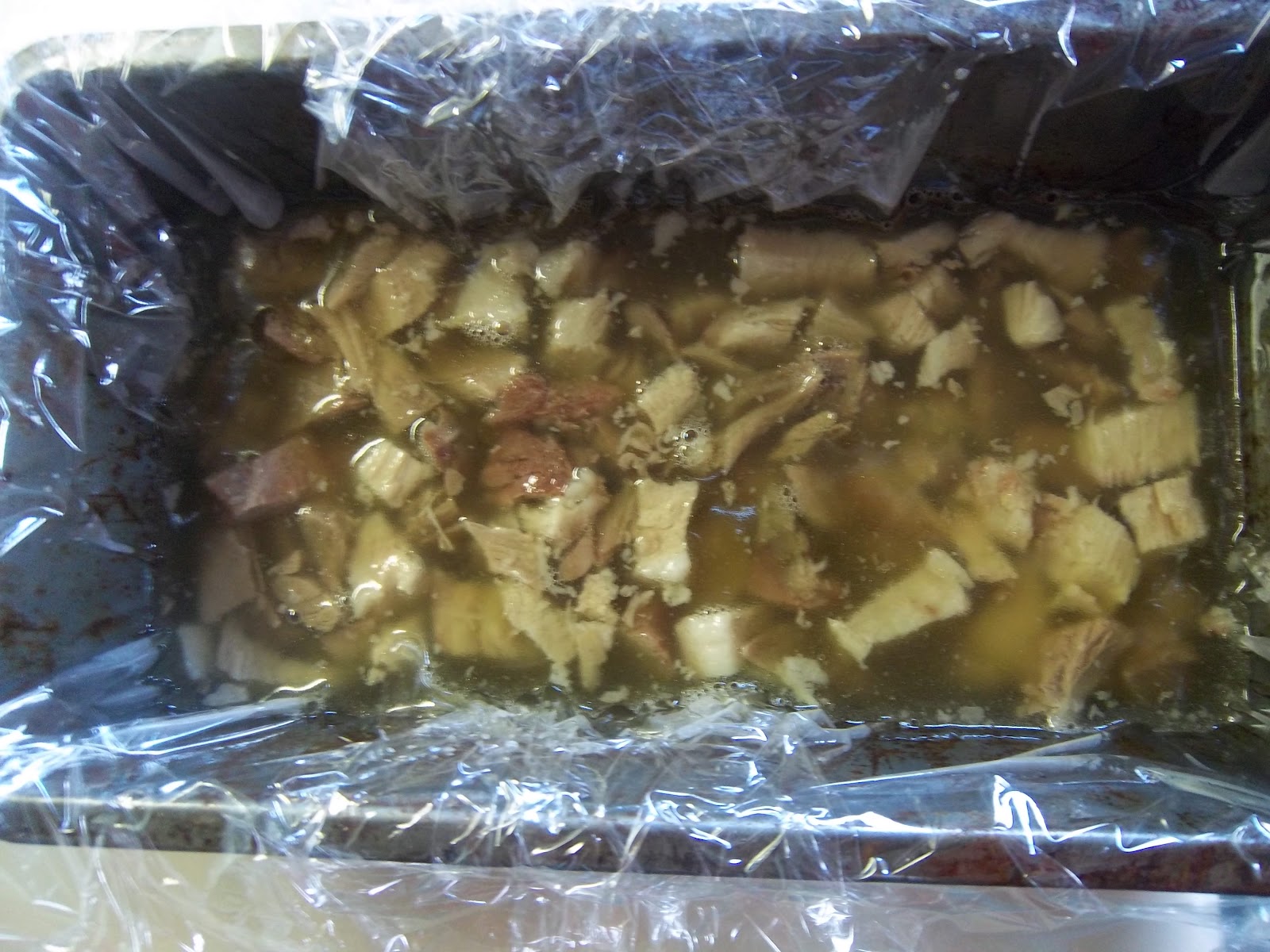
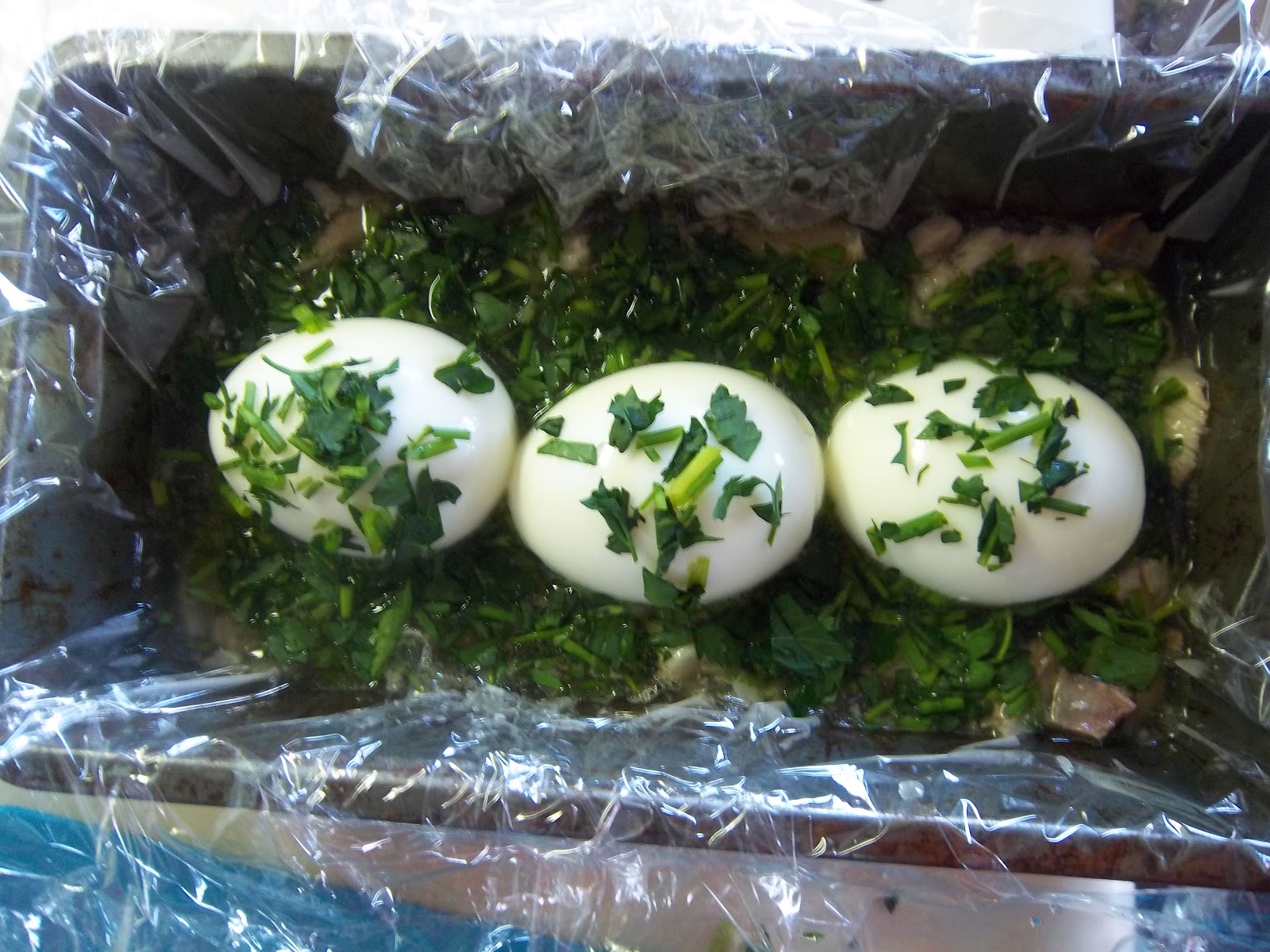
Strain the stock through a sieve lined with muslin into another pan and reduce the stock to concentrate both the flavour and the gelatine extracted from the bones. Put the meat back in the pan with the stock and simmer for 20 minutes. Season with more salt, if required, and a squeeze of lemon juice. Meanwhile boil three eggs and chop some parsley, chives and chervil.
Now it is time to assemble the whole thing. Start by lining a loaf tin with some cling film – you don’t have to do this step, but it will make it easier when it comes to turning out the brawn onto a serving plate. Next, spoon in stock and meat until you have filled up to just under half way.
You need a good balance of jelly and meat, our Grigson says: ‘you don’t want the brawn to look mean. On the other hand, if the meat is too solidly packed, the brawn becomes too heavy to be enjoyable.’ Sprinkle in half the herbs and line up your hard-boiled eggs.
Sprinkle over the remainder of the herbs and fill the tin with more stock and meat. Let it cool and then set it fully in the fridge, covered with more cling film. When it is time to serve the brawn, turn it out onto a serving plate and press onto it brown, toasted breadcrumbs.
Serve with wholemeal or rye bread and butter, mustard and salad. Alternatively, swap the bread and butter for some mashed potatoes. I went with the bread option as I couldn’t imagine cold jellied meat with mashed potatoes to be in any way delicious.
#336 Brawn or Headcheese. I have to admit when I turned it out onto the plate it looked like a giant slab of dog food. However, I was pleasantly surprised. The meat was very flavourful and tender and the jelly, very soft, was very nicely flavoured with the infused flavour of the herbs. As much as I enjoyed it, I’d much prefer a nice simple paté as a starter, nevertheless, I reckon it deserves  7/10.

#335 Boiled Capon with Sugar Peas

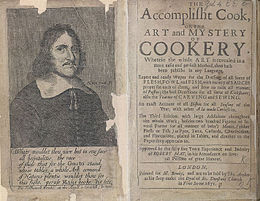
It is always interesting to try a new food, and this 1660 recipe from The Accomplisht Cook by Robert May contains two.

The first is a capon, which is a castrated cockerel. Castration causes the capon to grow fat and large and to develop a different flavour to chicken. There are two ways to castrate, or caponise your cock: the first is to remove the testicles surgically, the other is to do it hormonally using oestrogen implants. You don’t them around very often these days, but a good butcher should be able to order you one. I got mine from Straub’s – there was one just sat there in the freezer section, bold as you like. If you want to caponise your own cockerel, click here for instructions!

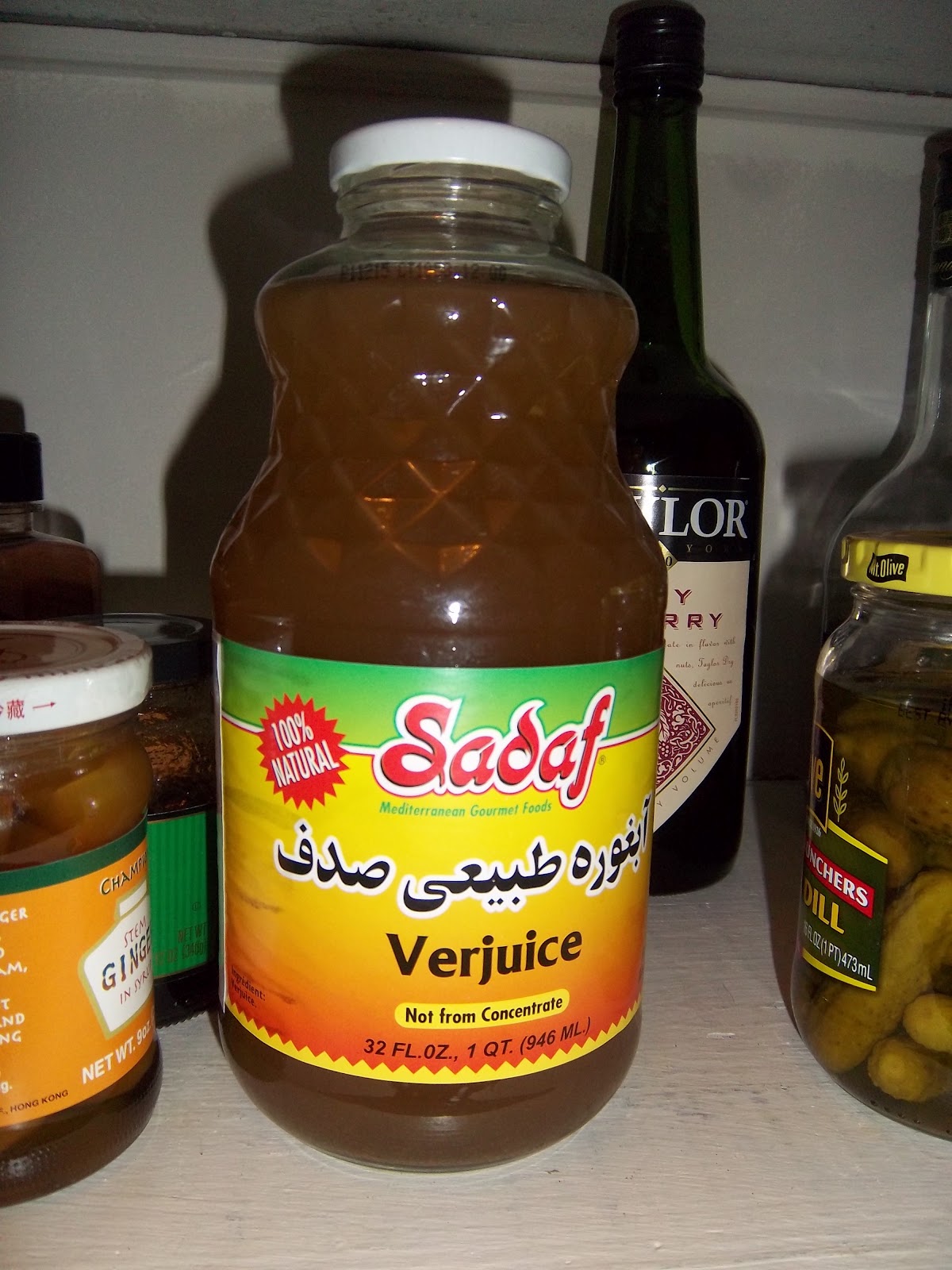
The second new foodstuff is verjuice which is certainly not something you see much these days. Verjuice is made of the juice of either sour apples or sour grapes and was used as an acidulater; lemons were very pricey then, but there was no problem growing sour grapes and apples in Britain! It was particularly popular in the 16th and 17th centuries. I found the verjuice another of my favourites St Louis haunts, Global Foods Market, but I see you can also buy it online.

This recipe asks for the capon to be gently simmered just like the turkey with celery sauce I made last November. It is served with a bread sauce that is seasoned with the verjuice and some oyster liquor, though no oysters are actually used in the recipes themselves. I was hoping I could buy some liquor in jars just as you see clam liquor in the supermarkets. I am sure clam juice would be a good substitution, but as I am cooking the recipes as given, I must use oyster. (It turned out well in the end, as it gave me the perfect excuse to make some angels on horseback – look here for my recipe.)
Also served are some crunchy sippets, made from bread, and sugar peas in a buttery sauce. I was quite surprised that sugar peas were even around in the 17th century, I’ve always considered them a recent addition to our grocer’s shops and allotments.

There are 4 elements to this recipe are not particularly complicated, but they do require a little thought…

The Capon
Place a capon, breast down, in a large stockpot with its giblets.
Add water to just about cover the bird and add the stock herbs: thyme, rosemary, parsley and fennel; then add 2 or 3 blades of mace and season well with salt and pepper. Bring to a boil and simmer exceedingly gently until cooked – my 7 pound capon took about 1 ½ hours – the best way to tell it’s done is to spear the thickest part of the thigh and look for pink juices just you would do for a roast turkey or chicken. Remove the capon to a plate, cover it with foil and let it rest for 20 to 30 minutes. On no account throw away the delicious fennel-scented stock. Freeze it in batches and use as needed for soups, &c.

The Bread Sauce
Start getting the sauce ready around 30 minutes before you think the capon will be ready.  Peel two onions and simmer them, covered, in water until they are tender and then blitz them in a processor or blender, or if you want to be old-school, pass them through a sieve or a mouli-legumes. Stir into the onions around four ounces of fresh breadcrumbs and a few ladlespoons of the capon stock so that you have a nice sauce. Use some oyster liquor and verjuice as well as some salt and pepper to season the sauce.

The Sippets
Sippets are fingers or triangles of bread either fried or baked and were very commonly served under meats to soak up the delicious juices. I made fingers with thickly sliced bread and baked them in a 180C (350F) oven until crisp and crunchy, around 20 minutes. These can be done in advance and warmed through in the oven if you like.

The Sugar Peas
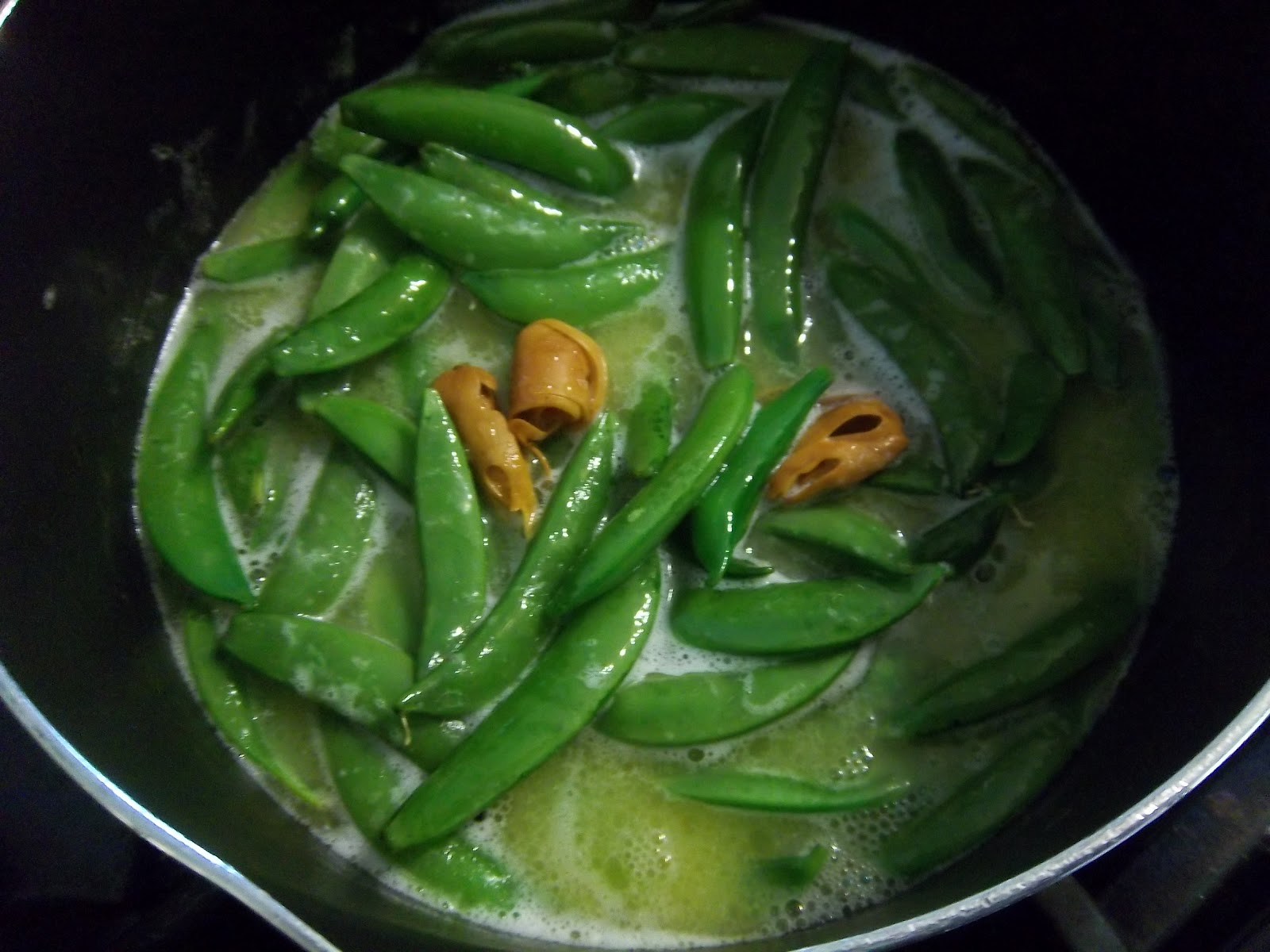
The sugar peas – ‘cods’ – can be prepared whilst the capon is resting. When the cods be but young, string them and pick off the husks. Take 2 or 3 handfuls and but with ½ sweet butter, ¼ pint of water [this equalled 4 fluid ounces back in the day, rather than 5 as it does today in the UK], gross [black] pepper, salt, mace and oil. I used olive oil. Heat all the ingredients aside from the pods in a saucepan, add the pods, cover and stew until tender but with a little bite left in them.
Next, thicken the sauce with 3 or 4 egg yolks that have been beaten with 6 tablespoons of dry sherry (this is one of Jane’s substitutions, the original recipe used sack, a type of sweet ale).

Joint the capon and serve it on the sippets with the peas and their sauce poured over. Serve the bread sauce in a separate bowl or jug.

#335 Boiled Capon with Sugar Peas. After the success of the boiled turkey, I was looking forward to trying this new meat. I was a little disappointed; the meat wasn’t particularly flavourful and it was a little tough. That cockerel must have been doing a lot of strutting around, even without its testicles. As I ate my leftovers over next day or two, I did notice that the flavour of the meat did develop more – it was very turkey-like.  The bread sauce and the peas were very nice however. I think if the capon was swapped for a chicken or turkey, this would be really good. 5.5/10.

#334 Salmagundi for a Middle Dish at Supper

A salmagundi is essentially a rather grand salad which was popular in the 18th Century that has origins in the Elizabethan era. The idea being that the ingredients could be laid out for a ‘Middle Dish’ to produce a large sallet. The Salmagundi originated as a game dish called a salmi (click here for the recipe) popular since Medieval days.

Meals in those days were not served in courses, but all at once, with large dishes in the middle and smaller ones around the outside. The Salmagundi – sometimes spelt as Solomon-Gundy or salamongundi – would be part of a splendid centrepiece, with the meat and salad vegetables in many individual plates, in piles, or layered up. The most important thing about a Salmagundi is that the centre is raised higher than the rest so that upon the apex of the arrangement pickled herrings can sit. For some reason, this recipe appears in the Poultry section of the Meat, Poultry & Game chapter. Seeing as the only necessary ingredient is pickled herring, I would have expected it to be part of the Cured Fish section of the Fish chapter, though chicken or pullet – a castrated hen (can you castrate a hen? You know what I mean) – was ‘one of the most popular salmagundi ingredients’, says Grigson.
Here is one Hannah Glasse recipe that Jane Grigson quotes in English Food, I can’t find the source of it anywhere, Jane doesn’t say where she got it but it’s not in Glasse’s famous Art of Cookery:
In the top plate in the middle, which should stand higher than the rest, take a fine pickled herring, bone it, take off the head, and mince the rest fine. In the other plates round, put the following things in one, pare a cucumber and cut it very thin; in another, apples pared and cut small; in another, an onion peeled and cut small; in another two hard eggs chopped small, the whites in one, and the yolks in another; pickled gherkins in another cut small; in another, celery cut small; in another, pickled red cabbage chopped fine; take some watercresses clean washed and picked, stick them all about and between every plate and saucer, and throw nasturtium flowers about the cresses. You must have oil and vinegar, and lemon to eat with it. If it is prettily set out, it will make a pretty figure in the centre of the table, or you may lay them in heaps in a dish. If you have not the ingredients, set out your plates or saucers with just what you fancy, and in the room of a pickled herring you may mince anchovies.
Hannah Glasse: she was no looker, was she?

Other recipes include many other ingredients such as cold roasted veal, pork, duck, pigeon, oysters, lettuce (cut…as fine as a good big thread), samphire, peas, sorrel, spinach, chopped shallots and lemons, pickles, grated horseradish, a scattering of barberries, figs, oranges and lemons stuck on the top of a sugar loaf. The list goes on…
The secret to a good salmagundi, according to Jane Grigson, is in the layering of flavours, you need a good mixture of sharp, piquant things like the herring or gherkins as well as crisp salad vegetables and bland meats and eggs. The salmagundi often turned into a bit of a disaster, mainly because of the sentence: [I]f you have not the ingredients, set out your plates or saucers with just what you fancy… A housekeeper in a grand 18th Century larder would have had a plethora of wonderful pickled vegetables, preserved meats, plus whatever was growing in the kitchen garden at her disposal; housewives would not, and tended to make it after they’d cleaned-out their pantries. People were just being economical of course, but just what you fancy, does not translate as whatever’s in the back of the cupboard
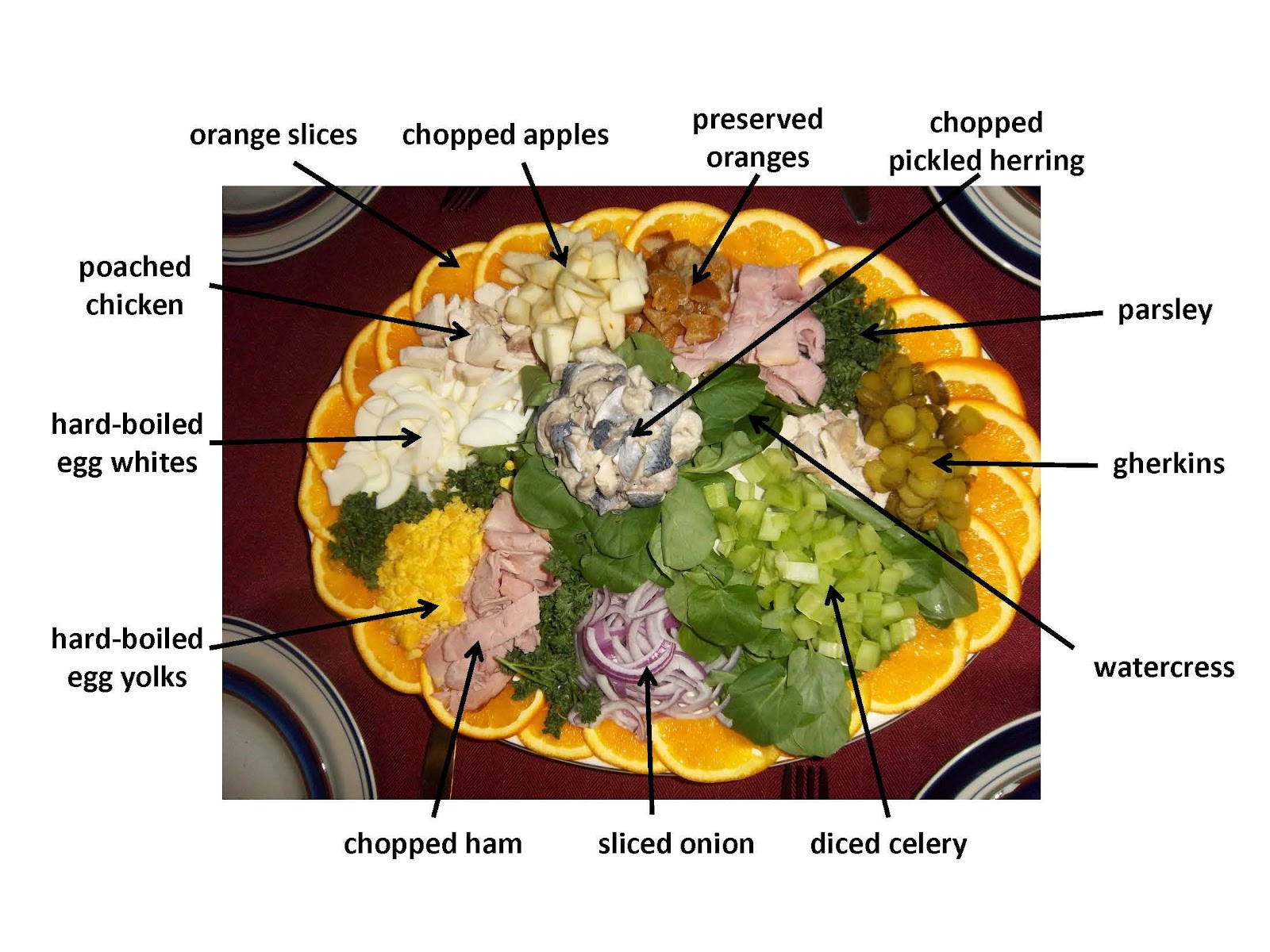
When it came to making a salmagundi of my own I simply tried to take Jane’s advice and make a platter with a good mix of stuff and a decent olive oil and vinegar. I put an upturned bowl in the centre of a serving dish so that my pickled herring would be raised up and got to covering the whole thing in various bits and bobs. Here’s what I did:
#334 Salmagundi for a Middle Dish at Supper. I quite liked putting the salmagundi together and it was quite nice to look at and fun to eat. I think I got a good balance of the crisp, bland and piquant. It certainly made a nice change having an English salad that had a bit of thought put into it because usually they are a little sad. Shall I do it again? I think so – hopefully with a giant sugar loaf in the middle next time. 6.5/10.