#209 Chicken and Leek Pie from Wales

During this rubbish weather (God, I am so English – all I do is talk about the weather) there is nothing like a good pie. The Farmers Market in Manchester Piccadilly Gardens just happened to be on as I was walking through and I saw a stall selling some very nice free range farm chickens and so I snapped one up. I then consulted the book for chicken recipes and decided on this. It seemed a little bit like the pork and apple pie I did a while ago in that there is no gravy or sauce per se but runny juices instead. I was slightly concerned about this as it was a major short-falling in the pork pie. Anyways, I have cook everything in this book whether I like it or not.

It is best to start this pie the day before you want to cook it, or at least in the morning. Start by placing a roasting or boiling chicken in a close-fitting pan along with a quartered, unpeeled onion, two tablespoons of chopped celery (a stalk, in other words), a bouquet garni and some salt and pepper. Place a close fitting lid on top, bring to a boil and simmer until cooked. The cooking time will be dependent upon the type of chicken you have – around 45 minutes for roasters, and at least an hour for boilers. Let the chicken cool in the stock (leave overnight if you want). Remove it and strip the carcass, cutting the meat into nice chunks. Skim the stock – if it seems a bit bland, add more seasoning or return the bones to the pot and simmer again. You could also reduce the stock after straining it too.


Arrange the pieces of chicken in a pie dish along with 4 ounces of sliced ox tongue that has been cut up. Next, wash, trim and slice a load of leeks – Griggers says eight in all, but I reckon that that it all depends on the size of your pie dish. Either way, blanch them for two minutes in salted water before draining and adding to the pie dish. Chop two tablespoons of parsley and sprinkle that over and then ladle the stock over the lot until it comes up about half way up the chicken and veg. Season well. Cover with shortcrust pastry (the amount will depend on the dimensions of your pie dish). To make sure you get a good seal, when you roll it out cut a strip of pastry and glue it around the rim of the dish with some beaten egg. Brush glued pastry with more egg and lay the pastry over. Press it down, make a central hole and brush the top with egg. Bake at 230⁰C for 20 minutes, then turn the oven down to 180-190⁰C for another 20. Allow to cool a little before you eat it. It had it with mash and peas.

#209 Chicken and Leek Pie from Wales. This was a really good pie – the stock was very flavoursome and ensured the chicken remained very moist. I’m not sure what the point of the tongue was though. It is also very nice cold – the stock cools to become a nice, rich jelly; though that kind of thing is not to everybody’s taste. Give it a crack! 7/10.

#207 Sussex Stewed Steak

Stewed steak is one of the things that remind me of being a kid back home in Pudsey, Leeds. My Mum used to do stewed steak with dumplings sometimes and it was delicious. It’s odd, however, that I’ve never had it anywhere other then my Mum’s; nobody else seems to eat it. I don’t what it has to do with Sussex either. This recipe is pretty much exactly what my Mum did, except for two main differences: this uses one big piece of steak and has additional flavourings. This is a very easy recipe and perfect for these times of filthy weather that seems to keep your socks permanently soggy and your mind on sunnier times. Give it a go.

Start off with a nice two to two-and-a-half pound slice of either top rump or chuck steak. Make sure it is well trimmed. Season both sides well with salt and pepper and coat with flour. Place it a well fitting ovenproof dish, and cover with sliced onion; use a large one. Now add six tablespoons each of stout and port and two tablespoons of either mushroom ketchup or wine vinegar. Cover tightly with foil and place in an oven preheated to 140⁰C for three hours. That’s it! Serve with mashed potato and field mushrooms, says Griggers.


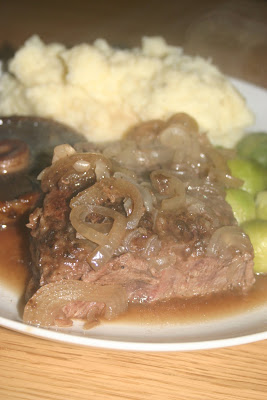
#207 Sussex Stewed Steak. This took me right back to my childhood. The delicious thin gravy with a hint of rich booze and wonderfully tender beef cooked slowly – it’s what rainy November evenings were made for. 8.5/10.

#205 Potted Tongue

There are several recipes in English Food that involve tongue; a bit of the animal now much ignored by most, including me. It’s one of the few things I’ve never tried, so I thought I should make sure my first foray into tongue cookery a simple one. Potting is nice and easy as long as you have a food processor or blender, plus I always need sandwich fillings for work. It uses eight ounces of cooked tongue – this can be calf’s or ox tongue, pickled or fresh. The calf’s tongue that I got from Winter Tarn was exactly eight ounces in weight after it had been cooked and trimmed. However, if tongue is not your bag then you can use beef, salt beef, venison or any other game.

Chop the calf’s tongue and place in a blender or food processor – use a blender for a smooth finish, a food processor for a slightly coarse one – along with four or five ounces of clarified butter, some salt, pepper and mace (if you are potting a different meat, you could use a different spice or even a couple anchovy fillets). Blend until the right consistency and place in pots, making sure you pack them down well and leave flat surface. Pour more clarified butter over to form a seal.


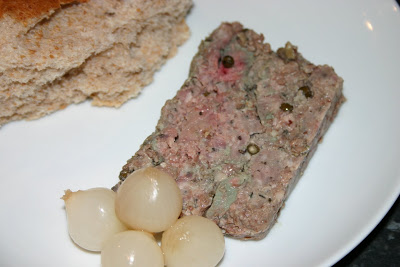
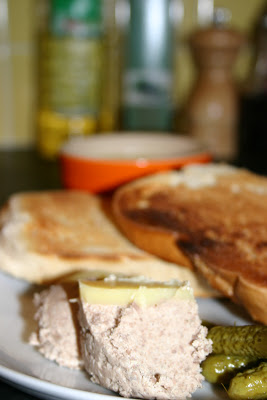
#205 Potted Tongue. In Yorkshire, potted beef is still quite popular, but for me, the tongue did not work quite as well as I’d hoped. The tongue tasted okay when it had been cooked, but perhaps stronger tasting cured ox tongue would have been more appropriate. Oh well, never mind – you can’t win ‘em all. 4/10.

#204 Minced Veal and Eggs

Here is another recipe from Alexis Soyer – the first celebrity chef and all-round (though slightly pompous) good guy. I have mentioned him before in previous posts. I thought I would try this recipe as a test for the veal I bought from Winter Tarn. This seemed like a good mid-week meal as it is quick to cook that seemed nice and satisfying; just what one needs of a Wednesday in rainy Manchester.

Begin by chopping a small onion and a clove of garlic and softening them in a generous ounce of butter. Once soft, turn up the heat to brown them slightly and then add 8 ounces of minced veal. Fry until it has browned slightly. Now add some seasonings, herbs and spices: a rounded teaspoon of salt, half a teaspoon of black pepper, a pinch each of cinnamon and nutmeg and a teaspoon of thyme leaves. Next stir through a heaped teaspoon of flour and when that has browned slightly pour in a quarter of a pint of milk (full fat if you can!). Simmer very gently for fifteen to twenty minutes until the mince has become soft and unctuous in its now creamy sauce. Whilst that is happening poach an egg and fry a slice of bread per person. Taste the veal and add more seasonings and ‘sharpen it’ with some lemon juice or white wine vinegar.


Place a slice of fried bread on each plate, then a helping of the veal and finally a poached egg on top.

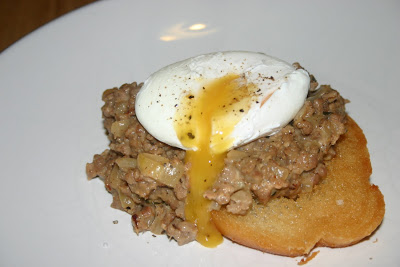
#204 Minced Veal and Eggs. What seems like a bizarre recipe turned out to be absolutely delicious, the delicate milky veal melds perfectly with the milk in the sauce and the fried bread and poached eggs added to the comfort food kick that I really required. Great stuff. Give it a go; quick and easy. 8/10.

#203 Partridge

One of the good things about my favourite fishmonger, Out of the Blue, is that – like any good fishmonger – they supply game during the season. It’s very well priced there and I picked up a couple of partridges for just £2.50 each. Great stuff. I’ve already done a stewed partridge recipe from the book. As well as specific recipes, Griggers goes through each game species with some advice on how to cook them. Here is what she says about partridge:

Roast: 30 minutes, 220⁰C;
Inside: chopped liver, chopped onion and butter, mushrooms chopped and stewed in butter;
Serve with: bread sauce, etc as for pheasant (see this recipe);
Braised: with chestnuts and cabbage and white wine (see this recipe).

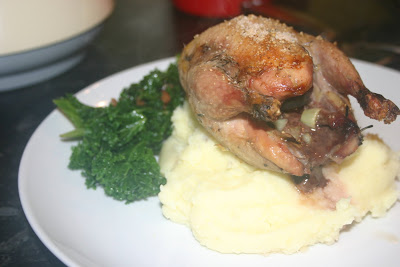
So roast them I did. I filled them with onion and butter (the fillings used for game are there more to prevent them drying out than anything else, really). Before roasting I did make sure they were well-seasoned. To serve I thought I’d add some mashed potatoes – the bland creaminess goes well with strong metallic-scented game – and some kale with fried bacon lardons stirred through them. Lastly I made a sweet rich sauce from half a pint of strongly-flavoured game stock made from a woodcock carcass (see next entry, if I pull my finger out and write it!), a tablespoon of redcurrant jelly and the deglazed juices from the roasting pan (I used some port do to the deglazing).


#203 Partridge – 6/10. I liked the partridge, the leg meat was very gamey and the breast meat milder; a good combination. I am assuming that they were our own indigenous grey partridges because of their small size and strong flavour (there are two species in the UK, the other being the slightly larger and introduced red-legged partridge). There was a surprisingly large amount of meat on these little birds and one was certainly enough per one person. I would certainly recommend trying them if you haven’t before, though I’d go for the braised recipe rather than this roasted one.

#202 Pressed Beef

A quickie this one.

I wanted to do a recipe from the cured meats section of the book as I haven’t done many of them and I didn’t want to start getting behind. This one appealed to me because it was similar to the salt beef recipe I had already done and I knew that the cold, pressed beef would keep me in sandwiches and snacks for the week, plus the cooking process would produce a nice stock which could be turned into a lovely soup. I also thought that you don’t really see salt beef these days in supermarkets etc, and then by total coincidence my workmates and I went to the very good café in the Whitworth Art Gallery (which makes up part of Manchester University’s campus) and what was on the menu? Salt beef sarnies! I may be some kind of soothsayer.

To make your own pressed beef you need a joint of silverside – go for somewhere between 2 and 3 ½ pounds in weight, I reckon. You can use either fresh or salted for this. If you want to do pressed salted beef, you can buy it from your butchers, but it is much better if you make your own. I did – follow the instructions on brining on this earlier post if you want to have a go. Next, you need to boil the beef joint – follow the instructions on this post here for how to do that (I love how the blog is becoming self-referential!) you can follow the same recipe if you’re using fresh beef too. Leave the beef to cool in the broth for a couple of hours before removing and wrapping well in cling-film or foil. It now needs to be pressed overnight; either use a tongue press or place it under some very heavy weights. I used an upturned loose-bottomed cake tin so I could precariously balance a cast-iron griddle pan, an earthenware jug and some tins of food on it with at least some attention to health and safety.


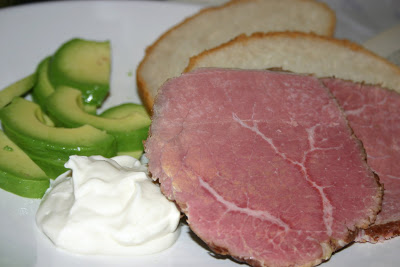
Next day, you can slice the beef as you need it. Make sandwiches using rye bread, pickled gherkins and horseradish sauce (I also added some mayonnaise). Alternatively serve with an avocado salad.

#202 Pressed Beef. This is absolutely delicious. So much more tasty and such better quality than any supermarket pre-sliced nonsense. I would really recommend trying the curing, cooking and pressing yourself, it’s doesn’t take much effort at all and the pay-off is great. The beef is firm and deliciously sweet and salty. The spices – particularly the mace – come through beautifully and compliment the beef so well without drowning out its flavour. 8.5/10.

#200 Steak, Kidney and Oyster Pudding

As promised, a dish that is more English that roast beef and Yorkshire puddings, at least I think so anyway. It may be because I’m a Northerner, but I also think (and I could be wrong here) that although it is very English, it hasn’t travelled to other countries as well as, say, roast beef. In other words, it’s a sort of hidden gem. I have been saving this one for number 200 for a while, though I did change my mind a fair few times.

The seemingly unusual ingredient here is, of course, the oysters. The recipe is surprisingly recent: it appears as a steak pudding in a book by Eliza Acton in 1845 and the kidney turns up in Mrs Beeton’s Household Management nearly fifteen years later. In those days folks living near the coasts were falling over oysters – they diminished however due to a combination of an increased population eating them and the increased pollution created by all those extra people. No one wants a shitty oyster. However, before this, they were cheap and the preferred alternative to the very pricey mushrooms that the posh gentry would have enjoyed. It was only since around the Second World War that mushrooms have been cultivated on a large scale, before that they acquired by foraging: limited and very seasonal. Of course, these days it is the mushrooms that are ten-a-penny, and the oysters that break the bank. That said, native oysters are in season at the moment and the ones I bought from Out of the Blue in Chorlton were just sixty pence each.

This pudding is a pretty posh all-out one; giant, full of rump steak, red wine and extra beef stock plus both mushrooms and oysters:

To begin, make the filling: cut two pounds of trimmed rump steak into one inch cubes and then slice a pound of ox kidney (or veal, if you’re being really posh), removing any fat or gristly bits on the way. Toss these in two tablespoons of seasoned flour. Chop a large onion and fry it gently in two ounces of butter until nicely softened, remove with a slotted spoon, turn up the heat and then hard fry the beef and kidney. When brown transfer to a casserole dish (or, if you have a cast-iron one that goes on the hob you can keep it all in there. Deglaze the pan (or casserole dish) with either a pint of beef stock, or half-and-half stock and red wine. Now slice 8 ounces of mushrooms and fry them in an ounce of butter. Add these along with the cooked onions and a bouquet garni to the meat. Cover with a lid and cook in the oven for 1 ½ hours at 140-150⁰C. You can do all this the day before if need be.

Next, open the oysters: Griggers suggests 18-24 oysters, though makes them an optional ingredient for the pudding. I went for a dozen as I didn’t want to go bonkers with the spending. Add them, plus their liquor to the meat. I’ve written about opening oysters before.

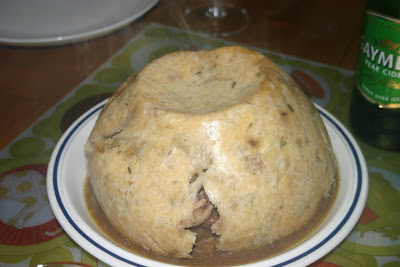
To make the suet pastry, use a knife to mix together 10 ounces of self-raising flour, a teaspoon of baking powder, ¼ teaspoon of salt, ground white pepper, ¼ teaspoon of thyme and 5 ounces of chopped fresh suet (use the packet stuff if you can’t get hold of it). Now add cold water little by little to the mix, stirring with the knife. Use the minimum amount of water that will bring the pastry together, using your hands towards the end. If it seems too wet, add more flour. There’s enough pastry to line a three pint pudding basin, so roll it out in a circle large enough and remove a quarter of it (you’ll use this later). This’ll make it easy to line the basin – use water as glue to stick down the ‘hem’. Spoon in the mixture and then roll out the reserved quarter into a circle to make the lid. Place this on top and fold any surplus edging over it and glue it with more water. Secure the lid if using a plastic basin, or cover with buttered, pleated foil secured with string. Place in a steamer and cook for one and a half hours; don’t let it boil dry. Turn it out onto a plate and serve immediately.


#200 Steak, Kidney and Oyster Pudding. The poshest pudding in the world! It was very, very good though. The beef and kidneys were very tender and the gravy was good and rich. The real revelation was the oysters – at first I wasn’t very sure about them, but it was a taste that was acquired very quickly. They provided a mysterious iodine tang to the whole thing. The original surf ‘n’ turf! The only thing I would change is the amount of pastry – there was barely enough to line the basin, making it split open when it was turned out! 9/10.

#191 Lamb with Plums

It was Butters’ birthday the other week, so naturally I did a bit cooking. He requested lamb as that is his favourite meat. This one is an interesting one – a leg of lamb pot roasted with wine and plums. Butters was a bit disappointed that it wasn’t a roast, you just can’t please some people, can you? I wanted to do this one because it used plums and they are in season and are nice and cheap to boot. I’m quite a fan of the English habit of eating rich meat with fruit; we have gotten out of this habit recently though. Another important thing: it’s also nice and easy.

Start off by browning a leg of lamb all over in butter. If it is very fatty, it would be a good idea to trim any excess off – it’ll prevent the dish becoming too greasy. Place the joint in a large ovenproof casserole and add two glasses of red wine, ten plums (leave them whole), a medium chopped onion, a chopped clove of garlic and a quarter teaspoon each of ground cinnamon and allspice (or nutmeg). Cover with the lid and place in an oven preheat to 200⁰C for around two hours. Remove the lamb, and keep it warm. Skim any fat from the juices in the casserole and pass it through a sieve to make a smooth sauce. Reheat it and add sugar – one or two teaspoons should do, you don’t want it too sweet, plus some extra spices if you like. Pour some sauce over the lamb, and serve the remainder in a jug or gravy boat. Griggers is strict with the accompaniments: “Potatoes are the only vegetable to serve with lamb cooked in this way.” That’s us told.


#191 Lamb with Plums. This was a really delicious, simple recipe. The lamb turned out to be very succulent and the tart, spicy plum sauce was really delicious. I’m not about just having spuds with it though, I like a bit of green with my tea. 8/10.

#188 Ragout of Lamb

Another bargain from Orton Farmers’ market – a nice leg of lamb for a tenner. I love lamb, I do. Griggers actually half-inched this one from a chap called Michael Smith. I don’t know who he is. Anyway, I wanted to do this one because I got to use to use up a massive punnet of tomatoes that I also got from the market. This recipe is not worth making with those crappy old chlorosed supermarket thingies. Get some proper ones; if you grow them yourself, alls the better. It’s a nice recipe this one, a nice summery stew.

You need 2 pounds of leg of lamb that has been cubed for this recipe. If you get the butcher to bone it, don’t forget to ask for the bone – you’ve paid for it, make some stock out of it! Shake the cubed meat in a bag along with two tablespoons of well-seasoned flour. Brown them in a pan with a couple of tablespoons of vegetable oil. Place the browned lamb in a casserole and then brown 2 diced carrots and half a head of celery that has also been diced in the pan. When done add those to the casserole. If you have a casserole that can go straight onto the hob, then you can do it all in one. Now add ½ teaspoon of Cayenne pepper, 2 crushed garlic cloves, a sprig of rosemary and the grated rind of a lemon to the meat and vegetables and pour over 1 ¼ pints of chicken stock. Bake in the oven for 1 ½ hours at 190⁰C.

At the mid-way point, you need to add around 18 caramelised spring or pickling onions. To make them prepare the onions: leave about 2 or 3 inches of green stalk on the spring onions. If it’s pickling onions, you are using, just peel them. Melt ½ an ounce of butter in a pan and add the onions, plus 1 ½ teaspoons of sugar. Cook until caramelised, making sure they all get coated and browned evenly.


The final stage of this recipe is to cook the tomatoes lightly – they are used as a topping: peel the tomatoes, halve them, scoop out the seeds and dice them up. Melt ½ an ounce of butter in a saucepan and cook the tomatoes lightly. Take the ragout out of the oven, skim it of fat, check for seasoning, place it in a bowl and place the tomatoes on top. Scatter with chopped basil. Serve with a baked potato.

#188 Ragout of Lamb. A really nice stew this one; the meat was beautifully tender and the chicken stock, tomatoes and basil really lifted and made it light and summery – it’s a shame we have no actual summer to speak of. The onions collapse into sweet, sweet mush too. Great stuff – 7.5/10.

#181 Yorkshire Pudding

If one is having roast beef (or roast anything, for that matter) one simple has to have Yorkshire pudding. I have been using my own Yorkshire pudding recipe for years (it can be found on a previous entry) and I was not sure about someone else’s, even Griggers’.

In English Food, Griggers says to pour the batter, once made, into a roasting tray below the meat (see last entry). However, you can pour the batter into small trays. In Yorkshire, we make giant ones in sandwich tins and put our meat, veg and gravy inside. Other alternatives are to have them as a starter with a little gravy or with some sugar, or for afters with golden syrup or sweetened condensed milk pour over. The idea of the former being that you can fill your guests up with Yorkshire pudding, so they eat less meat later! That’s Yorkshire folk. It is, of course, also the batter required to make toad-in-the-hole (also on the blog!).

The first Yorkshire pudding recipe appears in 1737 in a book called The Whole Duty of Women and is pretty much unchanged, though it does state that it should be eaten with roast mutton. Now there’s a bombshell!

Before I give the recipe, I have two important instructions that Griggers doesn’t explicitly give: first, make your batter as early as possible, the night before if you can remember to; second, make sure your oven is very hot and that the fat used in the tray is very hot too. These two simple rules will help your Yorkshires to rise and rise.

Start by making pouring half a pint each of milk and water into a jug. To make the batter, mix 8 ounces of flour and a pinch of salt in bowl. Make a well in the centre and crack three eggs inside plus some half-milk half-water mix. Mix everything together to make a thick paste. Add most of the water-milk until you have a creamy and pourable mixture (I used the whole lot). Leave the batter to settle. Preheat the oven to 200°C and place some fat (oil or dripping) in your tin and let it get good and hot. Pour the batter into the tin and give it 40 minutes to rise.


#181 Yorkshire Pudding. If you are doing it the traditional way in a single roasting tin, Griggers doesn’t say what size you should use – it turns out you should use a big one! Mine was too small so the batter was rather deep and so it didn’t crisp up properly. Some people like it like that, but I don’t. That said it did taste good from the beef fat dripping on top of it throughout cooking. Hmmmm. Tricky to mark. 3/10 I think, but that’s because they weren’t in the correct sized tray. I’m pretty sure they would score higher (though not as high as my own ones!).