#77 Baked Semolina Pudding

Semolina pudding is probably what most people think of when looking back at the school dinners they detested. I don’t know why people hate it so much – I love it. I almost lived off it as an undergraduate. Griggers herself detested it. It’s all very odd. Anyway, I needed a cheap pudding to go with the cheap dinner – all I had to buy was semolina and milk, everything else I had in. Scanning the recipe, I realise why Griggers liked her recipe; it’s nothing like a normal semolina pudding at all! It is for this reason that you should try it. If you normally hate it, you’ll like this version; it’s more like a soufflé. Weird.

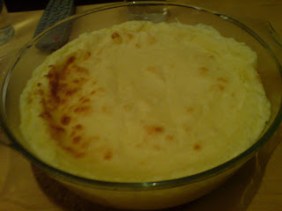
Start by measuring out 1 ½ pints of milk, and use a little of it to mix into 2 ounces of semolina so that a paste is formed. Bring the rest of the milk, 2 tablespoons of sugar and a split vanilla pod slowly to the boil. When boiling, tip in the milk and whisk vigorously to avoid any lumps and return to the pan to simmer gently for 10 minutes. Take it off the heat and stir in two egg yolks and then fold in two stiffly beaten egg whites. Pour the whole lot into a buttered ovenproof dish (leave the vanilla pod in) and bake at 190°C for 15-20 minutes until the pudding has set and it had gone brown on top.


FYI: Semolina means ‘part-milled’ in Italian as it is produced from the partly ground Durum wheat the Italians use to make pasta.

#77 Baked Semolina Pudding – 5.5/10. I liked the dessert; an odd mix of traditional semolina pud and, as I said, a soufflé. The only problem I had with it, is that it wasn’t sweet enough – 2 tablespoons ain’t enough, Sister. I think I would add an extra tablespoon of sugar and sprinkle some on top too for good measure.

#74 Vanilla Ice Cream with Plum Sauce and Lace Biscuits

Real vanilla ice-cream, a port-spiked plum sauce and a crunchy caramel oat biscuit; this is a dessert to impress. You could, of course, make any of the things separately as they are all good. In fact, you make much more of the sauce than you need, so freeze what is left for the next time you make ice cream. Make sure you have to the whole day to make it, or start it the previous day, which is what I did. The whole reason I made this was that I saw some lovely plums in the grocers window and remembered seeing this recipe, thinking I’d never get round to it, since plums in this country are usually a bit insipid. If you see some nice ones, make this dessert, people.

You can make any of the three elements in any order.

The vanilla ice-cream
Boil half a pint of milk or single cream (however, see review bit, below) along with a split vanilla pod with the seeds scraped out. Pour gradually onto 2 egg yolks, a whole egg and 2 tablespoons of soft brown sugar, whisking all the way. Then pour the whole lot back into the saucepan and heat gently until it thickens slightly. Don’t be tempted to turn the heat too high as you’ll get scrambled eggs. Pour the whole lot through a sieve and back into the bowl. You don’t have to sieve it, but it will remove any scrambled egg bits, should there be any. Fish out the vanilla pod; you can wash and dry it and use it again later (I keep mine in a jar of sugar, in case a recipe asks for vanilla sugar). Cover with cling-film and allow to cool.

When cold, pour the mixture into an ice cream maker, and when about half frozen, add half a pint of whipped double cram. Keep churning in the mixer until stiff enough to scoop into a tub and freeze. Make sure that you bring the ice cream out of the freezer at least half an hour before you want to serve it.

The lace biscuits
These are quite tricky customers. You can make them big or small, but the bigger they are, the more difficult they are to handle. I did big ones which looked great, but were a total nightmare. There was a small amount of swearing involved, so I recommend not to make them with children present.

Before you start making them, grease two baking sheets and a rolling pin, and set your oven to 180°C. Next, gently melt 2 ½ ounces of butter and take it off the heat. Mix in2 ½ ounces of rolled porridge oats, 4 ounces of caster sugar and a teaspoon each of flour and baking powder, then beat in the egg. Using a dessert spoon, drop blobs of the mixture at least 2 inches apart from each other as they do spread out rather a lot. The more generous you are with your spoons the bigger the biscuits will be. Bake one sheet at a time for 8-12 minutes, depending on size, until golden brown.
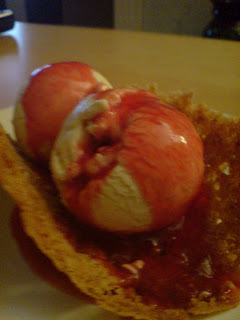

This is the tricky bit: Using a palette knife, remove the still-soft biscuits from the baking tray and drape over the rolling pin. Wait about 30 seconds for it to solidify a little and transfer to a wire rack to cool properly. Hey presto, a posh curly biscuit! Repeat with all the biscuits. If they start getting to hard again, just put them back in the oven to soften up.

The plum sauce
De-stone and slice 1 ½ pounds of ripe plums and gently heat with a few tablespoons of water in a saucepan. Make sure the fruit doesn’t stick. Meanwhile make a caramel. I’d never done this before, but it was a piece of piss, so don’t be scared. Stir 8 ounces of sugar in 5 tablespoons of water very gently over a low heat. When dissolved, stop stirring and bring it to the boil. Keep doing this for about 10 minutes until it’s a lovely dark caramel colour. Whilst it’s boiling, liquidise and sieve the stewed plums. When the caramel is ready, take off the heat and very gradually add 6 tablespoons of cold water by stirring. Be very careful here – if you add too much, it will spit on you. I cannot be responsible for any injuries! When fully incorporated, return to the heat to dissolve any lumps and stir in the plums. When cool, add a slosh of port; I’ll leave the amounts to you, as it depends on taste, though I put in around 4 tablespoons.

To present: Place one or two scoops of ice cream onto a biscuit and pour over the sauce.

#74 Vanilla Ice with Plum Sauce and Lace Biscuits – 9/10. A brilliant dessert! Everything works together perfectly. One of the best things about this dish is the real restaurant-quality feel you get about it. All the other desserts, even the ones that are a bit posh, are no way near as impressive as this. I made the ice cream with milk instead of cream, and it didn’t have the silky texture it had when I made the ginger ice cream (it’s exactly the same recipe, except for the flavourings). If I’d one it with cream, I think it would’ve been a 10!

#65 Mangoes of the Sun

I need to catch up on the old recipes…

At the weekend Lee came over – I’m glad to see that he’s enthused by the whole Grigson thing – so I made a Green Thai Curry (recipe coming soon) and I wanted a nice healthy pud to go with it. It had been warm and sunny all week, so I went down the tropical route with (#65) Mangoes of the Sun. What this has to do with English Food I do not know. Nevertheless it’s really simple to do and is a really refreshing end to a Thai meal, or indeed any meal. The dessert didn’t stay healthy for long seeing as Grigson says to serve it with shortcake biscuits (recipe coming later today!). Like with tomatoes, leave your mangoes out on a sunny shelf to ripen up – to use an unripe mango would be a disaster!

This makes enough for three: Slice two mangoes down the sides of the large stone, cut the slices in half, peel them, and then slice again but nice and thinly. Cut away any other fleshy bits that are still around the stone. Arrange the slices on a large plate. Next cut three passion fruit in half and scoop out the seeds into a small pan along with 60 ml (about 2 fluid ounces) of water, along with a squeeze of lime juice and half a tablespoon of sugar. Heat the mixture, but don’t let it boil. After a couple of minutes the pulp should be softened and easy to pass through a sieve, leaving just the shiny pips behind. Taste the sieved juice and add extra sugar or lime juice if necessary. Add a few of the black seeds back to the juice and pour over the mangoes. Lastly, cut thin slices of lime and then quarter them so you have little triangles and scatter them over. Hey presto!


FYI: If you are vegetarian, you might be interested to know that mangoes are a source of Omega-3 oils; better than having to eat those crappy flax seeds. Everyday’s a school day!

#65 Mangoes of the Sun: 8/10. Delicious and summery; I could’ve eaten it all to myself. I was tempted to serve cream as well as biscuits with it, but am glad I didn’t. The shortbread soaks up the juice a treat too. Brilliant. Make this whilst it’s still sunny!

#64 Soyer’s Orange Salad

All is going well thus far re: fitness. I’ve been to the gym every morning so far this week and I’m determined not to eat to much fatty greasiness. That said, one must treat oneself, mustn’t one? So I’m sure that I’ll do something naughty later on in the week. By compromise at least one of my 5 a day will be included (does butter count?). For tea I had salady bits – a green salad, hummus, coleslaw, brown bread etc etc. For dessert, Soyer’s Orange Salad. The recipe is taken from his 1860 book Shilling Cookery for the People (full title, Shilling Cookery for the People: Embracing an Entirely New System of Plain Cookery and Domestic Economy). You can still buy it as a paperback. Odd though that there’s an orange recipe, as they were pretty expensive up until post-war times. Also it contains Madeira wine. Anyways, it’s very easy – all you need is a very sharp knife or a Japanese mandolin and time for the oranges to macerate. The quantities I give are for four people:

Thinly slice three oranges, making sure that you remove pips; don’t buy the great big warty navel ones, get the small thinner skinned ones. Don’t slice the ends as they’re too pithy. Arrange the slices on a large plate, keeping the best ones for the top. Next, sprinkle two ounces of sugar over them, and then 2 fluid ounces (80 mlsish) of Madeira. Cover with cling film and chill for a few hours, or overnight.


FYI: Alexis Soyer is considered the first ‘celebrity chef’ and was an all-round nice chap: he took his travelling kitchen to Ireland during the potato famine to feed the poor, and to the Crimea and was a contemporary of Florence Nightingale.

#64 Soyer’s Orange Salad – 4/10. An odd creature. Not sure if I liked it, so I erred on the side of caution with score. The sweet Madeira is a treat and got easily drink a vat of it, but the oranges were odd – I don’t eat oranges like this normally – as the pith and peel were very tear and made my tongue a bit numb. That said, I couldn’t leave it alone. Maybe the slices weren’t thin enough, or perhaps I didn’t leave it long enough. I’ve got some in the fridge and will see what it’s like tomorrow.

#61 Melon Water Ice

Melons are on tip-top form in late Spring and early Summer so I thought I’d better do the only (I think) melon-related recipe in the book. It also seems that we are not going to have any decent weather either, as it rained on St. Swithen’s day and that means it’s going to rain for forty days. Bloody St. Swithen. A bit of a crap Saint if you ask me, if that’s all he did/does. I digress…..Make sure you get a good, ripe melon. I used cantaloupe as it’s the most fragrant, but apparently any will do. A small one is just the right size for the recipe too. I tried doing it using the ice cream maker, but it turns out it’s easier just to stick the mixture in the freezer and break the ice up every now and again. To stabilise it, it has whipped egg whites, which didn’t down well with some that ate it. I don’t know why, as it’s pretty commonly used in all sorts – next time there’s something like that I shall not mention it! If you are squeamish about it, please don’t be, and have a go at making it:


Start off by making a stock syrup by boiling half a pint of water with 4 ounces of sugar and letting it simmer for four minutes. Allow to cool. Whilst you’re waiting, liquidise enough melon flesh to give you about half a pint’s worth and stir in the cool syrup. I found that after adding about three quarters of it, it was too sweet and added a bit more water, so be careful. Add enough lemon juice to bring out the flavour of the melon – it shouldn’t actually taste lemony – about half will do. Freeze the mixture and keep breaking it up with a spoon or wire whisk. When it starts getting quite firm, whisk an egg white until stiff, but not dry, using an electric mixer and add the melon to it spoon by spoon. It froths up a bit – it’s the bubbles in the egg white stabilises the mixture and makes it easy to spoon out when frozen. Return the mixture to the freezer, and when you want to serve it, bring it out at least half an hour before.

#61 Melon Water Ice: 7/10. A lovely, refreshing dessert. The egg made it nice and light. It was very sweet – perhaps too sweet, so I knocked it down a bit for that. I would probably mark it higher if I had eaten it on some sunny veranda somewhere, but hey-ho…

#58 Apricot and Almond Crumble

Other than asparagus, the fruit and veg stall had some lovely ripe apricots, at only a quid for 6. So It thought I had to make use of them. Consulting the book, there’s a crumble and a pie. I couldn’t be bothered making pastry, so I went for the crumble. However, I seem to have a mental block when it comes to making crumbles – they are meant to be the easiest pud in the world to make, but when I do them, they end up as mush, as the floury topping gets soaked into the fruits beneath. However, I trusted Grigson to guide me through the crumble-making process. I also used top tips from my Mum. The exciting thing about this dish is that you use the kernels from the apricot stones – a new one on me. They taste like very aromatic, but bitter, almonds. Crack then with a hammer – it worked for me, and the flavour they give to the crumble is beautiful and I shall always take the trouble to do it in the future.

Start by poring boiling water over 18 apricots. After a couple of minutes peel the apricots and slice them. Put them in a shallow baking dish along with the kernels from the stones, 1 ½ ounces of blanched sliced almonds and 2 or 3 ounces of sugar. I like my fruit tart.


For the topping rub together using your hands or a mixer 3 ounces of flour, 2 ½ ounces sugar, 3 ounces of ground almonds and 4 ½ ounces of chilled butter. Pour the mixture over the apricots and bake for 20 minutes at 200 degrees C, and then for a further 20 at 180 degrees. Make sure the top is browned, but not in any way burned. Don’t serve straight away – a warm crumble is better than a scolding hot one. Softly whipped cream is the best accompaniment to this summery dessert.


TOP TIP: My Mum says that for a good crumble topping, don’t rub in your butter too finely; some small lumps of butter make it richer and crunchier, which is good news as this also mean less work!


#58 Apricot and Almond Crumble: 8.5/10. A lovely sweet topping and tart fruit resulted in a substantial but light and perfumed marzipan wonder. The addition of apricot kernels was the genius touch. Plus the crumble topping wasn’t mush. I now have to conquer my other food nemesis Hollandaise sauce.

#54 Yorkshire Almond Tart

They say that you are what you eat, and being from Pudsey in Leeds, I suppose that makes me a Yorkshire tart, or something. One of my favourite puds is Yorkshire curd tart, but I’d not heard of a Yorkshire almond tart (if you’ve not heard of a curd tart, go and hunt one down), I had Greg, Joff and my mate from way, way, way back, Lee over for a curry, I had most of the ingredients in, so I thought I’d give it a crack. Have a go; it’s a piece of piss!

Roll out some puff pastry (I bought mine, but there is a recipe for it in English Food; I haven’t plucked up the courage, nor had the spare 5 days or whatever to put aside in order to make it) and line a deep plate, or a pie plate. Whisk up 2 egg yolks, 2 ounces of sugar and the rind and juice of half a lemon in a basin or bowl until creamy. This is not as arduous as it sounds, it happens quickly, I assume because of the citric acid in the lemons stabilising the egg proteins. Add an ounce each of ground almonds and melted butter, and whisk the mixture over simmering water for 8 to 10 minutes, I reckon, until it becomes thicker. Pour the mixture onto the pastry and spread the mixture leaving a good gap at the edges and bake at 190 degrees C for 20 to 30 minutes until golden brown on top. Whilst your waiting for that whisk two egg whites and a pinch of salt until stiff, when the pie is done, spread the egg whites over the top and sprinkle over a tablespoon of sugar and return it to the oven for 10 minutes. Eat warm. Foolishly, I forgot to buy cream.


#54 Yorkshire almond tart – 7.5/10. Very sweet, sticky and yummy! This comes as no surprise being a Yorkshire dish. The filling and eggs collapsed rather, and I’m not sure if it meant to – perhaps next time I’ll add the tablespoon of sugar to the eggs to make a meringue that shouldn’t sink. That said, the pastry was crisp, the almond insides were soft in the centre, but caramelised on top, the eggs were light-ish, and the sugar had formed a very pleasing crust. The only other way it could’ve been improved would be to have a dollop of vanilla ice cream with it.

#42 Soft Fruit Ice Cream

Since Greg had tonsillitis, I simply had to make some ice cream! Greg chose (#42) Soft Fruit Ice Cream (or Soffru, as Vic and Bob would say). It’s a great recipe and very different to the ginger ice cream I made last month; it doesn’t require any custards, so although there are several stages, it’s quite easy because you can take your time without the worry of your custard turning into scrambled eggs. If you’ve never made ice cream, this is probably the best place to start I reckon.

The main problem was finding soft fruits in April in Britain! It’s easy to buy strawberries, but they are so insipid unless they’re in season. I had a look in the greengrocers and saw some lovely ripe peaches and snapped them up. I knew I had raspberries frozen at home as a back up, and they are prefect with peaches – a la peach Melba.


To make the ice cream start by liquidising a pound of soft fruit along with the juice and zest of an orange in a blender, add about 4 ounces of icing sugar to sweeten it (you must use icing sugar as it dissolves instantly). This was folded into half a pint of double cream and a quarter of single single cream that had been whipped and sweetened, again with icing sugar. The mixture was poured into the ice cream maker. Meanwhile, I whipped two egg whites, and when the ice cream was softly frozen, I folded it into the whites, along with three tablespoons of Cointreau. Then I scoffed a load of it the next day. Oink!

#42 Soft Fruit Ice Cream – 8/10. This is a lovely fresh ice cream, very different to a custard-based one. It could have been improved by the addition of a more appropriate liqueur, such as creme de framboise, seeing as I used raspberries. However, I shall be practicing this one loads whenever I see some nice fruit in the summer!

#40 Elizabeth Raffald’s Orange Custards

I knew that we’d be hungover on Saturday after a big drinking session on Canal Street, so I knew I’d have to choose a recipe for a dessert I could prepare ahead for the meal we were having at Greg sister’s boyfriend’s in the evening. I wanted to do a sticky toffee pudding really, but it would have to have been cooked there. I went for (#40) Elizabeth Raffald’s Orange Custards as I had a couple of Seville oranges in, and it would be a shame not to use them. It was a bit of a risk however, as custards are either loved or hated. I realise that they don’t look that nice on the picture, but they were very good.

They were easy to prepare: In a blender the juice of one Seville orange, the blanched peel of half of said orange, granulated sugar, a splash of Cointreau (which I happened to have in! Get me!) and six large egg yolks were all whizzed up until the peel was just tiny specks. I then boiled half a pint of double and half a pint of single cream and slowly pored this into the whirring mixture. Pour the whole thing into eight ramekins and bake in a bain Marie for half an hour in a cool to moderate oven.

All would have gone well if my stupid oven hadn’t conked out! I got it sorted in the end though. I cannot wait to get my new oven in. My partly-done kitchen is getting pretty depressing now. My stuff is still in the lounge in boxes and bags…

Anyways, enough whingeing…

FYI: Elizabeth Raffald did many things in her short 18 year career (she started aged 14, but died at 32). She wrote the first English cookbook (The Experienced English Housekeeper), was the landlady of two inns, including the King’s Head pub in Salford, ran two shops, ran the first domestic servant’s employment agency, organised the first street and trade directory in Manchester as well as two newspapers as an eminence rose (not sure what that means, anyone know?) and had fifteen daughters! I think I might try and get hold of a copy of her book…

#40 Elizabeth Raffald’s Orange Custards – 8/10. Surprisingly orangey bearing in mind the fact you only need one to make eight. The Seville orange makes your tongue go all tingly – they really are superior to normal oranges when cooking.

#37 Ginger Ice Cream

Oh my god! Everybody has to go out and buy and iced cream maker right this instant! I made (#37) Ginger Ice Cream as a pud to eat after a super-hot Thai red curry. It was super-easy to do and tasted gorgeous! No bought stuff can compare, even the posh bought stuff. You use the stem ginger in syrup to flavour it. All you do is make a custard with cream, 2 egg yolks and an egg, add ginger syrup and churn. Then add loads of chopped stem ginger and lightly whipped double cream after 10 minutes or so. When it’s finished churning, eat straight away for soft ice cream or freeze in a tub and eat whenever!

FYI: Ices were invented by the Greeks in the fifth century BC, who added fruit juice and honey to crushed ice. The Romans made iced wines. All the ice had to be either imported or collected from frozen lakes in the winter and stored in ice houses, as apparently Thomas Jefferson did. It was in tenth century Baghdad where ices that included milk and cream were made commercially. In terms of English food, the first ice cream recipe appears in the 1751 Hannah Glass book, The Art of Cookery Made Plain and Easy – a favorite book of Jane Grigson’s – for raspberry ice cream.

These days there’s loads of posh creamy ice creams these days and the cheap ones are OK compared to the cheap stuff when I was a lad. I’m sure I read a few years back that in the seventies and eighties, the really cheap stuff, like the ice cream you’d get for a dessert in your school dinner contained whipped lard and other animal fats. Does anyone else know of this? I may have dreamt it!

#37 Ginger Ice Cream. 9/10 – I love ice cream and I love ginger! Perhaps there are better ones out there, but I think that home-made ice cream cannot be less than an 8 anyways.