#87 Mrs Beeton’s Traditional Mincemeat

Christmas is coming, and I am going traditional on your ass. First thing to be made is Mrs Beeton’s Traditional Mincemeat. According to Griggers it is better than any modern mincemeat. The main difference is that there is proper fresh suet and actual meat in it. She reckons that when she makes this recipe, the mince pies get eaten double-quick. Well we’ll see. Getting hold of fresh suet is easy, the butcher in Levenshulme sold me 2 and-a-half pounds of it for only a quid! Bargain! Also, I got the chance to use the mincer attachment for my Kitchen Aid for the first time; it was very good, and now I intend to mince everything. I like a good mince, I do (but you probably knew that already…). I haven’t had the chance to eat any yet, but it’s very easy to make, as long as you have the ability to stir.

The amounts are quite big in the recipe, so I’m giving you what I did which is half of Good Lady Beeton’s instructions:

Mix together 8 ounces of seedless raisins, 12 ounces of currants, 6 ounces of minced, lean rump steak, 12 ounces of fresh, chopped suet, 8 ounces of dark brown sugar, 1 ½ ounces of dried mixed peel, ¼ grated nutmeg, 12 ounces of apples that have been peeled, cored, and grated and the zest and juice of half a lemon. When all has been incorporated, mix in 2 ½ fluid ounces of brandy. Spoon the mincemeat into sterilized jars. (To sterilise jars, place jars and lids in oven set to 110°C for 35 minutes). This recipe made enough for four big jars. Leave for at least two weeks…
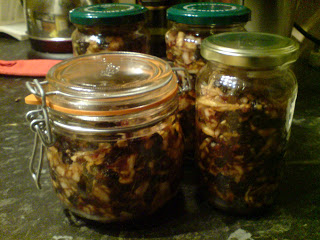

FYI: Mincemeat recipes go back as far as the Fifteenth Century, and pretty much any meat was used for mincemeat – Sixteenth Century recipes use heart or mutton and bone marrow instead of suet. It’s probably one of the few surviving Elizabethan dishes still made today.

…to be continued.
#86 Walnut Cake

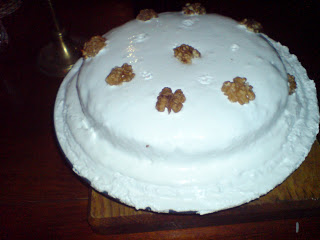
We all went up to Cumbria to visit Frances and James last weekend. It was also Dean’s birthday, so I thought I’d make a cake. On asking him what cake he’d like, he said ‘anything, as long as it’s not from that bloody book of yours’. Well that’s just lovely, isn’t it? I think he’s expecting brains and gonads in every recipe. After giving many alternative suggestions and turning them down, he eventually went for a walnut cake. Where did I find a recipe? You know! It’s a good cake too, for a walnut cake – the icing is a complete faff though. If you can’t be bothered to do the icing, do butter cream instead.

For the cake:
Cream together 5 ounces of butter with 6 ounces of sugar; beat in 2 beaten eggs, then 8 ounces of sifted self-raising flour, 3 ounces of coarsely chopped walnuts and 4 dessertspoons of milk. Lastly, add half a teaspoon of vanilla essence (or use vanilla sugar instead of normal sugar). Line an 8 inch cake tin, add the mixture and bake for 1 to 1 ¼ hours at 180°C. Test with a skewer, and when ready turn out onto a cake rack and allow to cool.

For the icing:
A bit tricky this bit…Stir a ¼ of a pint of water and a pound of sugar lumps in a pan under a low heat until the sugar gas dissolved. Raise the heat and add a generous pinch of cream of tartar. Boil the syrup until it has reached the soft-ball stage which is 120°C; easy if you have a sugar thermometer, which I don’t. Alternatively, as it boils, carefully remove a teaspoon-full of syrup and drop it into small cold water. Fish out the blob of sugar, and if it is soft but can form a ball between your fingers, you are done. You mustn’t stir the syrup as it boils; this reduces the temperature, causing the sugar to crystallise, resulting in total disaster. It takes a few minutes, so in the meantime, whisk two egg whites until stiff in an electric mixer, and when the syrup is ready pour it into the egg whites with the electric mixer on full-whack. Keep mixing until it has nearly set and then add a teaspoon of vanilla essence. You should have a lovely smooth meringue icing. Spread this over the cooled cake with a palette knife and decorate with some walnut halves.

It is very important to wait until the icing has nearly set – I didn’t and it went everywhere!

Not a wedding hat, but in fact, a cake.

#86 Walnut Cake – 6.5/10. Certainly an above-average cake as far as walnut cakes go. Not normally a big fan really. I think it may have been nicer with some coffee-flavoured butter cream instead of the posh icing, but that’s just me.

#83 Almond Fingers

The almond finger. A Mr Kipling favourite I think. I recently decided, since there is no such thing as a bad cake, that if I am to avoid a severe sugar and carbohydrate addiction that I should never buy a cake again; if I want one, I’ll just have to bloody-well bake one meself. I remember liking these as a student, and my Mum used to make them when I was little, so I thought I’d give Grigger’s recipe a go. Griggers reckons that the difference between the flavour of the commercial ones and the home-made. Also, I was off to my mate Stuarty’s flat, and thought it would be nice to bring round something home-baked. People don’t do that kind of thing these days do they? We had a grand old night playing Guitar Hero and getting sloshed.


The recipe is in two stages: First of all you need to make a sweet pastry for the base. Cream together 4 ounces of softened butter and 3 heaped tablespoons of icing sugar. Next, beat in an egg, then a tablespoon of lemon juice, and 8 ounces of plain flour. Wrap the pastry in cling film and let it rest in the fridge for an hour, or the freezer for 20 minutes if rushed for time, as I was. Roll out the pastry into a lined 7 x 11 inch Swiss roll tin. Don’t worry if it breaks up – sugary pastry always does – just fill in any holes with spare bits. Lastly, spread a thin layer of apricot jam over the pastry and phase one is complete!

Now make the filling: Cream together 5 ounces of softened butter with the same weight of vanilla sugar (make your own), beat in 2 eggs, then a heaped tablespoon of flour, 4 ounces of ground almonds and lastly, 2 tablespoons of dark rum. Spread this evenly over the sweet pastry and sprinkle over 2 ounces of slivered almonds. Bake at 180ºC for 35-40 minutes.

#83 Almond Fingers. 7.5/10. Jane was right; much better than any bought nonsense. The whole remains very moist, almost like a cookie. I feel that I was a bit too tipsy to appreciate it, I hear Stuart was still eating them a couple of days after, so they can’t have been bad.

#79 Carrot and Hazelnut Cake

Right. I promise that October shall be much more eventful in the world of The Grigson than September. It was my turn to do the cake for Evolution Group at University, so I’ve been given a good kick up the arse.

A favourite of the group is carrot cake, and there is a recipe in English Food – though it’s very different to the American carrot cake. It’s made without using fat, like a Genoese spoge to make it light and has the added bonus of having hazelnuts in it. Couldn’t resist not sandwiching it with American-style cream cheese filling.

FYI: Carrots have been used for desserts quite a lot in England. Mrs. Beeton had a sweet, chewy carrot tart in her book; it was revived as mock apricot tart during rationing in the Second World War, if I remember rightly (not that I was in WWII, you understand).

Separate four eggs and add to the yolks to the bowl of a food mixer along with 4 ounces of caster sugar. Whisk them together until pale and frothy. This takes a while so meanwhile finely grate 4 ounces of carrots and blitz 2 ounces of toasted hazelnuts in a food processor (or, heaven-forbid, chop them by hand!). Fold these into the eggy mixture along with 4 ounces of sifted, plain flour. Next, whisk the egg whites until stiff. Slaken the mixture by stirring in a third of the whites and then fold in the rest. Spoon the mixture into two greased and papered 9 inch cake tins and bake at 190ºC for anywhere between 15 and 25 minutes. They’re ready when the sponge springs back pressed lightly. Cool on wire racks.

To make the filling, beat together 8 ounces of full-fat soft cheese with 5 ounces of softened unsalted butter, once incorporated, beat in 4 tablespoons of icing sugar and a teaspoon of vanilla extract. Use this to sandwich the cakes together. Dust the whole thing with icing sugar, if you please.


#79 Carrot and Hazelnut Cake – 8/10. A success. Every seemed to like it. Much less dense than a typical carrot cake. I could only have a tiny wee sliver since I’m meant to be on a carb-free week this week, but I had to taste it for the blog, didn’t I!?

#72 Madeira Cake

I made a Madeira cake because it seemed refined – one should drink a glass of Madeira wine with it as one reclines for a mid-morning treat, apparently. It’s basically a slightly lemony sponge cake and is pretty D.R.Y., hence the excuse of drinking wine with, I expect. I’d only had it with a cup of tea, but either is pretty good. Drinking cake with wine is very much a nineteenth century idea, partaken by middle-class ladies, the cake itself has nothing directly to do with the island.


Cream 6 ounces of butter and the same of sugar until light and fluffy. Sift 9 ounces of flour and half a teaspoon of baking powder into a separate bowl. Next, stir in 4 large eggs one at time, adding a small amount of flour between each egg to avoid them splitting the mixture. Once incorporated, stir in the rest of the flour and the grated rind of half a lemon. Pour the mixture into a lined or greased 8 inch cake tin. Bake at 180°C for anywhere between 50 minutes and 1 ½ hours, depending on your oven’s idiosyncrasies (I’m still getting used to mine). Half-way through the cooking time, place two strips of lemon zest on the centre of the cake. To test if it’s cooked, stab it with a skewer. When it’s ready let it cool for about 10 minutes before tuning out onto a wire rack.

#72 Madeira Cake – 7/10. I really liked this cake. I usually prefer something with a bit of cream or icing, but in combination with the sweet Madeira wine, it is really lovely. How refined!

#63 Fruit Tea Loaf

The third bit of stodge I made for the little gathering at mine for my birthday. Tea loaves are great and very Yorkshire, but I’d not made one before – it’s extremely easy, in fact, if you’ve never baked or have some terrible affliction, like feet for hands or something, then you should try this. People don’t eat this kind of stuff any more, so many don’t like dried fruit for some reason. They are better left in an air tight container for a few days before scoffing (if you can last that long – I couldn’t). Always serve your tea loaf with butter spread generously over it, or as they do in Yorkshire – though non-Yorkshire folk never seem to believe me – a slice of cheese. Sorry for the shit picture, folks.


To produce a squidgy ingot of loveliness of your own, start off by mixing 12 ounces of mixed fruit with 4 ounces of dark brown sugar. I like the soft, moist molasses sugar that you get in boxes best. Pour over half a pint of strained, well-stewed Indian tea, I used Assam. Leave this mixture overnight, so that the syrupy tea is absorbed by the fruit. Next day, mix in 8 ounces of self-raising flour and an egg. Pour the mixture into a lined 9 inch loaf tin and bake for one hour at 180°C, then down the temperature down to 160°C for a final half hour. Like all baking check with a larding needle or a knife toward the end of cooking, in case of funny temperatures in weird ovens like my fan one.

#63 Fruit Tea Loaf – 9/10. Cheap and easy and delicious! I also seem to have converted people who don’t like raisins with this one. The molasses sugar and the tea make the cake moist and rich. A perfect little gem of a cake.

#62 Mrs Sleightholme’s Seed Cake

Seed cake, it seems, goes way way way back. Jane mentions books from the 1700 with several recipes. A classic English cake if ever there was one; except I’ve never heard of it. In fact there’s two seed cake recipes in English Food itself. The seeds are provided in the form of caraway, a most English of spices. The cake itself is an unusual one – half way between a traditional recipe, where you cream butter and sugar and a sabayon, where eggs are whisked up until thick and frothy.

To make the cake, cream 6 ounces each of butter and sugar and stir in a rounded dessertspoon of caraway seeds. Separate three eggs and whisk the whites until stiff, but still creamy. Beat the yolks and carefully fold these into the whites with a metal spoon, then fold the eggs into the creamed butter. Next, stir in a tablespoon of ground almonds and eight ounces of sifted self-raising flour. I find it easier to mix the flour in three or four stages to avoid getting a lumpy batter. The mixture should be slack enough to ‘fall off the spoon when you shake it with a firm flick of the wrist’, and we must do as we are told. If too thick, add a little milk; a tablespoon or two should do it.

Pour the mixture into a lined 9 inch loaf tin and smooth it down with the back of a spoon. Decorate with blanched, slivered almonds if you fancy. Bake for up to an hour (but check on it with a larding needle as it may be less) at 180 degrees Celsius. Let the cake cook for 15 minutes before taking out of the tin to cool on a wire rack.


FYI: In Henry IV Part II, Falstaff is invited by Shallow to have a snack on some of ‘last year’s pippin [apples] of mine own graffing, with a dish of caraways’. So if Mr. Shakespeare liked them, they can’t be bad.

FYI 2: Mrs Dorothy Sleightholme was a cook on Yorkshire Television. Growing up in Yorkshire and being an avid telly watcher naturally means I have no recollection of her whatsoever.

# 62 Mrs Sleightholme’s Seed Cake: 4/10. A low scorer, though not foul tasting. It was like a dry Madeira cake. It certainly needed tea to go with it as it was on the claggy side. The caraway seeds save it to some degree. There is, of course, the slightest chance that I over baked it, but I find that very hard to believe…

#56 Stuffed Monkey

Well I do have some catching up to do! I’ve been cooking loads – not all Grigson dishes, but a few. Trouble is, life keeps getting in the way, and I can’t find time to write everything up. Also, I’m knackered. And lazy.

A good excuse to do a recipe is cake day at work – every Wednesday – so I thought I’d look through the book to find something to make where I’d got all the ingredients in the store cupboard, and came across (#56) Stuffed Monkey; a favourite of Jane Grigson’s. She lifted it herself from a book of Jewish Cookery, but has no idea what makes it particularly Jewish, or indeed what it has to do with monkeys. If anyone knows please tell me. Although Jewish, it does have an English feel to it – it’s basically an almond and candied peel filling sandwiched between two rounds of very sweet pastry that’s almost shortbread in texture and flavour. When baking, it’s difficult to tell whether it’s ready or not, so add an extra 5 to 8 minutes to the cooking time I’ve given if you think you would prefer your Stuffed Monkey more biscuity. Don’t worry, no monkeys were harmed in the making of this sweetmeat.

Here’s how to stuff your very own monkey:

Make a sweet-spiced pastry by mixing together 6 ounces of flour and a teaspoon of ground cinnamon. Rub in 4 ounces of chilled butter that has been cubes until fine breadcrumbs are formed. I always to this with a mixer set on a slow speed these days as it stops the butter softening and turning it to a paste too early. If you don’t have a mixer, use your fingertips. Mix in 4 ounces of soft brown sugar and an egg yolk, and bring the mixture together with your hands to form a dough. If it is too dry to come together add a teaspoon or two of milk. Allow this to rest in the fridge for half an hour, or the freezer for half that time.

Whilst you wait for this, make the filling by beating together 1 ½ ounces of melted butter, 2 ounces each of chopped peel and ground almonds, 1 ounce of caster sugar and an egg yolk.

Roll out half the pastry so it fits in the bottom of an 8 inch cake tin, spread the filling over the top, then roll out the other half and place on top. Brush with egg white and bake for 30 minutes at 190 degrees C. Cool in tin.

TOP TIP: Sweet pastry is a tricky bugger to roll and lift without it braking apart, so roll it on cling film that’s been floured. You can pick it all up at once without tearing.

#56 Stuffed Monkey – 5.5/10. It was an unusual sweet biscuity with a wonderful chewy citrus and marzipan flavored centre. I found it a little dry, however I think I may have overcooked it a little (I added an extra few minutes to the cooking time). That said, it got polished off pretty quickly and many people went for seconds, so what do I know!?

High Tea, #52, 53

I got me mates Kirsty, Keith and Thom over for a quintessentially English high tea for Bank Holiday Monday, and made some nice cakes. I did ( #52) Sponge Cake I (of two) and (#53) Ginger Cake, as well as some biscuits – I still had some dough left in the freezer from when I made (#29) Elegant Sugar Thins way back in February. We had an ace laugh., but fell pretty sick. I’ve still got some of the ginger cake, and probably will do for a few more days! Kirsty and Keith got me some ace pressies – the best being the Chinese tea set with green gunpowder tea. There’s some recipes that have gunpowder tea in it too – I had no idea what it was (and still don’t – is it the same as normal green tea?) but will find out in due course.

Sponge Cake I was pretty easy and Greg and I enjoyed making it – I’m trying to get him baking, but there is some resistance. Simply whisk together 3 ounces of caster sugar and eggs until they are all whipped up and pale in colour; this takes a while even using an electric mixer. While you’re waiting sieve 3 ounces of plain flour along with a pinch of salt, and fold it into the eggy mixture carefully using a metal spoon. (Apparently the friction of the wooden spoon pops the bubbles). Divide the mixture between two 7 inch sandwich tins that have been greased and sugared and bake for – 12 minutes at 180 degrees Celsius. Keep an eye on it if you’ve got a fan oven like me though, it does keep the oven dry (I shall use the water in the bottom of the oven trick next time). Turn them onto a wire rack, sprinkle with sugar, and allow to cool. Fill with whipped cream and raspberry jam.

The ginger cake was easy too. It’s one of those dense treacly ones that sink in the centre and weigh a ton – at least in comparison to the sponge cake. Start by creaming 4 ounces of butter, then add 4 ounces of Demerara sugar and beat that in too. Next, mix in 2 eggs and 10 ounces of black treacle (it sounds like a lot of treacle, and it is!). Sieve together 8 ounces of flour and a generous teaspoon of ground ginger and mix into the butter and treacle. Then, weigh out 2 ounces each of sultanas and chopped preserved stem ginger and mix them in too. Finally warm ½ a teaspoon of bicarbonate of soda and 2 tbs of milk in the microwave and stir them in. Pour the mixture into a 7or 8 inch cake tin that has been lined with greaseproof paper and bake for an hour and a quarter or more depending on the size of the tin at 160 degrees Celsius. Grigson reckons it gets better if you leave it. We shall see…

FYI: ginger is both a stimulant and a muscle relaxant due to it’s antispasmodic properties. It also does you wonders if you’ve got the shits. Plus, it is an essential seasoning for whale meat, according to Larousse Gastromonique!

#52 Sponge Cake I – 6/10. A nice sponge cake, but I’m used to a Victoria sponge with butter in it, and I’m not used to this super-spongy, like actual sponge, texture. This may be down to my new oven of course drying the bugger out. However any cake is nice by me, especially when it’s filled with cream and jam. We shall have to see what sponge cake II is like!!

#53 Ginger Cake – 7/10. I preferred this cake, although it was more of a treacle cake, than a ginger one. It reminds me of a stickier version of Yorkshire parkin, which is usually dry and crumbly. It’s definitely a wintertime heavy stodge cake, rather than a summery light teatime cake. The addition of the ginger pieces and sultanas made it very moreish. I reckon I would be nice warmed up and served with vanilla or ginger ice cream.

With great wisdoms comes great agony (and #49)

First off all I should apologise for my total blog tardiness of late; I have been very busy at University recently and so I’ve been working and cooking tried and tested recipes from (sharp intake of breath) OTHER cookbooks. I feel like I’ve been unfaithful to our Jane…

Today found out that I will be having my wisdom teeth out on the 15th May, which is the day Greg goes on his cruise and is also my Mum’s birthday, so I don’t know if I’ll have anyone to go with me! Not being able to eat however, will somewhat hamper my cooking, so expect a reduction in blog action! I am calling for help from you, the beloved blog reader – I need recipes for food that requires no chewing. I will obviously be making good use of my ice cream maker next week.

Any road, I did do some cooking – or, in fact, baking – again at the weekend. I am all enthusiastic about bringing back the old tradition of high tea. There was a spot on the BBC’s Breakfast programme with Prue Leith talking about how people don’t know what Eccles Cakes or parkin and other British fayre are, never mind not baking them themselves! I am on a one-man mission to bring it back. I shall open up a lovely tea shop…

I did (#49) Orange cake and invited Joff round again. I had an orange in and wanted to try the pound cake again from last week; the recipe is exactly the same, except the grated zest of an orange and the juice of half is added to the mixture. This time I baked it for only 30 minutes and it came out perfect. I suppose no one – not even Jane Grigson – is perfect. The best bit of the cake-making was the butter cream. 4 ounces of sugar and the juice of the other half of the orange were boiled until the sugar had reached the soft-ball stage. I didn’t have a sugar thermometer, but managed to do it by dropping small amounts into cold water and feeling it between my fingers. Easy. Thank goodness for my ever useful Larousse Gastronomique. This was whisked into 2 whipped egg yolks until thick and fluffy. When warm, 4 ounces of very soft butter was whipped in until even more thick and fluffy. Yum. Hopefully Greg and Joff think I have improved on the previous ones – hopefully they’ll mark it highly!

#49 Orange cake – 8/10. A fine cake indeed! I’m not going to mark it higher, because, although very good, more extravagant cakes, like the parsnip cake or divine treats like sticky toffee pudding beat cake hands down! I think I’ve nailed the pound cake now!