#150 How to Cure Meat in Brine

Well here we are – 150 recipes in. I didn’t realise I was at this milestone until yesterday – unfortunately it’s not some magnificent feast, in fact it’s really a recipe as such, and I can’t really give it a rating (at least not yet).

Jane Grigson has quite a few recipes that require salting and brining, so I thought I’d better start to get to grips with this completely ignored section of the book, by making roast ham from start to finish as the best way for me to get started, though I’ll discuss that in a separate post – this one is just concerned with brining generally.

I’ve been doing a bit of reading on the subject of brining and it seems a bit of a lost art – there’s not much information about the history of it or how to do your own curing by the method. Obviously it’s gone out of favour to some degree because it is a method of preservation first and foremost, and now with frozen and refrigerated meats on tap these days we don’t have to do such things. However, brining also lends good flavour – we all like good ham, gammon or salt beef – so you would think it popular (seeing as it’s easy too). The thing is that it is time-consuming, and we can all just pick some up ready brined or ready roasted meat, but one thing I read was that for many wet-cured meats, the wet-cure part of the process is missed out! These days they are cured with nitrating bacteria – nitrates help preserve things – resulting a lack of flavour. I’m certainly not insinuating that this method is ubiquitous, but I reckon most supermarkets (and many butchers) use it.

Brine contains three magic ingredients that help preserve meat: salt, sugar and saltpetre. The first two do so because they are in huge quantities in the brine, and can affect the normal osmotic pressures of cells – both animal and microbe. Salts and sugar enter the cells, and water rushes out in an attempt to equal the concentrations inside and outside of the cells. This results in the death of the microbes and the preservation of the meat. Saltpetre (or potassium nitrate) is antibacterial and also gives the meat a pleasing pink colour (it is what makes corned beef so pink, for example). Aside from these three ingredients there are several herbs and spices that improve the flavour of the meat.

FYI: In days of yore, saltpetre was produced by pouring stale urine to huge haystacks where it would drain and crystallise. Yum!!

To make the brine, start off by cleaning a tub or bucket with a close-fitting lid and a plate that will comfortably fit inside with soda crystals. I used a six litre Tupperware tub with a handle. Do not use a metal tub as it may react with the salt or saltpetre. Allow them to drip dry. Whilst you’re waiting for that, make the brine: To a large stockpot or similar add 5 pints of water, 12 ounces each of sea salt and brown sugar and an ounce of saltpetre. This is the basic mixture, but now you need some aromatics (all of which are optional): 1 level teaspoon of juniper berries, a small piece of grated nutmeg, a bay leaf, 3 sprigs of thyme, a level teaspoon of black peppercorns and 4 cloves, Grigson says, but anything you like in that goes with the meat you are brining. Bring to a rapid boil and skim off any scum should there be any. Allow to cool in the pot. Once cool, strain it into your cleaned tub. Place in the joint of meat and keep it submerged in the brine with the plate you washed earlier. Place in a cool cupboard or pantry – though don’t allow it to go below 4°C. The length of time it sits there now depends upon the type of meat and the reason you are brining it (see your recipe, or below, for guidelines). When it is done remove with some clean tongs.

The brine won’t last indefinitely – it may grow mould on it’s surface, which some people say just to skim off. The reason is; the amount of salt depletes every time you use it. For a corrective dose, boil 1 ¾ pints of water with 7 ounces each of salt and sugar and a heaped dessertspoon of juniper berries. Let it cool and add it to the skimmed brine. You could of course just make more from scratch.

Pork leg joint magically being tranfomed into ham

Brining times:
To convert shoulder or leg of pork into ham, or for pork loin: 3 to 10 days
Pig trotters and halved heads: 24 hours
Small tongues (e.g. pig): 36-48 hours
Large tongues (e.g. ox): 5 days
Duck (minus giblets): 36-48 hours
Beef silverside or brisket: 7-10 days
Lamb or mutton shoulder, leg and loin: 7-10 days.

The meat needs to be cooked by boiling – check the cooking water is not too salty after about 5 minutes cooking. If it is change the water and start again. If it’s okay, then add your stock vegetables or whatever the recipe requires.

However, if you are making a roast joint for Sunday lunch, try popping the joint in brine overnight to season it.

So there you have it – hopefully all works out and it doesn’t taste completely foul. My fingers are crossed that it ends up being worth the effort.
#98 Cawl

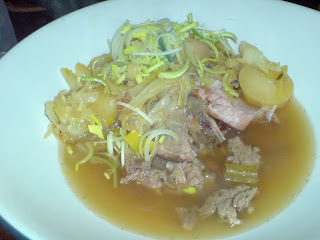
Butters and I went for a nice walk around Chorlton Water Park and the Mersey Valley. We lucky in that it wasn’t totally pissing it down with rain, as the weather has not been good of late. It was still pretty chilly though so I wanted to make something simple, nourishing and warming for when we got back. I plumped for the Welsh soup, Cawl (pronounced “cowl”, according to Griggers). Cawl is simply Welsh for soup, but it’s far from a light soup-starter; it’s a meal in one. I assume it’s a peasant dish; it is simple in its ingredients and methods, is cheap, and requires time to make it well. It’s basically the Welsh equivalent of Irish stew or Cock-a-leekie. What I like about this one is that the meat is cooked as a joint and sliced at the end and served with the vegetables and soup. To be really Welsh, marigold flowers can be added as a garnish, but I thought that was going a bit too far…

These measures make loads of Cawl – enough for 6 to 8 people.

Start off by browning your meat in some beef dripping; you need pounds altogether, either beef brisket of shin of beef, but best is to use one pound of beef and a pound of smoked hock, gammon or bacon. I went for brisket and a giant piece of smoked bacon. When browned, put in a large saucepan or stockpot. Next, brown 2 sliced onions and 3 carrots, parsnip, turnips or some swede cut into chunks; a mixture is best. Once they are browned, add them to the meat and cover with cold water, add salt and two stalks of chopped celery. Bring to the boil slowly, skimming off any scum that may rise to the surface. Add a bouquet garni (I used parsley, thyme and bay), sea salt and pepper to season, turn to a very low heat and simmer for at least three hours. I actually did all this the day before, so that we didn’t have to wait very long to eat when we got back.


About half an hour before you want to eat, add a pound of small potatoes (or larger ones cut up), and ten minutes before add a small white or green cabbage that has been sliced. When the potatoes are cooked the soup is ready. Finely slice 2 or 3 leeks and sprinkle them on top of the soup; the heat of the soup will cook them. Remove the joints and slice them up, putting some of each kind in each bowl, along with some of the veg and stock.

#98 Cawl – 7/10. A delicious, warming and beautifully clear soup. The meat was falling apart and the smoked bacon gave the whole thing a really delicious flavour. Definitely one of the best soups so far. This will become a staple winter dish, I think.

#84 Shepherd’s Pie

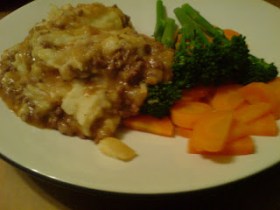
The second of the classics I’m trying to work through. Spoilt for choice for the next one. Thinking maybe a Lancashire Hotpot. Any suggestions, let me know. Anyways, my old mate Paddy was staying over, and he asked for a Shepherd’s Pie, and a Shepherd’s Pie, he got. According to Grigson, you can use either lamb or beef – I always thought that a Shepherd’s Pie contained lamb and a Cottage Pie had beef. We went for beef on Paddy’s request, as it’s the least fatty. One ingredient I found though – white wine. Never heard of that in a Shepherd’s pie, and I must admit I had reservations.

Chop a large onion and three cloves of garlic and stew them until soft in 3 tablespoons of oil. Raise the heat under the hob and add a pound of minced beef (or lamb), stir until browned. Next add a tablespoon of tomato puree, a ¼ of a pint of white wine, and ¼ of a pint of beef stock, keeping a few tablespoons in reserve. Slake 3 heaped teaspoons of cornflour in the reserved stock and add this to the beef. Season well with salt, and very well with pepper. I don’t understand it when people say that they don’t add salt when they’re cooking; it just all tastes so bland. Plus I don’t add anywhere near as must as the pre-made supermarket meals. Rant over. Simmer this for about 10 minutes and spoon off any surplus fat. Whilst simmering, boil 2 to 2 ½ pounds of potatoes (Grigson says boil them in their skins, but I skim-read the recipe and didn’t spot that sentence and peeled mine). Mash the spuds with 3 ounces of butter and up to ½ pint of milk (depending upon how sloppy you like it). Season the potato well too, readers. Pour the meat into a casserole dish and pile on the potatoes. Run a fork through the top so as to add texture to the spuds and so they crisp up nicely. Sprinkle over an ounce of grated Cheddar and a tablespoon of grated Parmesan. Bake for 10 minutes at 200ºC, and then turn the oven down to 180ºC and bake for a further 45 minutes.

Stodge-a-rama

#84 Shepherd’s Pie 8.5/10. The secret ingredient of a Shepherd’s Pie, it seems, is white wine. It enriches the whole thing without making it too rich, as red wine would do. It’s a bit frivolous, I know, but you could swap the wine for more stock if you liked.

#51, Part II


The Grigson recommended getting another meal out of the shin of beef stew by simmering the stew away until nice and thick and stirring through some chopped parsley, so that’s what I did! Well I have to re-think my previous mark of 8/10, because this was absolutely gorgeous. It was a thick super beefy sauce with a good hit of red wine behind it, and the beef was so unbelievably tender I didn’t even have to chew. I think that this is one of the best meals you could make yourself. All it requires is time. I’m not sure if it’s nicer than the game pie I made recently which I gave full marks…oh bugger it:

#51 (part II) Shin of beef stew – 10/10 Completely brilliant. Go out and make it right now!

#51 Shin of Beef Stew

I have heard people talk of the shin cut of beef, and knew it is supposed to be very tasty but very tough – the legs being a well used part of a cow and all. This means long, slow cooking, and after the tough-as-old-boots braised brisket I’d done a while ago, I thought I’d get this recipe wrong too…but how wrong I was! I tell you what I did first…

I trimmed the fat and the very sinewy parts of the meat before cutting them into big chunks and tossing them in three tablespoons of seasoned flour, then I browned them in dripping in a stockpot. You can have your gas turned up to the max here -don’t be shy! When browned, I added enough beef stock to cover the pieces of meat and added one sliced onion and two good sized sliced carrots. For extra flavour, I also added a bouquet garnei of parsley, thyme and bay leaves, a glass of red wine and 3 cloves of garlic (left whole). All this was simmered for two hours and allowed to cool so that the fat could be skimmed off. That was it! Serve with some more veg – I did potatoes and turnips.

#51 Shin of beef stew: 8/10. Simple, cheap and very tasty. I know the red wine is extravagant, but this would still be lovely without. The meat was wonderfully tender and the not at all gristly (I only got one chewy bit!). Because I don’t eat meat that often, it’s such a treat to get some good quality properly treated meat like this. That butcher in Levenshulme is a keeper!

There is plenty left over, and today I am about to eat the rest! The original recipe doesn’t mention doing anything else to it, but Jane mentions that it is best eaten the day after, and also it can be reduced down to a think unctuous gravy. It is bubbling as I type! Reducing the stock to make it a sauce is definitely the right way to go. See this future post to see how it turned out….

While the cat’s away…

…the mice gorge themselves on meat!

I awoke very late on Saturday morning with a stinking hangover. I was supposed to be at work by ten o’clock, and it was almost twelve. Oh dear. I was secretly happy that I didn’t have to go in though. A small snooze later and I felt fine, and since I was at Greg’s flat in Manchester Centre (I was far too drunk to bus it home the night before) I thought I would get something nice and meaty from the Arndale Market and get Joff round.

On arriving, I found that there’s only a cheap butchers there now selling massive trays of meat for £2 a pop. Not good. The fishmonger there is excellent, and so I had a look round. I bought a couple of nice Manx kippers (I don’t like buying fresh fish on a weekend as it’s usually been there since Monday). Wasn’t sure what to do about the meat, and I’d promised meat to Joff.

I arrived home and though I’d have a look in the butcher’s shop in Levenshulme expecting it to be similar to the one in the market, but how wrong I was! I briefly talked to the chap inside, and he said that they get most of their stuff in whole and butcher it properly on site. They were getting ready to shut up shop, but the beef laid out looked very rich and red, not like the strange translucent pink meat you see in the supermarkets. I bought some shin of beef whilst I was there.

Now I had the main ingredients for a two-course feast: (#50) Kipper paste and (#51) shin of beef stew.