#247 Anchovy Matchsticks

I had a few friends round for my 33rd birthday last week and thought it would be a good excuse to do some of the finger foods in the book. This is a slightly strange one and the anchovy-based recipes have been pretty hit-and-miss. I couldn’t really see anything that was hit about this recipe: anchovies, boiled eggs and cream. However, I’ve been surprised more times than disappointed doing this blog….

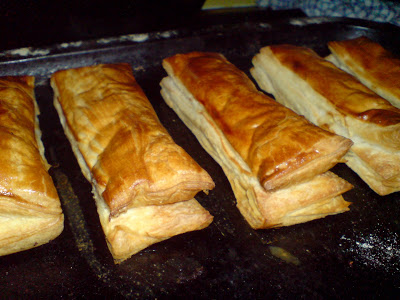
To make your very own anchovy matchsticks, start off by rolling out 8 ounces of puff pastry into two rectangles thinly. Place anchovy fillets in rows, spacing them around 1 ½ inches apart on one piece of pastry. Next, make the egg filling: mash together 2 hard-boiled eggs with a tablespoon of cream and a little salt and pepper. Carefully add a stripe of egg over the fillets, before painting egg wash over the gaps and placing the other piece of pastry over that. Press down and cut into ‘matchsticks’. Glaze with more egg and bake in the oven at 220⁰C for 15-20 minutes. Serve hot.


#247 Anchovy Matchsticks. These were absolutely vile. The combinations of the hot boiled egg and salty fish made my stomach turn. Horrible, horrible, horrible. 1/10

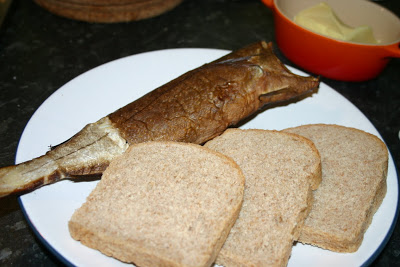
#240 Smoked Sprats (and #232 Pickled Eggs revisited)

‘An inexpensive luxury’, says Jane Grigson of smoked sprats. That sentence should be now changed to: ‘An expensive luxury’. How times have changed. I’m not sure why smoked sprats aren’t more widely available because fresh sprats certainly are, so it’s not like they are hard to come by. The only place I’ve seen them is The Fish Society’s website. You eat smoked sprats whole, rather like whitebait, the difference of course, is that they are quite a lot bigger than tiny whitebait.

Anyways, my friends Simon and Rachel came over to visit after their super-amazing trip around South America. They blogged it, natch, have a look-see at it here. I thought smoked sprats would make a great starter. Because my friend Stuart – a staunch vegetarian – came along too so I served some pickled eggs, remember them? Have a look here to see they were made.

To cook the sprats, simply grill them and serve them with lemon wedges and brown bread and butter. To eat them, pull off their heads and tails and eat. If that seems a little too much, you can remove the fillets from each side with your thumb.


#240 Smoked Sprats. I really liked these alot. The problem of bones/guts was, in the end, a non-issue. The bones were just the right side of not being too crunchy or sharp. They were quite strongly smoked, but also sweet in flavour and not over-powering like some cured fishes can be. If you see some, be sure to give them a go. 8.5/10

#232 Pickled Eggs. These were also very good – they required a little wait for the viengar to work its pickling magic, but were worth it. If you’ve had vile pub pickled eggs, don’t be put off by these. the white wine vinegar made them very subltly sharp and the chillies in the pickling liquor lent a decent spicy-punch to them. 7/10.

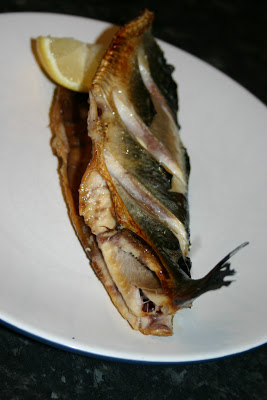
#238 Grilled Bloaters

For all you heathens out there today is Good Friday. Which, of course, means that Jesus got killed or some such other scrape. I am obviously in the heathen camp. Anyway, the point of all this is one should eat fish on Good Friday. I assume this is because we are at the end of the 40-day fast we have all been on and fish was always allowed on fast days. These rules were bent rather a lot in days of yore: ducks, geese and beaver were all added to the list. So as it is Good Friday, here’s a fish recipe with some of the fish I had delivered from The Fish Society.

Bloaters are cured herrings, like kippers, only the cure is much more subtle. They are also gamier because they are cured whole and ungutted, causing them to bloat as they hot cure in the smokehouse. I’ve never had bloaters before, and was looking forward to trying them. This recipe seemed to most appropriate to begin with as I would get to taste pure unadulterated bloater.

The bloater before prep

Start by getting your grill very hot. Whilst you are waiting for it to hot up, gut the bloater by cutting down its belly, this is not a horrible experience as they are quite dry. If there are any roes Griggers says to keep them for another dish. Now cut the head off and make slashes down both flanks of the fish and spread over with softened butter. Now simply grill for three minutes per side so that the skins go all bubbly and crispy. Serve immediately with brown bread and butter and a lemon wedge.


#238 Grilled Bloaters. These were very nice indeed. The cure as expected was much more subtle and less salty than kippers, which meant you could eat more; always a good thing in my book. They are also much less fishy and pungent, so I am surprised that they have gone out of favour somewhat as they are much less of an acquired taste than kippers. Anywho, if you have never tried them (and few have) this is definitely the best place to start. 7/10

#197 Sedgemoor Eel Stew

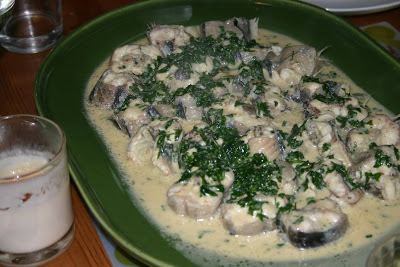
The first of four eel-based recipes from the book (five if you include the elvers recipe) and hopefully the star turn for my dinner party. I chose this one first because I knew them some people would be squeamish about them and this one seemed the least scary. It’s called a stew, but really it’s poached fish in a parsley sauce; a dish that everyone’s had in some way or form before. It’s a classic Somerset recipe this, where there are eels in abundance (according to Griggers); this is not the case so much these days, certainly for Manchester. However, I did get them. Try your fishmonger and you never know; I got mine from Out of the Blue in Chorlton. Be warned – you do get them live, so be prepared to kill them and prepare them yourself. Read how I went about it here.

This serves six easily.

You need three to four pounds of clean and skinned freshwater eel for this recipe. Begin by cutting the eel(s) into even-sized portions of around two inches in length. Season them lightly. Make a stock from the eel heads and skin as well as the flat part of the tails: Place the trimmings in a pan and cover them with half-water, half-cider (use good dry cider). Bring to a boil and then cover and summer for twenty minutes.

Arrange the eel pieces in a shallow pan and pour over enough hot stock to barely cover the eels. Poach the eels for around fifteen minutes, until the eel meat starts to come away from the bones. Don’t let the stock come to a proper boil though – steady poaching is the key, and it may take longer with thicker eels. When cooked, remove the eel pieces and arrange them on a serving dish, cover them with cling film and keep them warm.

Now make the sauce by boiling down the cooking liquor until it tastes strongly and then add ¼ pint (i.e. a 150 ml pot) of clotted, Jersey or double cream and four tablespoons of chopped parsley. Season again if required. Pour the sauce over the eel and serve. She suggests serving this stew with toast or fried bread. As fried bread had already featured in the last two courses, I went for toast. I also served some broccoli too.

#197 Sedgemoor Eel Stew. This was really good; the sauce was both sharp and creamy due to the cider and fresh with grassy parsley. The flavours were robust, but not too strong to mask the eel itself. It was very delicate in flavour; you could tell that they had come from a very good river as it tasted of fresh springwater. It stayed beautifully moist due to the gelatinous nature of it too. Much superior to salmon or trout, I think. Now that people don’t eat eel, I feel I have found a real hidden gem. I just have to go through the rigmarole of killing and cleaning them! At least I can say that this was the freshest fish I’ve ever had! 8.5/10

FYI: delicious as eel maybe, beware if someone offers you raw eel, say as sashimi. Eel blood is toxic before it is cooked, so if you get given a bloody bit, it could be a bad man trying to do away with you.

#195 Canapes a la Creme

The entrée for the dinner party. It’s one of those recipes that I’ve never got round to because – frankly – it’s never really seemed that interesting and a bit of a rigmarole to produce (there quite a few of these!). Grigson says that they are “[a] fine mixture of hot, rich, piquant and cold.” I don’t really know why this recipe is in English Food, I’m sure that there are other canapés in book Savouries à la Mode by Mrs de Salis she could’ve nabbed. Perhaps she chose this one because the ingredients are quite English. Anyways, here is the method, if you want to try and make some for yourself:

Cut some white bread in centimetre thick slices. Cut out circles and fry them in butter. Grigson doesn’t say how large they should be – I used a highball glass. Next put anchovy fillets on each slice – she says three, but that seemed excessive to me for the size of fried bread I’d cut out, so just added one. Finally add a spoonful of cold clotted cream to each canapé and serve straight away.

The canapes in production

#195 Canapés à la Crème. 3/10. They weren’t vile – all of the ingredients that go to produce this are among my favourite foods – they were just odd and uninspiring. There was not too much fattiness from the fried bread and cream, and the anchovies were too much (it’s a good job I didn’t add three!). I think they could’ve been improved if a cream cheese or crème fraiche mixed with chives as suggested on the night had been used rather than clotted cream. Still, they were easier to make than I thought – particularly when I had my army of sous chefs with me! Cheers guys.

#190 Finnan Haddock

A bit of a cop out this one as it it’s not really a recipe, though it is listed as one in the book. It’s actually more a bit of advice on good eating. There’s many like this in the book. Here, Griggers discusses the dos and don’ts of buying Finnan haddock, which is smoked haddock. We call it Finny haddock in Yorkshire. Findon, or Finnan is a small coastal village near Aberdeen in Scotland. It is there where the proper stuff is made. Griggers warns us of buying those ‘golden fillets’ that are that weird shiny orange colour like cheap sweaty spray-on tan, which I suppose it is but with added smoke flavour. Splarf. My mum used to buy them and they are vastly inferior to the proper stuff. There have been a few recipes so far in the book that has used Finnan haddock, and I think that I have mentioned all this before. However, if you want the really good shit, it is Arbroath that you need to travel to. There, Arbroath smokies are made. As I was in the fishmongers buying some prawns (see a later entry for what I wanted those for) there some were, just lying there. So I bought one, as you have to be opportunistic in this game.

So the recipe? “Heat briefly under the grill or in the oven, and eaten with plenty of butter and bread, or used for kedgeree.” So a brief grilling it was for my little smokie.


#190 Finnan Haddock. If you ever see those little Arbroath smokies in the fishmongers you have to buy some. The flesh was so succulent and sweet due to its protection by the now leathery skin, and the smoke flavour was nothing like anything I’ve tasted before: it was as though it had only just been taken out of the smokehouse and slipped onto my plate. The smoke flavour was sweet and acrid, not unlike a good cigar. Excellent. 8/10. If I catch any of you buying a golden fillet, I will come over personally and poke you in the eye with it.

#184 Kedgeree

The thrifty cooking is going well – Charlotte and I having been very shrewd. However, when it comes to Sunday dinnertime, I did want a nice big hearty (and pricey) roast. Instead I went for kedgeree. I don’t recall ever having eaten it before, even though I knew exactly what is required to make it. I had high hopes for it: curry, eggs and Finnan (smoked) haddock. What can’t be good about that!? It used to be a breakfast dish, but these days it’s eaten for dinner or tea.

I have been researching the origins of kedgeree, and there seems to be two differing stories: the Scots reckon that it hails from there, and when the lovely British Empire decided to pop over to Asia and add India to its collection, the Scots brought it over too and the curry element was added. The alternative story is that the dish started in India, but then when colonialists came over, they added the smoked fish. I’m going with the latter story – the best evidence is the etymology of the word: kedgeri is the name of a similar Indian dish containing rice, lentils and eggs.

To make kedgeree, start off by poaching a pound of Finnan haddock in barely simmering water for ten minutes. You can use any good-flavoured cured fish, of course, for example kippers, smoked salmon or bloaters. Meanwhile chop a large onion and fry it in olive oil until it browns. Add a teaspoon of curry paste (I used Madras) and fry for a minute. Remove the fish from the water, remove its skin and flake the flesh, removing any bones. To the pan, stir in six ounces of long grain rice and when translucent add a pint of the poaching water. Cover the pan and let it simmer gently until all the water has been absorbed. Gently stir in the flaked fish along with a large knob of butter. Plate out the kedgeree and decorate with quartered hard-boiled eggs, prawns and chopped parsley. Serve with a lemon wedge and mango chutney.


#184 Kedgeree. This did not disappoint – the food was substantial and well-flavoured, but light. The combination of curry and eggs, and of smoked fish and eggs is great. Plus the extra addition of the lemon, prawns and mango chutney; not something I would normally associate with this dish really makes it special. This is a high-scorer – the only gripe (and it is a minor one) is the use of long grain rice, I am a Basmati man myself; it has a nutty flavour and doesn’t go as stodgy. 8/10.

#10 To Make a Nice Whet Before Dinner

Yes, you heard! It’s from 1769, you know.

Simon came over and I did a 3 courser and this was the starter! Fried bread (in butter!), anchovy fillet, then grilled with a shed-load of Cheshire cheese on the top. That’s it. Quite possibly one of the most delicious (and fattening) morsels I’ve ever had – I know I keep saying these things on the blog…

Simon says:
The starters was as delicious as it was unhealthy. Butter-fried bread with anchovy fillet and Cheshire cheese. So simple, so tasty. We were drinking red wine but this dish would make a fine accompanyment to a good beer. 9/10

I say:

#10 To make a Nice Whet Before Dinner: 10/10. Delicious, simple, what can I say?? I’d eat it every day if my arteries could cope!