#164 Sorrel with Eggs

It’s always exciting trying a new food, and this one – sorrel – is completely new to me, even though it is a common part of many a British meadow’s flora. At least that’s what the foragers’ books keep on telling me. I’ve kept my eyes open and only found the quite similar, though inedible, dock leaf when I’ve been on the look-out. So, I was very lucky to happen up some at the Unicorn grocery whilst I wasn’t looking for it. It’s good really, because now I know what it looks like and tastes like I’m much more likely to see it in the grassland in the future.

Sorrel is one of our forgotten vegetables, and was once part of every garden as it grew happily in the early Spring when the store of over-wintered fruit and vegetables had run out, but the new springtime plants were not yet laden with their bounties. Famine time. These days of, course, we have no gap to fill in the food year and so it has gone out of favour. Another reason for its decline in popularity is that, because of its acidic zingy sharpness, it was used a lemon substitute and is therefore required no longer. It’s very easy to grow – I shall be growing some next year, for sure. Here’s a nice article about it from The Telegraph.

This recipe uses pureed sorrel that takes seconds to make, so if you find any, either in the meadow or the greengrocers, try this to get you started. It serves six, but you can decrease the amounts if you don’t have enough sorrel (or people!).

First boil six eggs for 6 minutes exactly (unless they are large, then boil for 7), this will achieve a boiled egg with well-cooked whites but still squidgy yolks. Whilst they are boiling, prepare 8 ounces of sorrel by rinsing, draining and removing the stalks just as for spinach. Add the leaves to a saucepan that’s over a moderate heat, after a few seconds it will reduce to a dark green puree, then add salt and pepper and 3 ounces of butter. Keep warm. Now fry six slices of bread in butter or oil until crisp, and cut into triangles (12 altogether). Now arrange the ingredients in a bowl or serving plate: sorrel first, then the eggs (whole or halved) and then the fried bread. Finally decorate with orange wedges (which I forgot to do!).
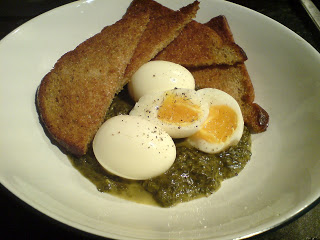

#164 Sorrel with Eggs – 7/10. I really enjoyed this usual and forgotten vegetable. The flavour was intense and was tempered well with the oily bread and creamy yolks of the eggs; it could be best described as lemon but with a strange astringency, like that of green rhubarb or raw gooseberries. It would be delicious with fish I expect. This is the only recipe that uses sorrel in English Food, but I am on the look out for other recipes elsewhere.
#154 Mrs Raffald’s Bacon and Egg Pie

I’ve cooked some recipes by Elizabeth Raffald before and they’ve come out well each time – there’s a potted history of her life in Salford in Greater Manchester in this earlier post. It comes from her book The Experienced Housekeeper, and I must try and get hol of a copy (if it still exists)

Technically this bacon and egg pie can be made any time of year, but I thought it seemed perfect for this time of year, served warm with a salad. The English bacon and egg pie seems to have gone out of favour, with people preferring quiches with roasted vegetables etc. added these days. Well, I love bacon and egg pie – in fact it was my second favourite school dinner (spam fritters came first) – and I think it deserves a come-back. It’s great for picnicking too, I reckon, due to its double pastry crust. I would advise to make this pie only with proper free-range farm eggs (surprisingly cheap in delis and fishmongers and the like) and good dry-cured bacon, it’s well worth spending a bit more money for what is, overall, a pretty cheap recipe.

Preheat the oven to 220°C. Place a baking tray on the shelf that the pie will be cooked on (important for later!)

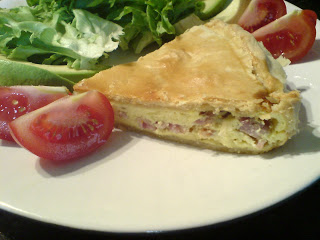
Start off by making some shortcrust pastry with 8 ounces of flour (or more, or less, depending upon how thick you like it). Use two-thirds of it to line a flan dish; Griggers doesn’t give sizes, but an 8 inch one was perfect. Chop 8 ounces of smoked streaky bacon and sprinkle it over the pastry base. Next, whisk up 4 large (or 6 medium) eggs and pour out a little of the mixture into a ramekin for later. Beat the eggs along with ½ pint of crème fraiche and some salt and pepper. Pour the custard into the pie dish and roll out the remaining pastry to form a lid, using some of the reserved egg to glue it on. Trim excess pastry and paint more egg over the top so that it glazes nicely in the oven. Bake for 15 minutes on the hot baking tray (it stops the base from going soggy), then lower the heat to 170°C for another 30 minutes. Serve warm with a salad.


#154 Mrs Raffald’s Bacon and Egg Pie – 9/10. This did not disappoint! I must admit I was unsure about not blind baking the pastry first, but it worked a treat. The inclusion of crème fraiche over cream or milk plus good quality eggs and bacon are the key to it though – so don’t skimp. The pie was ten times better than the one I used to get at school, yet it brought back all the memories at the same time. Bring on the spam fritters!

#138 Cheese Souffle

For the last few weeks, I’ve been dreaming about soufflés – I don’t know why but I had a real hankering. I hope I’m not pregnant. Luckily for me Lady Grigson always obliges – there are loads of soufflé recipes in English Food. Obviously the soufflé does not have English roots, but up until recently, they were pretty popular – particularly in the 1970s and 1980s when English Food was written. They do have a bit of a reputation for being tricky little devils – I had only cooked one once before when I was about 10 – I remember it completely sinking, but being delicious.

I like one comment Jane makes about soufflés when they are ready to come out of the oven:
…it is better to have everyone sat at table. In a properly trained household, the cry of ‘Souffle!’ should have the same effect of assembly as ‘Fire!’

We loves her.

FYI: the soufflé was invented in the late eighteenth century – around 1782, but the first recipes didn’t not appear until 1813, when several were published in Louis Ude’s The French Cook of 1813. The idea being they were cheap as they are essentially just eggs and air with some kind of flavouring so they were a good meal the common man.


This cheese soufflé feeds between 2 and 4 people depending upon how greedy they are. There’s a couple of stages, but they’re pretty straight-forward and not as tricky as people seem to make out:

First of all make sure you have a soufflé dish (or similar) that has a capacity of around 2 ½ pints and grease it with butter, then preheat the oven to 200°C. Next, heat ½ pint of milk to just below boiling point and melt 2 ounces of butter in another (decent-sized) saucepan and add 1 ½ ounces of flour to it. Allow to cook for a minute, take off the heat, and add the boiling milk. Whisk well to form a smooth sauce and then incorporate 4 large egg yolks, one at a time. Mix in 3 ounces of Cheddar (or Lancashire) cheese and season with salt, pepper and Cayenne (which I forgot!). Put back on a low heat and stir until all is nice and smooth. Easy-peasy thus far.

Next, whisk 5 large egg whites together with a pinch of salt until they reach the stiff-peak stage – you should be able to upturn the bowl without any of the contents to fall out. Take a tablespoon of the whites and mix it in to the cheesy sauce to slacken the mixture, then tip in the rest, folding the whites in carefully with a metal spoon until incorporated. You need to do this with minimal stirring, so don’t worry if there’s a few specks of white knocking around. Stir in a tablespoon of grated Parmesan cheese and pour/spoon the mixture into the soufflé dish. Lastly, sprinkle over another tablespoon of Parmesan and a tablespoon of stale breadcrumbs. Bake for 30 minutes – do not on any account open the oven door until the time is up. Serve straight out of the oven with a nice green salad.

#138 Cheese Soufflé – 8.5/10. This was really nice, and definitely English – just like Chicken Tikka Masala become part of our cuisine more recently. The top was very crisp and the centre was just cooked and extremely light. We wolfed it down. Bring on the other ones, I say – but which to do next..? You have to make sure everything is ready – salad dressed, plates laid out etc – otherwise as it does collapse, but I have to say, not that much. All I have to say is – give it a go if you’ve never made one, it’s no way near as tricky as I thought it would be.

#57 Asparagus Omelette

Another asparagus recipe; there’s two more, but I don’t think I’ll get them done before I go to France at the end of next week. (I’m going on a field trip to St. Auban, just north of Nice.) I bought the ingredients from the excellent fruit and veg stall that’s outside All Saint’s Park on Oxford Road, on the campus of Manchester Metropolitan University. I think a lot of people walk straight past it, thinking it’s some cheapo stall, but it’s certainly not. It sells seasonal produce – including English asparagus – at a very good price. I knew Joff was coming round and I wanted to make something quick and easy, so I thought an asparagus omelette would certainly fit the bill (and it did).


For 3. Start by trimming and cooking a bunch of asparagus as I did for the Asparagus and eggs. Drain them and cut them into thirds. Save some of the best tips for garnish. Keep the rest warm in the oven sprinkled with Gruyere cheese – a tablespoon per person. Make the omelettes using 6 eggs exactly how I did previously when I cooked mushroom omelettes. Add a third of the asparagus and to the centre and serve with a nice salad.

Make a vinaigrette from olive oil and cider vinegar in a ratio of 3:1, a teaspoon of Dijon mustard, salt, pepper, sugar and a small clove of finely chopped garlic.

#57 Asparagus Omelette 6.5/10. A very nice omelette, but oddly I preferred the asparagus and eggs I made earlier in the month. Not sure why, because the ingredients are essentially the same.

#55 Asparagus and Eggs

It is said that the English Springtime officially commenced with the start of the asparagus season. It is a shame that everything we do so far removed from the seasons these days with our constant demand for year-round food. What is the point of eating a chlorosed watery tomato in November, I ask you!? Yet we all do it. Asparagus, however, although I’m sure that it could be provided all year round, isn’t; the season is ingrained there somewhere. Those that eat it would know not to buy at any other time. That said, I saw some in Asda the other day from Peru!

The other travesty is that I have not cooked any this year, and there are a few asparagus-based recipes in English Food. (#55) Asparagus and eggs made use of the left over eggs from the almond tart I’d made previously, plus Greg and I were slightly hungover and scrambled eggs, as far as I’m concerned, are one of the best cures for such a malaise.


For two: Remove the woody bits from about 6 ounces of asparagus. To do this with minimal waste, just hold the asparagus spear in your hands and allow it to snap near the base end, this is the natural breaking point between woody stalk and tender spear. Boil them in just an inch or so of well-salted water for 2 to 4 minutes, depending on thickness. Do not overcook! Test them with a knife if you’re not sure. Salt is a must with any green vegetable as, apart from improving the flavour, it makes the colour much more vivid (also, don’t cover the pan for the same reason). Drain them and keep them warm. Toast some brown bread and butter it well. Keep that warm too. Make some scrambled eggs, using 4 of the lovelies, a tablespoon of butter and plenty of salt and pepper. Stop cooking the eggs before they are ready as the carry on cooking in the pan. I prefer them soft, creamy and pourable, but I know that makes some people want to vom, but please don’t overdo them. Place two-thirds of the asparagus on the toast, spoon over the eggs, and using your best artistic flare, stylishly place the rest of the spears on top. Scoff.


#55 Asparagus and eggs – 7/10. Simple yet effective. It displays the richness of the eggs, and the sweet but slightly astringent taste of the asparagus. Plus it takes only a few minutes to make. Very good.

#41 Mushroom Omelette

Well, well, well, it has been a while since I’ve updated the old blog. I’ve been busy and skint in equal measure so far this month. It’s gruel for me for now on, I think. Inamongst the business, I have managed to get a couple of dishes done at the weekend. Greg hs been quite ill with tonsillitis, so I was only allowed to make soft food, so I did (#41) Mushroom Omelette. I don’t know why I hadn’t done it before. It’s interesting that the omelette is considered English, as it is is obviously French, but we always see them in the English section of any Indian restaurants menu. The recipe that Jane Grigson gives here is very much an English omelette. Whenever I make one, it is always more French, i.e. pull the cook egg into the middle and don’t let it colour. I use eggs, a dot of milk, salt and pepper, plus butter to fry it in of course.

This recipe is enough for 6, so decrease – or increase – the amounts as you see fit. Cook a chopped medium onion in 2 ounces of butter until it softens, then add 12 ounces of good mushrooms that have been sliced – e.g. the dark-gilled Portobello – the juices will come out after a few minutes, so turn uo the heat so that just a small amount of the cooking juices are left. Make the omelette itself beat together 9 eggs very well, season and add a tablespoon of chopped herbs – parsley and chives are recommended by Jane – and pour a third of the mixture into an 8 inch omelette pan that had been heated with a knob of butter. Cook until the underside had set and turned slightly golden. Spoon a third of the mushrooms down the centre of the omelette and fold it over. Keep the omelettes warm as you cook them, or serve individually. Don’t worry if the eggs are a little runny – they will continue to cook, and should be a little moist..

#41 Mushroom Omelette – 7/10. The dish was very nice indeed – not as light as a French-style omelette, but the centre was perfectly cooked – still creamy as it should be. The dense mushroom mixture complemented it perfectly. I will do my omelettes in the English style from now on and see if I can improve on it.

A note on meat…

As well as trying to get to the bottom of what English Food actually is and perhaps discovering some lost foods, it’s also important that the food is as close to how it should be eaten. What do I mean by that? I mean the meat, eggs, etc. should come from good quality, healthy, free-range animals. This does of course mean that things are rather more expensive that if I’d go to the supermarket and buy those alarmingly white chicken breasts or surprisingly bright blood red pieces of meat in plastic boxes. However to do the English thing, animals will be eaten, so it is important that they were at least happy. Of course healthy animals with no stress hormones or antibiotics running through their veins are tastier. So I shall get meat, poultry and game from reputable butchers and farms (and fishmongers of course). I will give out their details, like websites, etc., as I go.

Recipe #6 – Wyau Ynys Mon

Last night I was craving stodge – it had to be veggie stodge too as Greg was staying over. What did I find? (#6) Wyau Ynys Mon, or Anglesea Eggs. It consisted of 3 main parts: a ring of potato that’s been through a vegetable mill mixed with mashed stewed leek; nestled in the ring eight quartered hard-boiled eggs, no less; and finally a topping of cheesy sauce made with flour, butter, milk and a good mature cheddar. Add an extra sprinkling of cheese for good measure and bake until golden brown on top.

All pretty straight-forward to do – except the veg strainer on the Kitchen Aid does not mill spuds very well as some website said it would…I think I will invest in a proper vegetable mill.

The dish was actually pretty bland, but was strangely satisfying. Greg and I ate a massive portion and continued to get fuller and fuller for a while after we’d eaten it. In fact I was still full this morning! I made so much I’ve got to have it for tea again tonight!

Here’s what Greg said:
“Anglesey Eggs. Is all British food entrails and stodge? If you live on a windy peninsula I guess you need food that keeps you warm 10 hours after you’ve eaten it, and this is perfect for that. Buttery leeks (haha) and eggs together are a sensation but you’d need an iron constitution, or at least to eat smaller portions than we did, to indulge more than once a year. It’s more filling than anti-matter but so delicious. I’d put mashed-up ready salted crisps in the cheese topping to jazz it up but that’s just me, I aint no purist. 4/5 again I think. Marks are still high but veggie options running low. Check out the vid of Neil making potato worms with ye olde Kitchene Aide to whet your appetites.”

My score:
#6 Wyau Ynys Mon: 2/5 – homely stodge, great on wet winter days but lacked excitement