#134 Mushrooms, or the Pearls of the Field

The male cook/chef that seems to appear often in English Food is one Alexis Soyer – he wrote a book called Shilling Cookery for the People in 1854. I’ve done one of his recipes before (reproduced in English Food) using oranges. This one is a method of doing good service to a large field mushroom, should you find one, as I did in Asda the other day. I thought I’d quote what he says about this dish straight from English Food as the language is brilliant, though the people for whom he was writing probably thought he was a right old ponce:

“Being in Devonshire, at the end of September and walking across the fields before breakfast to a small farmhouse, I found three very fine mushrooms, which I thought would be a treat, but on arriving at the house I found it had no oven, a bad gridiron and a smoky coal fire. Necessity, they say, is the mother of Invention, I immediately applied to our grand and universal mamma, how should I dress my precious mushrooms, when a gentle whisper came to my ear…”

This is what he did:
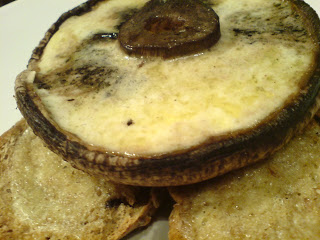
Place the mushroom on a round, or rounds of toast, depending on size, that have been spread with clotted cream (I had some left from the junket I made the other day). Have the mushroom stalk side up and spread that with more cream. Season well and place in inverted Pyrex dish over it and bake in a hot oven (200°C) for 30 minutes. He used a glass tumbler – to prevent the smoke spoiling the flavour of his precious mushrooms. It’s a good method, as it does keep all the mushroom juices in.

He goes on to say:
“The sight when the glass is removed, is most inviting, its whiteness rivals the everlasting snows of Mont Blanc, and the taste is worthy of Lucullus. Vitellius would never have dined without it; Apicius would never have gone to Greece to seek for crawfish; and had he only half the fortune left when he committed suicide, he would have preferred to have left proud Rome and retire to some villa or cottage to enjoy such an enticing dish.”

OK…

#134 Mushrooms, or the Pearl of the Fields – 8/10. I have to say, although he talks a load of nonsense, he knows how a treat a mushroom fairly. This simple supper dish is maybe the best way to show off the earthy flavour of those large meaty, juicy field/Portabello mushrooms. The clotted cream soaked into the crispy bread and also formed a rich sauce in the cap. Brilliant.
#73 Lady Shaftesbury’s Toasted Cheese

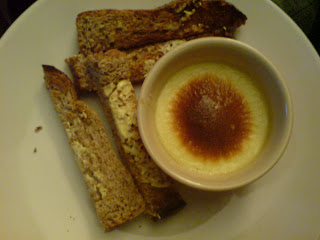
I thought that I’d completely run out of vegetarian recipes until I spotted a whole section in the ‘Cheese and Egg Dishes’ chapter of English Food. This is a dish that I know was popular in Victorian/Edwardian times in Gentleman’s Clubs and the like; it’s essentially a rarebit, but ‘deconstructed’, as trendy chefs would say nowadays. You get a pot of melted cheese and toast soldiers to dip in it. Be warned: this dish comes with a warning from Jane Grigson herself, ‘The quantities seem tiny, but this kind of dish should be eaten in small quantities; unless your family have stomachs of iron, toasted cheese can cause indigestion and nightmares.’ Whatever Griggers. The recipe is supposed to serve 6, but me, Greg and Joff ate the lot.

I do have to warn you, you DO get nightmares: I had totally trippy repetitive dreams all night and hardly got a wink of sleep, and Greg said he had nightmares and anxiety dreams, yet I heard him laughing in his sleep! Weird. I think I’ll conduct a scientific experiment in the future – there’s about six more of this kind of recipe; I’ll get people round, we’ll eat them all, score them, and then keep a dream diary. Thus proving the old wives’ tale as rock-solid fact!

Anyway, here’s the recipe. Divide it between however many people you want. Monitor your dream s though! And don’t eat if prone to sleepwalking.


In a saucepan, gently melt 2 ounces of butter, then, keeping the heat quite low, mix in 7 ounces of good grated Farmhouse Cheddar cheese, 6 tablespoons of cream, 2 large egg yolks, plus salt and pepper. Whilst stirring, get the grill nice and hot and toast a slice of brown bread, which should be buttered afterwards and cut into soldiers. When all the cheese has melted into a thick gloop, pour into ramekins and grill until the tops are browned. Serve immediately with the toast.

#73 Lady Shaftesbury’s Toasted Cheese: 8/10. Really delicious and simple to do. Although, by Jane’s standard, we have iron stomachs, a third is still only a little bit, but and is definitely enough to fill you up. I daren’t work out the amount of calories and saturated fat in this. Oh well, I’ll double my efforts at the gym.

#72 Madeira Cake

I made a Madeira cake because it seemed refined – one should drink a glass of Madeira wine with it as one reclines for a mid-morning treat, apparently. It’s basically a slightly lemony sponge cake and is pretty D.R.Y., hence the excuse of drinking wine with, I expect. I’d only had it with a cup of tea, but either is pretty good. Drinking cake with wine is very much a nineteenth century idea, partaken by middle-class ladies, the cake itself has nothing directly to do with the island.


Cream 6 ounces of butter and the same of sugar until light and fluffy. Sift 9 ounces of flour and half a teaspoon of baking powder into a separate bowl. Next, stir in 4 large eggs one at time, adding a small amount of flour between each egg to avoid them splitting the mixture. Once incorporated, stir in the rest of the flour and the grated rind of half a lemon. Pour the mixture into a lined or greased 8 inch cake tin. Bake at 180°C for anywhere between 50 minutes and 1 ½ hours, depending on your oven’s idiosyncrasies (I’m still getting used to mine). Half-way through the cooking time, place two strips of lemon zest on the centre of the cake. To test if it’s cooked, stab it with a skewer. When it’s ready let it cool for about 10 minutes before tuning out onto a wire rack.

#72 Madeira Cake – 7/10. I really liked this cake. I usually prefer something with a bit of cream or icing, but in combination with the sweet Madeira wine, it is really lovely. How refined!

#64 Soyer’s Orange Salad

All is going well thus far re: fitness. I’ve been to the gym every morning so far this week and I’m determined not to eat to much fatty greasiness. That said, one must treat oneself, mustn’t one? So I’m sure that I’ll do something naughty later on in the week. By compromise at least one of my 5 a day will be included (does butter count?). For tea I had salady bits – a green salad, hummus, coleslaw, brown bread etc etc. For dessert, Soyer’s Orange Salad. The recipe is taken from his 1860 book Shilling Cookery for the People (full title, Shilling Cookery for the People: Embracing an Entirely New System of Plain Cookery and Domestic Economy). You can still buy it as a paperback. Odd though that there’s an orange recipe, as they were pretty expensive up until post-war times. Also it contains Madeira wine. Anyways, it’s very easy – all you need is a very sharp knife or a Japanese mandolin and time for the oranges to macerate. The quantities I give are for four people:

Thinly slice three oranges, making sure that you remove pips; don’t buy the great big warty navel ones, get the small thinner skinned ones. Don’t slice the ends as they’re too pithy. Arrange the slices on a large plate, keeping the best ones for the top. Next, sprinkle two ounces of sugar over them, and then 2 fluid ounces (80 mlsish) of Madeira. Cover with cling film and chill for a few hours, or overnight.


FYI: Alexis Soyer is considered the first ‘celebrity chef’ and was an all-round nice chap: he took his travelling kitchen to Ireland during the potato famine to feed the poor, and to the Crimea and was a contemporary of Florence Nightingale.

#64 Soyer’s Orange Salad – 4/10. An odd creature. Not sure if I liked it, so I erred on the side of caution with score. The sweet Madeira is a treat and got easily drink a vat of it, but the oranges were odd – I don’t eat oranges like this normally – as the pith and peel were very tear and made my tongue a bit numb. That said, I couldn’t leave it alone. Maybe the slices weren’t thin enough, or perhaps I didn’t leave it long enough. I’ve got some in the fridge and will see what it’s like tomorrow.

Can’t Cook…Won’t Cook…

There are several ingredients in English Food that I have assumed that I won’t be able to cook, at least not in England. But watching television last night, it seems I can.

The Supersizers Go… Is a series showing off the eating habits of the English through the ages and last night they went Victorian. The presenters are a bit self-indulgent but it’s good mindless TV. Giles Coren and Sue Perkins tucked into giant game pies, calf’s ears, jellies, plum duffs, bad curries, croquettes, offal, offal and offal. It seems that English really food comes into its own here – many of Jane Grigson’s recipes are very similar to the dishes cooked then; in fact it was her daughter, Sophie that did the cooking. The main ingredients were butter and brandy, it seems, but it was all very restrained and frugal. Unless your very rich, or it was Christmas.

FYI: The Christmas as we know it now was invented in the Victorian era, courtesy of Queen Victoria, Prince Albert and Charles Dickens

One of things that really surprised me was the amount of game that our presenters were allowed to eat. One of the dishes contained snipe – I assumed that there are too rare to shoot these days, but obviously not. Searching on the web, I find that all the game birds that Jane Grigson lists in the game section of the tome are still legal game, including ptarmigan and wigeon. The other big surprise was that one meal’s centrepiece was a boiled calf’s head with the brain served in a garlic butter sauce. I thought that due to the BSE crisis, bovine brains couldn’t be eaten any more. It seems that I am wrong. It also seems that they taste vile. It also seems that I will be able to do the calf brain recipes. Damn.

On Channel 4 later that evening was Gordon Ramsay’s effort, The F-Word. I’m never sure whether I like the programme, yet I seem to watch it every week. This week he was fishing for elvers – baby eels – in Somerset. There is one recipe that uses elves in English Food, and I thought, as I have studied eels and elvers in the past that because elves numbers had dropped by 98 percent it would no longer be legal to fish for them, that they would be protected or something. Well, you have to have a special licence, but you can fish for them. If you want to buy them, they’ll set you back up to £525 a kilo. It took him 4 hours to collect enough for three measly portions. I know that the reason for the drop in numbers is not known, but surely fishing the remaining few is not going to help. I know I won’t be a part of it.

So it seems that there isn’t anything I can’t cook, but some things I won’t.

#46 Rich Orangeade

I have had a single Seville orange sat in my fruit bowl for about a month, Saturday was nice and sunny so I thought I’d make (#46) Rich Orangeade so that I could get Greg and Joff round and we can drink nice cool drinks and perhaps have some cake. In fact, have a proper Sunday high tea. It did of course piss it down all Sunday, natch.

The Seville orange was a little manky; it had done what fruit tend to do – go bad from the bottom up, but half of it was usable! To make the orangeade there was a three step process: thinly pare the zest from a Seville orange (in my case half, plus the peel of half a lemon to make up for it) and 6 normal sweet oranges. Put the peel in a litre of cold water and bring to a bare simmer for 5 minutes – the water shouldn’t boil properly because the bitter pithy flavour will be drawn out of the peel – then allow to cold. Meanwhile, do step two: boil 8 ounces of sugar with 3/4 pint of cold water for three minutes, then allow that to cool also. Step three: squeeze the juice from all the oranges, and when everything is cool, stir together. Finally add a little orange flower water (I added about 1/4 teaspoon and that was just right for me) and lemon juice – I used half a lemon. Allow to chill properly before being eaten.

Greg says:
The Orange-ade is simply Enid Blyton in a glass, if that doesn’t sound too graphic. Lashings and lashings say I! Once you taste that lovely floral kick that the blossom and lemon adds to it you can see the flavour that cheap cordial manufacturers have been harking after all this time, and failing to grasp. It’s lovely. Will be even better when the sun comes out. Come on . . . COME ON! 8/10


FYI: I noticed that the orangeade comes from a Victorian recipe and doesn’t require fizzy water. So what make an ‘ade’, I wondered…according to the Oxford English Dictionary, the suffix ‘-ade’ means: “The product of an action, and, by extension, that of any process or raw material; as in arcade, colonnade, masquerade, lemonade, marmalade, pomade.” So it seems that turning any fruit into a drink makes it an ‘ade’. Everyday’s a school day!

#46 Rich Orangeade. 8.5/10. A delicious summertime drink – the perfumed taste and aroma of the peel, the Seville orange and the orange flower water transforms it from just sweet orange juice into something pretty special!