#390 Isle of Man Herring Pie

I’ve been putting this one off for ages because it starts with the sentence: “A very similar recipe to the [#133] Welsh Supper Herrings”. These were not good; pappy fishy cat food mush and raw potatoes. However, that was 5 years ago (5 YEARS!) and I like to think of myself as a better cook now than in those naïve days.
This recipe comes from a Mrs Suzanne Woolley who ran a restaurant called Mheillea(‘Harvest Man’) on the Isle of Man. Normally herrings would have been cooked with potatoes as in Wales, but she decided to make a pie of them. Aside from that, it’s pretty much the same as the Welsh Supper Herrings. This did not bode well.
Mrs Woolley’s book – still avaialable!

First of all you need to make or buy some shortcrust pastry, large enough to line and lid a baking dish large enough to hold the ingredients of the pie. A small lasagne-style dish would be appropriate. Line the dish and keep it in the fridge. Reserve the pastry for the lid in the fridge too.

Next, prepare 6 herrings. You need to scale, gut and bone them. Or ask your fishmonger to do it. Boning herring is actually a pretty straight-forward job, as you need no filleting skills whatsoever. I can’t put it better than Jane herself:
Cut off heads, fins and tails and bone them: to do this, put the herring on a board, backbone up, spreading out the slit sides of the belly. Press gently along the backbone from neck to tail, until you feel the bone giving. Turn the herring over, and you will find you can pick out the backbone complete with most of the whiskery bones still attached (separate bones can be pulled out).
It’s worth mentioning that you need really fresh firm herrings for this. If they’re just a few days’ old, they will have started to go mushy, and the procedure described by Jane above will be most unsuccessful.
Next, season them on both sides with salt, black pepper and ground mace (about ½ a teaspoon should do it). Spread some softened butter over the base of the pie and arrange the herrings on top. Peel, core and slice 3 good-sized cooking apples and thinly slice 2 medium onions. Put the apple on next to forma layer, then the onions. Place dots of butter over the top, season again with salt and pepper, then sprinkle over 4 tablespoons of water

 Roll out the remainder of the pastry, sealing the pie with some beaten eggor cream. Make a hole in the middle of the pie so that steam can escape and brush the lid with your egg or cream.

Bake at 180-190⁰C for 40 minutes or so. “Check after 30 minutes”, says Grigson, “by pushing a larding needle or skewer through the central hole of the lid, so that it pierces the herring; you should be able to feel whether the herrings are cooked by the way the needle or skewer goes in.”
And there you have it. I assume the pie was supposed to be a self-contained meal, maybe a suitable salad could be served alongside it.
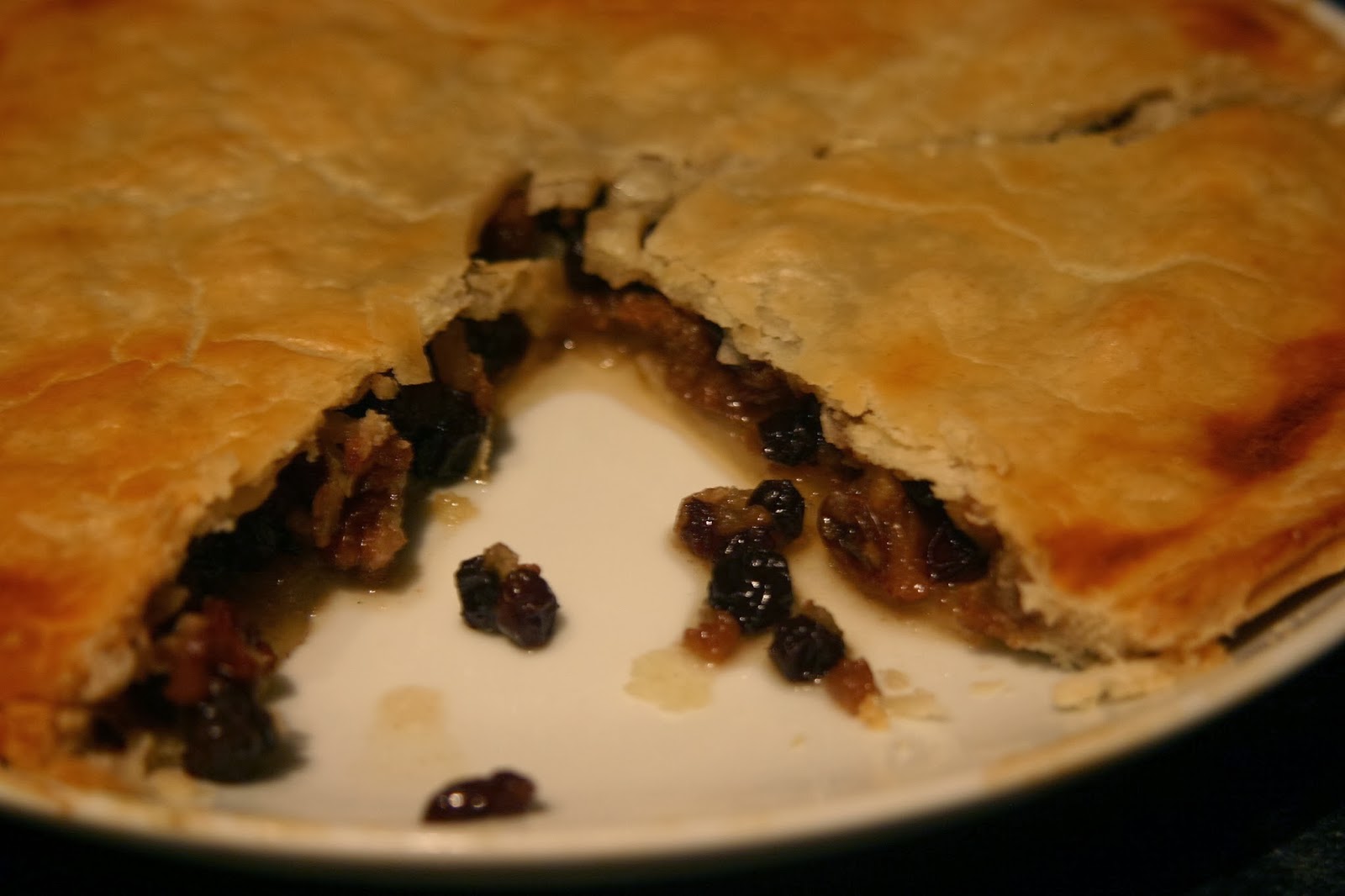
#390 Isle of Man Herring Pie. Well I have to say I’ve not had a really terrible recipe from English Food in quite a while, so I was well overdue. The herring just did not go with the apples at all; it would at least have ben palatable as an apple and onion pie. I cannot see how this recipe made it into any cookbook! Really bad. Went straight in the bin. 1/10.

#389 Salmon Stewed in Seaweed with Dulse Hollandaise

Seaweed is not so popular in this country and this recipe requires two different kinds. The first is dulse and I have used it before to make #307 Mashed Potato with Dulse. There’s some information about dulse on that post, should you want it. 
However, the other seaweed – the one the fish is stewed in – is not so familiar. It is called fingerware, and according to the recipe, comes in ½ ounce (or 15g these days) packets. I could find no mention of fingerware in any of my books, or in shops. I did manage to find its Latin name in A Dictionary of Food and Nutrition by David A Bender, but that was all I found though. Here’s the full entry:
                fingerware Edible seaweed, Laminaria digitalia
This name sounded familiar (being an ecologist one picks up the Latin names to some organisms), and it turned out to be good-old kelp. Now I had something to try and order. Unsurprisingly, I was able to find it on Amazon, but only in massive triple packs. Hey-ho. It just had better be bloody nice!

Fingerware, Laminara digitalia, in situ
Now I had my two seaweeds I could cook the recipe, which, by the way, is one that Jane modified from a book from Karin Perry’s Fish Book. Originally, halibut was used, but you could also use any round sea fish like sea bass, cod, or grey mullet.
 Fingerware how I received it.

Begin by preparing your whole salmon. According to Jane, it should weigh somewhere around 2 ½ pounds, mine was a little larger because the only salmon available to me was farmed, and they grow much larger than wild salmon. Anyway, give the salmon a rinse and pat it dry. Leave out in the kitchen for it to warm to room temperature for 30 minutes or so.

Next prepare the fingerware, you’ll need ½ ounce of it. I could only get it in huge sheets, so I cut out a piece and cut that into broad strips. Pour boiling water over it and leave it to rehydrate for 30 minutes.

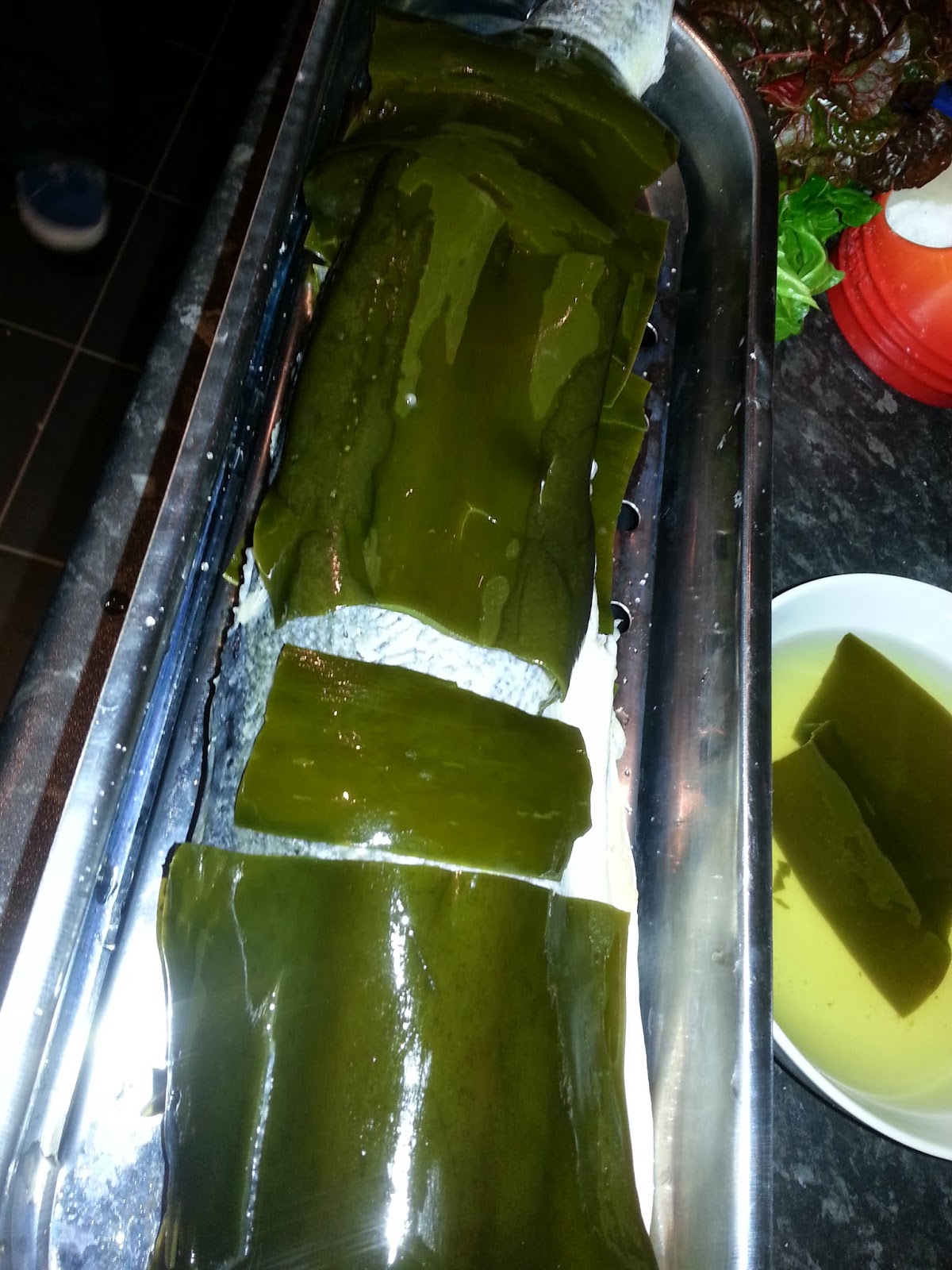
While you wait, get the fish kettle ready: place two upturned ramekins inside end-to-end to act as a stage for the rack; the idea here is that the fish cooks in the steam rather than in the water. Lay the fingerware over the rack and then brush the upper side of the fish with some melted butter. Season it with salt and pepper, and then lay the fish butter-side-down on the rack. Brush the other side of the fish with more melted butter and season. Don’t forget to season inside the fish too. Lay the rest of the fingerware over the fish.

Next, get some hot water on ready to pour into the kettle. Cut a piece of kitchen foil large enough to cover the fish in its kettle; the lid cannot be used because of the ramekins. Pour in the hot water, then place the rack and fish inside the kettle. Cover with foil, put over two burners and steam for 15 minutes.

When the time is up, have a little look and see if the fish is done. You could use a knife to have a little inspection, or pull a fin; if ready the fin should pull out in a satisfying way. If not ready, leave another 5 minutes.
When done, take the kettle from the heat, but keep the foil over it for another 15 minutes. While you wait, prepare the hollandaise sauce.
Take 2 tablespoons of crumbled, dry dulse in a bowl and pour over it boiling water. Leave for 2 minutes, strain it in a sieve and refresh with cold water. Pat dry with kitchen paper.
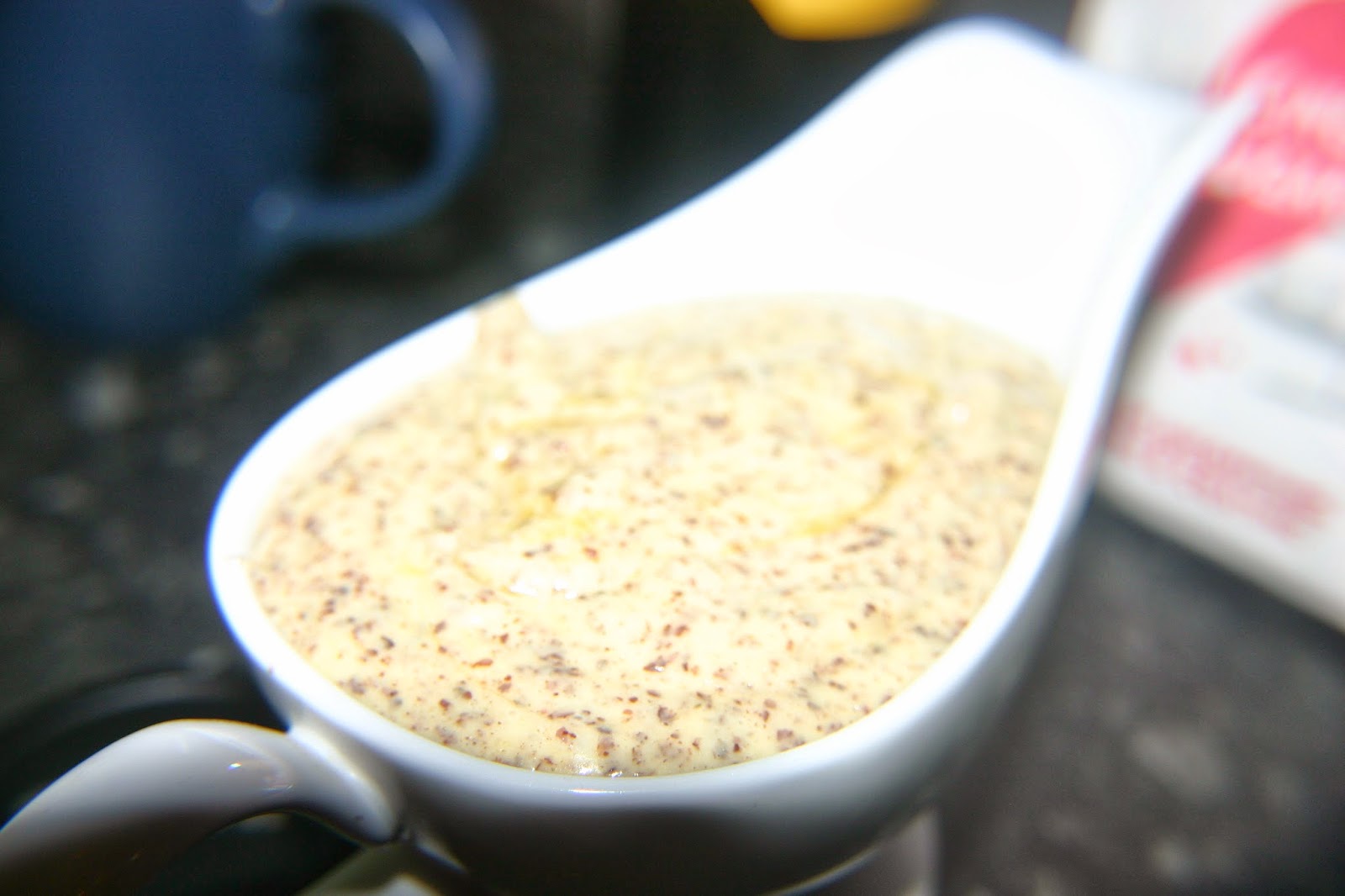
Start by cutting 7 ounces of softened unsalted butter into small cubes. Place 3 egg yolks in a bowl along with a tablespoon of water. Whisk well and then place the bowl over a pan of simmering water. Then, whisking all the time, add one or two cubes of butter and when incorporated add a couple more cubes until all the cubes are used up. Season with salt, pepper and lemon juice and stir in the dulse.

Transfer the salmon to a serving dish and pour the sauce into a jug.

When portioning out the fish, Jane suggests, giving each person a small piece of the fingerware. She also suggests to accompany it with boiled new potatoes and samphire or blanched cucumber or mange tout.

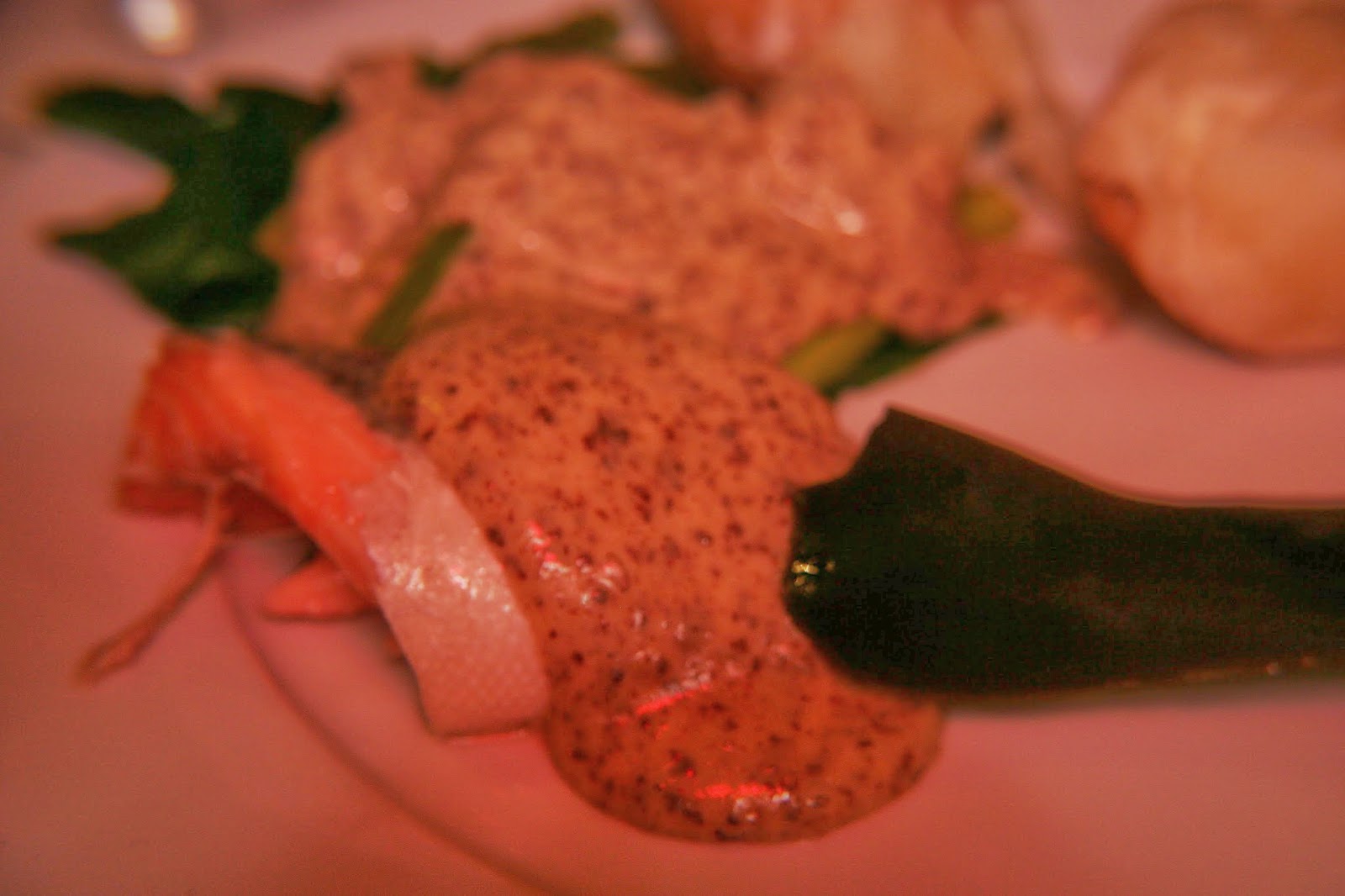
 #389 Salmon Stewed in Seaweed with Dulse Hollandaise. Hmmm. A tricky one to judge, this one. I thought the salmon was cooked very nicely and one cannot ever complain about hollandaise sauce. The problem was the seaweed didn’t seem to add anything at all to the dish. I think if I had used partially-dried dulse like you can get in Ireland, fried it to make it crispy and used that in the sauce, it would have made a world of difference. For that, it loses points, so let’s say 6/10.

#388 Sweet Lamb Pie from Westmorland

Happy New Year Grigsoners!

There are no Christmas recipes in English Food left to cook, but this one is close, being a cross between a savoury lamb pie and a sweet mince pie. It’s a recipe that has no introduction from Jane Grigson, though I feel it should, as it is pretty strange-sounding: a pie with a minced lamb, dried fruit and apple filling. Though it hails from Westmorland (a now defunct northern English county now made up of bits of Cumberland, Lancashire and Yorkshire), it seems to me to be a very typical pie baked during the medieval period, where it was very common to cook meat with lots of dried fruit and spices.
The Westmorland Coat of Arms
Why was this done? After all it seems to be an odd combination. Many people say that it is because heavy use of fruit and spices masked the taste of rancid and rotten meat. This, however, is a total myth; the reason meat was combined with spice, dried fruit and sugar was because all of these ingredients were extremely expensive. It was all showing off. They are – in my past experience – also a good combination: previous recipes like #87 Mrs Beeton’s Traditional Mincemeatand #328 Salmon in Pastry, with a Herb Saucefollow the same principle.
By the time of the Victorian era, none of these ingredients were particularly expensive, and this sort of food fell from favour, the only surviving remnant being the now totally meat-free mince pie.
This pie is known as a ‘plate pie’, which is still commonly made in Northern England. It is simply a pie made, not in a tin, but on a plate. The plates can be of typical (ovenproof!) ceramic or formed from enamel. Whichever you use, make sure it is deepish. My Mum still makes both sweet and savoury plate pies.
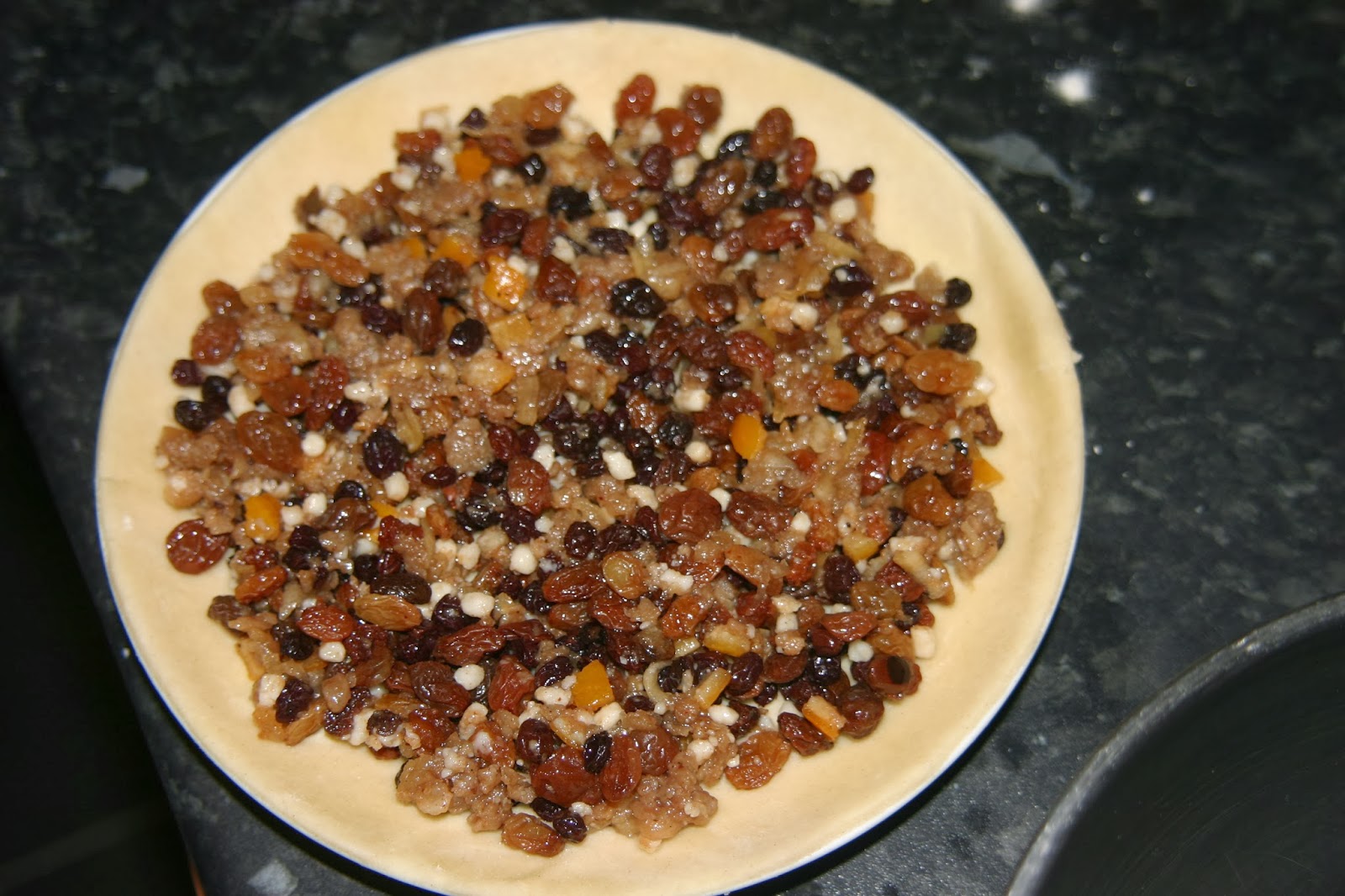
To make the pie, start with the filling. Mince together 6 ounces of lean, boned lamb with 3 ounces of lamb fat(you can the butcher for fat trimmings or keep your own and freeze them until you have accrued enough). Mix these together along with 6 ounces of apples, any will do, but I used tart Bramleys, 4 ounces each of currants, raisins and sultanas, 2 ounces of candied peel, the juice of one orange and half a lemon, 2 ounces of blanched, slivered almonds, 4 tablespoons of rum, a good pinch of salt, freshly ground black pepper, half a teaspoon each of mace and cinnamon and a quarter of a teaspoon of freshly grated nutmeg. Phew.
Once well-mixed, give it a little taste and add more seasoning and spices if you wish.
Next, roll out enough shortcrust pastry and line the plate with it. Scatter over the filling and cover with more pastry, sealing the edges with beaten egg or water. Trim the edges and crimp, before glazing with beaten egg in the usual way.  
Bake at 200⁰C for around 30 minutes.
Jane says that any remaining filling can be used to make small mince pies. I think I went one better however, and made sweet lamb Eccles cakes, which were such a success they ended up on my last Pop-Up Restaurant’s menu.
#388 Sweet Lamb Pie from Westmorland. I spotted this pie quite early, thinking it must be awful. Today I feel Jane Grigson has taught me well and I now knew this would be good. When you bite into it, you get the taste and aroma of lamb – so you know it is there – but the fruit and spice compliment it very well. There is no added sugar and the apples are still tart, so it is not sickly like a Christmas mince pie. Is it sweet? Is it savoury? It does not matter; these sorts of recipes are the crowning glory of English Food. Really lovely, go and make one. 8/10.
#387 Pheasant Braised with Celery

 
The great thing about celery is that it is two vegetables and one spice all in one.
The large familiar swollen stems are actually greatly enlarged leaf stalks and make up most of the plant visible above the soil. The celery we know and love was selectively bred in 14th century Italy from the wild plant that is “rank, coarse, and…poisonous” according to the celery expert Theophilus Roessle. It is these stalks that join onions and carrots to produce the trinity of stock vegetables – indeed it is for stock, or for salads, that celery is commonly used, but it does make a great vegetable on its own. It was very popular to serve celery sauces with poultry, or served covered in a cream sauce with pheasant, which is what we have here for this recipe.
In Good Things, Jane Grigson gives us two valuable pieces of advice: firstly, that celery is a seasonal vegetable that is at its best from November and December. We have lost this seasonality and it is a shame, I expect few of us have eaten prime celery improved by the ‘first frost’. The second piece of advice is how to eat the vegetable raw; once you have procured your first-frosted celery, you should trim it and spread down the curved length of the stem good butter. Next, sprinkle with sea salt. “Avoid embellishments”, she says “a good way to start a meal.”
It is a myth that celery is calorie negative: a stick may only contain 10 calories, but it takes only 2 or 3 calories to chew, digest and process it. It is very low in calories, of course, and can help you lose weight, though “It’s more of a gateway to cream cheese or peanut butter,” says the nutritionist David Grotto. Indeed. In this case, it’s a gateway to bacon, port and two kinds of cream.
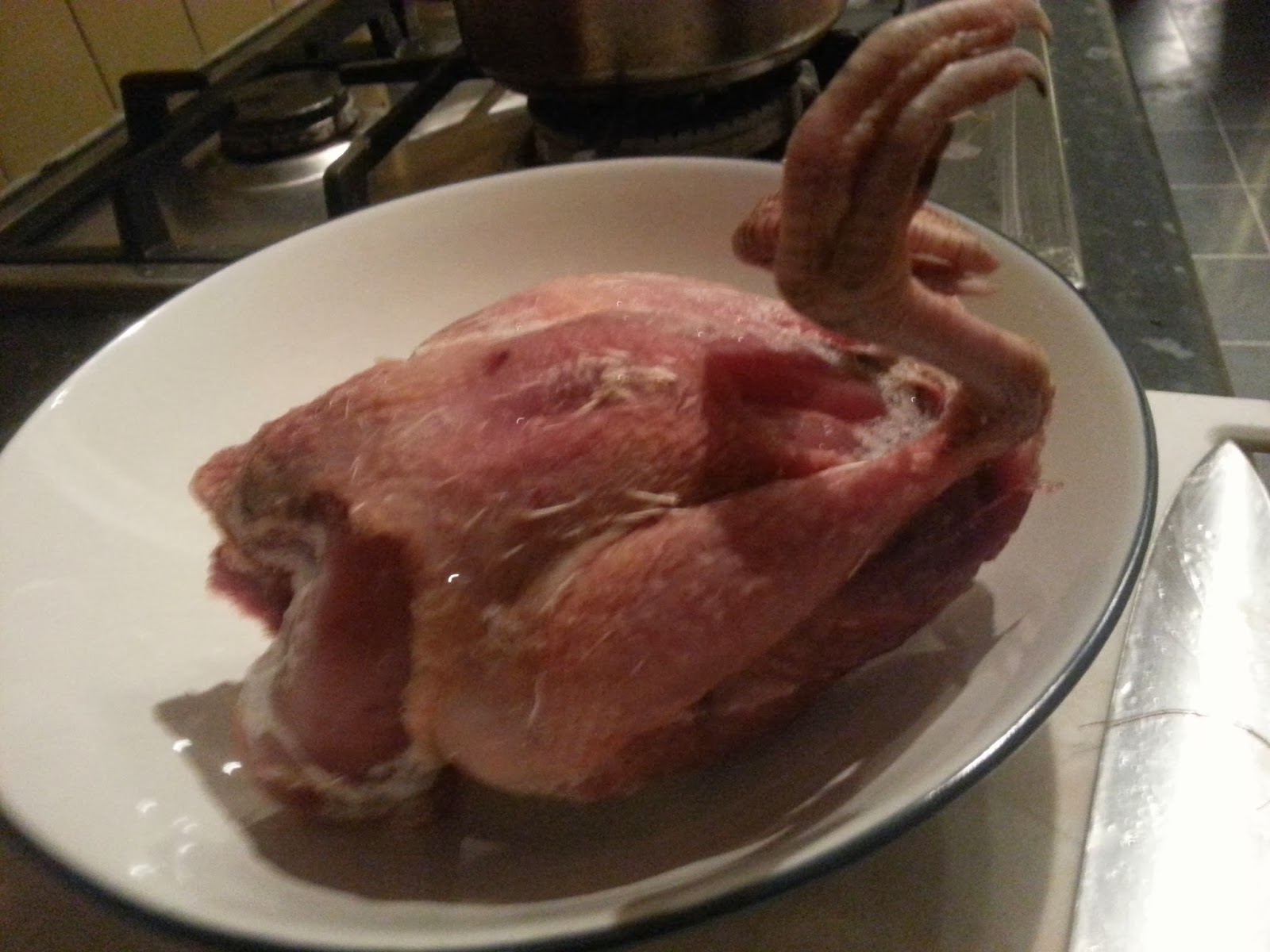
I plucked and drew my own pheasant, that way I could use its giblets for the sauce. For some reason, I decided that I should leave the feet on.
Start off by browning a pheasant in 3 ounces of butter along with a chopped onion in a frying pan. Place the pheasant breast side down with the onions in a casserole dish. Cut three strips of unsmoked bacon (aka green bacon) into thin strips and fry that in the pan briefly. Deglaze the pan with ¼ pint of port and a batch of giblet stock. See the now positively ancient post #122 Roast Pheasant for instructions on how to make some. Pour the stock, port and bacon into the casserole dish, cover tightly with a double layer of foil. Bake in the oven for 30 minutes at 180⁰C. At this point the legs of my pheasant stuck right out all flexed. At least there would be good handles when it came to the drumsticks.
Meanwhile, wash and slice a whole head of celery and when the 30 minutes is up, turn the bird the right way up and place celery around, under and within it. Season well with salt and pepper. Pop the foil lid back and give it another 30 minutes.
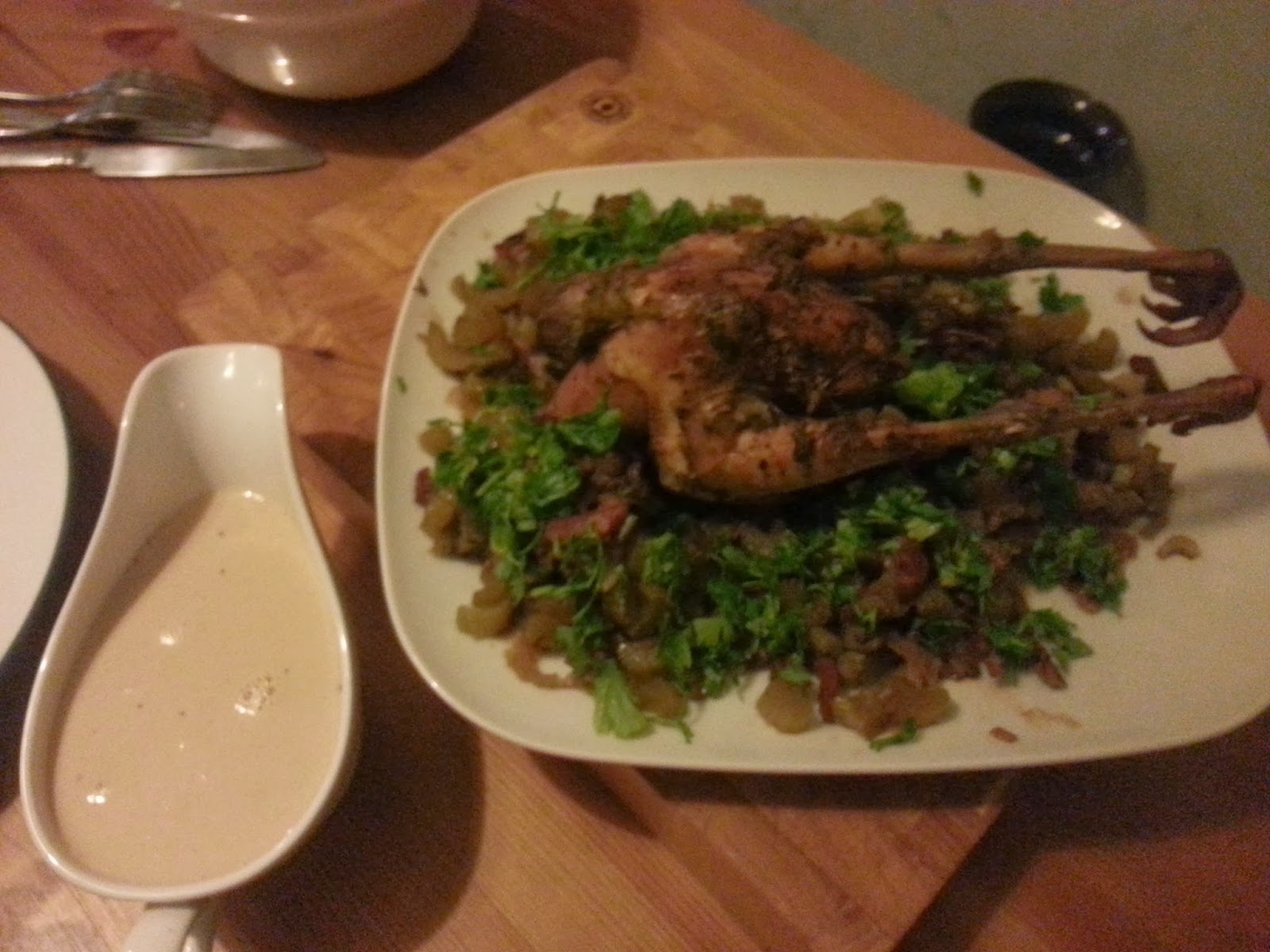
Remove the bird and place on a warmed serving plate, arranging the celery and bacon around it. Strain the cooking liquor into a small sauce pan. Whisk together a quarter-pint each of single cream and double cream along with a large egg yolk. Add this to the saucepan and stir with a wooden spoon over a low heat until it thickens slightly. Taste and check for seasoning and add a good squeeze of lemon juice. Lastly, scatter over some chopped parsleyand serve with the sauce in a sauceboat.
#387 Pheasant Braised with Celery. This was a great recipe that was not anywhere near as rich as I expected it to be. The port wine cream sauce was so very tasty and complemented the still slightly crisp celery perfectly. It’s worth mentioning that you should use a nice deep-green organic head of celery – and not the intensively grown stuff you get at the supermarket. Hunt out a local supplier. The pheasant itself was nicely-flavoured, but a little on the dry-side. An hour’s cooking was too much for the tiny white lady pheasant I had procured from my butcher. Luckily, plenty of creamy sauce covered a multitude of sins and it didn’t spoil this first-class recipe. I didn’t cover the claws though. 8/10.

#386 Herrings in Oatmeal

Herrings and oatmeal used to be staple foods in the North of England and Scotland, where the ‘silver darlings’ were plentiful and oats were pretty much the only cereal crop that could be grown in those inhospitable climes of The North. They were particularly enjoyed at breakfast. We don’t seem to eat fish at breakfasttime anymore, except for the rare kipper or a bit of smoked salmon stirred through scrambled egg, if we’re feeling posh.
Also, you don’t see recipes for this dish in older cookbooks, I assume it is because it’s so straightforward and was so commonplace that writing it down was simply not required. I cannot even find the phrase “herrings in oatmeal” before the 20th Century! More modern books include them of course, even if it just to remind us of the foods our forefathers ate.

Herring in general are quite ignored, I think, though their relative the mackerel is increasing in popularity. It’s strange that in the middle of the last century they were over-fished. It’s a shame they’ve fallen out of favour, as they are very nutritious and very cheap.

It is herring spawning season right now – they are bright-eyed, plump and have massive creamy roes in them, so if you want to try them, now is the right time
I confess, I have never eaten herrings in oatmeal, but I love herrings and I love oatmeal, so they couldn’t be bad.
This recipe is for six, but it is easy to see how it can be scaled up or down:
First of all, you need six fine herring. Ask the fishmonger to open the herring from the back as though they were kippers. Ask him to save the roes (they’re not required for the recipe but they should always be saved).
At home, season the fish and them press them into some medium or fine oatmeal that has been scattered over a plate; about 3 ounces should do it. Fry the herrings in butter until they are lovely and golden-brown. Do them in batches if need be, keeping the cooked ones warm in the oven on a bed of kitchen paper to keep them crisp. Serve with lemon wedges.
Jane tells us the best way to serve these is with simple boiled potatoes and bacon. I had the spuds, but swapped the bacon for a salad! Traditionally fatty bacon would be crisped and fried, and the herring would then be cooked in the bacon fat; next time (and there will be a next time) I’ll do the bacon thing.
#386 Herrings in Oatmeal. Well I have said it many times, but I’m going to say it again, the simple ones are the best. These were delicious, forgotten gems. The chewy oatmeal really complimented the mild herring perfectly. This sort of food has fallen so out of our collective consciousness that you just do not see it anywhere. I might be my new favourite thing. When my little restaurant opens, herrings in oatmeal will certainly be on the menu. 9/10.


#385 Apricot and Pineapple Jam

A recipe from the Preservespart of the final chapter of the book and a recipe that I have been putting off for a good while because it seemed like the most pointless preserve. The two main ingredients, you see, are tinned pineapples and dried apricots WHICH ARE ALREADY PRESERVED! What is the point of that!?

Jane tells us that her mother made this jam during the war, but lost the recipe, but then a stroke of luck; someone sent her a recipe, decades later. And here it is below. I suppose it makes a little bit of sense jazzing up the pineapple and apricots into a jam for high tea at a time of rationing.
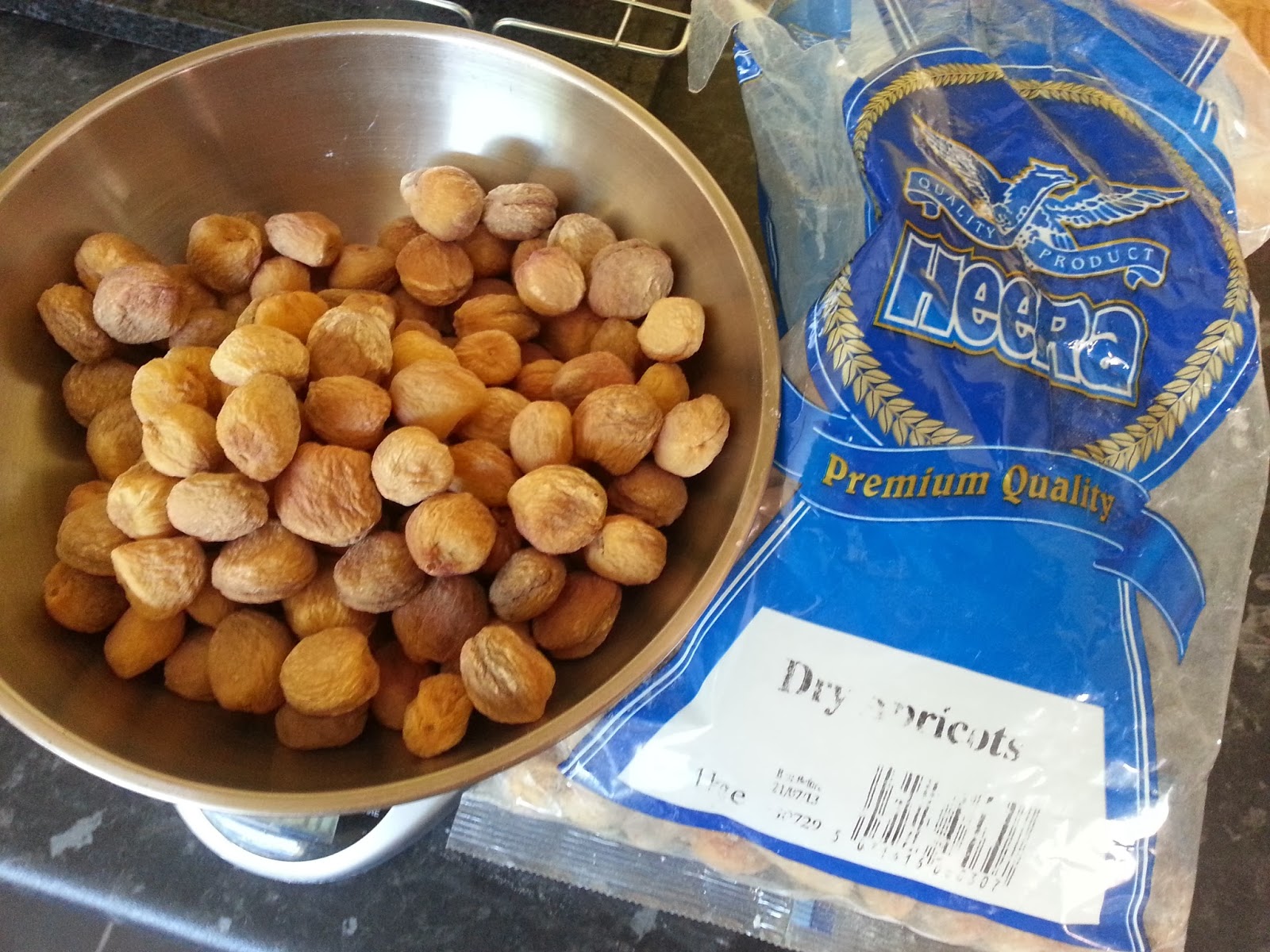
The recipe uses not the dried apricots you typically find with the dried fruit in the supermarket, but the kind you find dried whole and rock-hard, with their stones inside. These are readily available at your local Asian grocers.
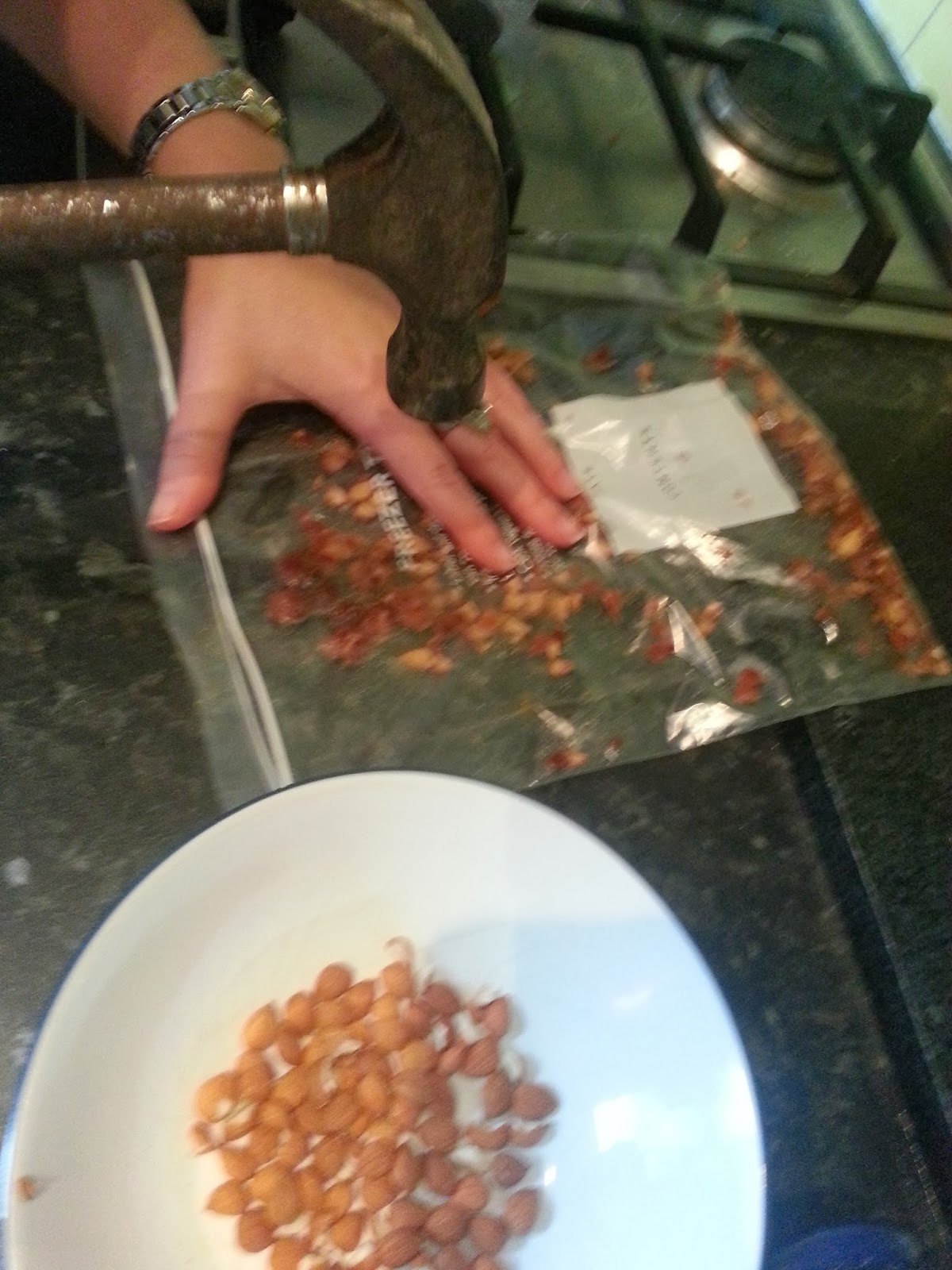
To begin, you need to soak a pound of the dried apricots in 2 ½ pints of cold water overnight. Take out the stones and crack them open to find the almond-scented kernels within. I find the best way to do this job is to put a dozen or so of the stones in a freezer bag and then swiftly crack them with a hammer. The bag stops the stones from flying everywhere, and a short swift crack with a hammer ensures that – in the main – the stones remain whole.
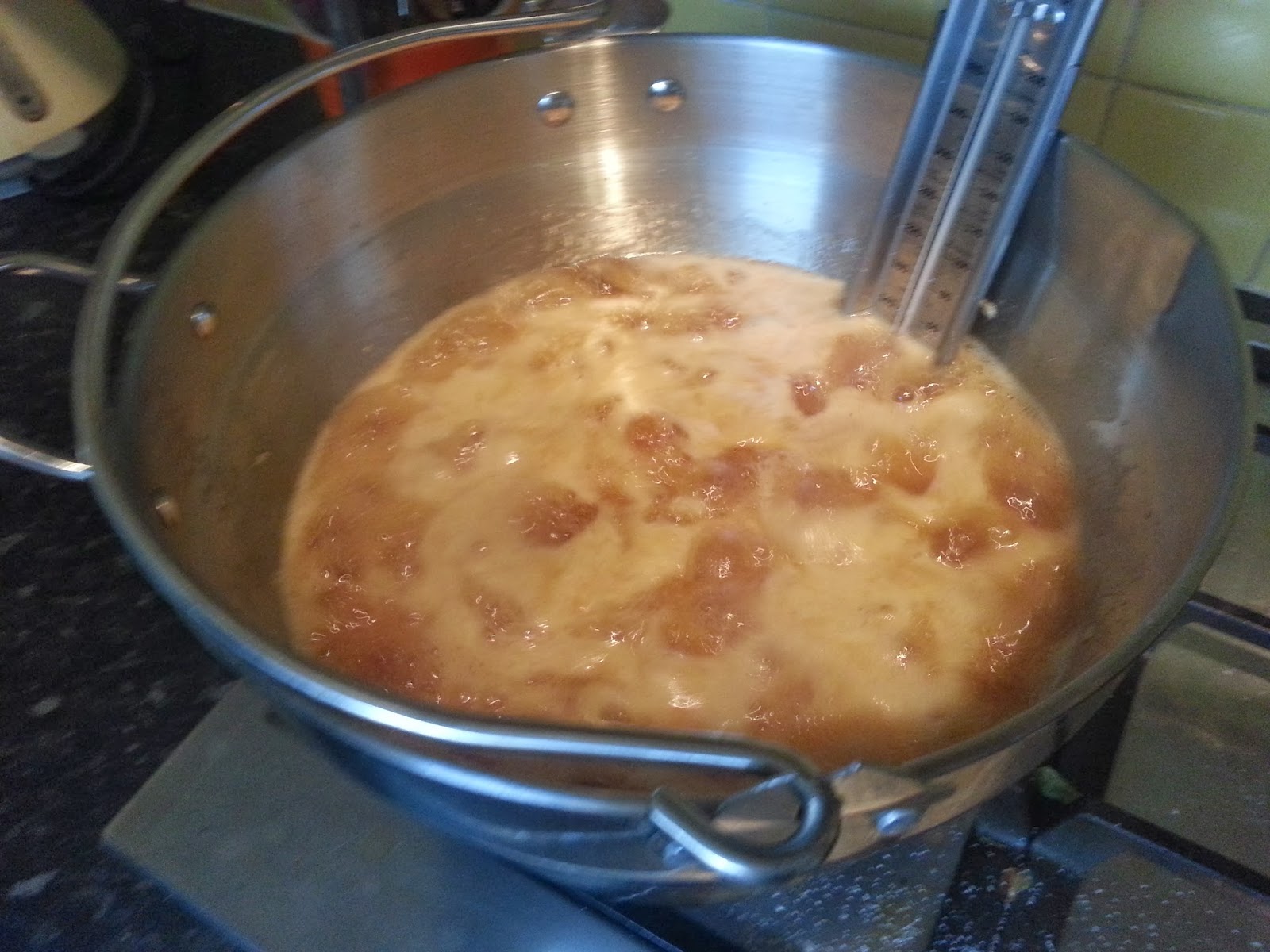
Put the soaking water along with the apricot flesh in a simmer gently for 30 minutes. Whilst they cook, drain a 12 ounce (375g) tin of pineapple, reserving the juice. Chop the pineapple quite small. Add the juice, the pineapple and kernels to the pan along with 3 pounds of sugar(granulated will do fine) and 4 ounces of blanched, slivered almonds. Bring to a rolling boil until setting point is reached using a sugar thermometer (104⁰C) or by the wrinkle test on a cold saucer.
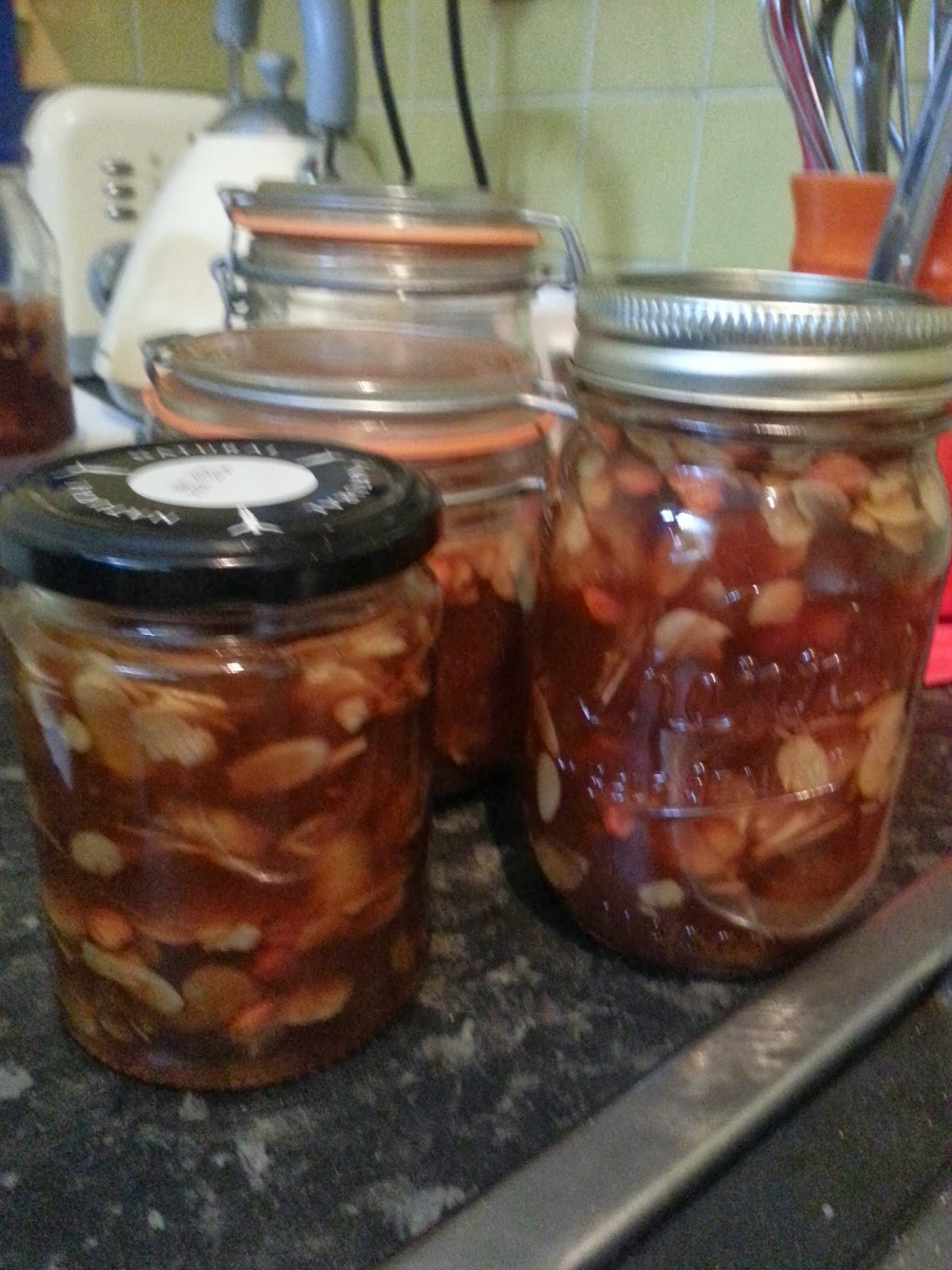
Let the jam sit for 10 minutes before potting into hot, sterilised jars.
#385 Apricot and Pineapple Jam. This is a great-looking and great-tasting jam. It looks like bejewelled honey with those almonds and kernels floating in there. It doesn’t taste as sweet as I thought it would, and is delicious on toast or in jam tarts. It seems that, although the ingredients did not need further preservation, a jam was created that was greater than the sum of their parts. All art is useless, as Oscar Wilde said. Very good: 8/10.
 

#384 Quick, Foolproof Puff or Flaky Pastry

Fool-proof? I’ll be the judge of that, Ms Grigson.

This is a recipe I have been putting off for ages; I have become pretty good at shortcrust pastries as well as hot-water pastry, but the rigmarole and potential disaster of a flaky pastry has always filled me with an inner dread. However, now that I am a half a fully-fledged patissier, and chock-full of confidence, I thought now is the time to give it a go.

I really should have looked at the recipe a little closer, because it is actually a rough-puff pastry as opposed to the true pâte feuilletée that can be made up of up to 1500 layers of pastry and fat. I was a little disappointed that it wasn’t the proper stuff, but then one shouldn’t run before one can walk, so perhaps a rough puff would be a happy stepping stone that will one day lead to the dizzying heights of the full puff.

This recipe was devised by, and then given to Jane Grigson, pastry chef Nicholas Malgieri who then worked ‘at Peter Frump’s famous New York cookery school’, and has now created an empire of his own. Like all rough puff pastes, it is best used for tarts, feuilletées or patisserie such as the good-old custard slice. To avoid bitter disappointment, don’t go trying to use them for something that requires a high rise, like a vol-au-vent (does anyone actually eat those anymore…?).

My good friend Charlotte came over to give me a hand, should I need it, though really I think she came to eat the dessert it would be used to make, which is fair enough. She did take some great photos for me though, so cheers Char.

It is important to buy good quality butter when making puff pastes, so don’t go using Tesco Value, instead go for a nice French or Danish one. Jane prefers French, I’d just say go for the best you can afford. This method satisfyingly uses a whole 250g block of butter, which is 8 ½ ounces in old money, which explains the seemingly strange weights used:

Start by cutting up 8 ½ ounces of unsalted butter into cubes, then sieve 8 ½ ounces of strong flour into a bowl. Rub in one ounce of the butter into flour. Tip in the rest of the butter and ‘work lightly’. I took this to mean to make sure each cube is separate and squashed flat, ready for easier rolling later.

In a measuring jug, dissolve half a teaspoon of salt in 2 teaspoons of lemon juice, then top up to 4 fluid ounces with ice-cold water. Tip it in and quickly bring it all together; ‘it will look appalling, a raggy mess’, says Jane, and so it did.

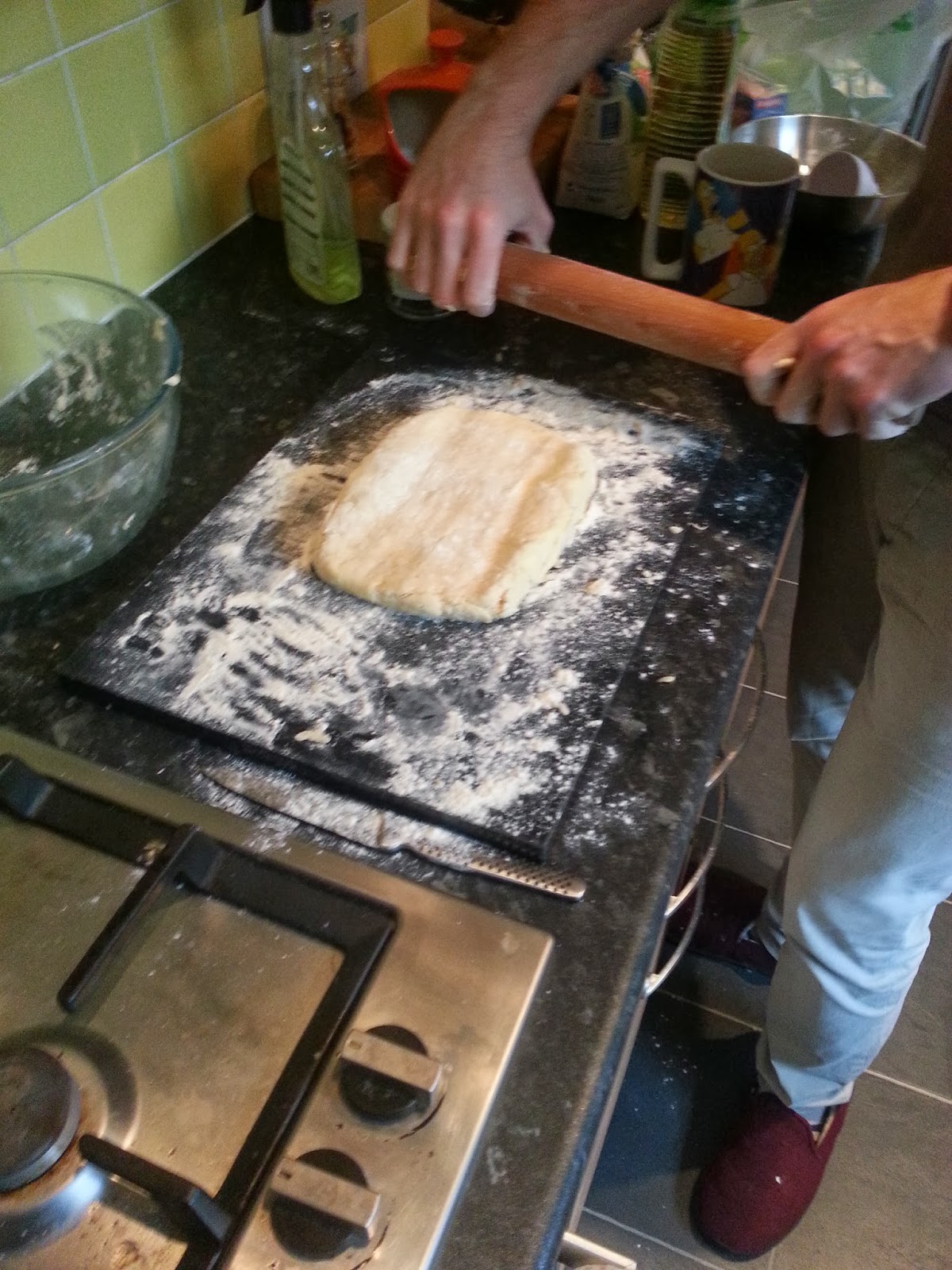
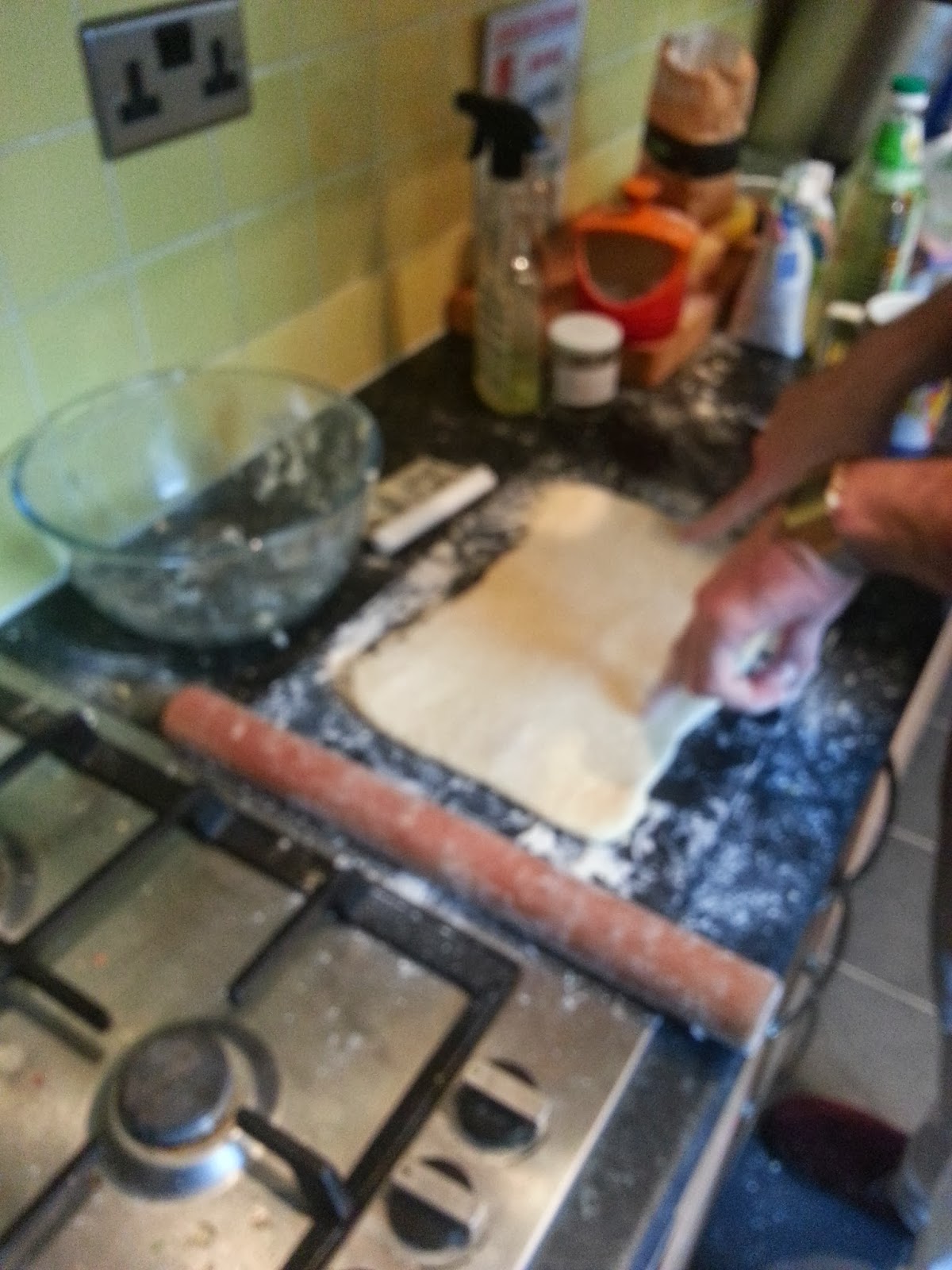
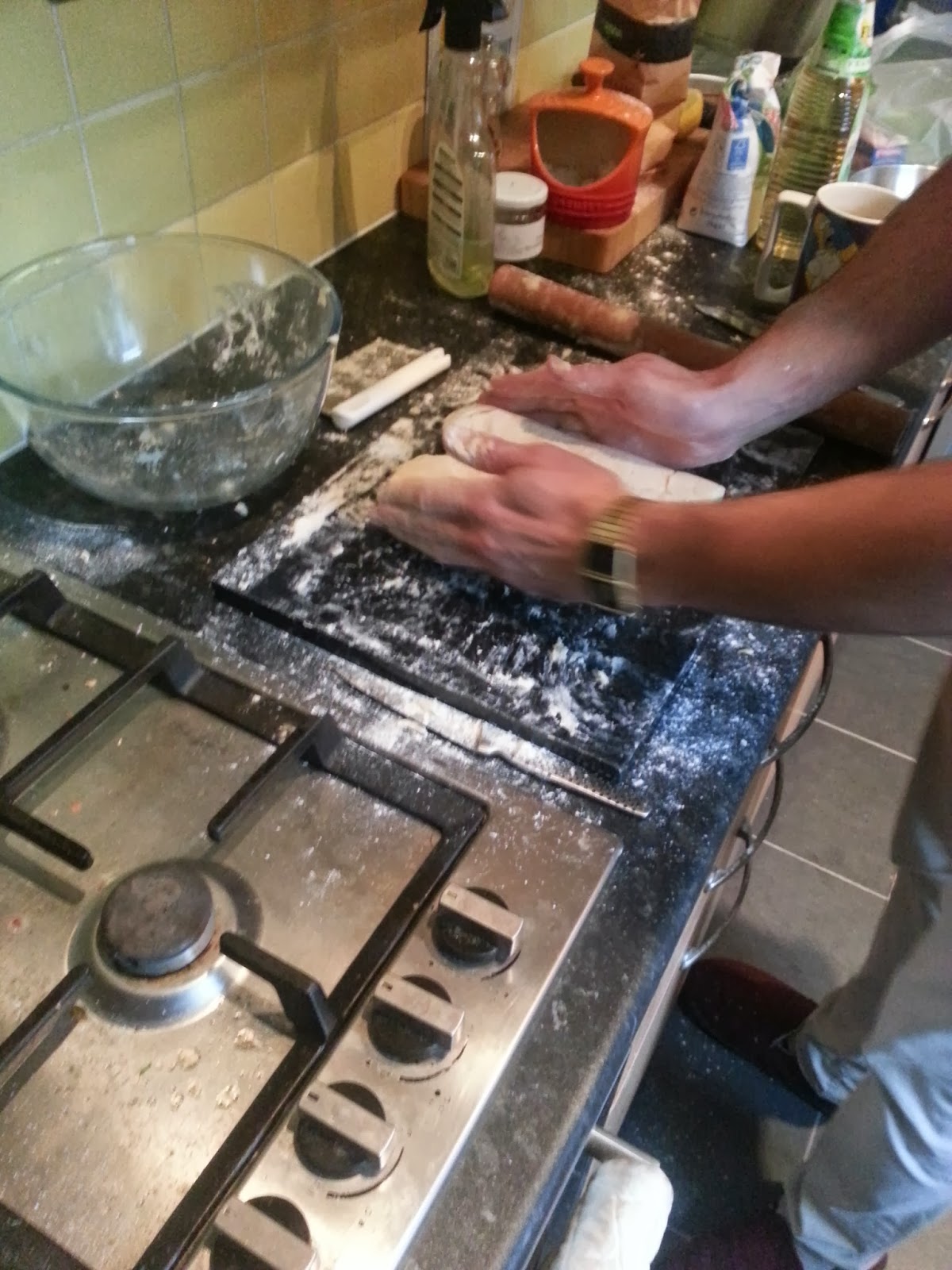
Flour your work surface and manhandle your pastry lump into an approximate 4-by-8 inch rectangle. Flour the top generously and roll out to a 9-by-18 inch rectangle, using more flour to prevent sticking. Now do the first folds: fold the short ends into the centre, then fold the whole thing in half so that it looks like a book. Turn the ‘spine’ one quarter turn to the left, roll out again, and make the very same folds. Turn, roll and fold one more time. If at any point the butter gets too warm and soft, pop it in the fridge to firm up.

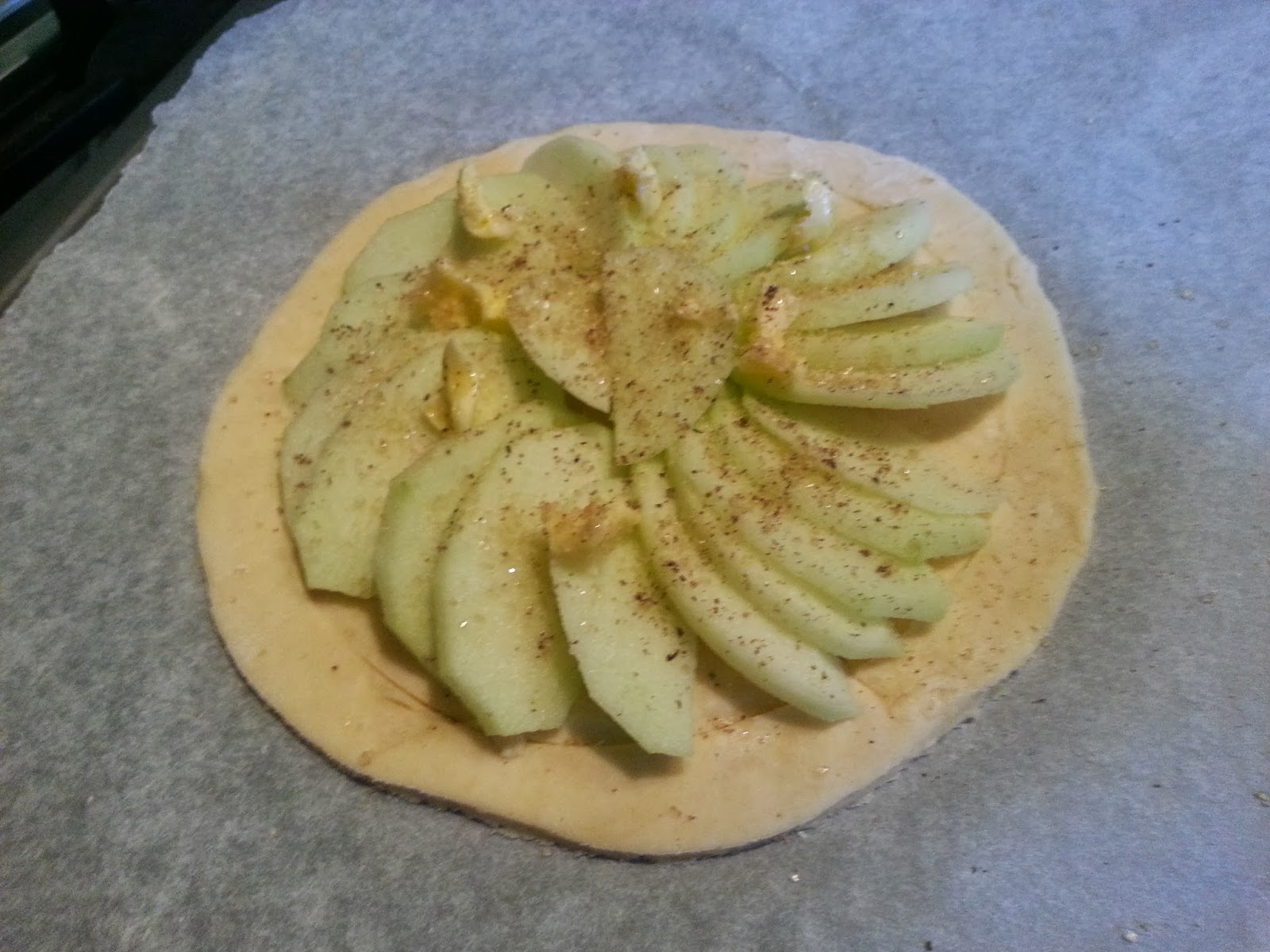
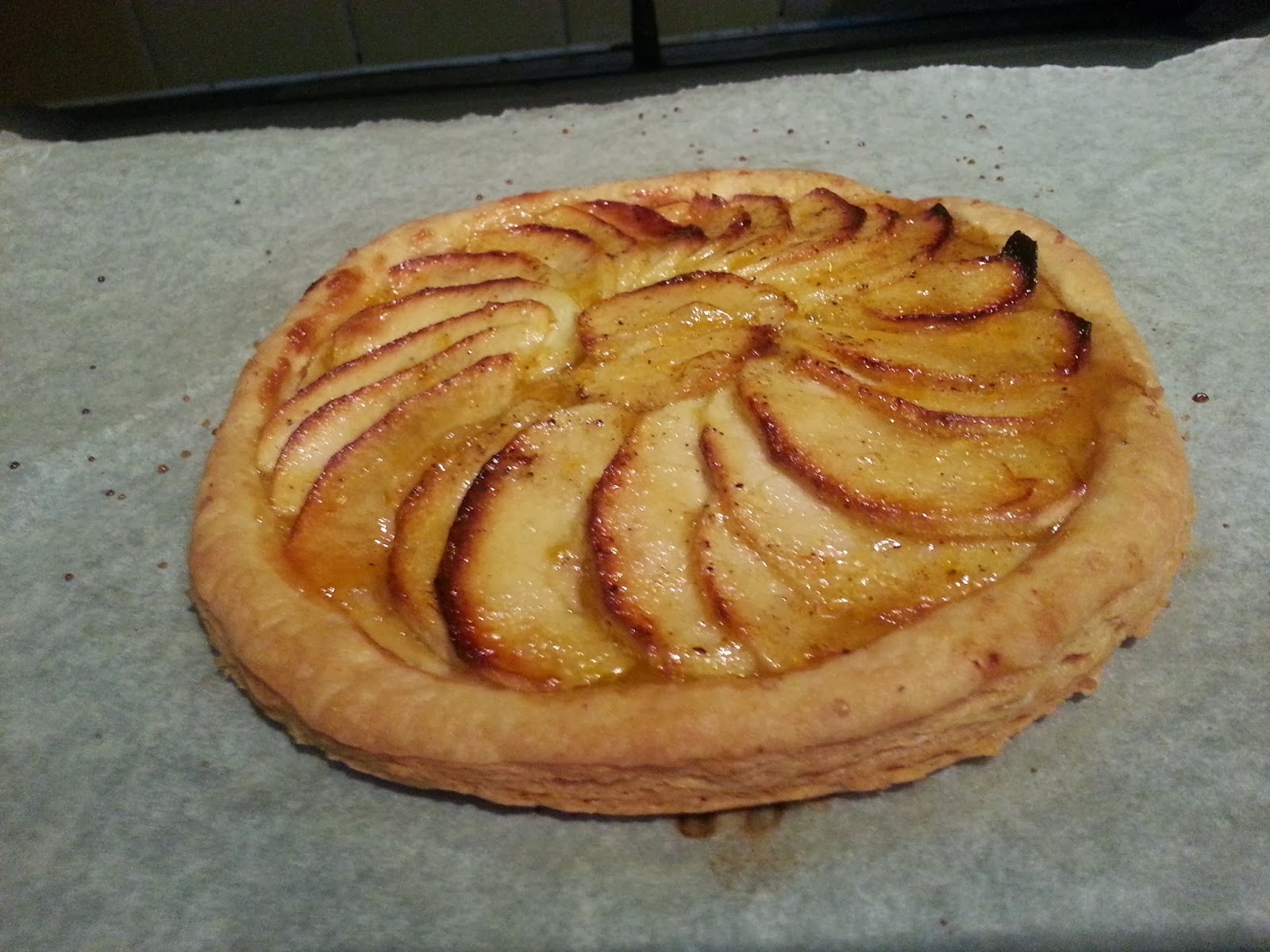
Chill for an hour (or freeze it) and it is ready to use. I used mine to make a couple of things. First was a nice crisp apple tart, glazed with brown sugar and apricot jam, and second was a nice pile of Eccles cakes. Lovely.
#384 Quick, Foolproof Puff or Flaky Pastry. Well, I have to say it was quick, and it wasfool-proof. In fact, aside for the rolling out that required some degree of precision, I would say it is easier than a shortcrust for a beginner: rubbing in is minimal, it won’t be too dry and it won’t be over-worked. Why did I put this off for so long? It has already become part of my regular repertoire and I shall be using it in the amuse bouchefor my next pop up restaurant in November. Great stuff, delicious, crisp and rich 9.5/10.


#383 Spiced Redcurrant Jelly

Redcurrant jelly is such an English sundry. Delicious with roast lamb, an essential ingredient in #45 Cumberland Sauce and venison sauce, and a great addition to a ham glaze.

A couple of things are interesting here: first the spice, and second the addition of vinegar. Jane likes adding tart vinegars to here sweet preserves that are used in savoury dishes. It was a revelation when I first came across it, making #367 Hot Red Pepper Jelly, which I was so impressed by I’ve been making it for the market stall.

In the past it has been difficult to get hold of redcurrants in grocers and supermarkets, but this year they seem to have been everywhere. However, I was prompted to make this jelly when I spied a heavily-laden redcurrant bush nestled among a load of 5-foot high weeds in an unruly corner of a vacant plot next to my allotment. How there was so many with all that competition from the weeds I do not know. Naturally, I had forgotten my phone, so I couldn’t photo it. I picked just a fraction of what is asked for in the recipe, but it is very straight-forward to scale down (or up).
Pick over 3 pounds of redcurrants, no need to remove stalks and leaves, and pour into a preserving pan, large saucepan or stockpot along with 1 ½ pints of water, 3 cloves and a teaspoon of ground cinnamon. Turn up the heat and bring to simmering pot and allow it cook until the currants have softened enough to burst open. Strain through a scalded jelly bag and allow it to slowly drip through into a clean bowl overnight.
Next day, pour the strained spiced juice into a clean pan with 3 pounds of granulated sugar and 8 ounces of malt vinegar. Put on a medium heat and stir until the sugar has dissolved, then turn up the heat and allow the jelly to boil for around 10 to 15 minutes before testing for a set. To do this put a few drops on a cold saucer and allow it to cool. Push the jelly with your finger, if it wrinkles, it has set, if not, boil for a further 10 minutes and check again. Alternatively, you can use a jam thermometer – a temperature of 105⁰C is the magic number.
Don’t worry about the scum, it’s easily got rid of
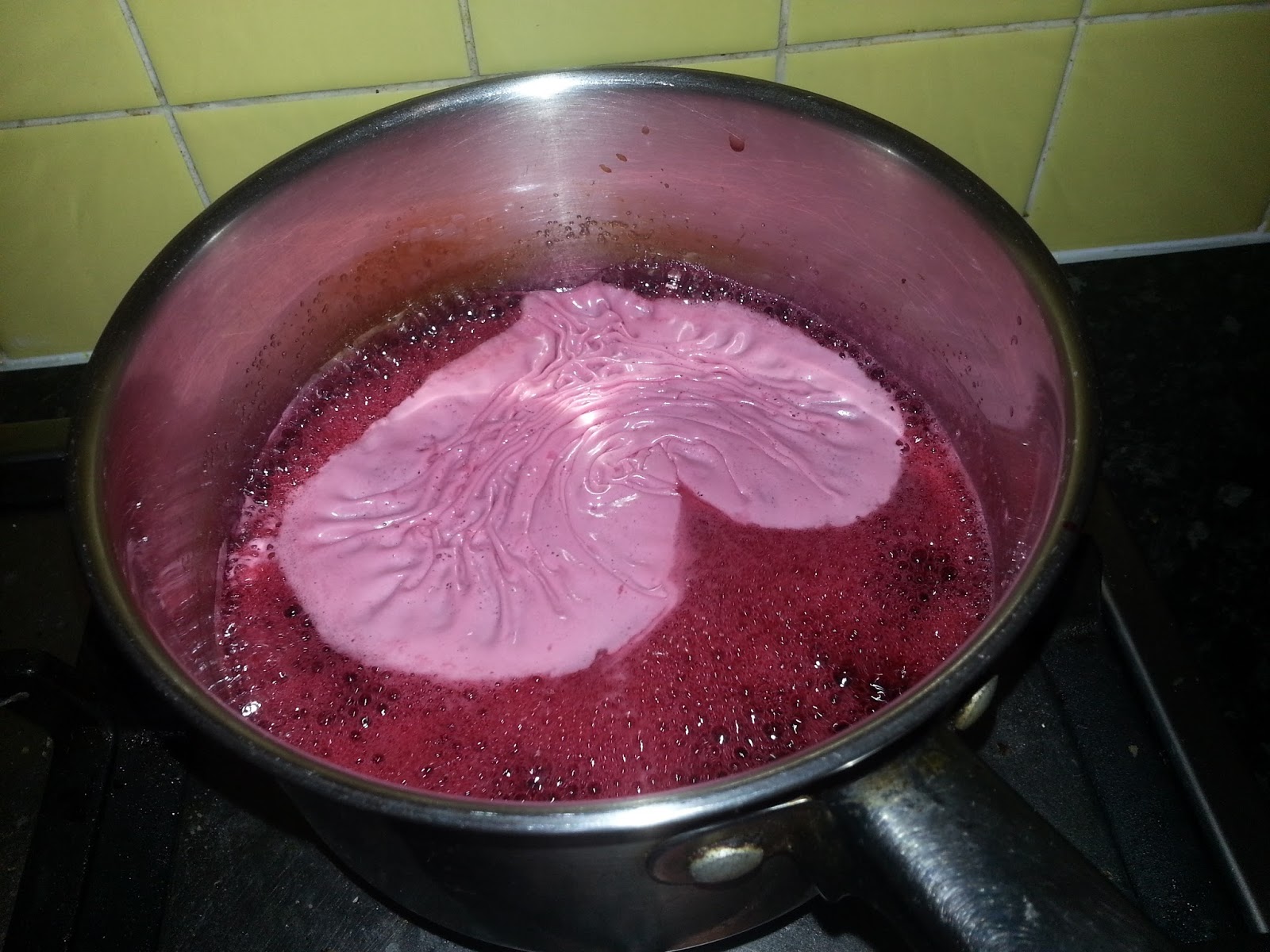
Let the jelly cool for 10 minutes and remove the scum either with a spoon or by beating in a small knob of butter until the froth dissipates. Pot into sterilised jars.
#383 Spiced Redcurrant Jelly. This is very good indeed. It has a pleasantly sweet and sour tang and is the most beautiful ruby colour; nothing like the bought stuff at all. I used it to accompany some lamb chops one day, and used it to make some lamb gravy on another. The sad thing is that now I have to until next summer to make some more! 8.5/10

#382 Laverbread as a Sauce

The third in a laverbread trilogy… the first post #352 Laverbread and Bacon tells you a little more about the mysterious iodine-tanged, deep-green gelatinous goo. Thanks to Jane Grigson it is goo I have grown to enjoy very much, and something I would never have tried had I not undertaken this project. Whenever I visit Wales I always come back with a tub of the stuff. Cheers Griggers!

This is a very quick and easy recipe that cleverly uses the flavour of orange to cut through and temper the very rich seaweed. It goes with roast lamb, ‘especially roast lamb and new potatoes’. It also goes with most fish; in Wales it is often eaten with cockles. Jane says that a hotelier friend of hers served it with lobster and it was ‘a most successful combination’.
Heat up 8 ounces of laverbread with the grated zest and juice of an orange, then season with lemon juice, salt and pepper. That’s it!

#382 Laverbread as a Sauce. This was a delicious sauce that was much lighter and more accessible than the sauce in #353 Roast Rack of Lamb with Laverbread, which was not for the faint-hearted. Lovely and light, I give it 7.5/10.

#381 Baked Gooseberry Pudding

I don’t know; you wait four years for a gooseberry recipe and then two come along at once. This year’s season for all soft fruits seems to be never ending, so there might be a third one yet…

The gooseberry is a strange fruit, isn’t it? It’s as lovely and tart as rhubarb, and yet very few people eat it, and it is seldom ever seen at all in countries like the USA or France. It is certainly a very British fruit. Jane Grigson points out in her Fruit Book, that the French don’t even have a name for it, or rather, a name that distinguishes it from a redcurrant. What is really interesting is that neither do we! You see, the goose-part of gooseberry has nothing to do with geese, because it comes from the French groseille, which means red currant, and that ultimately comes from the Frankish word krûsil, meaning crisp berry. Don’t say I don’t never teach you nuffink.

This is a straight-forward pudding indeed. It is a ‘good homely pudding to make when gooseberries first come in’, says Jane.

Start off by melting together 2 ounces of butter and 4 tablespoons of soft dark brown sugar in the bottom of a flameproof soufflé dish – if you don’t have one (as I don’t), melt them in a pan and then tip the resulting mixture into the dish.
Arrange enough topped-and-tailed gooseberries in the dish then spread over one batch of pound cake mixture (for the recipe, see the post #47 Pound Cake from all the way back in 2008!). Of course, you can use other fruits: I would imagine that halved apricots or sliced Cox’s orange pippins would work very well.
Bake at 180⁰C (350⁰F) for an hour.  A little before the hour is up, sprinkle over some granulated sugar and return the pudding to the oven.
‘Serve with plenty of cream, and put a bowl of sugar on the table in case the gooseberries were especially tart.’

#381 Baked Gooseberry Pudding. This was a great pudding! The layer of tart gooseberries was balanced well by the sweet cake topping that had developed a lovely dark, caramelised crust. A million times better than Eve’s pudding! 9/10