#148 Venison Sausages

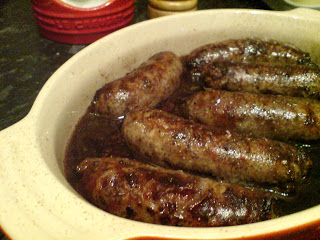
Contrary to what you may think; I am not a big meat eater – I’m just not picky! However, I’ve been having a hankering for meat recently, not sure why. Anyways, at the butcher, I spotted some venison sausages that looked very fine indeed so I bought them. They turned out to be from Lyme Park not too far away from me in the Peak District, so the old food miles were happily reduced. Venison sausages are available pretty much anywhere, but a word of warning people – venison from supermarkets probably won’t be British. Supermarket venison usually comes from big deer farms in New Zealand. It’s not bad meat; it’s just flown a long way! Buy yours from your local butcher to get local venison.

This is what the Lady Grigson says to do with your venison sausages:

Fry them in lard or oil very quickly so that they develop nice dark stripes and arrange them closely in a shallow oven dish. Pour in enough red wine to come half-way up the sausages and season them. Bake in a hot oven – 200°C – for 15 minutes. Serve them with mashed potato and some seasonal greens – she says Brussels sprouts and chestnuts, but as it’s Maytime, I plumped for green beans. Pour a little of seasoned wine over the sausages if you like.


#148 Venison Sausages – 7/10. A great way to cook special sausages of any kind I reckon. I’m not giving an excellent score because the venison sausages were good, but not the best ones I’ve ever had. However, the red wine did improve the flavour a lot. The most important thing was that it scratched my red meat itch. The best thing about the whole thing was the fried mashed potato sandwiches I made the morning after. You must try it – fry patties of left-over mash in lard until a crispy crust develops, turn them over and put them in a buttie with brown sauce.

#147 Devilled Chicken Livers

A cheap treat. I love chicken livers, yet so many people seem to turn their noses up at them – I suppose it’s because it’s offal and folks are squeamish. It is silly though, since they are the main ingredient in pate. Any road, any local butcher should sell them very cheaply – I bought 250 grams for about £1.20 and they were prepared too, which reduced the amount of faffage later. If you buy them – do check they have had their bitter green fall bladders removed or the food will be ruined. This recipe appealed to me because of its simplicity, but also because of its ‘devilled’ (i.e., spiced) nature – a very Victorian way of cooking things (eggs and kidneys spring to mind). Devilling seems to be having a resurgence recently – the day after I cooked this, some chef on The Great British Menu competition that’s being shown on the BBC cooked devilled crab claws. Hopefully it will get popular again.

Have a go at this – it’s enough for 4 people as a starter.

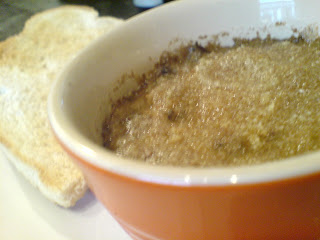
Finely chop a medium-sized onion and fry it in 2 ounces of clarified butter gently. Whilst you wait for the onions to soften, chop up 8 ounces of chicken livers roughly, raise the heat and fry the livers quickly, do this for only 2 minutes, 3 at the most. This is why clarified butter is required – it doesn’t burn when you heat it as the ‘butter solids’ have been decantered off. I made my own by melting some butter gently, skimming off any scum from the top and decanting and solids away that had sunk to the bottom. Take the livers off the heat and add 2 teaspoons each of Worcester sauce and Dijon mustard, Cayenne pepper, 3 tablespoons of breadcrumbs, ¼ pint of whipping or double cream, and finally some salt and black pepper. Mix well and check your seasonings. If you like you devil a spicy one add more – I did! Divide between 3 or 4 ramekins and sprinkle with more breadcrumbs and melted butter. Bake at 190°C for 15 minutes and serve with toast.


#147 Devilled Chicken Livers – 9.5/10. I may change this to a 10/10 as it was a perfect starter. Absolutely delicious – the devil was fiery yet it was perfectly tempered with the cream and breadcrumbs. The big strong flavours had no chance of drowning out the rich creamy chicken livers. Brilliant stuff. I haven’t stopped thinking about since I made them, and my stomach is rumbling as I type. This is definitely a Grigson classic!

#146 Asparagus with Melted Butter

Does anyone know if Britain has had an asparagus shortage this year? I’ve looked high and low for days and not found any from the UK, most are from Peru and the nearest were from Catalan. Then, I happened upon some in Asda of all places. I love asparagus, but refuse to eat the important stuff – aside from its flavor, the reason it’s special is because it is such a short-lived treat. I don’t want to eat it all year round. Griggers didn’t agree, it seems, and scoffed it whenever she could get her mitts on some.

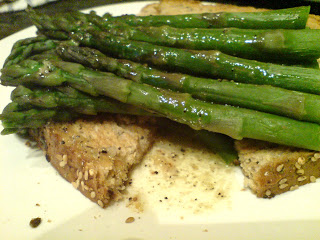
There’s no other way of enjoying this excellent vegetable – simply steamed with butter. The only addition I’ve made is a serving it on a slice of toast to turn this from a starter to light supper dish.


You will need at least 10 stalks per person – or more if you have those delicate thin fronds. Trim away the woody ends by cutting or snapping them off and tie the stalks up with string. Stand the asparagus in a saucepan with an inch of boiling water seasoned with salt and pepper. Cover the pan (or make a dome with foil if your pan is not deep) and simmer until tender and cooked – anywhere between 10 and 20 minutes depending on thickness. Alternatively, cook them in an asparagus kettle or steam them. Meanwhile melt an ounce of butter for every serving and season it with salt, pepper and a squeeze of lemon juice. Lay the asparagus on a plate and pour over the butter or serve it in a separate jug.

FYI: Asparagus is famous for producing smelly wee – though some people haven’t made this observation. This isn’t because their urine hasn’t taken on the smell, but that they lack the specific receptor in the nose that detects it. It is all down to one particular recessive allele of a gene – if you have both copies of the allele, you won’t be able to smell your sticky asparagus wee – but everyone else will! Nice.

#146 Asparagus with Melted Butter – 9.5/10. This is pretty hard to beat – the bitter-sweet asparagus with the rich salty and tart lemon butter are a marriage made in heaven. I could eat this forever.

#145 Singin’ Hinnies

This is a teatime treat that I’ve been wanting to make for ages – Griggers really bigs this one up, as does her daughter Sophie. Singin’ Hinnies hail from the North East of England around Newcastle and are regarded one of the best of the griddle cakes, apparently. Everyone, no matter how rich or poor, ate them at teatime or parties. If you were lucky, you’d find a shiny sixpence inside. Health and Safety would have a field day. Singin’ Hinnies sing because of the fat content – the lard and butter make a rapid sizzling noise. The word ‘hinnie’ is a colloquialism meaning honey, a term of endearment equivalent to luv or duck.

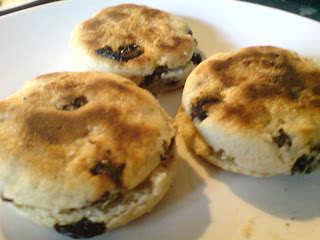
To make the Singin’ Hinnies rub 4 ounces of butter and 4 ounces of lard into a pound of flour that has been sifted along with ¼ teaspoon of bicarbonate of soda, ½ a teaspoon of cream of tartar and half a teaspoon of salt. Stir in 6 ounces of currants (or raisins or sultanas) and finally make a firm dough using a little milk (how firm? I don’t know – but mine rather like pastry). Roll out the dough and cut out into rounds of around 2 ½ inches (how thick? again I don’t know, but I did about ½ an inch). Grease a skillet or griddle pan with some lamb fat tat’s been “speared with a fork”. I happened to have some, but if you don’t, I’m sure you could use lard. Cook the cakes until they pick up brown spots, turn them over and cook the other side. When cooked (how long? I don’t know!), open them up and add a small knob of butter to each one and keep them warm in the oven whilst you cook the rest.

#145 Singin’ Hinnies – 4/10. Disappointed with this one. I’m not sure if it was me making them incorrectly, but they were either too dry due to overcooking or too squidgy and raw tasting the middle. The currants prevented them from being inedible as did the glug of maple syrup I added too!

#143 Boiled Leg of Mutton (or Lamb) with (#144) Caper Sauce

When Jane Grigson wrote English Food in the 1970s, she complained – quite rightly – that the general quality of lamb in England had declined rather. This was mainly due to the importation of cheap New Zealand lamb, which rendered mutton almost obsolete. These days things have changed and British lamb in a staple even in supermarkets and mutton is having a well-deserved comeback.

I popped into Manchester City Centre at the weekend and, by chance, the monthly farmers’ market was on so I had a little browse around the stalls and bought myself a leg of lamb from Bowland in Lancashire – a farm that outdoor-rears lamb, beef and pork. Here’s their website. The man at the fruit and veg stall spotted my purchase and commented that the best meat he’d ever had was from there. Great stuff. Now all I had to do was decide what to do with it and went for the boiled leg of lamb with caper sauce – mainly because it requires very little effort, but also because it is a very Victorian way of cooking meat and wanted to try it.

It’s well worth mentioning that caper sauce is also traditionally served with fish too, so if you’re a piscitarian, or whatever you fair-weather vegetarians like to call yourselves, you can try it with salmon or skate.

The original recipe asked for either a leg of mutton or of lamb – if you are to use lamb as I did, get hold of a real free-range one, otherwise it won’t stand up to the boiling.

Trim the leg of any large amounts of fat if it hasn’t been already and place the leg in a large pot with enough water to cover it. Add stock vegetables – 3 quartered carrots, 2 quartered parsnips, one quartered turnip and three whole onions (all peeled) – plus a very good seasoning with salt and pepper. Bring to the boil and turn down to a very low simmer and leave for 2 to 2 ½ hours depending upon size. Don’t dare to throw the stock away – use it make the caper sauce and with the leftovers, a soup (I did lamb and mint soup).

Whilst it is cooking you need to make a turnip puree as an accompaniment – also traditionally Victorian. Peel and slice 3 pounds of turnips and boil them in salted water until tender. Puree them in a blender, return to the pan and then whisk an ounce of butter into them. Next mix ¼ pint of double cream with a level tablespoon of flour and whisk this into the sauce. Cook the sauce until it thickens up slightly.

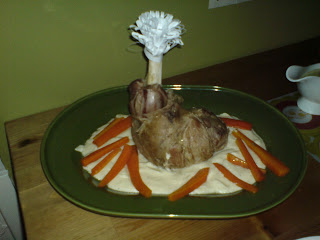
When the meat is cooked, remove it from the water, place it on a serving dish flat-side down and make a paper ruff (yes, a paper ruff!) to fasten around the shank for decoration. Spoon the turnip puree around the outside and scatter the quartered carrots over the puree.

Loving the ruff!
Serve it with caper sauce that has been made using the stock from the lamb.

For the sauce melt ½ an ounce of butter in a small saucepan and stir in a tablespoon of flour. Cook and stir for a few seconds before adding ¾ pint of the lamb or mutton stock (or indeed fish) bit by bit to avoid getting lumps. Simmer until it is the thickness of single cream. Season with salt and pepper and add an egg yolk that has been beaten with 2 tablespoons of cream and stir for a minute or two. Lastly add a generous tablespoon of drained and rinsed capers and ½ a tablespoon of chopped parsley. Serve immediately, says Griggers.

Sorry about the shite picture!

FYI: If you are looking for an alternative to capers – the flower bud of an Asian shrub, you can try using the buds of nasturtium, buttercup or marigold. I’ll stick to the original, though I think.

#143 Boiled Leg of Mutton (or Lamb) with (#144) Caper Sauce – 7.5/10. I really enjoyed this meal. It was so easy to cook, you could not go wrong with it, even if you’ve never cooked anything before in your life. The lamb was tasty and moist and not fatty as most of it had dissolved into the stock – I’m definitely going back to Bowland for my meat. The turnip puree was rather odd – unsurprisingly, it was quite bland and I suppose they were the bland carb element. I would’ve preferred mashed potato though. It’s very hard to mark the caper sauce separately as it is part of the dish. I really liked it – it was piquant and married with the lamb perfectly. The only way it could have been improved would be to chop the capers up first so that the sauce was very capery indeed!

#142 Ballymaloe Fruit Tarts

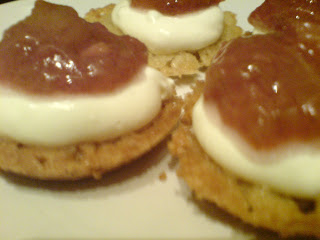
As Grigson says in her entry for this recipe – “in no way are these English”. Seeing as they’re obviously Irish; a recipe from a lady called Myrtle Allen who lived/lives in Cork (I wonder if she’s related to Rachel Allen?), but came up with it in France, I’d be inclined to agree. However, as you’ll see if you make them, they seem quintessentially English – the whipped cream, the chewy ground almond base and, most importantly, the use of seasonal fruit. One fruit on my seasonal list for May is rhubarb. However, there’s no rhubarb recipe in the book, at least not specifically rhubarb. This seemed like the only opportunity to use it. You can of course use any fruit: “During the first part of the year, top them with chunks of lightly cooked pink rhubarb, next come gooseberries, then the wild possibilities of the full summer…”.

FYI1: If like me, you love rhubarb, don’t make a habit of eating too much of the green rhubarb as it causes kidney and bladder stones due to the oxalate contained in the green areas – it dissolves in the blood no problems but in large amounts precipitates once it’s been filtered by the kidneys.

FYI2: All of the pink forced rhubarb in Britain comes from West Yorkshire – the rhubarb triangle. It’s a triangle because all farms are located within the triangle that Leeds (my home town), Branford and Wakefield make up. Read about it here.


This is a very easy recipe; summery and light, just right to finish off the skate salad I had made. For the base you need ground almonds, caster sugar and lightly salted butter all in equal amounts. Griggers says 4 ounces of each, but I went for 2 ounces of each seeing as there was just me and Butters to feed. This made 12 little tarts.

Preheat the oven to 180⁰C. Cream together the butter, sugar and almonds and place teaspoonfuls of the mixture into a small tart tin. Bake for 10 minutes, maybe more, maybe less; what happens is magical – the blobs of mixture spread out to form perfect little tart bases that are cooked once they are rimmed with golden brown. Take them out of the tins when they’ve cooled a little bit with a butter knife or a teaspoon and allow to cool and harden on a wire rack. Don’t leave them in there too long or they’ll stick to the tins. Now whisk some cream, and a little sugar if you like, and place a teaspoon of it in the tart case and some of the fruit on top. (For the rhubarb, I stewed it lightly with some sugar and a vanilla pod.)

#142 Ballymaloe Fruit Tarts – 7.5/10. Really simple and delicious. The base is chewy and the topping, light. Even if you don’t bake these sorts of things, have a go at these – you get a lot of return for little effort.

#141 Warm Skate Salad with Shaun Hill’s Dressing

Another fish dish. Skate is one of my favourite fish and liked the idea of having it in warm salad – perfect for this time of year when the weather is often bright and sunny but will a chill still in the air. Classically, skate is poached or fried and served with either a beurre noisette or capers, so I thought having it in strips with warm vinaigrette would be a new thing that might jazz up this tasty, though bland, fish.

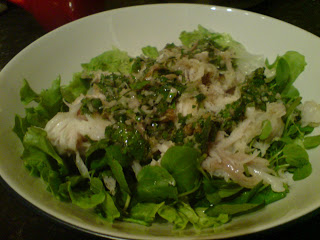
Start off by preparing your skate wings (one per person). Rinse each one under the tap or soak in a change or two of water – take heed of this advice, this gets rid of the taste of ammonia found in fresh skate. I didn’t know this, even though I’ve cooked it many times, it’s never been ponged of ammonia. However, this time it was different (for one of us anyway!). Dry the wings and fry them in a little olive oil until cooked through – a few minutes a side, you can tell they’re cooked as the flesh starts to raise itself up from the cartilaginous bones. Whilst you are waiting, wash and dry some green salad leaves (I used watercress to be seasonal) and place a pile of them in the centre of each plate.

Now make the dressing. Set up a bowl over some simmering water. Add three tablespoons of fish stock and around 6 tablespoons of olive oil to the bowl. Chop up a handful of parsley leaves with a shallot and a small clove of garlic. Add this and season with salt, pepper and lemon juice.

Remove the cooked skate from the pan and strip the meat of the wings with a fork. Pile the stripped fish on the salad leaves and sprinkle the whole thing with the dressing. Do this for each plate. Serve immediately.


FYI: Shaun Hill is still a chef, working at The Walnut Tree Inn in Wales. Here’s an article about him.

#141 Warm Skate Salad with Shaun Hill’s Dressing – 5/10. What a weird dish this turned out to be. None of the ingredients were bad , they just didn’t do together. The skate was nice and moist and gelatinous, but it’s delicate flavour was completely drowned out by the dressing with its strong garlic, shallot and olive flavours –delicious that it was. The ammonia was a cause for concern – it obviously doesn’t happen every time one cooks it, otherwise I’d have noticed before, but it’s worth bearing in mind in the future. Overall, I prefer my skate the old-fashioned way… Skate was very popular, but recipes like this won’t be doing it many favours in making it popular again.

#140 Crab Tart

I’ve mentioned before that a much ignored chapter in English Food is the Fish chapter (I must tell you what the chapters actually are, so you know where the seemingly random recipes fit). The fish that are in season during May and are in the book are salmon and crab. A quick phone call to Butters to help me decide which fish/crustacean to try first was required – I’ve never cooked with crab other than tinned, and salmon isn’t my favourite. We went for the crab. There’s a few crab recipes but this one seemed relatively straight-forward.

It seems the oceans were a much more plentiful place in the 1970s compared to now (though we knew that already!). The original recipe asks for a boiled crab weighing 2 pounds or one kilogram. Fat chance of that says the fishmonger, however I asked for the biggest one and it wasn’t too far off. It only cost a fiver! I was well happy there – a tiny tin of it cost about 3 quid. Bargin. In fact I noticed the fishmonger was stocked with loads of nice things at the minute…

Butters gets a crab infestation. Again

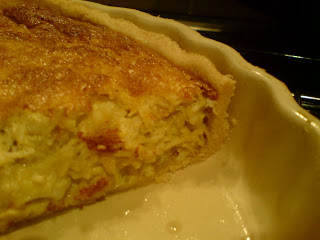
To make a crab tart, start off by making (or buying) some shortcrust pastry and lining an 8 to 9 inch flan or tart tin with it. Bake the pastry blind in a hot oven – 220°C – for 10-15 minutes. Do this by lining it with greaseproof paper or foil and pouring in some baking beans. For the final couple of minutes remove the beans so that the base can crisp and dry out a little.

Now you have to pay the boiled crab some considerable attention. It’s quite an arduous task but quite satisfyingly so. I won’t go through how to remove the meat here, but I’ll instead send you to this link to Deliaonline, which I followed and it did the job. In fact go to that website if there’s any techniques you want to reference. Once you’ve extracted as much meat as your patience will allow mix the white and brown meats together and season well with sea salt, black or white pepper and Cayenne pepper. Stir in one whole egg and two egg yolks (keep the whites) and 8 fluid ounces of whipping cream. Now add a tablespoon each of Cheddar and Parmesan cheese and stir in. Whisk the two egg whites until firm of peak and fold it into the crab mixture. Pour the whole thing into the case and bake at 220°C for 5 minutes and then turn the heat down to 190°C and bake for a further 25-40 minutes. The tart is ready when it has set and lost its eggy wobbliness.

Not the most photogenic of tarts, I know, but tasted lovely.

Griggers says to serve straight away with brown bread and butter, but to be extra-seasonal, I made a quick salad from rocket, sliced radishes, olive oil, lemon juice and salt and pepper. It went very well.

#140 Crab Tart 7/10. I really enjoyed cooking with and then eating crab. The brown meat dissolved into the cream and eggs making it deliciously sweet and moist and the white meat gave the whole thing good texture. The genius of the dish was the whisked egg whites, which lifted to so well. A definite success that really made me feel Spring is finally here! Great stuff.

Getting Seasonal

It’s tricky to choose recipes to cook when there are still so many to choose from in the book – plus, many ingredients are unknown to me, and because of a certain amount of trepidation I’ve ignored some. I have decided that the best thing to do here is to follow the seasons more closely (I try to do this as much as I can anyway). This means that anything new to me as a cook, should be in tip-top shape and therefore be much less likely to go wrong. At least that’s the theory. So, after a little bit of research on the internet, here’s a list of meat, fish, vegetables and fruits that are in season and/or at their peak in May. Not all are used in English Food, but I’ve included them for completeness. We shall see how many I can do this Maytime:

Lamb
Salmon
Sea trout
Sea bass
Crab
Beetroot
Cabbage (all kinds)
Carrots
Cauliflowers
Kale
Turnips
Samphire (I don’t know where I’m going to get thhis from! Help anybody?)
Asparagus
Jersey Royal potatoes
Watercress
Radishes
Rocket
Spinach
Spring onions
Cherries
Rhubarb
Elderflowers

Not quite the Good Life, but it’s a start…

Aside from a bit of baking to help me relax I’ve been attempting a little bit of gardening. I have no idea what I’m doing at the minute, but I’m aiming for two things: one, some kind of fresh produce for myself – though in very small amounts as my back yard is tiny; two, British flowers that will not only look nice but attract any passing wildlife that has dared enter darkest Levenshulme. I’m hopefully choosing plants that tick both boxes simultaneously. Thus far: rosemary, red basil, chives, leaf beet spinach, mint, marjoram, blackberry, raspberry and blackcurrant. I also plan to attempt some broad beans and maybe some peas too, as well as extra hard-to-get herbs like tarragon and chervil, plus some wild flowers too. All this should add up to a lovely little oasis in a sometimes miserable South Manchester.

Thus far only the red basil has germinated, I shall keep you posted. Has anyone got any tips or suggestion as to what else I can plant? It has to be something easy to look after that takes up little space. Any comments are very welcome. Ta!