#195 Canapes a la Creme

The entrée for the dinner party. It’s one of those recipes that I’ve never got round to because – frankly – it’s never really seemed that interesting and a bit of a rigmarole to produce (there quite a few of these!). Grigson says that they are “[a] fine mixture of hot, rich, piquant and cold.” I don’t really know why this recipe is in English Food, I’m sure that there are other canapés in book Savouries à la Mode by Mrs de Salis she could’ve nabbed. Perhaps she chose this one because the ingredients are quite English. Anyways, here is the method, if you want to try and make some for yourself:

Cut some white bread in centimetre thick slices. Cut out circles and fry them in butter. Grigson doesn’t say how large they should be – I used a highball glass. Next put anchovy fillets on each slice – she says three, but that seemed excessive to me for the size of fried bread I’d cut out, so just added one. Finally add a spoonful of cold clotted cream to each canapé and serve straight away.

The canapes in production

#195 Canapés à la Crème. 3/10. They weren’t vile – all of the ingredients that go to produce this are among my favourite foods – they were just odd and uninspiring. There was not too much fattiness from the fried bread and cream, and the anchovies were too much (it’s a good job I didn’t add three!). I think they could’ve been improved if a cream cheese or crème fraiche mixed with chives as suggested on the night had been used rather than clotted cream. Still, they were easier to make than I thought – particularly when I had my army of sous chefs with me! Cheers guys.
#190 Finnan Haddock

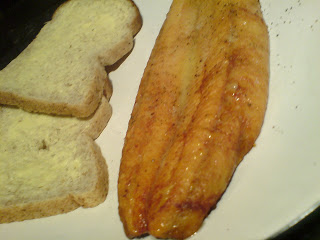
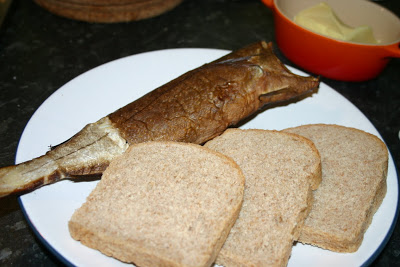
A bit of a cop out this one as it it’s not really a recipe, though it is listed as one in the book. It’s actually more a bit of advice on good eating. There’s many like this in the book. Here, Griggers discusses the dos and don’ts of buying Finnan haddock, which is smoked haddock. We call it Finny haddock in Yorkshire. Findon, or Finnan is a small coastal village near Aberdeen in Scotland. It is there where the proper stuff is made. Griggers warns us of buying those ‘golden fillets’ that are that weird shiny orange colour like cheap sweaty spray-on tan, which I suppose it is but with added smoke flavour. Splarf. My mum used to buy them and they are vastly inferior to the proper stuff. There have been a few recipes so far in the book that has used Finnan haddock, and I think that I have mentioned all this before. However, if you want the really good shit, it is Arbroath that you need to travel to. There, Arbroath smokies are made. As I was in the fishmongers buying some prawns (see a later entry for what I wanted those for) there some were, just lying there. So I bought one, as you have to be opportunistic in this game.

So the recipe? “Heat briefly under the grill or in the oven, and eaten with plenty of butter and bread, or used for kedgeree.” So a brief grilling it was for my little smokie.


#190 Finnan Haddock. If you ever see those little Arbroath smokies in the fishmongers you have to buy some. The flesh was so succulent and sweet due to its protection by the now leathery skin, and the smoke flavour was nothing like anything I’ve tasted before: it was as though it had only just been taken out of the smokehouse and slipped onto my plate. The smoke flavour was sweet and acrid, not unlike a good cigar. Excellent. 8/10. If I catch any of you buying a golden fillet, I will come over personally and poke you in the eye with it.

#184 Kedgeree

The thrifty cooking is going well – Charlotte and I having been very shrewd. However, when it comes to Sunday dinnertime, I did want a nice big hearty (and pricey) roast. Instead I went for kedgeree. I don’t recall ever having eaten it before, even though I knew exactly what is required to make it. I had high hopes for it: curry, eggs and Finnan (smoked) haddock. What can’t be good about that!? It used to be a breakfast dish, but these days it’s eaten for dinner or tea.

I have been researching the origins of kedgeree, and there seems to be two differing stories: the Scots reckon that it hails from there, and when the lovely British Empire decided to pop over to Asia and add India to its collection, the Scots brought it over too and the curry element was added. The alternative story is that the dish started in India, but then when colonialists came over, they added the smoked fish. I’m going with the latter story – the best evidence is the etymology of the word: kedgeri is the name of a similar Indian dish containing rice, lentils and eggs.

To make kedgeree, start off by poaching a pound of Finnan haddock in barely simmering water for ten minutes. You can use any good-flavoured cured fish, of course, for example kippers, smoked salmon or bloaters. Meanwhile chop a large onion and fry it in olive oil until it browns. Add a teaspoon of curry paste (I used Madras) and fry for a minute. Remove the fish from the water, remove its skin and flake the flesh, removing any bones. To the pan, stir in six ounces of long grain rice and when translucent add a pint of the poaching water. Cover the pan and let it simmer gently until all the water has been absorbed. Gently stir in the flaked fish along with a large knob of butter. Plate out the kedgeree and decorate with quartered hard-boiled eggs, prawns and chopped parsley. Serve with a lemon wedge and mango chutney.


#184 Kedgeree. This did not disappoint – the food was substantial and well-flavoured, but light. The combination of curry and eggs, and of smoked fish and eggs is great. Plus the extra addition of the lemon, prawns and mango chutney; not something I would normally associate with this dish really makes it special. This is a high-scorer – the only gripe (and it is a minor one) is the use of long grain rice, I am a Basmati man myself; it has a nutty flavour and doesn’t go as stodgy. 8/10.

#166 Smoked Salmon

Butters and I went to the Cheshire Smokehouse at the weekend and bought lots of good things: smoked nuts, smoked trout, bacon and – amongst other lovely stuff – smoked salmon. You may be wondering why I’ve left such a simple thing out for so long – it is simply because I don’t like the stuff. It’s one of the problems with this whole plan; what do I do if I don’t like the ingredients? As it happens, I went to Glasgow on a conference earlier in the year and tried some there and it was, unbelievably, okay. So I thought that if I’m to do this I need to try really good salmon, not cheapo crap from a supermarket.

It’s perhaps I little bit of a cop-out citing this as a recipe, but I’m including it anyway. Jane makes a good point about smoked salmon that are worth reiterating and it applies to any food, really: always by the best quality, even if that means you buy less of it; I think that this is particularly applicable to any meat, fish or dairy product.

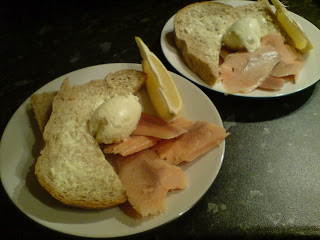
When you buy your smoked salmon arrange slices on a plate with brown bread and butter and some lemon juice. I added some capers and a little creamed horseradish, otherwise, that’s it. If you have a bought a side of salmon, use the trimmings for scrambled eggs or soufflés.


#166 Smoked Salmon – 7/10. After all these years, it turns out that smoked salmon is nice; I’ve just been eating the rubbish stuff! (Or I have expensive tastes.) It’s a simple concept – salmon, bread, butter and lemon juice, but that is really all you need. What have we learned: buy the best you can afford and do as little as possible to it to get the most out of it. Here endeth the lesson.

#105 Kippers

Charlotte and myself when to the bustling metropolis that is Stockport at the weekend to buy boots (Charlotte) and to take back a plane to B&Q (me). This is the exciting life we lead. Be jealous. One great thing about Stockport is its market. It’s very old and very good; the market hall has been restored and refurbished and it looks very nice. I wanted to go for one particular reason: sweets. There’s brilliant stall that sells all the sweets from your childhood: cough cops, pineapple cubes, midget gems, and pear drops. You name it; they got it. We bought enough to induce a diabetic coma. On the way back Charlotte pointed out the fishmongers, where we saw some lovely kippers. We’d not had kippers for breakfast for ages so we thought we’d get a couple.

There are three ways to cook your breakfast kippers according to Grigson:
1. Poach in shallow water for a couple of minutes, serve with knob of butter
2. Fry in butter, a couple of minutes each side
3. Grill a couple of minutes each side. Skin side first, then turn over and add a knob of butter.

I went for number three, as it’s my favourite way. Whichever way you do them, make sure there’s freshly ground pepper on them and brown bread and butter on the side.


FYI: kippers are the most recent of the cured fishes – the kipper cure was created for salmon, but was then later applied to herring, where it was obviously much nicer.

#105 Kippers – 8/10. It’s not very often I have a savoury breakfast, but kippers really are best thing, salty and rich they give you a boost you really need of a morning. I’m surprised to see how few people like them, bring them back, I say. They do repeat on you for the rest of the day, so don’t go on a romantic date that may later lead on to heavy petting. You have been warned.

#92 Smoked Trout

I bought some smoked trout from the Port of Lancaster Smoke House’s stall at Hoghton Farmers’ Market and was keen to try it. I was a little unsure about it, I have to say, as I’m not a huge fan of smoked salmon, and assumed it was going to be rather similar. Jane does say in English ooh, however, that smoking trout is the best way to eat it these days, as the trout you’re buying is (almost) sure to be farmed and therefore insipid in flavour. Smoking simply rescues it. I must admit, it have had trout before, and found it quite bland. It’s not everyday you see high-quality smoked trout so I snapped it up. The way to eat it, according to Griggers is very simple; a nice, quick light lunch or starter:

Make a horseradish cream with lightly whipped double cream and fresh or creamed horseradish to taste, plus a little sugar and lemon juice. Serve a fillet of trout per person, with a buttered slice of brown bread, a lemon wedge and some of the horseradish cream on the side.


FYI: if you buy fresh horseradish, don’t grate and freeze it to use later. I used frozen for this and there was absolutely no taste it. I have no idea why! I recommend you use creamed horseradish for this as you won’t need much of it.

#92 Smoked Trout – 7.5/10. Very tasty indeed; a pleasing cross somewhere between smoked mackerel and salmon. Everything went so very well together – the bread, lemon and cream. It’s a shame the cream didn’t taste of horseradish! Oh well, you live and learn – everyday’s a school day…

Fifty Grigsons Young – Kipper Paste

I didn’t realise that the kipper paste was my 50th Grigson recipe; if I had been on the ball, I would have done a feast. Never mind – when it’s the hundredth I’ll do something special.

I chose to do cook with kippers because not enough people eat things like kippers these days, and I hoped maybe people may be inspired to cook with them now I have. I remember thinking how foul they smelt as a kid when my mum used to eat them, but then when I tasted one, I couldn’t believe how sweet and piquant they were with out being horribly fishy. Also, kippers are cheap – even good quality ones should only cost about a quid each. Jane only has one proper kipper recipe, and it is kipper paste, a real Seventies dinner-party staple. I’d never had it, but I like that kind on thing.

Here’s what I did:

I covered the kippers with boiling hot water straight from the kettle and let them poach in the residual heat for 10 minutes. Next the skin and bones were taken off. This is not as laborious as it sounds; the fish is made up of longitudinal muscles, so you can peel strips of, as it were, and take the bones out as you go (you don’t need to removed the very thin hair-like bones – you wouldn’t ever notice they were there). These were allowed to cool slightly and weighed so than an equal weight of soft butter could be measured – it seems that one kipper equals around 100 grams. These were then carefully beaten in the food processor along with pepper, a little salt, some cayenne pepper and ground mace. Then the juice of half a lemon and a couple of table spoons of whipped cream were quickly mixed in (taste at this point – you might want more spices: they do make all the difference). The mixture was spooned into ramekins and a layer of clarified butter was poured over, and the whole thing was set in the fridge. Serve with toasted brown bread.

FYI: the kipper is the most recent of the cured fishes – fish were not split before hot-smoking, but left whole. All this was first done by a chap called Woodger in Northumberland. However, I happen to know that the best kippers can be bought in Whitby. However, because of stupid EU regulations, they cannot be posted to you, so you’ll have to simply drive there!

#50 Kipper Paste: 8/10. This dish should totally have a come-back. It is sweet and light, yet rich and salty. Really nice proper food. Go uot and buy some kippers this instant

#39 Finnan Haddock in a Mustard Sauce

On a visit to the Arndale Market earlier in the week on mission to buy something meaty, I found rather slim pickings! Maybe is was because I went the day after Easter Sunday, but there was little fish that appears in the Grigson’s book, and the game stall looked as though it may have closed down! I do hope not. Due to the lack of exciting ingredients, I plumped for old faithful: Finny haddock – or Finnan haddock as it appears it is really called.

It was quite an easy dish to prepare. The fish was poached gently in milk for 10 minutes that had already been brought to the boil containing cloves, bay leaf, a sliced carrot and a sliced onion. The fish was removed and kept warm. The milk was strained and used to make the sauce. The Grigson says to start with a roux of butter and flour and then to add the milk until a thin sauce is produced, which is then reduced. Be warned though, adding hot milk to a hot roux can cause lumps – use a whisk, but be prepared to sieve out any that shouls appear. Dijon mustard and seasoning was then added and poured over the fish. The whole thing was served with boiled potatoes turned in butter and parsley.

FYI: Finnan haddock, or haddie, originally comes from the Scottish village of Finnan near Aberdeen. Its IUCN conservation status is Vulnerable. However, stocks have been recently reported as increasing once more.

#39 Finnan Haddock in a Mustard Sauce – 8/10. I absolutely love Finny haddock, so I couldn’t go wrong with this one. I was a bit stingy on the mustard though – add more than you think is needed I’d say.

#10 To Make a Nice Whet Before Dinner

Yes, you heard! It’s from 1769, you know.

Simon came over and I did a 3 courser and this was the starter! Fried bread (in butter!), anchovy fillet, then grilled with a shed-load of Cheshire cheese on the top. That’s it. Quite possibly one of the most delicious (and fattening) morsels I’ve ever had – I know I keep saying these things on the blog…

Simon says:
The starters was as delicious as it was unhealthy. Butter-fried bread with anchovy fillet and Cheshire cheese. So simple, so tasty. We were drinking red wine but this dish would make a fine accompanyment to a good beer. 9/10

I say:

#10 To make a Nice Whet Before Dinner: 10/10. Delicious, simple, what can I say?? I’d eat it every day if my arteries could cope!