#133 Welsh Supper Herrings

After the creamy and rich oyster loaves last night, I thought I’d go for something a little bit more fresh-tasting and the Welsh Supper Herrings seemed to fit the bill. I chose herring because, like oysters, I’d never knowingly tried them except, of course, in the form of kippers. Herring are quite cheap as are most of the other ingredients so it didn’t break the bank. The odd ingredient here is the Bramley apple, but apparently it’s a traditional thing, herring and apple. First I’d heard.

Gut, clean, descale, behead and fillet a pound of herring – ask your fishmonger to do this, I tried to fillet them myself and was reasonably successful but was a bit of a ballache. Now mix an ounce of softened butter with a tablespoon of mustard made up from mustard powder (Why? Because Griggers says so, that’s why). Spread the butter over the cut side of the fish fillets and roll them up.

Next get to work on peeling and then finely slicing a pound and a half of firm potatoes – Jane recommends using a mandolin for this. Please, please, please be very careful here – I managed to slice a piece of my thumb off doing this last night so watch out. You have been warned. Don’t go suing me if you open a vein… Plunge the potatoes into boiling salted water for a minute she says – though I would do them for 2 or maybe even three (see below). Then slice a large onion and two Bramley (or other cooking) apples that have been peeled and cored. No need for the mandolin for those. Use a little more softened butter to grease a pie dish and make a layer using half the potatoes, then half the apples and half the onions, seasoning as you go with salt and pepper. Next, the rolled up herring fillets and sprinkle them with half a teaspoon of dried sage (Why not fresh? Because Griggers says so, that’s why). Then add the remaining apple, onion and potato, adding a brief painting on of melted butter to the last layer of spuds. Pour boiling water so it comes around half way up the dish. Bake for around half an hour until the potatoes are cooked.
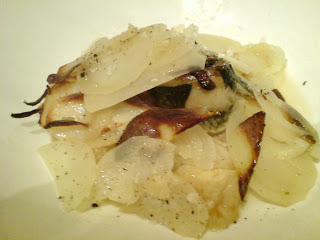

#133 Welsh Supper Herrings – 3.5/10. Not sure if this was a bad dish or a bad recipe for a good dish. The potatoes, apples and onions were very nice – the apples especially lifted it, but the potatoes were not cooked after half an hour even though I blanched them in the boiling water. They were done after an hour, but unfortunately this meant that the herrings had cooked down into a mush not unlike cat food. So pretty disappointing seeing as I almost sacrificed a digit for it. Hey-ho, such is the nature of this undertaking…
#132 Oyster loaves

One of the least-explored chapters in English Food is the Fish chapter. The main reason for this is that I have the least experience of the foods therein. Being English (I won’t say British as Wales, N. Ireland and Scotland may be different) means, generally, the only fish you get to eat is white fish – cod and haddock. Though I love the fish I’ve tried, one thing we have never eaten as a family growing up in Yorkshire is shellfish. The only exception is prawns because my Mum likes them. Because I’ve never really tried the bivalves – cockles etc., I find them tricky to get my head around them – they look like something from a biological specimen jar and do not resemble anything else that might turn up on the dinner table. I felt an inauguration coming on, and “why not” I thought, start at the top, with the king – oysters.

I popped on down to the Arndale Market in Manchester, got some rock oysters for 70p each and an oyster knife for a fiver from the cooks stall. Hopefully I’ll get to use it more than once…

I thought I’d better not go straight in at the deep end with a raw squirming oyster, but instead get there by degrees. First step – oyster cooked and smothered in some kind of sauce with lots of other flavours. Second step – oyster cooked but by itself. Final step – raw oyster. Griggers was there to help, natch, with this recipe straight out of the 1970s:

This recipe is per person, so multiply up depending on how many you’re cooking for:

Begin by heating your oven to 220°C whilst waiting for it to heat up, open 4 oysters with an oyster knife. This can be tricky if using large rock oysters with big gnarly shells, but with a bit of patience it’s quite easy to get the knack for opening them. Give them a rinse and a scrub under the cold tap first and make sure you hold the flat side of the oyster uppermost and with your grasping hand wrapped in a tea towel. Use the knife to prize the hinged back part of the oyster open. Do this over a bowl so you can keep any liquor that escapes – very important for later. I found that placing a sieve lined with some kitchen paper filtered away any sand or cracked bits of shell.

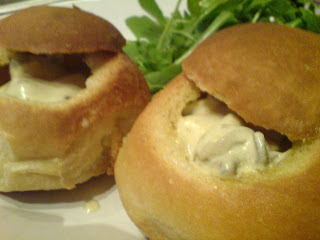
Now hollow out 2 bread rolls by first slicing the top off and then scooping out the centre, making sure you don’t make any holes in the side. Brush the lid and roll inside and out with melted butter – about ½ an ounce – and bake for 10 minutes until crisp and golden.

Meanwhile, melt another ½ ounce of butter in a pan and cook the oysters for around a minute and a half until they are opaque and firm. Remove them and cut them up into two or three pieces. Pour the oyster liquor into the pan along with 2 tablespoons each of double and soured cream, and season with salt, pepper and 3 or 4 drops of Tabasco sauce. Reduce it down to a thick sauce, stirring all the time, and warm the oysters through in the sauce. Check for seasoning. Lastly, divide the mixture between the hollowed bread rolls and serve immediately.

“Feed me, Seymore”

#132 Oyster Loaves – 7.5/10. I really enjoyed this. I’ve heard people say that oysters taste of ‘the sea’, or ‘ozone’ or iodine’; I’ve never been sure what they meant by that, but now I do! The oysters were sweet, rich and very soft and the piquant, yet creamy sauce really worked well. The idea of putting them in a hollowed bread roll might seem a bit naff now, but you could serve on a circle of bread fried gently in butter to make look more with the times. One would make a really good first course. I am very impressed with my first oyster adventure and would definitely encourage anyone who is squeamish about them to give this recipe a try – it simple and not expensive.

FYI: In days of yore, oysters were considered food for the poor and were largely ignored by the posh. They were used as a substitute for mushrooms (hence steak, kidney and oyster pie) in many dishes as they were very rare due to the fact no-one had worked out how to cultivate them. It wasn’t until they became scarce due to loss of habitat and pollution that they were thought to be a delicacy.

#105 Kippers

Charlotte and myself when to the bustling metropolis that is Stockport at the weekend to buy boots (Charlotte) and to take back a plane to B&Q (me). This is the exciting life we lead. Be jealous. One great thing about Stockport is its market. It’s very old and very good; the market hall has been restored and refurbished and it looks very nice. I wanted to go for one particular reason: sweets. There’s brilliant stall that sells all the sweets from your childhood: cough cops, pineapple cubes, midget gems, and pear drops. You name it; they got it. We bought enough to induce a diabetic coma. On the way back Charlotte pointed out the fishmongers, where we saw some lovely kippers. We’d not had kippers for breakfast for ages so we thought we’d get a couple.

There are three ways to cook your breakfast kippers according to Grigson:
1. Poach in shallow water for a couple of minutes, serve with knob of butter
2. Fry in butter, a couple of minutes each side
3. Grill a couple of minutes each side. Skin side first, then turn over and add a knob of butter.

I went for number three, as it’s my favourite way. Whichever way you do them, make sure there’s freshly ground pepper on them and brown bread and butter on the side.


FYI: kippers are the most recent of the cured fishes – the kipper cure was created for salmon, but was then later applied to herring, where it was obviously much nicer.

#105 Kippers – 8/10. It’s not very often I have a savoury breakfast, but kippers really are best thing, salty and rich they give you a boost you really need of a morning. I’m surprised to see how few people like them, bring them back, I say. They do repeat on you for the rest of the day, so don’t go on a romantic date that may later lead on to heavy petting. You have been warned.

#99 Baked Carp

Thank goodness for Britain’s lax laws on immigration, if we were a bit more like Australia we’d have no Eastern Europeans. ‘What does this have to do with the price of fish?’ I hear you ask (at least I would if you’re from Yorkshire). Well, your average Pole has a Christmas feast on Christmas Eve or a massive 12-courser on Christmas Day, either of which involves a baked carp. There’s only one carp recipe in English Food and I assumed, like most of the freshwater fish recipes, I would have to order it in especially, or even learn to fish. (FYI: I intend to learn to fish in 2009; a new skill instead of a resolution.)But what did I spot in the fishmongers in Manchester Arndale Market? Yup, a shed-load of giant carp. Thought I’d better snap one up before Johnny Foreigner gets hold of them all. If you see one, or even catch one, try this recipe; it’s an early Nineteenth Century recipe, apparently, so it’s the kind of thing that George III would’ve eaten, and there was nothing wrong with him!

Serves at least 6…

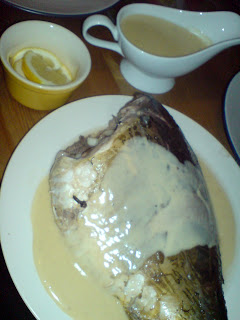
Choose a carp weighing around 3 pounds and ask the fishmonger to scale, gut and clean the fish* (and cut the head off, if you’re squeamish about these things). When you get home wash the carp in 6 tablespoons of vinegar dissolved in 4 pints of water. (Not sure why, may be to get rid of the slime – several freshwater fish produce slime). Whilst it’s draining, select a baking dish that will fit the fish snugly (to achieve this I unfortunately had to cut the head off). Smear the bottom of the dish with 6 ounces of butter and lay the fish on top. Season with salt and pepper, and add a quarter teaspoon each of mace, nutmeg and cloves, a bouquet garni (I did parsley stalks, bay and some pared lemon rind), a generous teaspoon of anchovy sauce and a chopped onion. Top up with dry white wine, so that the carp is almost covered. Cover with foil and bake at 200ºC for 40 to 50 minutes.


When done, put it on a serving dish and strain the cooking juices into a heavy based pan. Bring to the boil and allow to reduce slightly. Mash 2 ounces of butter with a tablespoon of flour and drop knobs of the mixture gradually whilst whisking to thicken. Once thickened, season with salt and pepper, add a squeeze of lemon juice and a little cream. Pour some sauce over the carp, and serve the rest in a sauceboat.

FYI: If you’re concerned as the potential damage to stocks of carp by this sudden increase of demand, the common carp is either farmed these days, or lakes are stocked with them. In fact they are considered a bit of an evasive species, so tuck in ladies and gents.

#99 Baked Carp – 7.5/10. I really liked this dish; I wasn’t really sure what to expect, I’ve not really eaten freshwater fish much (except for salmon, which I don’t like). I was very surprised at it’s subtly fishy and oddly gamey flavour. The very English mace-laced sauce was lovely. If you get the chance to lay your hands on one over Christmas, get it bought, though I’m not sure I’d replace my turkey with it!

*If you are lucky enough to have a fish with roe inside, ask the fishmonger to keep it aside, as you can make a stuffing with it – I didn’t get any, but it’s the look of the draw. Obviously I can’t comment on it’s loveliness, but have a go and tell me about it: Start by softening a small onion in butter. Meanwhile, mix an ounce of breadcrumbs with some milk to turn them to a paste. Mix the onions in along with the chopped roe, a tablespoon of chopped green herbs, a teaspoon of grated lemon rind and ½ teaspoon of anchovy essence. Season with salt, pepper and lemon juice. Stuff the fish with the mixture and sew it up.

#92 Smoked Trout

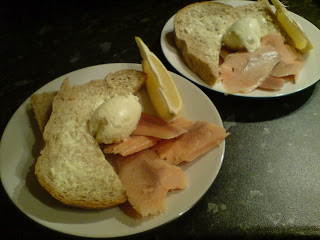
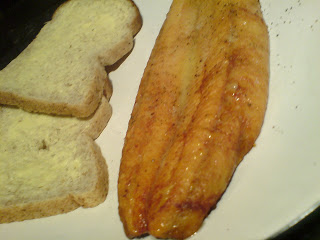
I bought some smoked trout from the Port of Lancaster Smoke House’s stall at Hoghton Farmers’ Market and was keen to try it. I was a little unsure about it, I have to say, as I’m not a huge fan of smoked salmon, and assumed it was going to be rather similar. Jane does say in English ooh, however, that smoking trout is the best way to eat it these days, as the trout you’re buying is (almost) sure to be farmed and therefore insipid in flavour. Smoking simply rescues it. I must admit, it have had trout before, and found it quite bland. It’s not everyday you see high-quality smoked trout so I snapped it up. The way to eat it, according to Griggers is very simple; a nice, quick light lunch or starter:

Make a horseradish cream with lightly whipped double cream and fresh or creamed horseradish to taste, plus a little sugar and lemon juice. Serve a fillet of trout per person, with a buttered slice of brown bread, a lemon wedge and some of the horseradish cream on the side.


FYI: if you buy fresh horseradish, don’t grate and freeze it to use later. I used frozen for this and there was absolutely no taste it. I have no idea why! I recommend you use creamed horseradish for this as you won’t need much of it.

#92 Smoked Trout – 7.5/10. Very tasty indeed; a pleasing cross somewhere between smoked mackerel and salmon. Everything went so very well together – the bread, lemon and cream. It’s a shame the cream didn’t taste of horseradish! Oh well, you live and learn – everyday’s a school day…

#91 Spicy Prawns

What makes these English, I do not know; other than a sort of nod to Maharajah days maybe. Anyways, I bought a huge bag of tiger prawns from W H Lung, the Oriental Cash and Carry near where I work for when I made Phat Thai for me and Butters at the weekend. I had loads left over, so I looked through the book and saw Spicy Prawns. I had all the ingredients in and it takes very little time to make. If you have spices at home, it’s a good one to do.

BTW: if you don’t, buy some spices in – they’re cheap as long as you don’t buy Schwartz spices; they are ridiculously overpriced. Go to an Asian supermarket. If you live in Manchester, Unicorn sells good value, organic spices. Also, buy your spices whole and grind them as you need them – the flavour is much better. Use a pestle and mortar, or as I do, a coffee grinder.

For two:
Peel (if you need to) and devein 8 ounces of raw tiger prawns. To devein, cut down the back of the prawn and remove the black vein running along its length. (FYI: it isn’t a vein, but the digestive tract and the black is the mud and God-knows-what else they’ve scoffed). Make a spice mix of ½ teaspoon of paprika, ½ a teaspoon of ground cumin, a ¼ teaspoon of ground ginger and a pinch of cayenne pepper, plus some salt. Heat a couple of tablespoons of olive oil in a pan and fry two chopped cloves of garlic. When they start to turn golden add the spice mix and fry for a minute. This is very important when cooking any spice – you need to fry them in oil at the start, otherwise they taste bland and raw. Add the prawns and fry for another two minutes, stirring them around so they get evenly cooked. Lastly, throw in a good few tablespoons of coriander leaves and cook for one more minute. Serve immediately.

Grigson says to serve with crusty bread or with saffron rice garnished with toasted pine kernels and fried onion slices. I went for the latter as you can see. To make saffron rice, you need to sprinkle in ¼ teaspoon of saffron strands to the rice when it is cooking. Use Basmati rice, fry it in oil for a minute before adding boiling water and some salt. The ratio by volume of rice:water is 1:2. Add the water, stir once, cover, and leave it on the lowest possible flame until all the water has been absorbed. Let it stand for a few minutes and fluff up with a fork. Perfect rice, every time!

FYI: I usually don’t eat prawns, but have fallen off the wagon recently. If you eat alot of them, try and cut down. Those that are fished are trawled up with huge trawlers that kill everything in their path. For every tonne of prawns fished, ten tonnes of sea life dies. If you buy farmed, it is not much better; most farms are built on mangrove swamps – a habitat we are already losing at a rate of knots. When I’m done cooking the Grigson recipes with prawns, I’m going only have prawns at special treats.

#91 Spicy Prawns – 7/10. Very tasty and quick to do. Brilliant if you can’t be bothered cooking but want something proper. The prawns were ready in the time it took to cook the rice. The oily spices were just right – very intense, but didn’t mask the subtle flavour of the prawns. The saffron rice helped this thing along with it’s slightly musky-sweet flavour. Of course, this is even easier if you just have it with bread. Great stuff!

Fifty Grigsons Young – Kipper Paste

I didn’t realise that the kipper paste was my 50th Grigson recipe; if I had been on the ball, I would have done a feast. Never mind – when it’s the hundredth I’ll do something special.

I chose to do cook with kippers because not enough people eat things like kippers these days, and I hoped maybe people may be inspired to cook with them now I have. I remember thinking how foul they smelt as a kid when my mum used to eat them, but then when I tasted one, I couldn’t believe how sweet and piquant they were with out being horribly fishy. Also, kippers are cheap – even good quality ones should only cost about a quid each. Jane only has one proper kipper recipe, and it is kipper paste, a real Seventies dinner-party staple. I’d never had it, but I like that kind on thing.

Here’s what I did:

I covered the kippers with boiling hot water straight from the kettle and let them poach in the residual heat for 10 minutes. Next the skin and bones were taken off. This is not as laborious as it sounds; the fish is made up of longitudinal muscles, so you can peel strips of, as it were, and take the bones out as you go (you don’t need to removed the very thin hair-like bones – you wouldn’t ever notice they were there). These were allowed to cool slightly and weighed so than an equal weight of soft butter could be measured – it seems that one kipper equals around 100 grams. These were then carefully beaten in the food processor along with pepper, a little salt, some cayenne pepper and ground mace. Then the juice of half a lemon and a couple of table spoons of whipped cream were quickly mixed in (taste at this point – you might want more spices: they do make all the difference). The mixture was spooned into ramekins and a layer of clarified butter was poured over, and the whole thing was set in the fridge. Serve with toasted brown bread.

FYI: the kipper is the most recent of the cured fishes – fish were not split before hot-smoking, but left whole. All this was first done by a chap called Woodger in Northumberland. However, I happen to know that the best kippers can be bought in Whitby. However, because of stupid EU regulations, they cannot be posted to you, so you’ll have to simply drive there!

#50 Kipper Paste: 8/10. This dish should totally have a come-back. It is sweet and light, yet rich and salty. Really nice proper food. Go uot and buy some kippers this instant

#39 Finnan Haddock in a Mustard Sauce

On a visit to the Arndale Market earlier in the week on mission to buy something meaty, I found rather slim pickings! Maybe is was because I went the day after Easter Sunday, but there was little fish that appears in the Grigson’s book, and the game stall looked as though it may have closed down! I do hope not. Due to the lack of exciting ingredients, I plumped for old faithful: Finny haddock – or Finnan haddock as it appears it is really called.

It was quite an easy dish to prepare. The fish was poached gently in milk for 10 minutes that had already been brought to the boil containing cloves, bay leaf, a sliced carrot and a sliced onion. The fish was removed and kept warm. The milk was strained and used to make the sauce. The Grigson says to start with a roux of butter and flour and then to add the milk until a thin sauce is produced, which is then reduced. Be warned though, adding hot milk to a hot roux can cause lumps – use a whisk, but be prepared to sieve out any that shouls appear. Dijon mustard and seasoning was then added and poured over the fish. The whole thing was served with boiled potatoes turned in butter and parsley.

FYI: Finnan haddock, or haddie, originally comes from the Scottish village of Finnan near Aberdeen. Its IUCN conservation status is Vulnerable. However, stocks have been recently reported as increasing once more.

#39 Finnan Haddock in a Mustard Sauce – 8/10. I absolutely love Finny haddock, so I couldn’t go wrong with this one. I was a bit stingy on the mustard though – add more than you think is needed I’d say.

#10 To Make a Nice Whet Before Dinner

Yes, you heard! It’s from 1769, you know.

Simon came over and I did a 3 courser and this was the starter! Fried bread (in butter!), anchovy fillet, then grilled with a shed-load of Cheshire cheese on the top. That’s it. Quite possibly one of the most delicious (and fattening) morsels I’ve ever had – I know I keep saying these things on the blog…

Simon says:
The starters was as delicious as it was unhealthy. Butter-fried bread with anchovy fillet and Cheshire cheese. So simple, so tasty. We were drinking red wine but this dish would make a fine accompanyment to a good beer. 9/10

I say:

#10 To make a Nice Whet Before Dinner: 10/10. Delicious, simple, what can I say?? I’d eat it every day if my arteries could cope!