#70 Cornish Pasties

pasty
When we all thought about going out for the day picnicking, the first thing I thought of making was a Cornish pasty; easy to make and easy to eat. The whole idea is that they are hardy. I’d never made one before, but knew that it was pretty straight forward…

Start off by making the pastry. Cornish pasty pastry should be made with lard as the only fat, apparently. Grigson doesn’t give much instruction on how to make pastry other than, fat and flour are to be used in a ratio of 1:2. To make two large pasties I used a pound of flour and 8 ounces of chilled, cubed lard. It sounds a lot, but these are big pasties! Start off by rubbing the flour into the fat, along with a pinch of salt. Use the tips of your fingers, or the appropriate attachment on your food mixer. I usually go for the mixer as it doesn’t make the fat warm up like fingertips do. Don’t be tempted to put the mixer on a high speed; use the lowest setting possible (see review, below). Let the pastry rest in the fridge for at least half an hour.

Meanwhile, chop up a pound of beef – use skirt, chuck, or as I did, top rib. Make sure all the fat and gristle is cut off. Chop a four-ounce onion, and thinly slice 3 ounces of turnip and 8 ounces of potato. Mix the vegetables and meat in a large bowl and season well with salt and pepper – do not skimp – plus a pinch of fresh or dried thyme.

pasty filling

Divide the pastry into two and roll one half to the size of a large dinner plate, pile in half the mixture in a line down the centre of the pastry circle, pull up the sides and crimp them together using water as glue.

pasty crimp
Place it on a baking tray and brush with egg. Repeat with the other half. Bake for 20 minutes at 200ºC, then turn down the oven to 180ºC for a further 40 minutes.

#70 Cornish Pasty – 2/10. The first disaster of the project! I’ve given the recipe because I know what I did wrong – because I was making such a large amount of pastry, I tried to hurry it along by turning the speed of my mixer too high. The result of this is the fat didn’t form ‘breadcrumbs’, it softens too early and doesn’t get incorporated properly. If you are making it, heed my advice! It would perhaps make two lots of pastry, using half the required amounts of fat and flour. The filling was delicious , but the pastry turned into dust, I couldn’t even get them of the baking tray without them collapsing. Instead I ate the filling with a spoon, and threw the rest in the bin. I am going to try them again next week.*
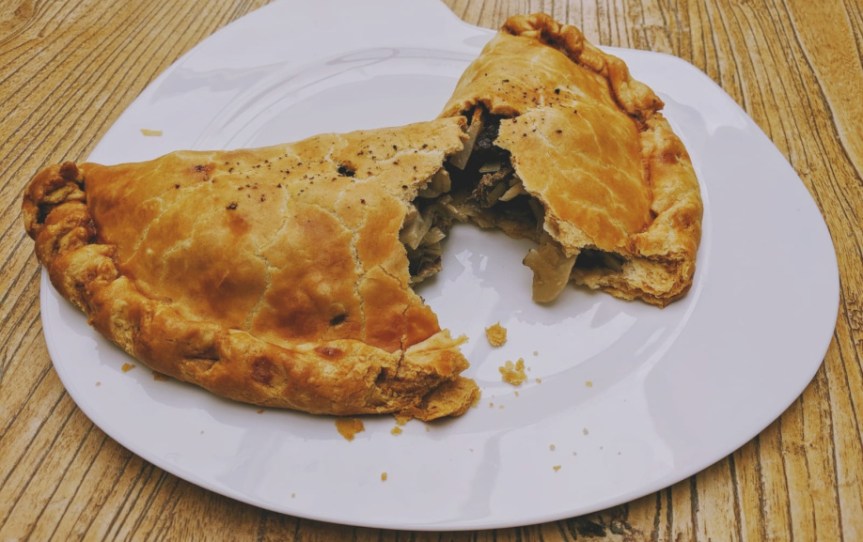
pasty baked

*and I eventually did and that’s what the photos are of – just to prove they can be made properly! Neil – August 20202

#44 English Game Pie, #45 Cumberland Sauce


I invited Clive from work to help me finish off the last of the game I got from Bury Market last night in the form of (#44) English Game Pie. Looking through the ‘Stuffing, Sauces and Preserves’ chapter of English Food for something to go with game, I found (#44) Cumberland sauce. I’ve never had it before, and had no idea what it was. Everything was straight-forward, though the pie had lots of preparation. Anyways, here’s what I did…

The day before I simmered a brace of pheasants and a pigeon (essentially everything I had!) in a very light chicken stock along with a good seasoning and a bouquet garnei of parsley, bay leaves and thyme springs. Jane recommends between 2 and 4 birds. It took an hour and a half for the meat to become tender enough for me to pull the meat from the bone with relative ease. I cut the meat into chunks and kept them in a sealed tub topped up with the stock so it didn’t dry out over night and reserved the remaining stock.

Next day I arranged the meat in one large dish, and a smaller, as I made an extra one for my PhD supervisor too. Then hard-boiled and quartered three eggs and tucked them between the pieces of meat along with small rolls of grilled bacon (though not in yours Jason, don’t worry!), and chopped parsley. Next, I fried a large onion and about 8 ounces of mushrooms in 2 ounces of butter until they were golden. A tablespoon of flour was mixed in to the mushrooms and onions and stirred around so that the butter got absorbed, and then stock was added a ladelful at a time until a thick sauce had developed – about the thickness of double cream. Make sure the sauce is seasoned very well. It was simmered for about 5 minutes, and I added extra stock whenever the sauce thickened too much. The sauce was poured over the meat and then a puff pastry covered the pies. The large pie was cooked at 200 degrees for 20 minutes and then the oven was turned down to 170 for a final ten.

The Cumberland sauce was very easy. Make sure you make it in advance as it should be served cold. Whisk together a jar of redcurrant jelly and a teaspoon of Dijon mustard in a pan over a low heat. Meanwhile blanch the thinly pared peel of a lemon and an orange that have been cut into matchsticks for 5 minutes, then drain. Once the jelly has melted, add the peel, the juice of the two fruits, 5 tablespoons of port, plenty of black pepper and salt and ground ginger to taste (I used a scant teaspoon). Pour into sauce boat. Easy peasy.

FYI: Cumberland sauce is, in fact, German – the recipe was brought over with the House of Hanover in the late Eighteenth Century, and is named after George IV who was the Duke of Cumberland.

#43 English Game Pie – 10/10. This is my first full point dish I think! It was absoluely delicious. Although I’d never had it, there was something very familiar and comforting about it. It was also, for me, the epitome of English Food. The meat was beautifully tender, and he sauce had turned into a delicious gravy and the salty bacon added an extra dimension. The full flavour of the pheasant and pigeon coped very well with the rich Cumberland sauce…

#44 Cumberland Sauce – 8/10. A perfect complement to the game. Although it was very rich and sweet, the savory additions such as the pepper and mustard allowed you to add loads. All in all a fantastic meal!