#82 Toad-in-the-Hole

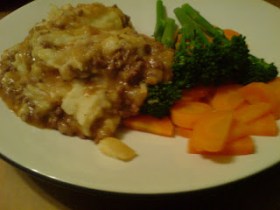
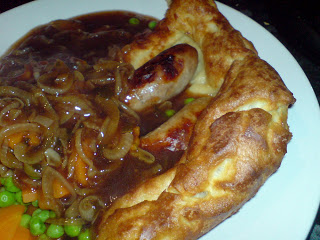
Very sorry for the recent few weeks being blog-lite. However folks, this doesn’t mean I’ve not been cooking, just been rather busy with work, plus I have become rather a social butterfly of late. Anyways, I have decided to go through the book and do some of the proper classics. So first up is (#82) Toad-in-the-Hole. I do love it. You have to make sure you get decent sausages. I was mant to get mine from the butchers in Levenshulme or Chorlton, but ran out of time as I worked late, and had to go to blinking Asda. However, did find some organic pork sausages in natural casing, which were very good. Didn’t think I’d be recommending Asda on here, bearing in mind their animal-rights record. I cooked it for John, who – shock horror – had never had it before! That’s the Irish for you.

Makes four servings:

First of all make some Yorkshire pudding batter. I usually do this by eye, but followed Grigger’s measurements which do turn out well. Mix 8 ounces of plain flour with a pinch of salt in a bowl. Make a well in the centre and break 3 eggs into it. Make up a pint of half-milk, half-water and add about a third of it to the flour and eggs. Whisk this into a thick paste – adding only some of the liquid at the beginning should prevent lumps. Keep adding the liquid until the batter is the consistency of double cream. Leave to rest.

Meanwhile, preheat the oven to 220ºC and then brown a pound of sausages in an ounce of lard in a frying pan; you’re not cooking them through, just getting two decent brown stripes along their lengths. Strain the fat into a large roasting pan and pour a thin layer of batter and bake in the oven until set – about 5 minutes. Place the sausages on top of the set batter and pour over the rest. Bake for 35 minutes. The batter should rise up and be a nice golden brown. Serve with some veg and onion gravy.


#82 Toad-in-the-Hole: 9/10. I love this kind of food. Can’t go wrong with this kind of food. If for some reason you have never had it before, simply go and make it right now. You have a recipe. It’s very easy. The only thing I ask is that you buy good sausages and make onion gravy to go with it, otherwise it’s just not the same.

#70 Cornish Pasties

pasty
When we all thought about going out for the day picnicking, the first thing I thought of making was a Cornish pasty; easy to make and easy to eat. The whole idea is that they are hardy. I’d never made one before, but knew that it was pretty straight forward…

Start off by making the pastry. Cornish pasty pastry should be made with lard as the only fat, apparently. Grigson doesn’t give much instruction on how to make pastry other than, fat and flour are to be used in a ratio of 1:2. To make two large pasties I used a pound of flour and 8 ounces of chilled, cubed lard. It sounds a lot, but these are big pasties! Start off by rubbing the flour into the fat, along with a pinch of salt. Use the tips of your fingers, or the appropriate attachment on your food mixer. I usually go for the mixer as it doesn’t make the fat warm up like fingertips do. Don’t be tempted to put the mixer on a high speed; use the lowest setting possible (see review, below). Let the pastry rest in the fridge for at least half an hour.

Meanwhile, chop up a pound of beef – use skirt, chuck, or as I did, top rib. Make sure all the fat and gristle is cut off. Chop a four-ounce onion, and thinly slice 3 ounces of turnip and 8 ounces of potato. Mix the vegetables and meat in a large bowl and season well with salt and pepper – do not skimp – plus a pinch of fresh or dried thyme.

pasty filling

Divide the pastry into two and roll one half to the size of a large dinner plate, pile in half the mixture in a line down the centre of the pastry circle, pull up the sides and crimp them together using water as glue.

pasty crimp
Place it on a baking tray and brush with egg. Repeat with the other half. Bake for 20 minutes at 200ºC, then turn down the oven to 180ºC for a further 40 minutes.

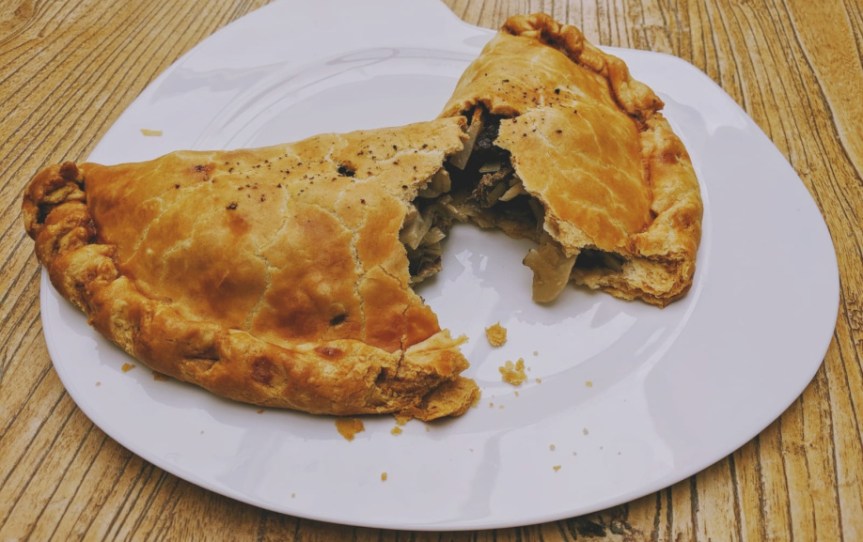
#70 Cornish Pasty – 2/10. The first disaster of the project! I’ve given the recipe because I know what I did wrong – because I was making such a large amount of pastry, I tried to hurry it along by turning the speed of my mixer too high. The result of this is the fat didn’t form ‘breadcrumbs’, it softens too early and doesn’t get incorporated properly. If you are making it, heed my advice! It would perhaps make two lots of pastry, using half the required amounts of fat and flour. The filling was delicious , but the pastry turned into dust, I couldn’t even get them of the baking tray without them collapsing. Instead I ate the filling with a spoon, and threw the rest in the bin. I am going to try them again next week.*

pasty baked

*and I eventually did and that’s what the photos are of – just to prove they can be made properly! Neil – August 20202

#51, Part II


The Grigson recommended getting another meal out of the shin of beef stew by simmering the stew away until nice and thick and stirring through some chopped parsley, so that’s what I did! Well I have to re-think my previous mark of 8/10, because this was absolutely gorgeous. It was a thick super beefy sauce with a good hit of red wine behind it, and the beef was so unbelievably tender I didn’t even have to chew. I think that this is one of the best meals you could make yourself. All it requires is time. I’m not sure if it’s nicer than the game pie I made recently which I gave full marks…oh bugger it:

#51 (part II) Shin of beef stew – 10/10 Completely brilliant. Go out and make it right now!

#51 Shin of Beef Stew

I have heard people talk of the shin cut of beef, and knew it is supposed to be very tasty but very tough – the legs being a well used part of a cow and all. This means long, slow cooking, and after the tough-as-old-boots braised brisket I’d done a while ago, I thought I’d get this recipe wrong too…but how wrong I was! I tell you what I did first…

I trimmed the fat and the very sinewy parts of the meat before cutting them into big chunks and tossing them in three tablespoons of seasoned flour, then I browned them in dripping in a stockpot. You can have your gas turned up to the max here -don’t be shy! When browned, I added enough beef stock to cover the pieces of meat and added one sliced onion and two good sized sliced carrots. For extra flavour, I also added a bouquet garnei of parsley, thyme and bay leaves, a glass of red wine and 3 cloves of garlic (left whole). All this was simmered for two hours and allowed to cool so that the fat could be skimmed off. That was it! Serve with some more veg – I did potatoes and turnips.

#51 Shin of beef stew: 8/10. Simple, cheap and very tasty. I know the red wine is extravagant, but this would still be lovely without. The meat was wonderfully tender and the not at all gristly (I only got one chewy bit!). Because I don’t eat meat that often, it’s such a treat to get some good quality properly treated meat like this. That butcher in Levenshulme is a keeper!

There is plenty left over, and today I am about to eat the rest! The original recipe doesn’t mention doing anything else to it, but Jane mentions that it is best eaten the day after, and also it can be reduced down to a think unctuous gravy. It is bubbling as I type! Reducing the stock to make it a sauce is definitely the right way to go. See this future post to see how it turned out….

#44 English Game Pie, #45 Cumberland Sauce


I invited Clive from work to help me finish off the last of the game I got from Bury Market last night in the form of (#44) English Game Pie. Looking through the ‘Stuffing, Sauces and Preserves’ chapter of English Food for something to go with game, I found (#44) Cumberland sauce. I’ve never had it before, and had no idea what it was. Everything was straight-forward, though the pie had lots of preparation. Anyways, here’s what I did…

The day before I simmered a brace of pheasants and a pigeon (essentially everything I had!) in a very light chicken stock along with a good seasoning and a bouquet garnei of parsley, bay leaves and thyme springs. Jane recommends between 2 and 4 birds. It took an hour and a half for the meat to become tender enough for me to pull the meat from the bone with relative ease. I cut the meat into chunks and kept them in a sealed tub topped up with the stock so it didn’t dry out over night and reserved the remaining stock.

Next day I arranged the meat in one large dish, and a smaller, as I made an extra one for my PhD supervisor too. Then hard-boiled and quartered three eggs and tucked them between the pieces of meat along with small rolls of grilled bacon (though not in yours Jason, don’t worry!), and chopped parsley. Next, I fried a large onion and about 8 ounces of mushrooms in 2 ounces of butter until they were golden. A tablespoon of flour was mixed in to the mushrooms and onions and stirred around so that the butter got absorbed, and then stock was added a ladelful at a time until a thick sauce had developed – about the thickness of double cream. Make sure the sauce is seasoned very well. It was simmered for about 5 minutes, and I added extra stock whenever the sauce thickened too much. The sauce was poured over the meat and then a puff pastry covered the pies. The large pie was cooked at 200 degrees for 20 minutes and then the oven was turned down to 170 for a final ten.

The Cumberland sauce was very easy. Make sure you make it in advance as it should be served cold. Whisk together a jar of redcurrant jelly and a teaspoon of Dijon mustard in a pan over a low heat. Meanwhile blanch the thinly pared peel of a lemon and an orange that have been cut into matchsticks for 5 minutes, then drain. Once the jelly has melted, add the peel, the juice of the two fruits, 5 tablespoons of port, plenty of black pepper and salt and ground ginger to taste (I used a scant teaspoon). Pour into sauce boat. Easy peasy.

FYI: Cumberland sauce is, in fact, German – the recipe was brought over with the House of Hanover in the late Eighteenth Century, and is named after George IV who was the Duke of Cumberland.

#43 English Game Pie – 10/10. This is my first full point dish I think! It was absoluely delicious. Although I’d never had it, there was something very familiar and comforting about it. It was also, for me, the epitome of English Food. The meat was beautifully tender, and he sauce had turned into a delicious gravy and the salty bacon added an extra dimension. The full flavour of the pheasant and pigeon coped very well with the rich Cumberland sauce…

#44 Cumberland Sauce – 8/10. A perfect complement to the game. Although it was very rich and sweet, the savory additions such as the pepper and mustard allowed you to add loads. All in all a fantastic meal!

#34 Black Pudding, #35 White Pudding…

Ok, I know I didn’t slave over a hot bucket of pig’s blood and offal to make this stuff, but it great food and the Grigson does make a point of mentioning where to buy good puddings and how they should be eaten. Bury, in Alongshore, UK is the best place to get them (and it’s where I got mine). They are made in horseshoe shapes and are not as firm as those in long sausages that you slice, which I think is very important. They are also in ‘natural casing’, i.e. intestine. You don’t eat the casing, but I think it’s much better this way – there is less waste, and I’m all up for that. People should eat more offal. Of what I’ve eaten, it’s really tasty. It’s also very low in fat and very high in nutrients. I think that calves’ liver is as nice as steak. Anyway for those that are not aware, black pudding is made from pig’s blood, fat, oatmeal and herbs and spices. This mixture is then boiled in the natural casing. Jane suggests eating it fried with mashed potato, bacon, fried chopped apple and a blob of mustard.

I’d never had white pudding before, and I had to wonder: ‘What on earth is in it?’. I mentioned it to friends, who also had no idea. It’s very similar to black pudding, but contains pork meat and suet instead of blood. It’s not as spicy as black pudding either.

Grigson suggests eating it with bacon, so I combined the two to produce an extremely meaty tea! It’s all good though, I think, because I’m going to the gym alot at the moment and need my protein, and it’s offal and therefore less wasteful. Oh I am so holier-than-thou these days…

#34 Black Pudding: 8/10. I’d not had black pudding as a teatime meal, always as part of a full-English breakfast, and I have to say it was wonderful – the apple and mustard cut though the salty streaky bacon and soft, stodgy black pudding. Yum!

#35 White Pudding:7/10. Very tasty indeed! Soft in the centre and crispy on the outside. Much more subtle than black pudding, but a change to normal sausages. More please!

#33 Stewed Pigeons in Foil

The first of the game dishes made with the produce from my trip to Bury Market. I’ve not had woodpigeon before, and wasn’t too sure if it would be too gamey. I have tried to cook it before but it was so tough it was inedible. My mate John came over for tea and I thought I’d try and do (#33) Stewed Pigeons in Foil. It seemed easy; all was required was time. One pigeon is required per person. Brown the pigeon in butter, breast only, using a hot pan. Allow them to cool. Meanwhile cut pieces of foil large enough to encase the pigeons individually, and spread softened butter over the centre of each piece. Place the birds in the centre and make a parcel with one end still open so you can add the flavourings. Into the cavity add a large knob of butter, thyme, pepper, a slug of brandy, finely chopped onions, a tablespoon of lemon juice, and one of beef stock. Make sure all is sealed well, place on a baking tray and cook for three hours in a low oven. The breasts were removed and seasoned well. It was served with mashed potato and celeriac and the juices from the pigeons (Grigson’s orders). I added some purple sprouting broccoli for something green.

This is definitely the most cheffy looking dish I’ve made so far. It certainly looked the part. The wood pigeon was very tender and moist – it came away from the bone easily. The flavour is very much like liver, in that it’s quite metallic, and it’s got a slightly grainy texture. The mash was divine – used the ricer that I bought for the first time, and will never go back to mashing! – the celeriac and parsley gave in a herby, perfumed taste. Absolutely brilliant! What’s more, eating game is totally sustainable food – even if we all went vegetarian tomorrow, we’d still have to shoot them as part of woodland management (same goes for deer, pheasant, etc…)

FYI: according to the BBC, the wood pigeon is the most common bird in the UK http://news.bbc.co.uk/1/hi/uk/4646685.stm

#33 Stewed Pigeons in Foil. 9.5/10 – I cannot believe how nice this dish was. Can’t wait to do more game recipes!

#11 Braised Beef with Carrots

Second course. This one couldn’t be simpler either – all you need is time…and thyme too.

I got a piece of brisket from Savin Hill Farm (http://www.savin-hill.co.uk/), who have a stall from the farmers’ market in Manchester. Brown it in lard and put it into a flameproof casserole. Add loads of sliced carrots, and inch or two’s depth of chicken stock and a big sprig of thyme. Cook on a very low heat, topping-up the stock and adding more carrots for about 2 hours. I served it, as the Grigson recommends, with boiled potatoes. I have to say, I’m going to have to give this one mixed reviews. The carrots cooked with the beef and in the thymey stock were beautifully tender. The beef itself was extremely tasty; really….er….beefy! When I bought it, it was a deep red colour with a little bit of marbling. I don’t think I’ve actually cooked brisket before, and tasty though it was, some of it was pretty tough. The Grigson did say you could use the more expensive cut, silverside. Perhaps I should’ve. I’m sure it wasn’t down to Savin Hill’s produce. FYI: rolled brisket is the strip of muscle from the breast of the cow rolled up. It is one of the 8 primal cuts of meat. I found out that apparently you’ve to cook it fat facing upwards to make it lovely and tender. Oh well – next time it’ll be better!

Simon says:
A main course of beef with carrots was greedily consumed. The carrots were outstanding, cooked in the meat stock and packed full of thyme flavour. The beef was tasty but rather tough in parts: questions were raised over Grigson’s suggested cut for the dish. Served with good peas and spuds. 6/10

I say:
#11 Braised Beef with Carrots: 6/10. I agree with Mr. Simon on this one. Have a feeling it may be my naive beef cookery!