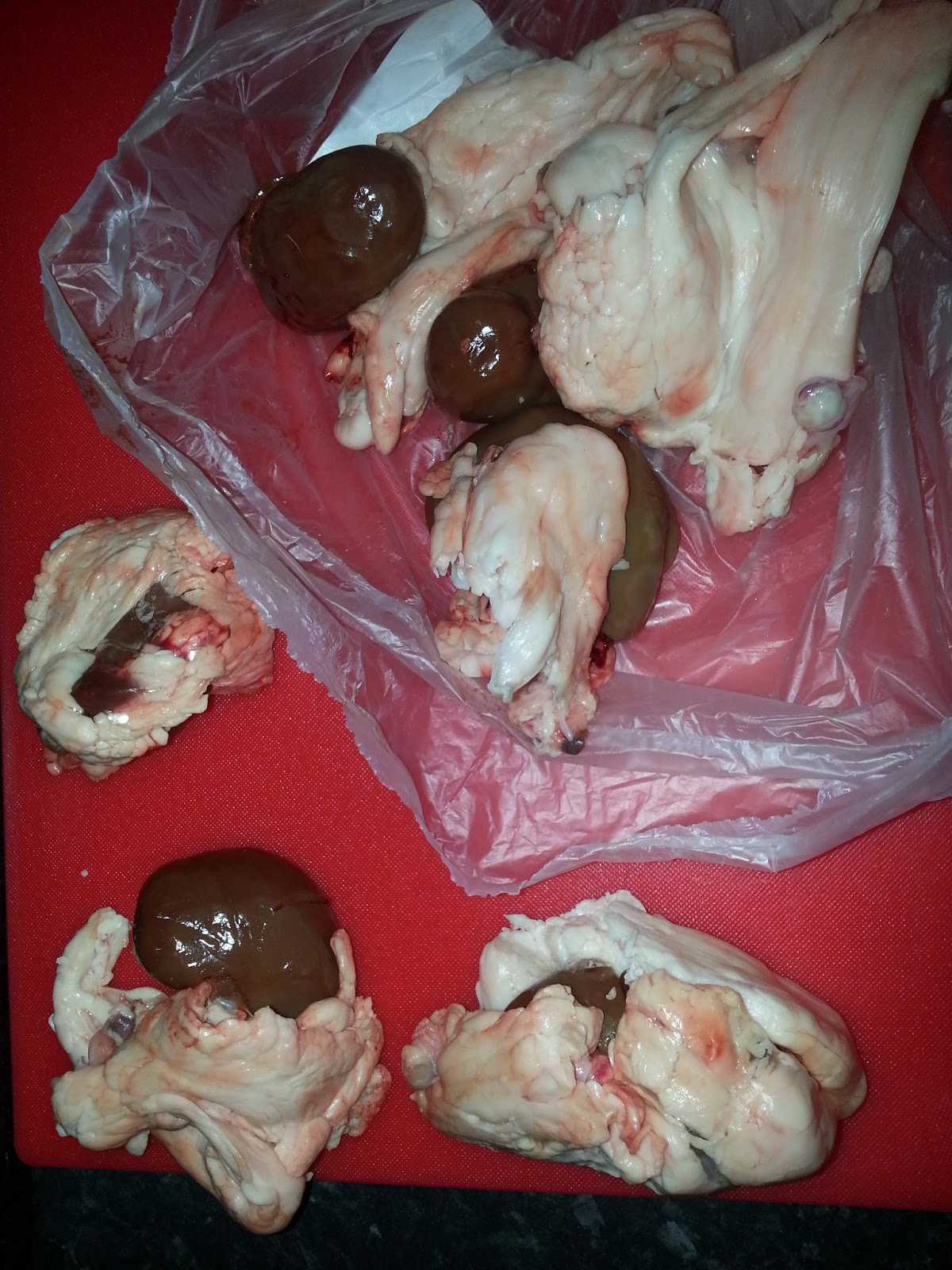
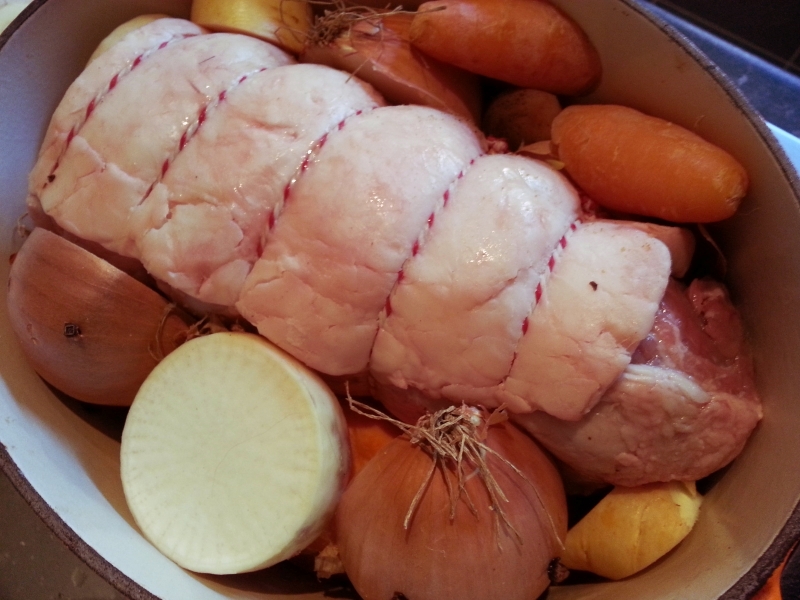
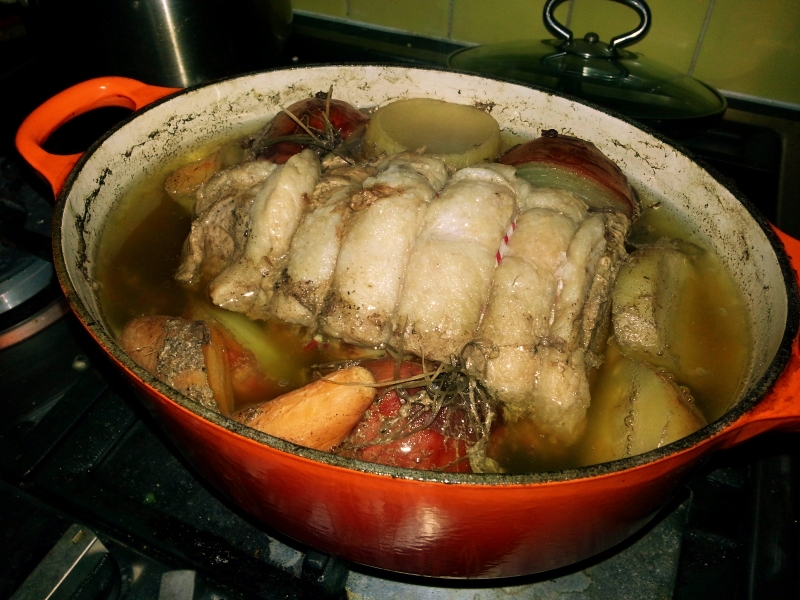
#411 Brains with Curry and Grape Sauce

Brains have never really been that popular in England, often banished to a messy tray, at least that’s when they could be found at all. They’ve made appearances in other British cook books but they are few and far between.

The final nail in the coffin for the brain in British cuisine was surely the BSE or ‘Mad Cow’ crisis of the 1990s where cows were infected by a prion which causes the disease bovine spongiform encephalopathy (BSE). A prion is an infectious protein, and is therefore not alive, and cannot be denatured by regular heat-treatment. It may have been derived from the prion that causes the encephalopathy in sheep known as scrapie, but this link is unclear.

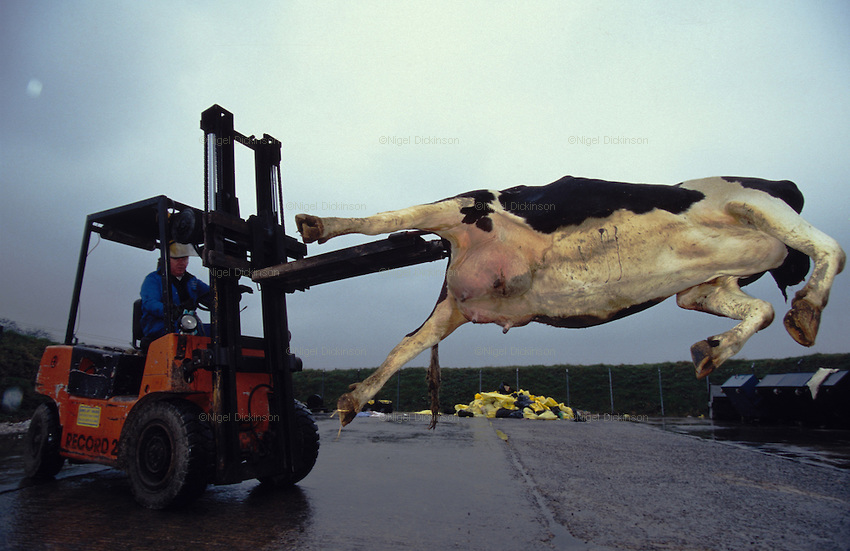
The BSE prion infects the CNS causing the brain to appear spongy under microscopic observation. The symptoms, unsurprisingly, are behavioural: infected individuals become solitary, aggressive and frenetic, they become anorexic and their milk yield drops dramatically. Eventually they lose all coordination. BSE is all-consuming, infecting not the just the CNS but the peripheral nervous system, bone, intestines, placenta and tonsils. It is also found in saliva and excrement, and can sit in the soil perfectly viable for years. I remember watching the pictures of the wretched stumbling beasts on the television news in shock and in horror as they were bulldozed into mass burning graves. A total of 4.4 million cattle were killed during the crisis.

The source of the outbreak was the cattle’s feed, where ground up cadavers of sheep and cows were included in their diet. Shockingly, this practise had been going on since the 1920s, so it was just a matter of time before infection spread. In retrospect, it beggars belief that it could ever have been considered a good idea to turn herbivores into not just carnivores, but cannibals

There was of course worry that BSE could be passed onto humans, not just in food but in bovine insulin for diabetics and in bone meal for gardeners. Though bovine-human transmission was possible, there was no real initial evidence to suggest it actually occurred. Nevertheless, in 1996 the EU banned the UK from exporting beef and beef products including semen, embryos, gelatine and fat. Within the UK sales of beef plummeted, the government blaming the media storm. Secretary of State, John Gummer, famously said it was the British public and not the cows that had gone mad. Douglas Hogg, the Minister of Agriculture, was adamant that there was no link between the new variant CJD (Creutzfeldt-Jakob Disease, the equivalent disease in humans). In the Government’s desperation to calm the country and show just how safe British beef was, the Right Honourable Mr Gummer fed his little daughter a beef burger in front of TV cameras. Idiot.

Meanwhile, the World Health Organisation had been collecting data, and reckoned that nv-CJD was probably caused by the BSE prion. Hogg and Gummer had been desperately slow to act, but now the country had to tackle the crisis swiftly.

The most important and easily implemented regulation was the ‘over 30 months rule’, a simple ban on killing cattle for beef older than 30 months. When it came to using any part of the CNS for food, the cattle must be under 12 months old, with the same rule applying to sheep. Pigs are not considered a risk.

Simple rules such as this helped deal with the crisis swiftly. In 1992 there was 37 000 cases of BSE, in 2004 there was just 90. By 2006 the EU beef ban was completely lifted; now the UK is back in line with the rest of the EU

Now with all this behind us, you can get hold of them from a good butcher. Order well in advance though, and expect to have to buy in bulk.

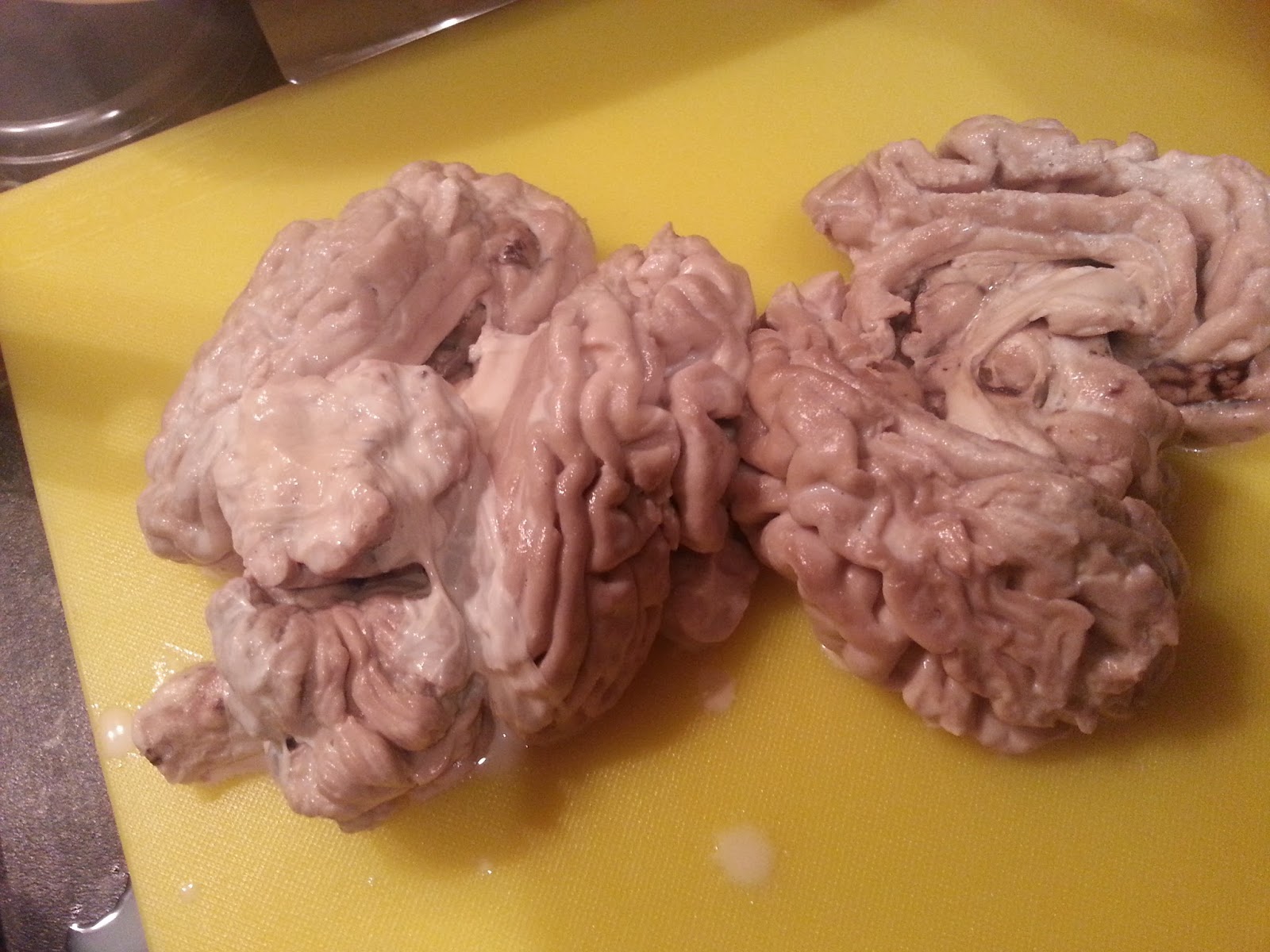
First of all you need to prepare your brains – you’ll need around 1 ½ pounds of calves’ brains, which I reckon to be 2 sets, or thereabouts. For some advice on preparing and poaching brains, see this previous post. For this recipe, poach them in milk, as you’ll need it to make sauce.

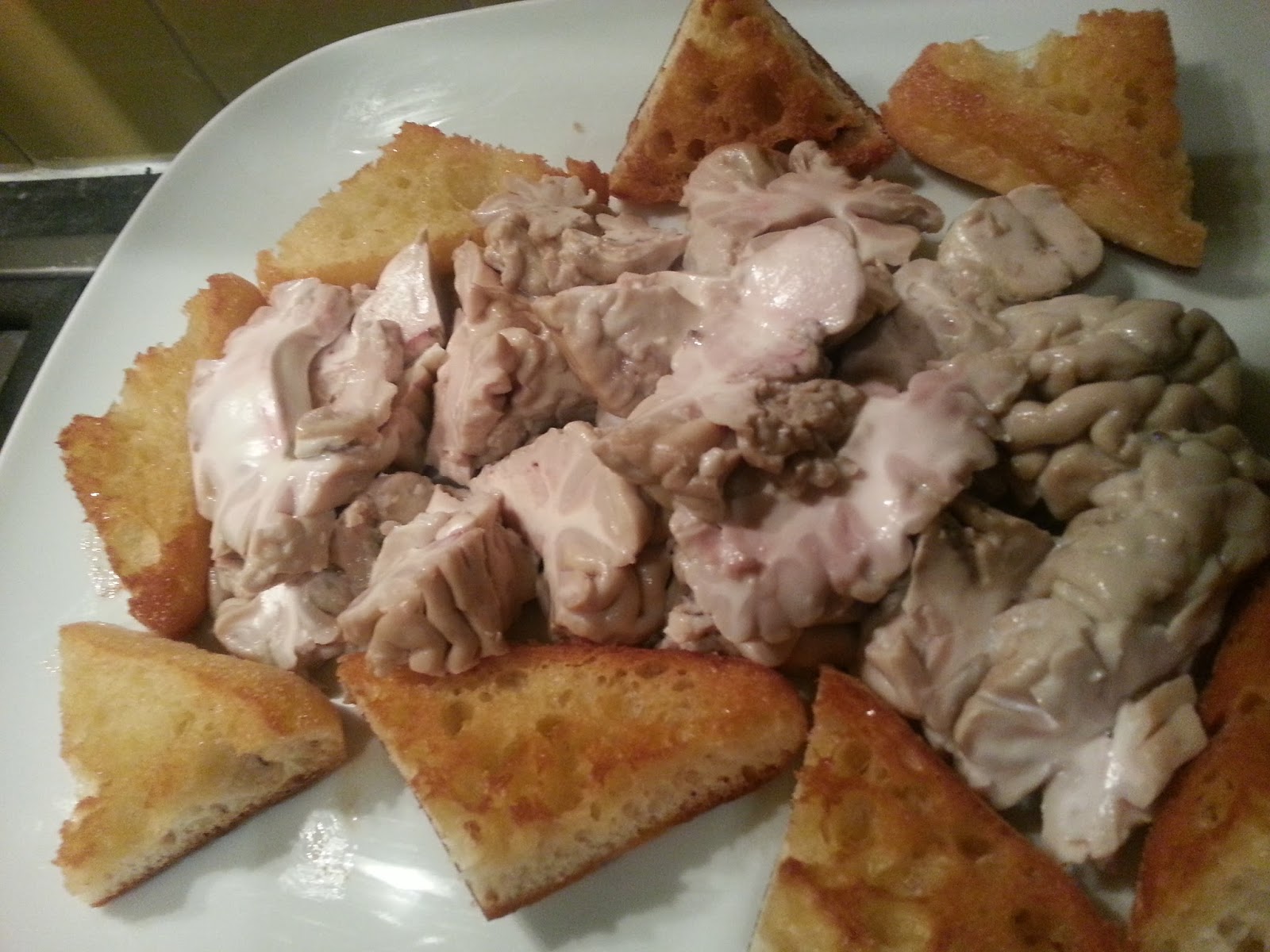
Strain the milk into a jug and slice the brains on a large plate. Keep them warm as you get on with the sauce, a cross between a béchamel and a velouté.

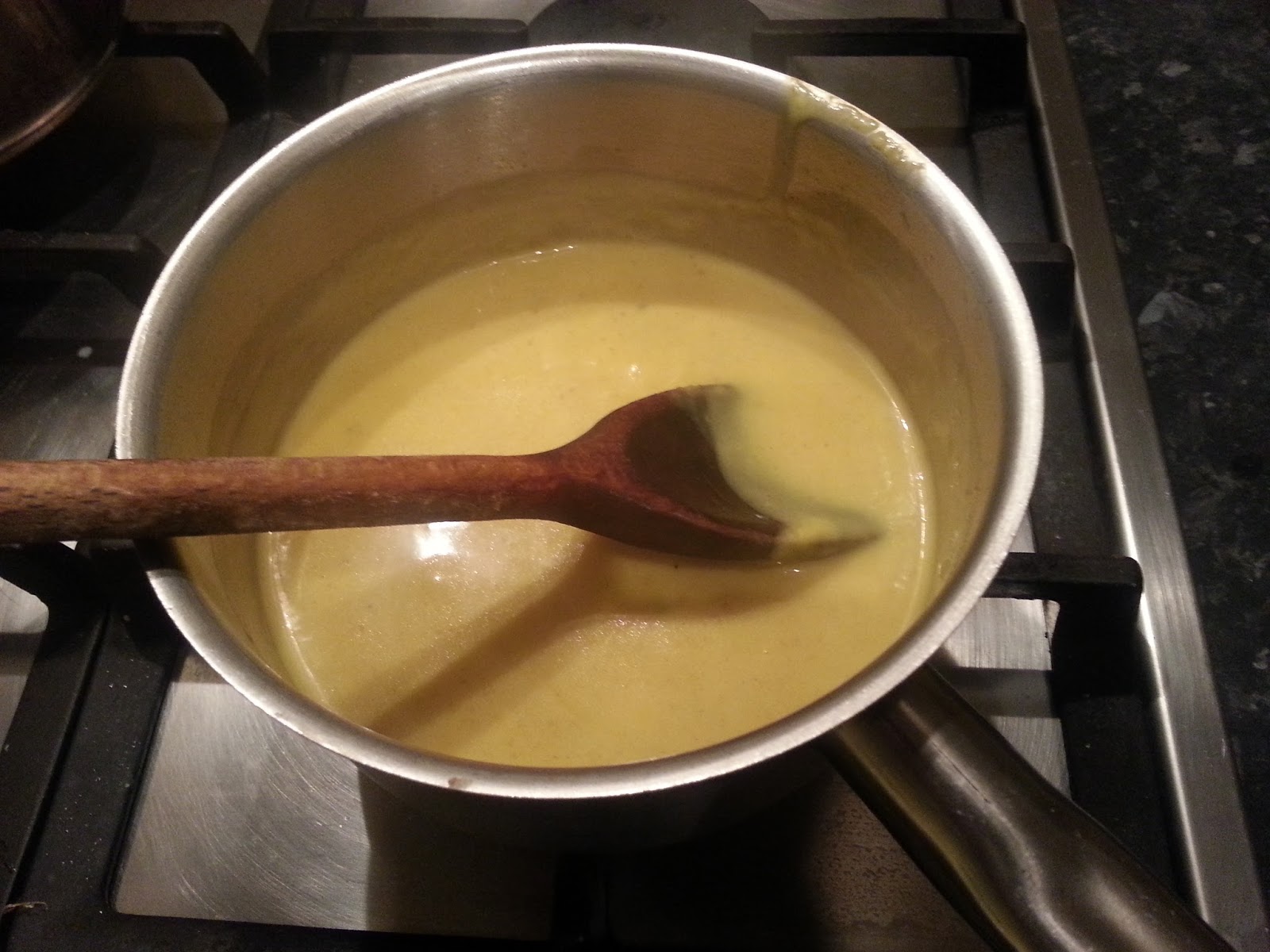
Start by melting an ounce of butter in a saucepan, then stir in a rounded tablespoon of flour and a teaspoon of curry powder. Mix all around in the butter for a couple of minutes, then add ¼ pint of hot chicken stock, adding a little at a time to prevent lumps forming, then add the amount of the milk the brains were poached in. Simmer the sauce gently for 20 minutes, stirring every now and again, then add ¼ pint of double cream


Meanwhile, get on with preparing 8 ounces of peeled grapes. To do this put them in a bowl and pour over boiling water. Let them sit for a few seconds and then strain them. The skin should now peel away with relative ease. When the sauce is ready, season with salt and pepper and tip in the grapes, including any juice. The sauce is now ready, but if it seems a little thick – it should be the thickness of double cream – add a little more stock or milk.

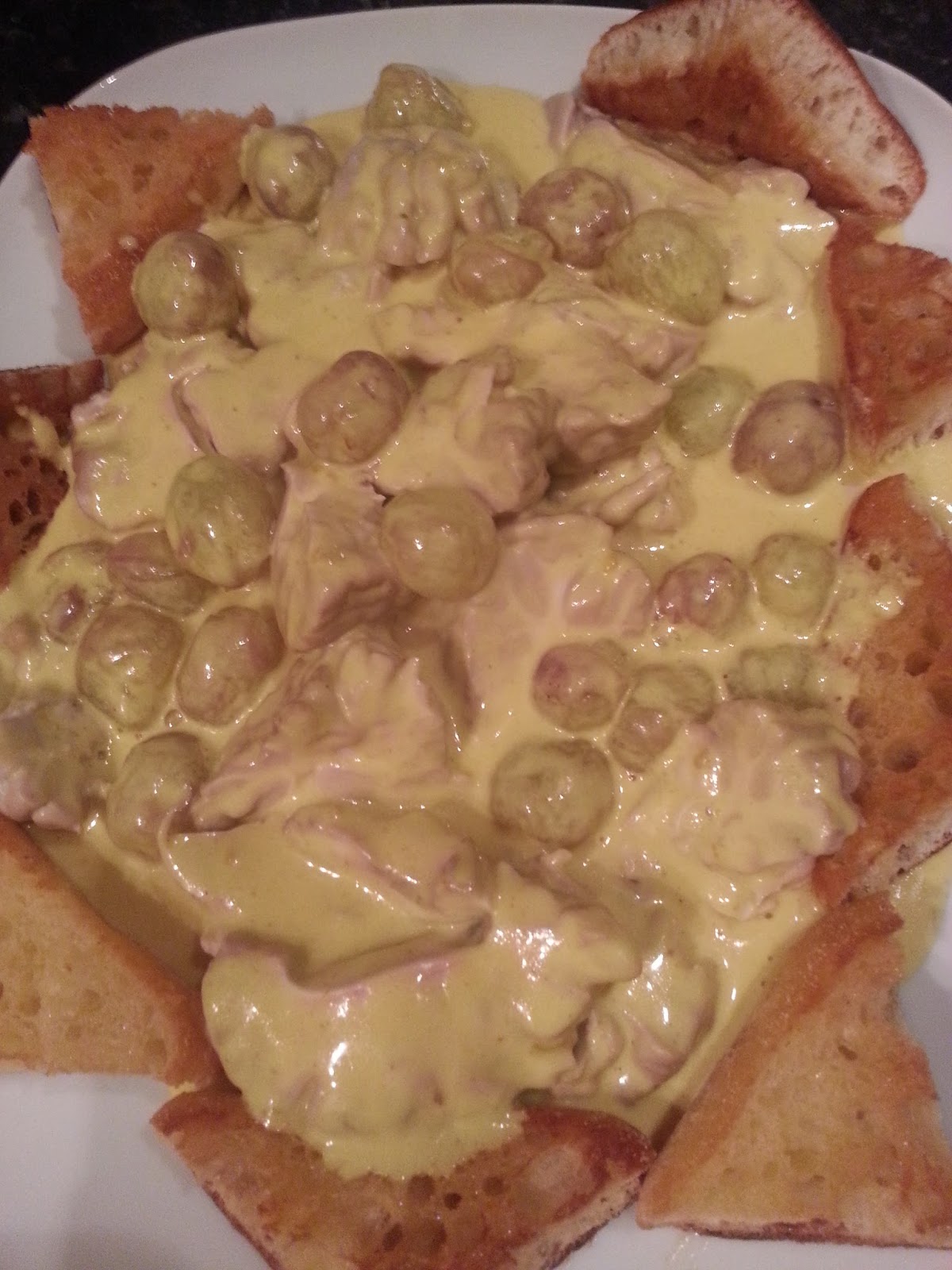
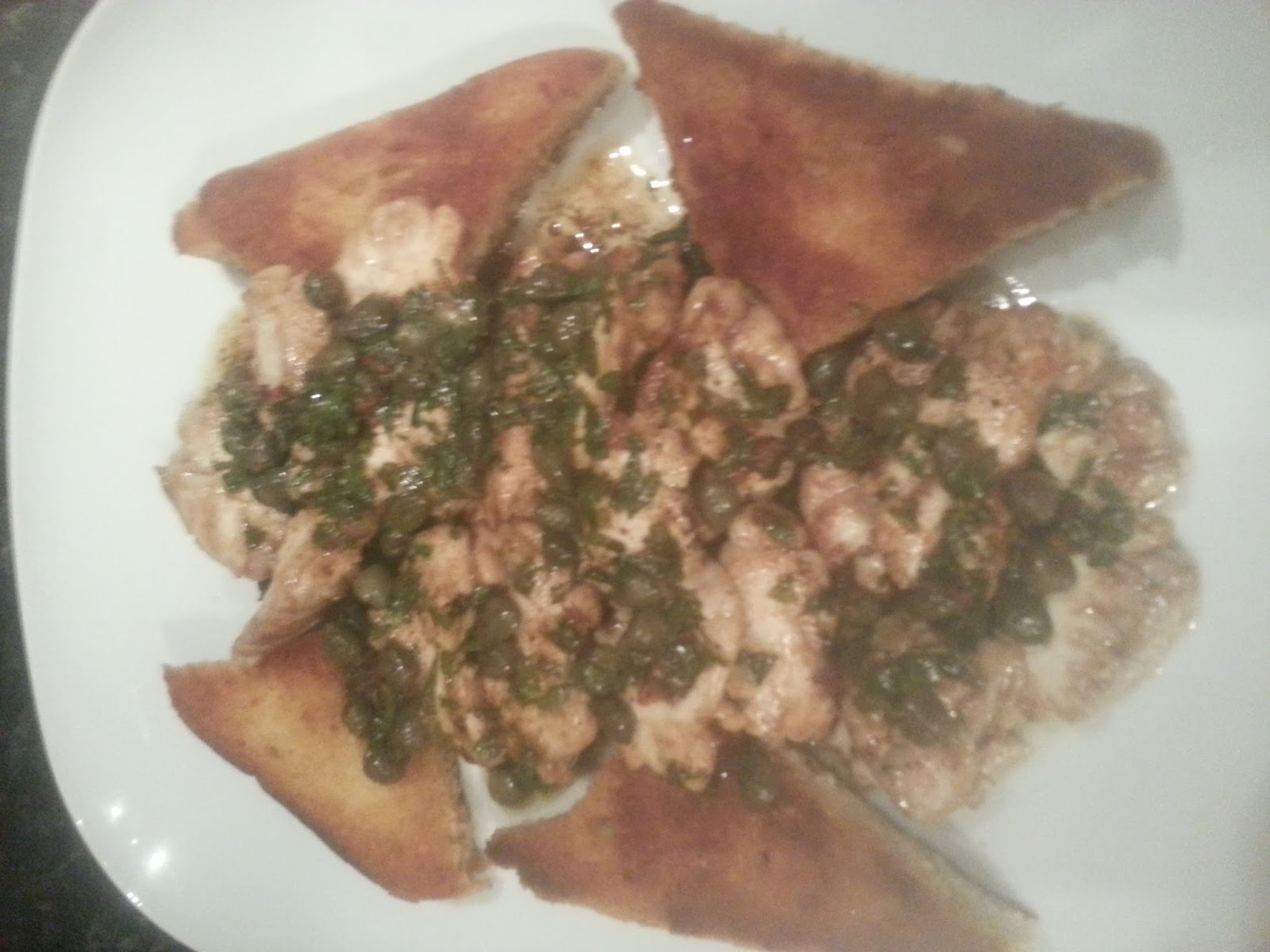
Pour the sauce over the brains and tuck in triangles of bread fried in butter and serve.

#411 Brains with Curry and Grape Sauce. Well I am glad I cooked the other brain recipe first, as this monstrosity would have put me off for life! The sauce was simply horrible; cloying in such a way, that when in the mouth, you couldn’t tell where sauce started and brain finished. The grapes simply did not go with the sauce. Obviously a thing of its time. I enjoyed the fried bread. 1/10.

#409 Calf’s Brains with Black Butter

Many years ago when I began this blog, I winced in fear at prospect of eating brains but after scoffing sweetbreads, wood cock intestines, lamb’s head and jellied eel mousse, the prospect has become an exciting one. The only reason it’s taken me such a long time to cook the brain recipes in this book that you have to order a huge box of them – it’s how butchers buy them from their suppliers and they’re not going to be able to sell the rest of them after you have bought the one or two you need for your recipe. Of course, these days I do my pop up restaurants and so thought it’s about time they appeared on the menu. When it comes to recipe-testing, I always look to Jane first, so I cooked the two brain recipes in quite quick succession.

If you want to try and cook calves’ brains yourself, find a good butcher and ask for a box of brains. You’ll probably receive ten in all, but give him plenty of notice as it could take a couple of weeks for him to get his hands on them.

Before I go on with the recipe, a few words on the preparation of brains:

First, you need to get them ready for the pot by removing any pieces of bone and then gently peeling away the thin membranous network of blood vessels that surround the brain. To do this, you need to soak the brains in salted water for a few hours in the fridge, preferably overnight. This toughens up the membrane so that it peels without breaking so easily. This is a little fiddly to do, but you soon get the knack. You might find it easier to do it under a running tap. Large calves’ brains are difficult to hold in one hand, so cut them in half. Better have two, neat hemispheres than a dropped, destroyed whole. With a little perseverance, you should end up with a nice, milky-white very delicate brain ready for the next stage.

The prepped brains can now be very gently poached in milk for five minutes so they get nice firm (if going by Jane’s exact words, but a good court-bouillon is a good other option), then cut up appropriately.

For this recipe you’ll need 1 ½ pounds of calves’ brains (about two) that have been poached in milk and cut in slices about 1/3” thick.

Swiftly fry them in some butter over a quite high heat so that the brain browns nicely, whilst they remain nice and soft inside. Keep them warm in the oven as you make the sauce by first melting a good 3 or 4 ounces of butter. Soon it will start to sizzle and froth, but then it will go silent. This is the point at which all of the water has boiled away and the butter solids will soon start to change colour. Timing is critical now; ready yourself with 1 ½ tablespoons of white wine vinegar and wait for the pale solids to turn to a deep golden brown. As soon as they do, take the pan off the heat and pour in the vinegar, swirling the pan as you go. Add a heaped tablespoon of capers and level tablespoon of parsley and season with salt and pepper.

Jane suggests serving the sliced brains on a bed of cooked spinach with the sauce spooned over the top, surrounded by triangles of bread that have been fried in butter. 

The photographs are not really doing the process justice. I really need a better camera!

#409 Calf’s Brains with Black Butter. Well I must say this was absolutely delicious! The soft and slightly-sweet brains were contrasted excellently against the fried bread, and the piquant sauce provided the dish with plenty of oomph, which bland brains need I think. I cooked an adapted version of this for a pop up restaurant by making it into a warm salad; every single plate came back clean. What a shame they have gone out of favour these days, perhaps now that the shadow of BSE no longer looms too darkly, they will begin to sneak back into our butchers’ shops again? Get your hands on some and have a go; fun to cook with, and a true gastronomic experience! 9/10
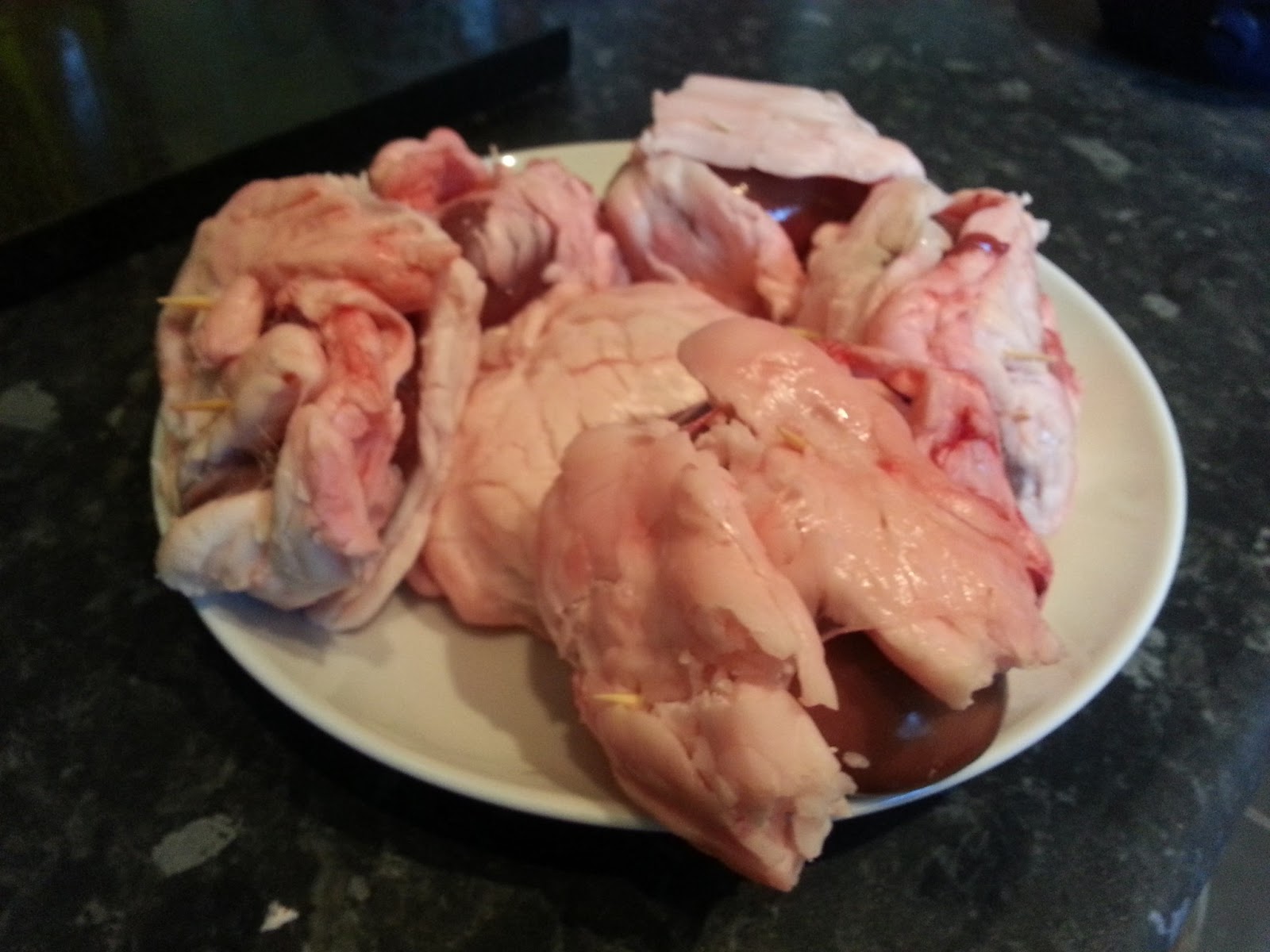
#405 Capon, Goose or Turkey Neck Pudding / Poddyng of Capoun Necke (1430)

Here’s a recipe that I’ve been dying to do since I first picked up Jane Grigson’s tome and, at Christmastime, I finally got the chance to cook it (yes, I am THAT behind on writing my posts!).

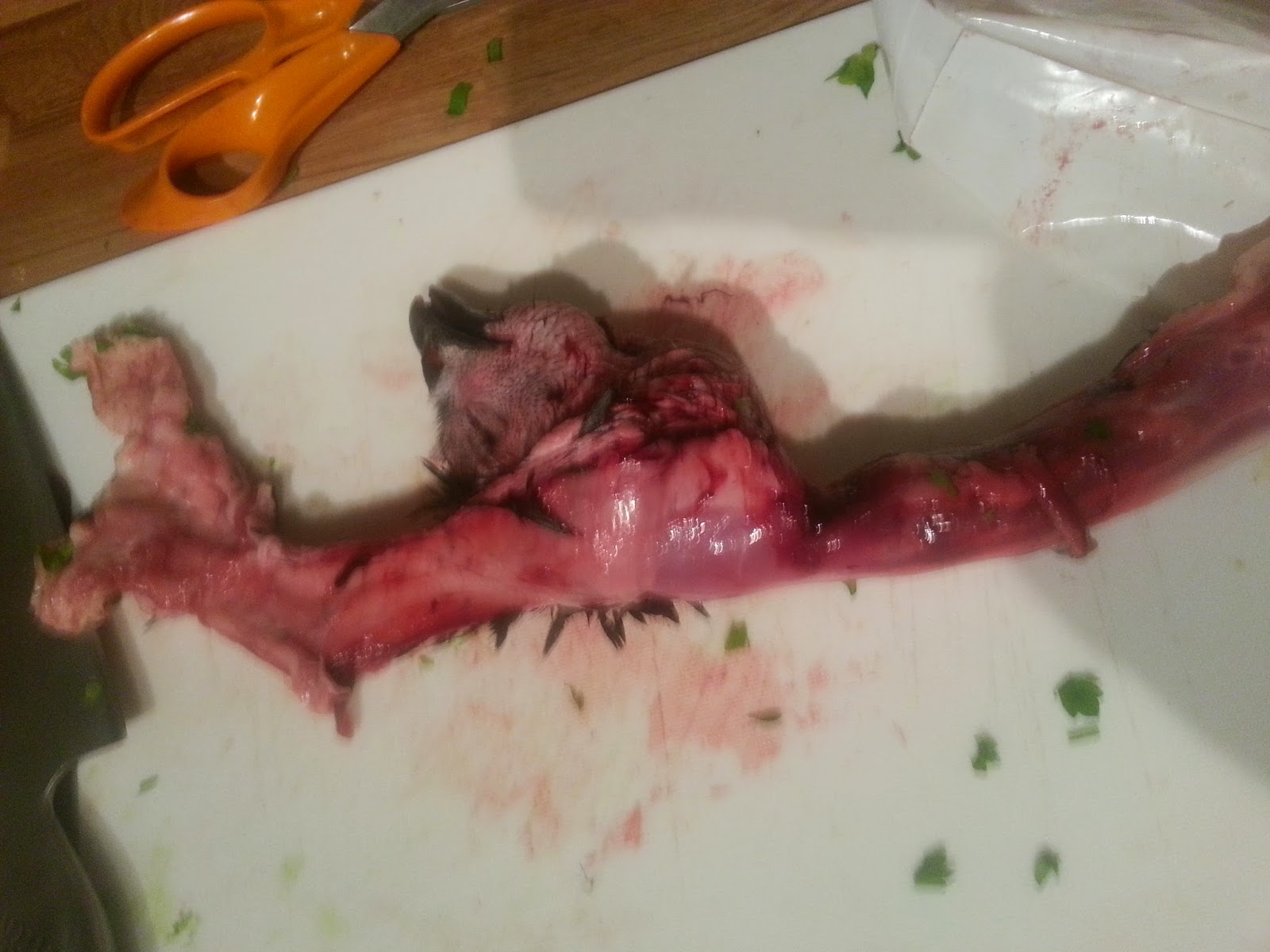
The main problem, you see, is getting hold of the neck of a turkey, goose or capon. It’s not the neck muscle that’s needed; that would be easy! All I’d have to do is rummage inside the giblets bag and pull the neck out. This recipe requires the neck skin – all of it, from the base of the neck, right up to the beak. In other words, I needed a fowl with its head still on.

The trouble is, it is very tricky to get one. I have three very good butchers close to me and none of them could get me a turkey with its head on! These birds are plucked and gutted mechanically these days, and the butcher doesn’t have to do a thing when he receives them.

To get a bird with its head on, you have to know a farmer or keep them yourself. Luckily for me Dalesbread Finest Meats, who attend Chorlton Market with me (3rd Saturday of the month!), farm and sell their own meat, including turkey and geese. No problem, they say.

This recipe comes from an early Fifteenth Century manuscript, jazzily called Harleian MS.279. Here’s the original recipe:

Poddyng of Capoun necke.—Take Percely, gysour, & þe leuer of þe herte, & perboyle in fayre water; þan choppe hem smal, & put raw ȝolkys of Eyroun .ij. or .iij. þer-to, & choppe for-with. Take Maces & Clowes, & put þer-to, & Safroun, & a lytil pouder Pepir, & Salt; & fille hym vppe & sew hym, & lay him a-long on þe capon Bakke, & prycke hym þer-on, and roste hym, & serue forth.

Essentially, it’s the skin of the neck wrapped around some spiced offal to produce some kind of hybrid between a sausage and a meatloaf.

This is Jane’s somewhat modified version of that recipe.

First job on the list is to get the neck skin removed from the bird. To do this, get yourself a pair of good, sharp scissors. Three incisions is all you need to make, and the first is around the base of the neck, as low as you can without exposing the breast. Next, cut around the neck end, close to the beak. Lastly, cut straight up the length of the neck, so that you can remove the skin in one piece.

This sounds easy. It is not.

Okay, now for the filling. Get yourself a good-sized mixing bowl and break up 8 ounces of sausagemeat and mix into it a good tablespoon of finely chopped parsley and a couple of egg yolks. Season with salt, pepper, mace and cloves. If you like add a pinch of saffron that has first been soaked in a tablespoon of hot water.

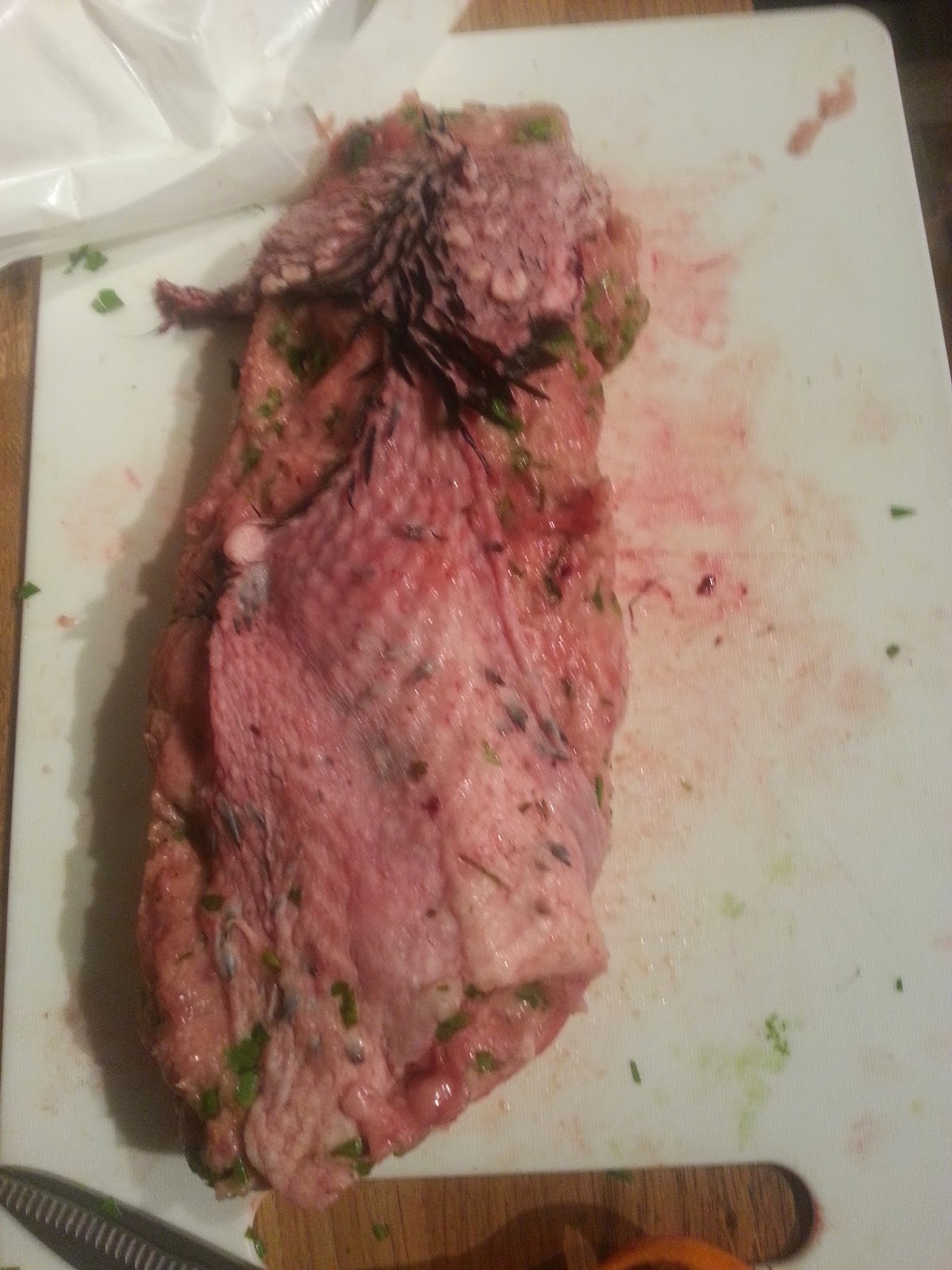
Lay the neck skin flat on a work surface and spread half of the mixture over it. Cut the liver of your bird into three pieces and arrange these in a line going down the centre then spread the remainder of the filling over the top of that. Pull the edges of the neck skin around, wrapping the filling up, turning it over and tucking it in. Pop it into a loaf tin.

This sounds easy. It is not.

I could not get the skin to wrap around the sausagemeat, nowhere near in fact. I tried my best, but it ended up essentially a meat loaf with some skin draped over it.

Bake at 180⁰C for 45 minutes. Cool and leave in the fridge so that the flavours can permeate. Slice and eat like a pâté.

#405 Capon, Goose or Turkey Neck Pudding / Poddyng of Capoun Necke (1430). This was both a disaster and a success at the same time. There was far too much filling for the neck, so as the ‘pudding’ baked the skin shrank, leaving a wrinkled line of neck flap. However, the filling was absolutely delicious! The liver was good and creamy and those mediaeval spices complemented the meaty, rich filling. All pâtés should have cloves and mace added to them, I reckon. Even though the neck ended up being completely superfluous, it’s still a high scorer. 7/10

This terrible photo doesn’t show it at it’s best!

#404 Lamb (or Mutton) to Eat as Venison

All the way back in November, I was asked to cater for a dinner party; a very special one because it had the most interesting brief. A seven-course dinner was required where each course represented a different time in history.

For the Georgian course, I went straight to my favourite book from that time period The Experienced Housekeeper by Elizabeth Raffald (1769). Flicking through the pages, I happened upon a recipe To dress a Leg of Mutton to eat like Venison. It required you to ‘[g]et the largest and fattest leg of mutton you can get cut out like a haunch of venison as soon as it is killed, whilst it is still warm.’ It then goes on to tell you to ‘remove the bloody vein’ and then marinade the thing in wine, dry it, and to roast it in pastry. I was intrigued, but it was obviously unachievable. Looking in other books, I found many versions of it, sometimes roasted, sometimes braised, but always marinated in red wine (and often in the blood of the beast too!). I knew the recipe looked familiar, and it finally dawned on me that a recipe for it appeared in good old English Food by good old Jane Grigson.

There’s a 4 day marinating time for this recipe, so plan ahead if you fancy making it – and I really suggest you do; see my review of the recipe below.

Start off by making the marinade: dice up 5 ounces each of onion, carrot and celery, chop 3 cloves of garlicand brown them in a couple of tablespoons of oil, such as sunflower or rapeseed. Take your time over this and get them good and brown; the veg won’t be in the final dish, but its flavour will be. Let it cool.


Now mix the cooled, browned vegetables with the following:

1 bay leaf
2 good sprigs of thyme
4 sprigs of parsley
2 sprigs of rosemary
8 crushed juniper berries
8 crushed coriander seeds
10 crushed black peppercorns
3 tsp salt
1 (UK) pint red or dry white wine, or dry cider

¼ (UK) pint of red or white wine vinegar(and, though not on the ingredients list, cider vinegar, if going down the cider route)


Now tackle the meat. Use a full leg of lamb or mutton, I went for the latter. It was huge, so I increased all the above values by a half. All you need to do it score the fat into a diamond pattern, like you would do for a ham. Find a large, deep dish or pot and place the lamb inside and pour over the marinade. Make sure the whole leg gets the marinade on it, so turn it over a few times. Keep the leg somewhere cool – a fridge, or a nice cool cellar or pantry – and cover it with foil. Turn it twice a day for four days.

When the four days is up, get a new set of vegetables ready. Slice 2 onions, 2 carrots, 2 leeks and chop 2 sticks of celery. Also chop up 8 ounces of unsmoked (‘green’) streaky bacon. Brown all of these in a couple of ounces of butter


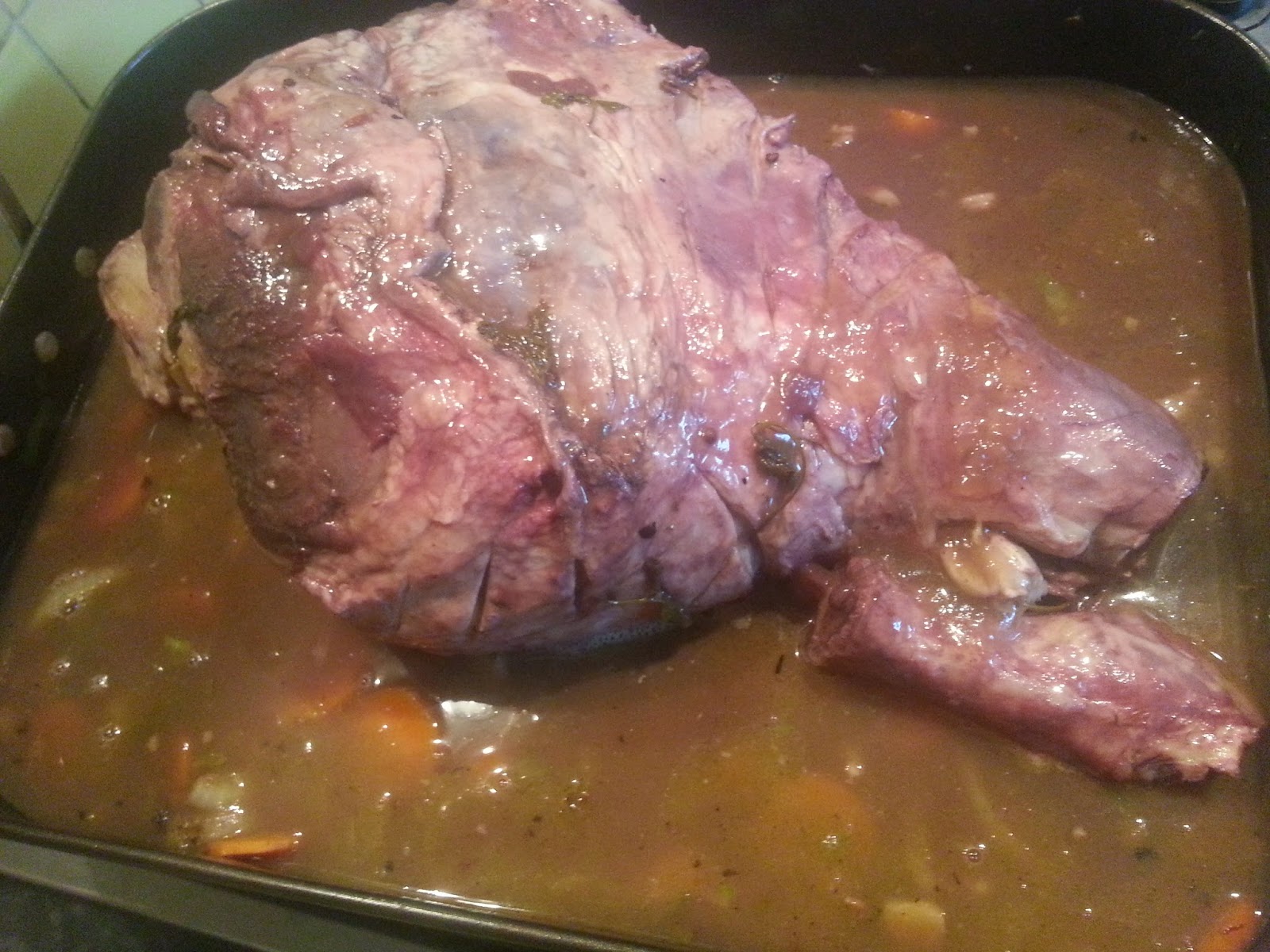
Spread the vegetables over the base of a deep roasting tin, place the leg on top and strain the marinade over it. Top up the marinade liquid with veal stock so that it comes up two-thirds of the way up the tin. You don’t actually need to use veal stock; chicken stock or water would do, I am sure. However, if you want to make your own, look here for my recipe for it from the other blog). Cover with more foil.


You have two choices now: either bring the whole thing slowly to boil and simmer gently for 2 hours on the hob, or bring to simmer and pop it in a cool oven instead, 150⁰C will do it. If you are using mutton, you need to cook the leg for another hour or even 90 minutes. Turn the joint over after one hour and in the final thirty minutes, ladle out 2 pints of the cooking liquid and boil it down hard to make a concentrated, richly flavoured stock.

When the cooking time is up, remove the leg and put it into another roasting tin and turn the oven up to 220⁰C. Roast for a good 20 minutes and baste well with the concentrated stock to achieve a nice glaze.


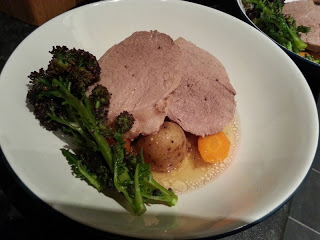
Jane suggests serving with gravy made with the pan juices and reduce stock and the usual lamb/mutton accoutrements. See here for a post all about that. I actually served it with a ‘Lenten Pie’, from Raffald’s book. At some point I will blog each course on the other blog.

Jane points out that you do this recipe with a leg or pork and magically transform it into wild boar.

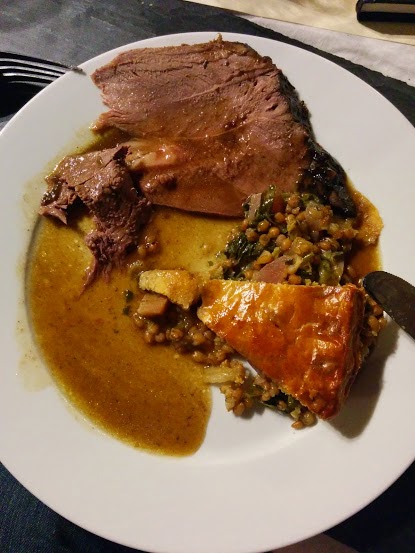
#404 Lamb (or Mutton) to Eat as Venison. Oh my goodness, this may simply be the single most delicious thing I have ever cooked! First of all, it tasted exactly like venison; beautifully gamey, but with the moist succulence you would expect from lamb or mutton. It was transformed! There must be some kind of witchcraft afoot. I was amazed, and luckily so were my diners! I cannot recommend this more highly, absolutely bloody brilliant. 10/10.

#403 Raised Mutton Pies

Just a quickie from theMeat Pies &Puddings part of the Meat, Poultry & Game Chapter:

This is the last of the raised pie recipes in English Food. It’s a little different in that you don’t need to make a jellied stock like the others, but a gravy made from mutton bones.

If you can’t get hold of mutton, then lamb will do just as well.

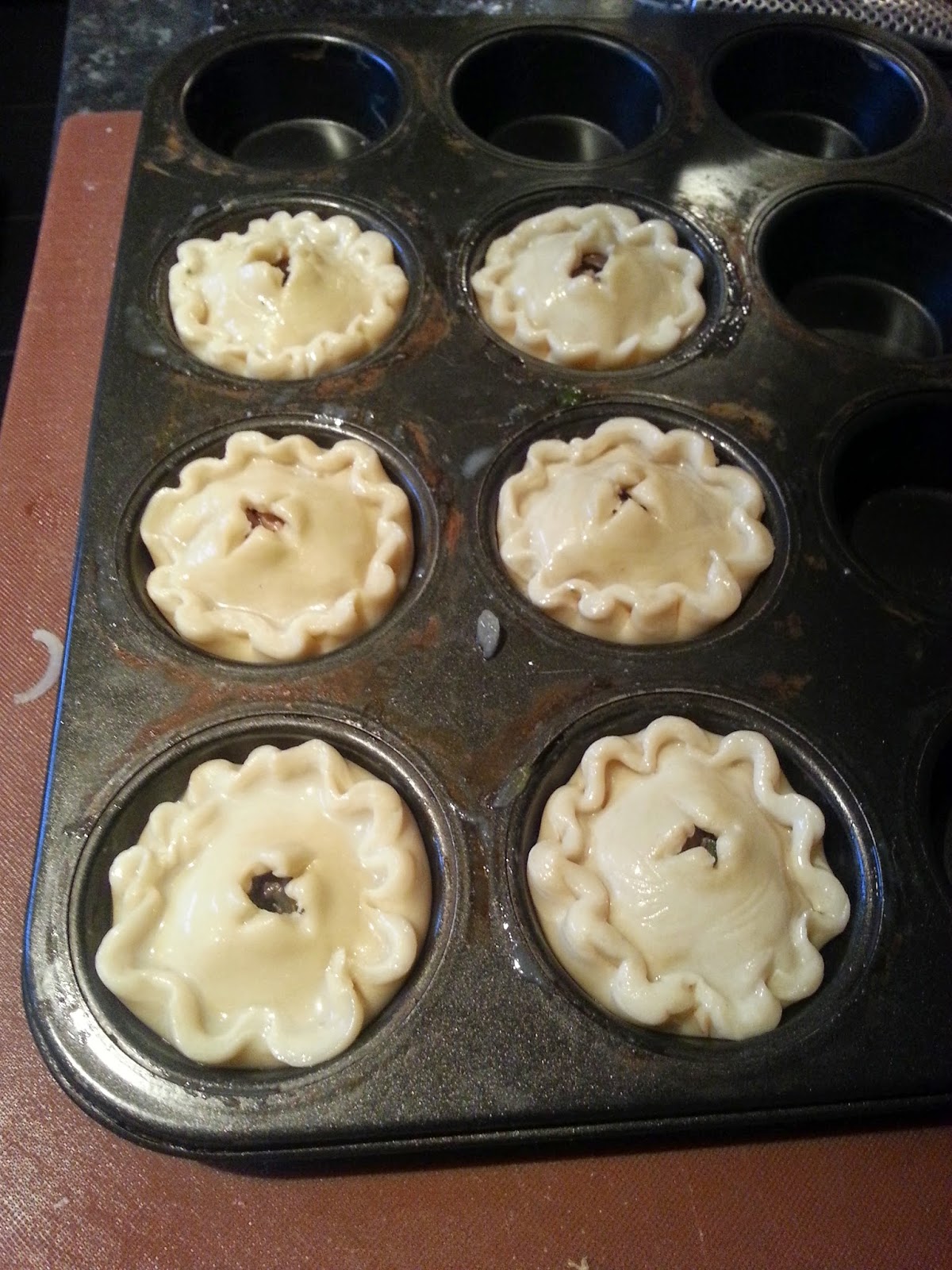
To make the pie, you will need to make a batch of hot water pastry – have a look at the post #282 Raised Pies. It also goes through the process of making the pies themselves. In this case, the pies are to be made small. To do this you can use wooden pie dollies or jam jars and raise the pastry around them. Alternatively, and much easier, is to use muffin tins and roll pastry to fit.


For the filling, you need a whole best end of neck of mutton, or a pound of fillet meat. Make sure the butcher give you the bones of the sheep. Chop the meat finely, including some fat. Finely chop 3 shallots or 4 ounces of onion along with 4 ounces of mushrooms and a tablespoon of parsley. Mix all of these together with the meat and a teaspoon of dried thymeand salt and pepper. Place in a pan with ¼  pint of water, bring to a simmer and let it tick over for 5 minutes. Cool.


Fill your pastry cases, however you have constructed them, with the mixture and bake for 25-45 minutes at 200⁰C, depending on size.


Once whipped out of the oven, pour in gravy made from the bones. There is no instruction from Jane as to how to make this, but it’s pretty easy. Make a stock from bones, trimmings and some stock veg. Reduce it and mix into a roux of butter and flour to thicken it up.


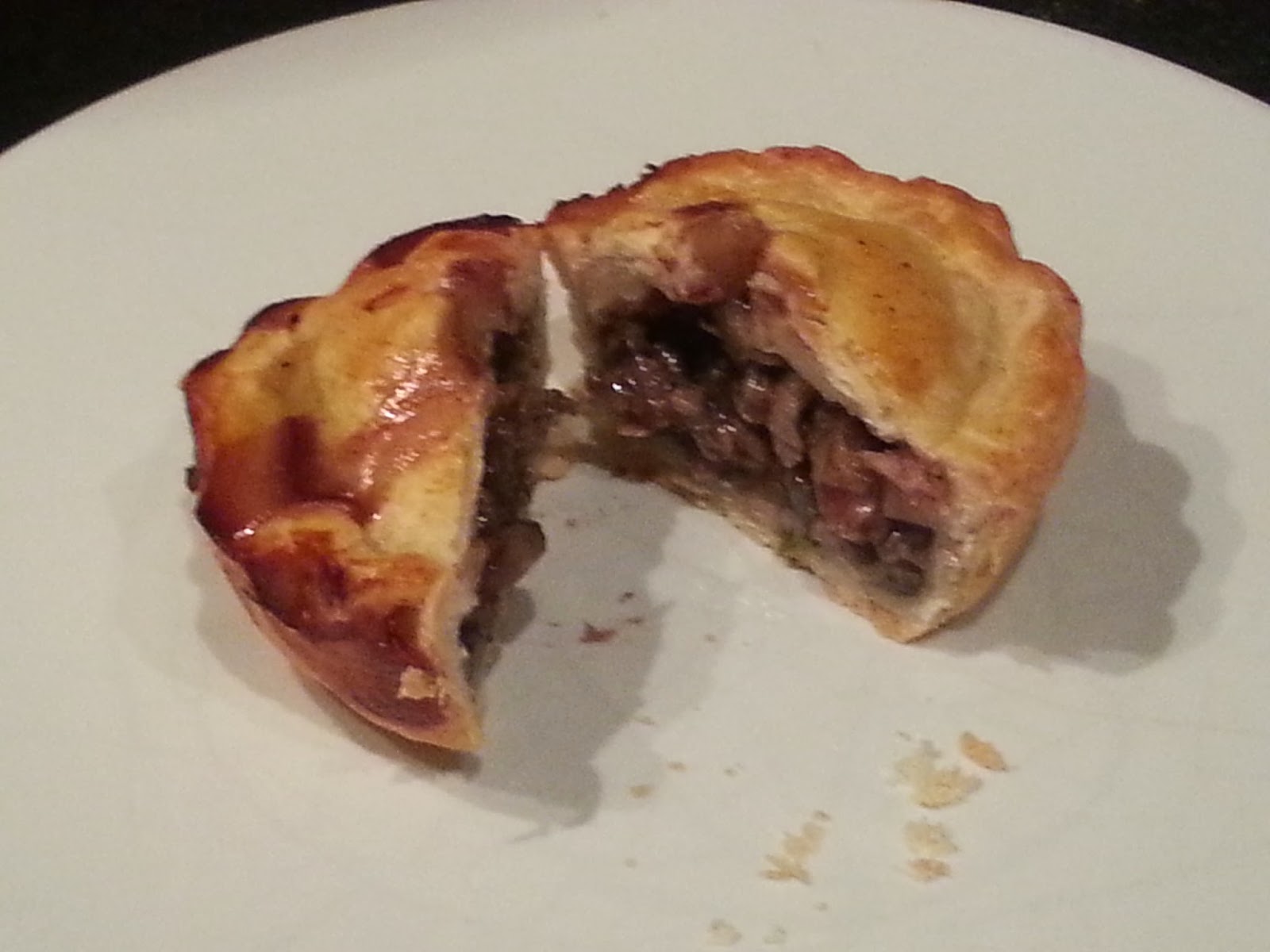
#403 Raised Mutton Pies. These were great – I must admit I was a little dubious of the watery filling, but it really was delicious, the vegetables and herbs made the water into a delicious stock, which reduced during baking. They were so good, I added them to one of pop-up restaurant menus. 8/10.


#400 Crown Roast of Lamb

Well, well, well. Here we are at #400! Who would have thought I’d get this far?

I’ve chosen this classic piece of meat sculpture for this milestone as it is such a special thing, and hardly seen these days. Plus, doing it Jane’s way means you don’t simply pop to the butcher’s shop and ask for the roast assembled and oven-ready. No, Jane’s way means constructing it yourself; something I really could not have done at the beginning of this project. This saves you a lot of money, and earns you plenty of kudos with your friends.

I did a quick look through some old books and it is odd that this classic and ancient and slightly macabre dish does not seem to appear before the 20th Century. I must be wrong here – can anyone shed any light on it?

To make your own rack of lamb, you will need three things: your lamb, stuffing and a trussing needle & thread.

First, the stuffing: go for any of the stuffing recipes in the Stuffings section of thelast chapter, or go with the stuffing recipe from #175 Shoulder of Lamb with Rice and Apricot Stuffing. I chose the latter.

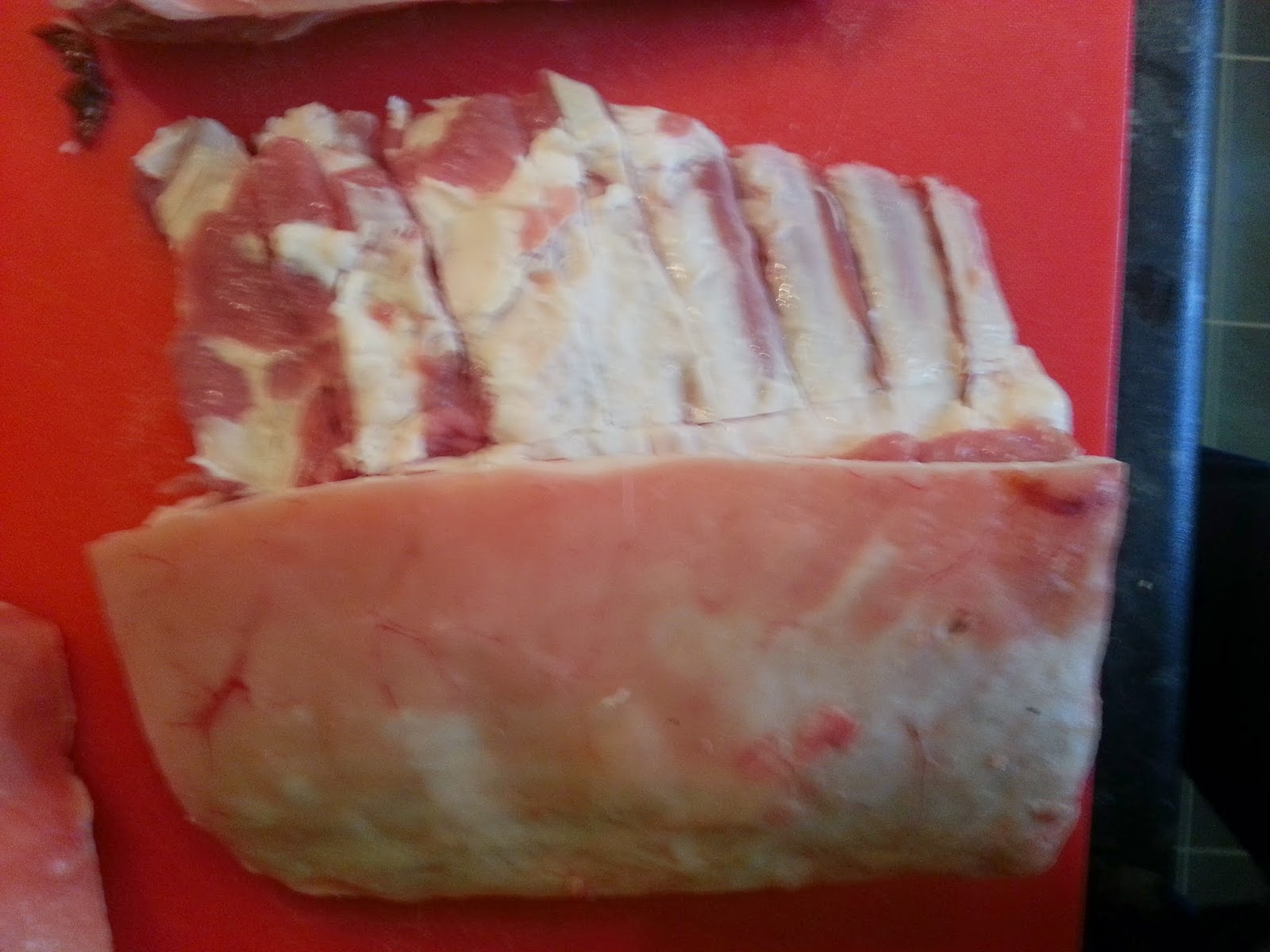
Ok, now the tricky bit. Go to your butcher and ask for a whole best end of neck; it is from this that you will get your two, perfectly symmetrical, racks. You should get 7-8 cutlets from each rack. Here’s what you ask the butcher to do (in Jane’s own words):

  1. to divide in two down backbone so you have two symmetrical pieces,
  2. to chine it [this means to remove the backbone],
  3. to make small cuts between the cutlet bones [this is quite simple to do yourself].

The butcher will desperately try to chop off the long bones and you must insist he does not! At home, you can get the racks prepped by French trimming the thin ends; scraping away the fat from the ribs, just like#305 Guard of Honour. It’s quite laborious at first, but you’ll soon get the knack.

Sit the two racks back-to-back with the fatty sides touching. Take your trussing needle and sew the ends together with two stiches, making sure the thread is tied good and tight.

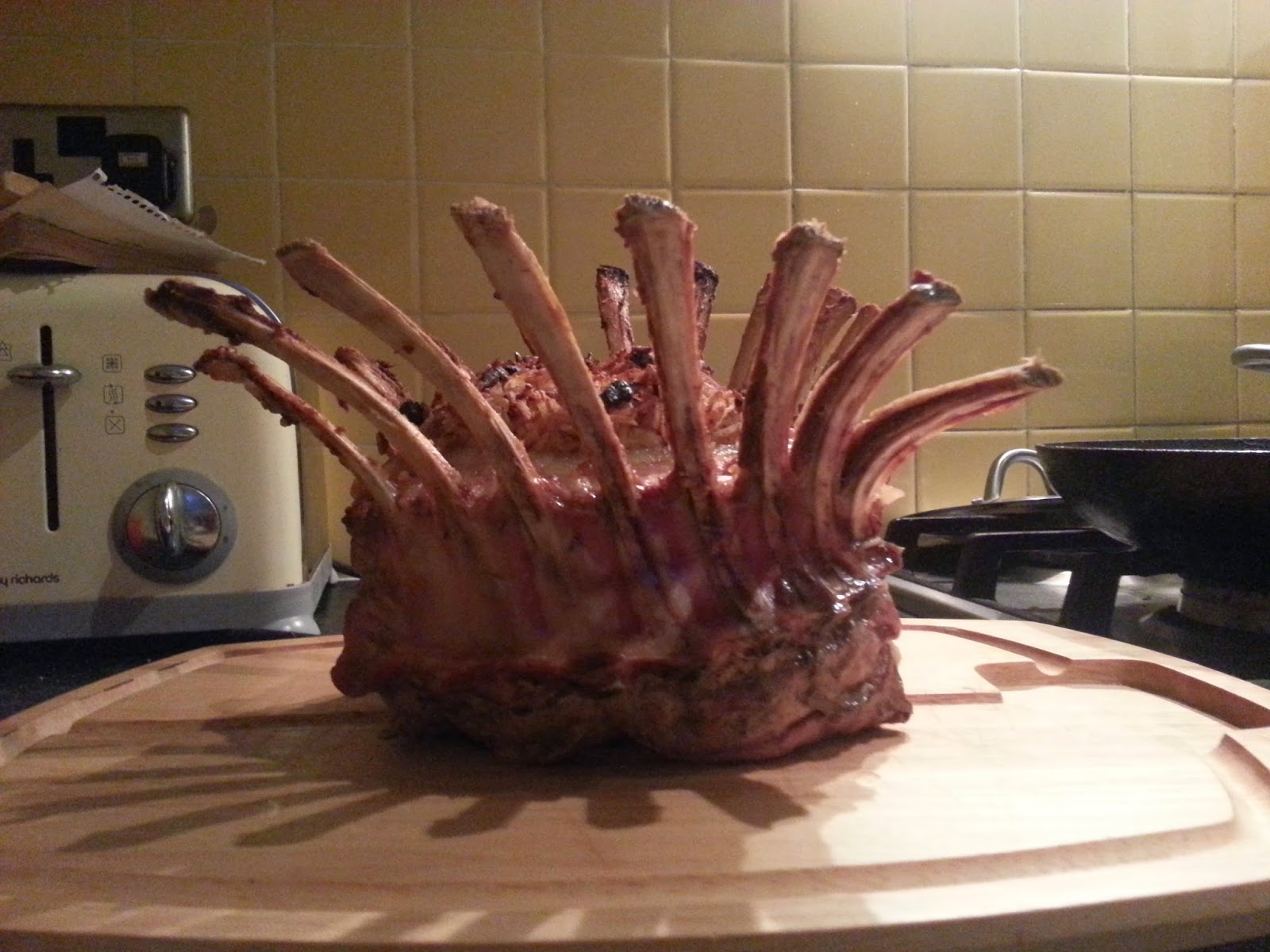
Stand it up and shape it into a crown using your fist – this is where those little cuts the butcher made are important.  Cover the ends with foil and sit the whole thing on a rack in a foil-lined roasting pan. Season the meat (especially the fat) and fill the centre with your chosen stuffing.

Roast for 75 minutes  at 190⁰C. Remove from the oven, cover with foil and let the meat rest for 20 minutes or so. If you want to be posh remove the foil from the ribs and replace with paper ruffles.

But what to serve with roast lamb? Don’t fear, Grigson has it all covered for us in this post.

#400 Crown Roast of Lamb. What a spectacle this was! I loved the way it looked; not all nice and neat with each rib the same length, but instead the bones were their natural varied lengths, making it look even  more like a real crown. The stuffing was, of course, great and the meat itself wonderfully tender and medium rare. A surprising thing bearing in mind it had been a roasting for what seemed like a long time. The only minor thing is that the stuffing began to char, so I would recommend covering it with some foil for the first half of the roasting. Nevertheless, still marvellous. 10/10.


#388 Sweet Lamb Pie from Westmorland

Happy New Year Grigsoners!

There are no Christmas recipes in English Food left to cook, but this one is close, being a cross between a savoury lamb pie and a sweet mince pie. It’s a recipe that has no introduction from Jane Grigson, though I feel it should, as it is pretty strange-sounding: a pie with a minced lamb, dried fruit and apple filling. Though it hails from Westmorland (a now defunct northern English county now made up of bits of Cumberland, Lancashire and Yorkshire), it seems to me to be a very typical pie baked during the medieval period, where it was very common to cook meat with lots of dried fruit and spices.
The Westmorland Coat of Arms
Why was this done? After all it seems to be an odd combination. Many people say that it is because heavy use of fruit and spices masked the taste of rancid and rotten meat. This, however, is a total myth; the reason meat was combined with spice, dried fruit and sugar was because all of these ingredients were extremely expensive. It was all showing off. They are – in my past experience – also a good combination: previous recipes like #87 Mrs Beeton’s Traditional Mincemeatand #328 Salmon in Pastry, with a Herb Saucefollow the same principle.
By the time of the Victorian era, none of these ingredients were particularly expensive, and this sort of food fell from favour, the only surviving remnant being the now totally meat-free mince pie.
This pie is known as a ‘plate pie’, which is still commonly made in Northern England. It is simply a pie made, not in a tin, but on a plate. The plates can be of typical (ovenproof!) ceramic or formed from enamel. Whichever you use, make sure it is deepish. My Mum still makes both sweet and savoury plate pies.
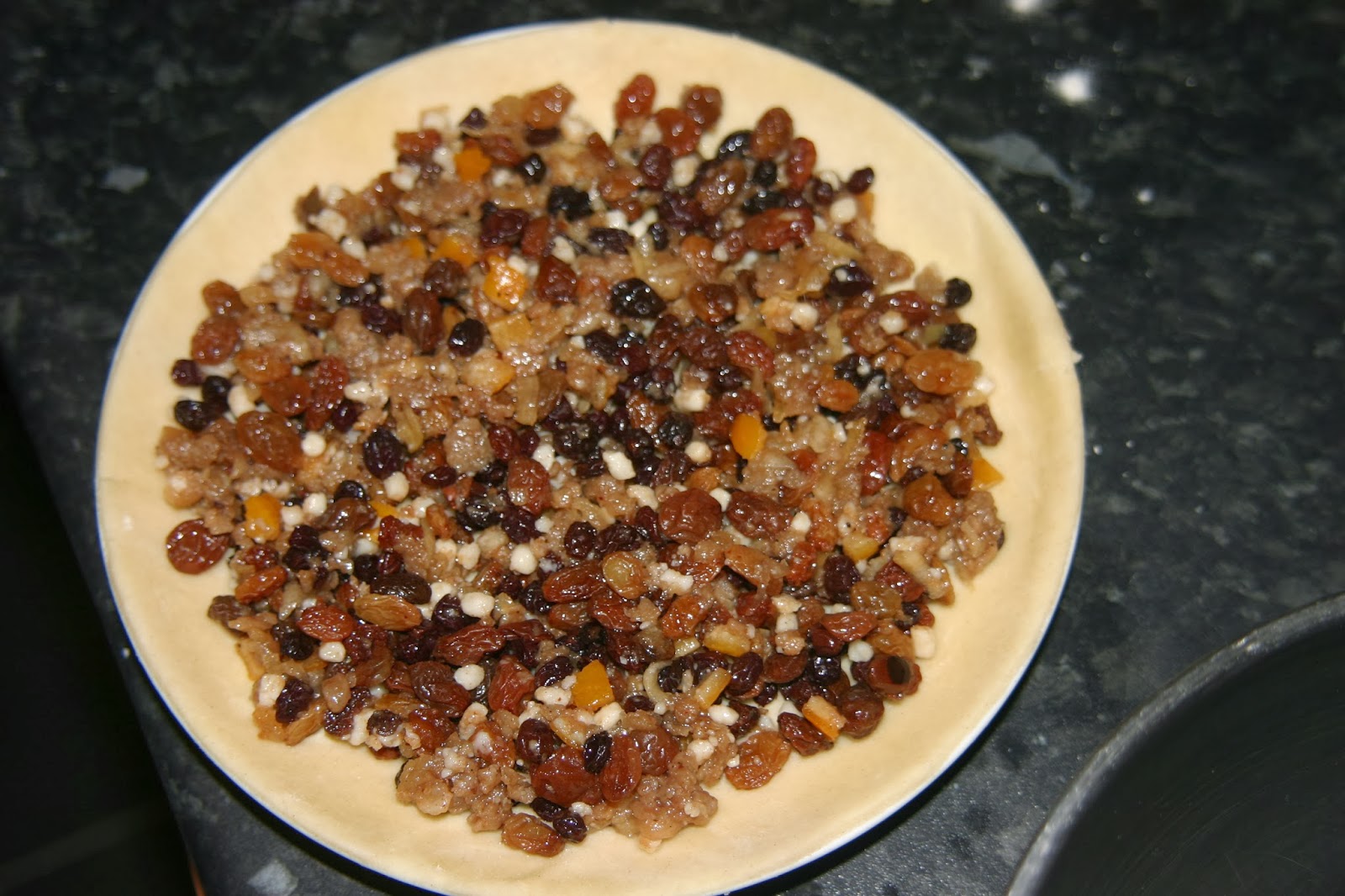
To make the pie, start with the filling. Mince together 6 ounces of lean, boned lamb with 3 ounces of lamb fat(you can the butcher for fat trimmings or keep your own and freeze them until you have accrued enough). Mix these together along with 6 ounces of apples, any will do, but I used tart Bramleys, 4 ounces each of currants, raisins and sultanas, 2 ounces of candied peel, the juice of one orange and half a lemon, 2 ounces of blanched, slivered almonds, 4 tablespoons of rum, a good pinch of salt, freshly ground black pepper, half a teaspoon each of mace and cinnamon and a quarter of a teaspoon of freshly grated nutmeg. Phew.
Once well-mixed, give it a little taste and add more seasoning and spices if you wish.
Next, roll out enough shortcrust pastry and line the plate with it. Scatter over the filling and cover with more pastry, sealing the edges with beaten egg or water. Trim the edges and crimp, before glazing with beaten egg in the usual way.  
Bake at 200⁰C for around 30 minutes.
Jane says that any remaining filling can be used to make small mince pies. I think I went one better however, and made sweet lamb Eccles cakes, which were such a success they ended up on my last Pop-Up Restaurant’s menu.
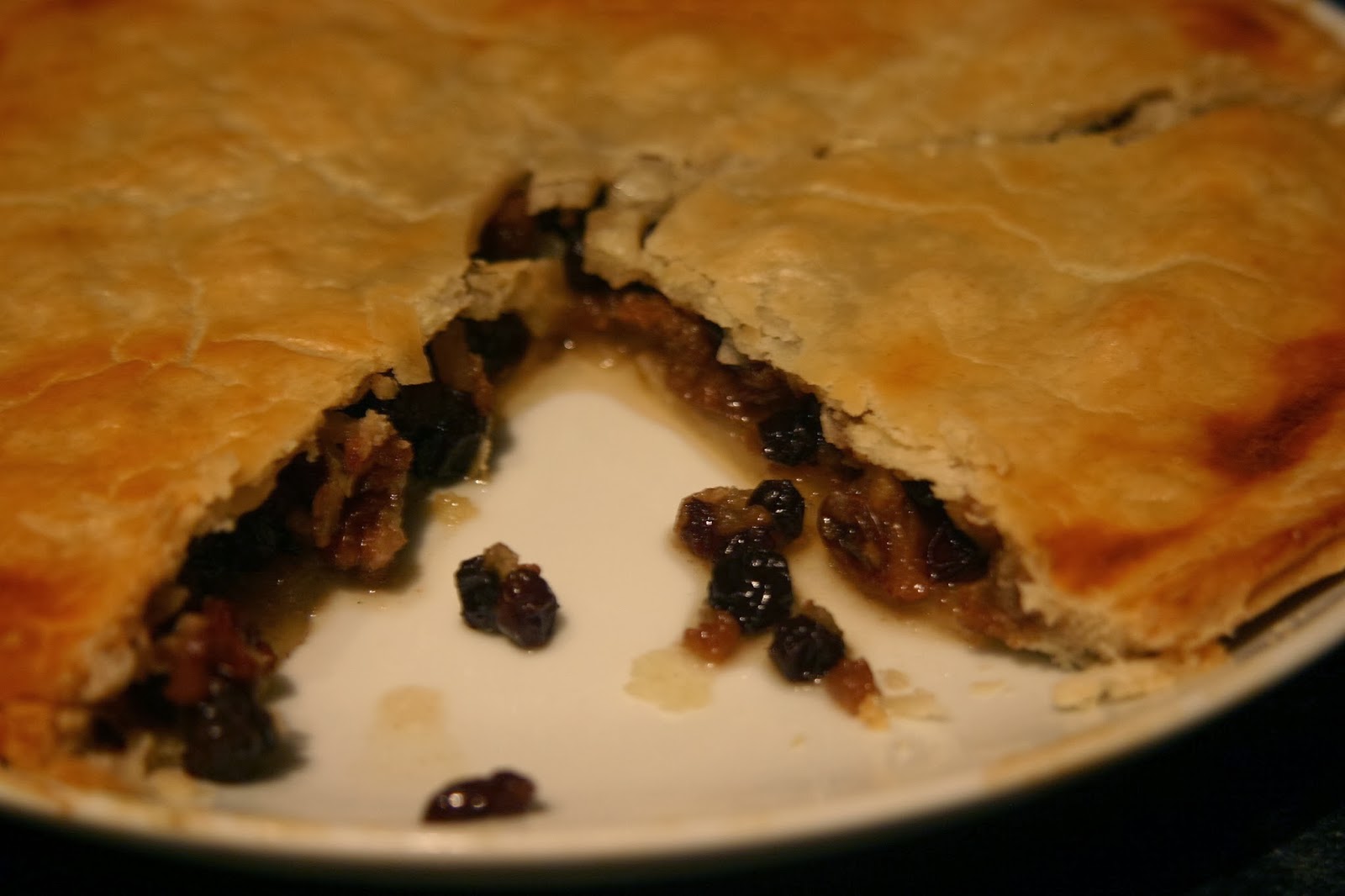
#388 Sweet Lamb Pie from Westmorland. I spotted this pie quite early, thinking it must be awful. Today I feel Jane Grigson has taught me well and I now knew this would be good. When you bite into it, you get the taste and aroma of lamb – so you know it is there – but the fruit and spice compliment it very well. There is no added sugar and the apples are still tart, so it is not sickly like a Christmas mince pie. Is it sweet? Is it savoury? It does not matter; these sorts of recipes are the crowning glory of English Food. Really lovely, go and make one. 8/10.

#375 Boiled Silverside of Beef

 
Here’s a nice simple recipe that really shows off simple English cooking at its best. When I first started cooking boiled meats for the blog, it was always a disaster because the meat was tough and all of its flavour seemed to just dissipate away. It is for these very shortfallings that English food is viewed as bland and boiled to death. Here a joint of beef is ‘boiled’ with plenty of stock veg and spices, but really ‘boiled’ is the wrong word to use entirely because it’s poached rather than boiled. The most you want the water to be doing is giving off the odd tiny bubble and gurgle, a temperature of about 80⁰C. As soon as I realised this error, boiled meats have been coming out tender and delicately-flavoured, so I was looking forward to this nice, light recipe that seemed perfect for early spring.

It’s worth giving a few more pointers for perfect boiled meats: First, use a closely-fitting pot so that the vegetables can lend maximum flavour and so the meat juices don’t become too dilute. Second, use the best ingredients you can afford because it makes a world of difference to the finished dish. Try and get meat that has been hung properly by a real butcher, that pink nonsense you buy in the supermarket will simply not do. Lastly, season, season, season! Simple cooking like this depends on a good seasoning of salt and black pepper.

Although this recipe uses a piece of fresh meat, it is really a footnote to #161 Boiled Salt Beef & Dumplings and so appears in the Cured Meats part of the Meat, Poultry & Game chapter and not the Beef & Veal section.

Once you have your silverside of beef, you need to calculate the cooking time which I described in #150 How to Cure Meat in Brine.
 
Put the beef into its close-fitting pot along with the vegetables and spices from #161 Boiled Salt Beef & Dumplings, which were: 2 large unpeeled onions studded with 8 cloves, 2 blades of mace, a small bit of nutmeg and plenty of black pepper. However, seeing as this meat is fresh meat and not strongly-flavoured cured meat, it will need a bit of a helping hand, so add also a parsnip, a carrot and a piece of turnip gives some extra flavour. Cover with water, bring slowly to a gurgle and simmer gently until cooked.
When ready, carve slices and serve with boiled potatoes, carrots and horseradish sauce. Although Jane doesn’t say it, I also added a couple of ladlefuls of the cooking broth to produce a meal not unlike #98 Cawl [which appears to have not been proof-read before posting].
#375 Boiled Silverside of Beef. I knew Griggers wouldn’t let me down on this one! It was beautifully and subtly flavoured with the sweet vegetables and meat itself was so tender. It really makes a great alternative to a roast on a summery Sunday. I reheated the next day and the broth was even better flavoured. Any broth left over makes ‘beautiful soup, says Lady Jane. 8/10

#369 Game, Rabbit or Chicken Pie

Here’s a raised pie that is versatile – you can use chicken, rabbit or any other game as its base. I went with game as I love cooking with it and love eating it even more. I’m giving you it just in time for the end of Britain’s game season. I would advise you go out and get some pheasant and pigeon right know – this was so good I have been making them in huge amounts for the market stall.
You can make pies of all sizes here – one massive one or many tiny ones. It’s up to you – look at the #282 Raised Pies post for more details on cooking methods. That post also goes through how to make the hot water pastry. If you want to make your own jellied stock, have a look at this post here.
For the filling, start by removing one pound of meat from the bones of your chosen game, rabbit or chicken and cut it into nice pieces. Keep any trimmings and bones.
 
Next, mince together 8 ounces of hard pork back fat (or fatback in America), 12 ounces of lean pork, 8 ounces of lean veal as well as any of the game, rabbit or chicken trimmings. You’ll also need 8 ounces of thinly sliced streaky bacon (unsmoked preferably); you use it to line the pie, but before all that, you’ll need to take 2 of the rashers and mince them. Mix all the meats together well – the most effective way to do this is to squeeze and squidge it through your fingers – incorporating 3 tablespoons of brandyor Madeira or 5 tablespoons of dry white wine as well as a good seasoning of salt and pepper as well as nutmeg, cinnamon and cloves plus a heaped tablespoon of chopped parsley.
 
Once you have made your raised crust – I did these ones in muffin tins and there was enough meat for just a shade under 40 pies! – line the pastry with the remaining bacon. Lid them and bake for the appropriate amount of time, my little ones took 35 minutes at 200⁰C (400⁰F). See this post here on how to make and bake a raised pie.
 
When cooked, pour in the jellied stock as normal (see this post here for help with that). Use the bones from your chosen star meat to make the stock.
Would you believe I forgot to take a picture of the finished product. What a plank I am.
#369 Game, Chicken or Rabbit Pie. As mentioned in my little introduction this pie was amazing, and by far the best of the raised pies so far; the pork and veal prevented the game flavours from becoming dominant, and the warming spices really gave the pie a taste and aroma air of old-fashioned England. I must try this pie with chicken and rabbit soon. I hope it is as good without the game! 10/10.

#368 To Dress Rabbits in Casserole

Rabbits are vermin and therefore, unlike most other game, have no ‘season’ and can be hunted all year round. This does not mean they are dirty animals of course; they simply breed like nobody’s business. The reason for this is that they are an introduced species, the Normans raised them on farms and inevitably there were escapees. Rabbit became the ultimate peasant meat and a stigma became attached. Rabbit and other game seem to be having a bit of a comeback. Bring it on, I say.
Farmed and young rabbits have pale, tender flesh and older wild rabbits have much darker flesh; almost black in some areas. Florence White, writing in her wonderful book Food in England gives us some sage advice on cooking and selecting wild rabbits: A young rabbit shot clean in the fields, is white like chicken and should be treated as such… Fat old country rabbits make good pies and stews. Thin, scavenger rabbits, trapped, broken-legged, and killed in fever and slow misery should not be eaten at all. They are definitely unhealthy food.
This is the last rabbit-based recipe in the book and probably my final one from the Gamesection until next season. It is an 18th century dish that comes from The Art of Cookery by Hannah Glasse, a lady that pops up a lot in English Food.
Hannah Glasse’s recipe serves four.
Joint one wild rabbit or ask your butcher to do it for you. Season some flour – around an ounce – with plenty of salt and pepper and liberally coat the rabbit pieces with it. Melt 2 ounces of butter in a pan and fry the rabbit pieces a golden brown colour – don’t overcrowd it, fry in a couple of batches if need be. Place the browned pieces in an ovenproof casserole dish. Deglaze the frying pan with ¼ pint of dry white wine and pour over the rabbit along with a pint of beef stock. Make a bouquet garni with suitable herbs and spices (I used bay leaves, rosemary, lots of thyme, parsley stalks, pared orange peel and a few whole black peppercorns) and pop that in too.
Put on the lid and bake in a low oven – 120-140⁰C (250-275⁰F) for at least 90 minutes. It is best to let the rabbit cool in the oven then reheat it the next day – this will produce nice tender rabbit – alternatively cook for another hour or two at that very low setting.
Fish out the meat and herbs and keep the rabbit warm somewhere. Strain the sauce through a sieve and bring to a simmer. Make a beurre manié by mashing two ounces of butter with a rounded tablespoon of flour. Whisk in pieces of it until the sauce is of desired consistency. I like a nice thick sauce so I used it all.  Add the juice of a Seville orange to the sauce and season with more salt and pepper if you think it needs it.
Slice two more Seville oranges thinly and nick out small triangles from the slices is a decorative manner. This is a very fiddly and boring job and I must admit I did give up after a couple of slices. Add the little nicked pieces of peel to the sauce.
Arrange the pieces of rabbit on a warmed serving dish with the orange slices arranged around it. Lastly, pour the sauce over the rabbit and serve it nice and hot.
#368 To Dress Rabbits in Casserole. This was a good dish – the rabbit was nice and tender and the sauce was light. The only problem was that there wasn’t much flavour from the Seville oranges in the sauce. I think that the juice of 2 oranges would have been better. Perhaps it was my fault for giving up nicking my little triangles from the orange slices. I would also lose the pointless decorative slices. 6/10.