#198 Compote of Bonchretien Pears

I’ve been rather busy of late and not had much time for cooking or blogging. Oh well, we all have fallow periods. It seems like ages ago that I did the dinner party that was just a couple of weeks ago and I’ve only just gotten round to telling you about the dessert.

I wanted to do something that I could make ahead and was seasonal too. This pear compote was the obvious choice. A nice clean tart fruit after all that cream and fried bread from the previous courses. I was concerned that I wasn’t going to find any Bonchrétien pears though – I’d never heard of them. I turns out the Bon Chrétien (which translate as ‘good Christian’) pears are a type of Williams pear, the most common of the pears.

This recipe is another from Hannah Glasse, a book called The Complete Confectioner, published in 1790 – there are no specific weights and cooking times really, which is a good thing as there is a huge variation in sweetness and folks’ tastes too. Do buy good pears for this though; don’t worry if they are under-ripe.
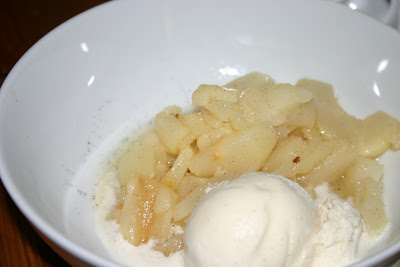
Peel, core and slice your pears. Plunge them into a pan half-full with boiling water that has been acidulated with lemon juice. Bring to the boil and simmer for two minutes before draining and returning to the pan. If your pears are particularly hard, they may need a little more time; if they are soft, I probably wouldn’t simmer them at all. Gently stew the fruit with some sugar to taste for a few minutes, either over the hob or in the oven. Make sure the pan is covered well. To add extra flavour and interest add some pared lemon peel or a split vanilla pod (I went with the latter). Once tender, remove from the heat, squeeze some orange juice over the pears and leave to cool, covered. Griggers or Glasse make no suggestions for accompaniments, so I went with vanilla ice cream.

#198 Compote of Bonchrétien Pears. I don’t cook with pears very often and this is first time I’ve made a compote from them. They were are very good end to a rich meal, and the vanilla made them extra-delicious. I think that we should all swap our apples for pears whenever we think about making a crumble or pie this autumn or winter. 8/10

#179 Fruit Salad with Tea

I made this dessert to go after the duck with mint and sauce paloise as it was all very rich, the idea being that it would cleanse the palate and all that. Plus it’s a chance to use lots of the dark summer fruits now that they’re on the wane a bit. (That said, they are just coming through in the wild – when Butter and I went to Chatsworth House for a walk in the woods, we found wild raspberries, blackberries and strawberries.) I had mentioned making this fruit salad a few times, but people always opted for something else. This time, I just made it and didn’t tell anyone what they were having; a strategy I may use again. What seems to put folk off is the addition of the tea, of course, and think it’s just some weird post-war thing (I must admit, I thought that too), but Griggers says that it is delicious and that you would never guess the delicious sweet liquid is mainly Earl Grey.

You can any fruit you like and in any quantity, though it is best to stick to dark and red soft fruits. I stuck to what Jane suggests: 1 lb purple plums, stoned and chopped; 1 lb black cherries, stoned; ½ lb black grapes, halved; ½ lb strawberries, halved (or sliced if they are large) and 4 ounces of raspberries. Arrange the fruit in a glass bowl in layers, using sliced strawberries to line the bowl, and sprinkling sugar as you go. Cover and leave overnight. Next day, make a double strength brew of Earl Grey or orange pekoe tea and leave to cool. Pour it onto the bowl so that it almost comes to the top. Taste the tea and add more sugar if necessary. Decorate with mint leaves. There is no need to serve it with anything at all.

#179 Fruit Salad with Tea. Really, really good! A complete surprise and a taste sensation. The tea was light, sweet and delicious, and Jonty and Butters didn’t guess that there was tea in there. The fruit had gone soft and juicy, looking like little jewels. I didn’t think a fruit salad could be so good! I shall never make a fruit salad any other way again. 8/10

FYI: The Earl Grey referred to in Earl Grey tea is the second Earl Grey, who was a Prime Minister in the 1830s. He was sent some tea flavoured with bergamot oil as a gift from China, and so it was forever named after him

#173 Summer Pudding

The quintessential English pudding for, er, summertime. The summer pudding is one of my favourite desserts; I’d never made one before, but had eaten many. It is my favourite because it contains a massive load of summer berries, in particular, raspberries. For those of you that don’t know, a summer pudding contains lightly stewed summer berries encased in slightly stale bread. The ‘soggy’ bread seems to put many people off, but it doesn’t even seem like bread. Trust me. Apparently, the summer pudding arose in care homes of yore because many invalids couldn’t stomach the rich and heavy pastry or suet puddings.

Make this pudding whilst there is a glut of summer berries that are in season and therefore won’t cost a fortune. (The original recipe is for a huge one that serves eight to ten people, but I halved all the ingredients).

Place a pound of summer berries in a bowl with 4 ounces of caster sugar. Grigson says to use blackcurrants, or a mixture of raspberries, redcurrants and blackberries. The truth is, you can use whatever you want – chopped strawberries are a common addition, for example. Stir, cover and leave overnight. Add the fruit and the juices to a saucepan and bring to a boil and simmer for two minutes to lightly cook the fruit. Next, prepare the pudding basin – you’ll need a 2 ½ pint one for this amount of fruit. Cut a circle of slightly stale white bread for the bottom of the bowl, and then cut wide strips for the edges which should overlap as you place them inside the mould to produce a strong wall with no leaks – make sure you remove the crusts!. Once they are all arranged, pour in half the berry mixture, then add a slice of bread, then the rest of the mixture. Cut more bread make a lid and then fold over or trim any surplus bits. Put a plate on top and weight it down with a couple of food cans and place in the fridge overnight. Turn the pudding out onto a plate and serve with plenty of cream. (Grigson suggests making some extra berry sauce to cover any bread that has not become soaked, though you can get around this by dipping te bread in the berry juices before you place them in the pudding basin.)


#173 Summer Pudding – 9.5/10. It is jostling with Sussex Pond Pudding for first place in the pudding stakes for me. What is there not to like about a big load of tart berries and a dollop of cream? Anyone squeamish about the soggy bread really needn’t be – it is an English classic and everyone should try it (if not this one, then the Sussex Pond Pudding!).

#167 Brown Bread Ice Cream

Aside from all the smoked stuff we bought at the Cheshire Smokehouse, we also got ourselves some nice desserts (and VERY nice they were too). To go with them I knocked up this very traditional brown bread ice cream. It’s an easy one as you don’t require an ice cream maker to make it, and is also the last of the ice creams in the book. It’s seems a little over-simplified as dry baked breadcrumbs are used – as far as I know it is caramelised breadcrumbs that give it a special crunch. Hey-ho – one must do as one is told.

I don’t know anything about its history – I know it’s very English, but I can’t find any websites that say how or why the addition of brown bread to ice cream came about. If you know, send me a comment! Ta.

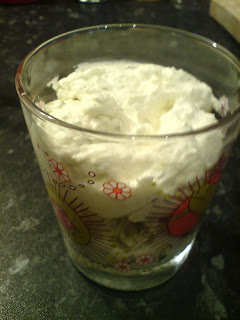
First of all spread six ounces of wholemeal breadcrumbs on a baking tray and bake in a moderate oven until crisp – around 20 minutes. Whilst they cool, beat together ½ a pint each of double and single cream along with 4 ounces of pale brown sugar until it thickens and the sugar dissolves. Now mix a tablespoon of rum into 2 egg yolks and add that to the cream mixture and beat it in well (the rum is optional, but makes all the difference). Whisk 2 egg whites until stiff and fold those into the creams, and then lastly the cooled breadcrumbs. Pour into a tub and freeze. There’s no need to stir it.


#167 Brown Bread Ice Cream – 6/10. A nice ice cream, but I was slightly disappointed; the brown bread, brown sugar and rum produced a lovely subtle malty taste, but because the crumbs were not caramelised with some sugar, they went soggy. I’m not sure why Jane doesn’t include this step, as it would take a good ice cream and transform it into a delicious one. If I were to make it again, I would caramelise the dried crumbs with a tablespoon or two of sugar and an ounce or two of butter so that they get really crisp before folding them into the cream.

#163 Wild Apricot Fool or Ice Cream

Seeing as we’d had a very un-summery meal of beef and dumplings, I thought I’d better do something nice and cool and refreshing for pudding. This fool is classed as a winter fool by Jane Grigson, I assume because it has dried fruit rather than fresh fruit in it. However, she says it can also be made into an ice cream, transforming into a summer pud.

It uses an ingredient previously unknown to me – dried apricots; not the semi-dried apricots you get from the supermarket, but whole, tiny completely dry ones from Asian supermarkets. They really are rock-hard dry so make sure you soak them in cold water overnight before you use them.

In case you didn’t know what to look for –

the apricots in their dry state

This recipe uses six ounces (dry weight) of the apricots.

Simmer the soaked apricots in their soaking water for 5 minutes. Remove them with a slotted spoon and boil their soaking liquor down to a syrup. Meanwhile, remove the flesh, reserving the stones, and mash it into a coarse puree. Crack open the reserved stones, to reveal the kernels, chop them roughly and add those to the puree. When the soaking liquor is syrupy add that too and allow to cool. Add some icing sugar and lemon juice to bring out the flavours, if needed. Beat ½ pint of whipping or double cream and fold this into the puree. If you are making this into a fool put into glasses and chill, or alternatively pour into an ice cream maker.

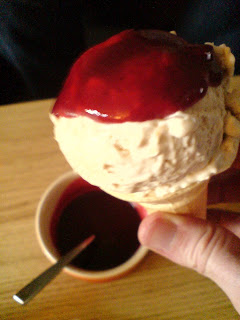
Griggers suggests serving it with almond biscuits, but I went one better – I served them in ice cream cones with home make monkey blood (that’s raspberry sauce to you).


#163 Wild Apricot Fool or Ice Cream – 6/10. Very nice, though lacked flavour; this was, I think, due to it being cold and therefore requiring a lot more sugar and lemon juice than I gave it, as it tasted fine before freezing. That said it did have a nice honey-like taste and the chopped kernels were delicious and made it texturally more interesting than a bog-standard ice cream. I think the recipe was best suited to a fool rather than an ice cream. With a few changes though, this could be bumped up to be a 7 or 8 out-of-ten ice cream.

FYI: apricot kernels contain potent anti-cancer drugs and have been used to treat tumours since the 6th Century. They are also believed to cleanse the respiratory system and have been used to treat coughs. Combine this with the super-high carotenoid content of the apricot flesh, and you’ve got a serious super-food on your hands, mister!

#157 Gooseberry Fool

Technically the first of the British soft summer fruits, the gooseberry is one of my all-time favourites. It seems to have gone out of favour these days and quite tricky to track down. I suppose it’s because you have to top and tail them and cook them before you eat then. It’s big shame though. It seems that some people don’t even know what gooseberries are, seeing as one woman in the greengrocers told the lady on the till that there was “something wrong with your grapes, ‘cos they’re all hairy”. I despair sometimes, I really do. Oh well, if you come across some and don’t know what to do with them, start of by making a fool. If you don’t find any, you can substitute any soft fruit for the gooseberries and still have something delicious.

This was enough for three:

Top and tail 8 ounces of gooseberries, place them in a pan with an ounce of butter, cover and cook them gently. Once the gooseberries turn a yellow-ish colour and have softened – around 5 minutes – crush then with a wooden spoon and/or a fork. Try to avoid making them too pureed and mushy; you still want a bit of bite. Now add sugar, not too much as the fruit is supposed to remain a little tart, however, this is all down to personal preference. Allow to cool. Now whip ¼ pint of double cream and fold in the gooseberries and spoon into serving dishes. Grigson suggests serving with an almond biscuit (I didn’t)


#157 Gooseberry Fool – 8/10. This is my kind of pudding; small, yet perfectly-formed, I love stewed fruit and cream (or custard) of any type, but gooseberries especially and they are such a short-lived treat that you need to show them off as best – and as simply – as you can.

#153 Mocha Cake

This recipe contains absolutely no seasonal produce whatsoever. I’m not even sure it has any nutritional value either. This bizarre pudding was greatly loved in the Grigson household, particularly at birthdays and it seems to be some odd post-war version of a tiramisu: fresh coffee replaced by instant (fine by me), cream and cream cheese replaced by butter, sugar and ground almonds, and coffee liqueur replaced with sherry. It harks back, I think, to World War II where ‘mock’ foods were commonly made, e.g. mock cream, mock apricot tart, mock mayonnaise. They usually involved whipped margarine or lard. I know the apricot tart used carrots as its substitute.

Jane Grigson also mentions how good the French are (were?) at coming up with new and exciting puddings using boudoir biscuits. However, this one’s not French, it’s English, and was originally published in the Daily Telegraph. Alarm bells should have started ringing at that point…

Makes enough for 8–10 people:

Begin by creaming together 4 ounces of lightly salted butter with 4 ounces of vanilla sugar, once fluffy, beat in a large egg yolk. Next, measure out ¼ pint of milk and 4 ounces of ground almonds. Incorporate these into the creamed butter and sugar by adding alternately, a little at a time. Now slake a generous teaspoon of instant coffee in 2 teaspoons of boiling water and mix that in. Give it a taste – add more coffee if you like.

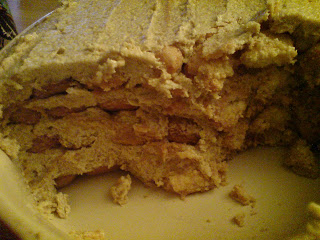
Now pour another ¼ pint of milk into a bowl along with a glass of dry sherry. Dip boudoir biscuits in the milk, but don’t let them soak, and arrange them in the bottom of a shallow oblong or oval dish. Now spread a quarter of the almond mixture over those. Repeat so that you have a total of 4 biscuit layers and 4 creamy layers. Make sure that you put cream over the sides so that all biscuits are covered. Cover with toasted slivered almonds and glace fruits if you like.

It’s hard to believe, but this tasted worse than it looked

#153 Mocha Cake – 2/10. Not precisely inedible, but just so unbelievably sweet and sickly. I have no idea why the Grigson clan like this pudding so much. There amount of sugar put my teeth on edge, and I may have woken up the next morning diabetic. The pudding was left out for a few days and was still okay to eat (it was slightly better in fact as the biscuits had gone soggier), no fly or microbe seemed to have touched it. I think that it may remain perfectly preserved for ever more due to its humongous sugar content.

#142 Ballymaloe Fruit Tarts

As Grigson says in her entry for this recipe – “in no way are these English”. Seeing as they’re obviously Irish; a recipe from a lady called Myrtle Allen who lived/lives in Cork (I wonder if she’s related to Rachel Allen?), but came up with it in France, I’d be inclined to agree. However, as you’ll see if you make them, they seem quintessentially English – the whipped cream, the chewy ground almond base and, most importantly, the use of seasonal fruit. One fruit on my seasonal list for May is rhubarb. However, there’s no rhubarb recipe in the book, at least not specifically rhubarb. This seemed like the only opportunity to use it. You can of course use any fruit: “During the first part of the year, top them with chunks of lightly cooked pink rhubarb, next come gooseberries, then the wild possibilities of the full summer…”.

FYI1: If like me, you love rhubarb, don’t make a habit of eating too much of the green rhubarb as it causes kidney and bladder stones due to the oxalate contained in the green areas – it dissolves in the blood no problems but in large amounts precipitates once it’s been filtered by the kidneys.

FYI2: All of the pink forced rhubarb in Britain comes from West Yorkshire – the rhubarb triangle. It’s a triangle because all farms are located within the triangle that Leeds (my home town), Branford and Wakefield make up. Read about it here.


This is a very easy recipe; summery and light, just right to finish off the skate salad I had made. For the base you need ground almonds, caster sugar and lightly salted butter all in equal amounts. Griggers says 4 ounces of each, but I went for 2 ounces of each seeing as there was just me and Butters to feed. This made 12 little tarts.

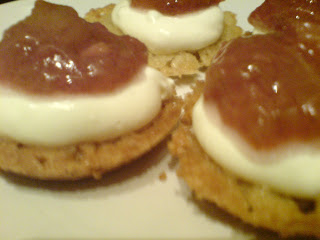
Preheat the oven to 180⁰C. Cream together the butter, sugar and almonds and place teaspoonfuls of the mixture into a small tart tin. Bake for 10 minutes, maybe more, maybe less; what happens is magical – the blobs of mixture spread out to form perfect little tart bases that are cooked once they are rimmed with golden brown. Take them out of the tins when they’ve cooled a little bit with a butter knife or a teaspoon and allow to cool and harden on a wire rack. Don’t leave them in there too long or they’ll stick to the tins. Now whisk some cream, and a little sugar if you like, and place a teaspoon of it in the tart case and some of the fruit on top. (For the rhubarb, I stewed it lightly with some sugar and a vanilla pod.)

#142 Ballymaloe Fruit Tarts – 7.5/10. Really simple and delicious. The base is chewy and the topping, light. Even if you don’t bake these sorts of things, have a go at these – you get a lot of return for little effort.

#139 Bakewell Pudding

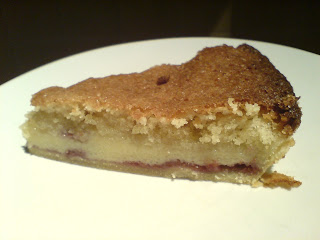
As I’ve mentioned previously, I’ve got quite a lot on at the minute – the main ball-ache being that I’ve been in work almost everyday over the last few weeks including weekends. Therefore, on Saturday after a big lab sesh, I really felt the need to do some baking, so for pudding on Saturday evening I plumped for the Bakewell Pudding. Don’t be getting this confused with a Bakewell tart – they are similar, but with important differences: Bakewell tarts have a pastry base, a thin layer of cherry jam, frangipane, and then a covering of icing with a cherry on top. A Bakewell pudding, pastry, raspberry jam, then a layer of egg custard mixed with ground almonds (in fact, in days of yore, there would have been no almonds at all, so the emphasis is definitely on the egg custard). These may not seem like important differences, and they are not, but just pointing them out for any pernickety people out there who like their factoids.

Anyways, have a go at this pudding – serve it warm or cold. Griggers doesn’t mention cream when serving it or anything like that, but I can’t imagine it would do any harm!

Start by making a sweet shortcrust pastry – I made mine from 6 ounces of plain flour, 2 ounces of icing sugar, 4 ounces of butter and a little milk. Griggers says to line an 8 inch tart tin with the pastry, but I found that there was mixture left over, so make it in a 9 inch tin if you have one – alternatively make additional mini ones as I did! Once lined, spread over a thin layer of raspberry jam – not too much, a good dessert spoonful will do it.

Now make the main filling: gently melt 4 ounces of unsalted butter in a pan and leave to cool. Then beat or whisk together 4 eggs with 4 ounces of caster sugar until creamy and frothed up (use an electric whisk/beater, unless you like doing it by hand). Slowly pour in the butter and mix gently before folding in 4 ounces of ground almonds with a metal spoon. Pour the mixture into the case and bake for 30-40 minutes, or until the filling has set, at 200-220⁰C.


#139 Bakewell Pudding – 7/10. A real homely comforting pudding/tart, very sweet and moist. It reminded me of the cakes my mum used to make when I was little – I think hers was coconut rather than almonds, but the effect is pretty much the same. Really nice with a cup of tea or a glass of milk.

#131 Devonshire Junket

No I’d never heard of one either. A junket is made by mixing milk with rennet and letting it curdle, adding whatever flavour you wish. Essentially, it is Little Miss Muffet’s curds and whey. These sorts of puddings were very popular – and still are in France. The English version being different in that the curds and whey aren’t separated, whereas other nations usually do. This is a very old recipe going way back – the earliest Griggers found was in a book from 1653. In fact the term ‘junket’ comes from the Norman French, jonquet, which was a basket made from rushes (jonques) to drain cheeses, says Jane. The junket has fallen out of favour, but is hanging on as a speciality of Devonshire, south-west England. The trickiest bit of the recipe, is finding somewhere that sells rennet – if there’s any Mancunians reading this, I got mine from Barbakan in Chorlton.

FYI: Rennet is an enzyme that used to be extracted from the stomachs of calves to curdle milk. Although still used, most manufacturers used vegetarian rennet to make their cheeses etc. I think the veggie-friendly rennet is produced using bacteria with the rennet gene inserted.

For 4 to 6:

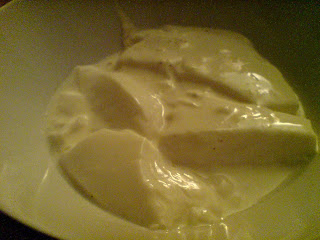
Warm a pint of Channel Island milk slowly until it reaches 37°C. If you can’t get Channel Island milk, use whole milk – do not be tempted to use skimmed or semi-skimmed, it will not work. Whilst it’s warming, mix a dessert spoon of sugar with 2 tablespoons of brandy in the serving dish that you want to set your junket. When at temperature, pour the milk into the dish and carefully stir in a dessertspoon of rennet (follow the instructions on the bottle in case this is different). Now leave the milk to set at room temperature. I went back and checked it after an hour and it was done – it had essentially become fromage fraise. Now slacken off ¼ pint of clotted cream with a little double cream and pour or spread it over the junket, being careful not to let it split. Lastly sprinkle some nutmeg or cinnamon over the top and you are done.


#131 Devonshire Junket – 5/10. This was ok, but sugar and cream always tastes good. I think the brandy should be replaced with some stewed fruit or vanilla extract, because I loved the texture of it. I think with a little playing around, the junket could have a come-back. I am dreaming up variants as I type…