#66 Shortbread

I made these shortcakes to go with the Mangoes of the Sun dish, but make them any time you want. Greg, Lee and I polished the remaining ones off with mug-fulls of tea and even white wine (we were a bit pissed by then, though!). Make the biscuits any size you want – I used a fluted pastry cutter, but use whatever is at hand, or cut into fingers, or even to a plate sized bit. Traditionally, oats should be used, but the English way is to replace them with flour and corn flour to give the biscuits a delicate, crumbly texture

First, make a flour mixture made up of two parts plain flour to one part corn flour (or rice flour). Either make a big batch of this or make precisely nine ounces. I made just what I needed, though I think I’ll be making some more pretty soon. Mix in 3 ounces of cold, cubes butter and one of sugar (In other words, a ratio of 3:2:1, so you can actually use any amount you want!). Either use a mixer or the tips of your fingers to rub in the butter, and once the mixture is breadcrumb-like, bring it together and knead briefly to form a dough. It will seem too dry at first, but the heat of your hands will help it. Don’t over work the dough either – you want a crumbly biscuit, not a cookie. Roll out the mixture to your preferred thickness and cut into your preferred shape. Put on a baking tray and scatter with more sugar. Bake at 180°C until cooked, you must take them out before they stat to colour, so keep an eye out for the merest hint – the timing will depend on the shape and thickness of your shortbreads.

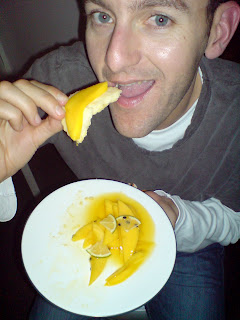
Lee with said shortcake and mangoes

FYI: Traditional Scottish shortbread goes back to around the Twelfth Century, and it is traditional in the Shetland Isles to break a giant shortbread over the head of the bride on the day of the wedding.


#66 Shortbread – 9/10. Wonderful, crumbly and tasty; and this was the first time I’d ever made them. You cannot but shortcakes like this no matter where you go – they are too crumbly and short to be packaged. You’d just end up with a packet of dust.

#63 Fruit Tea Loaf

The third bit of stodge I made for the little gathering at mine for my birthday. Tea loaves are great and very Yorkshire, but I’d not made one before – it’s extremely easy, in fact, if you’ve never baked or have some terrible affliction, like feet for hands or something, then you should try this. People don’t eat this kind of stuff any more, so many don’t like dried fruit for some reason. They are better left in an air tight container for a few days before scoffing (if you can last that long – I couldn’t). Always serve your tea loaf with butter spread generously over it, or as they do in Yorkshire – though non-Yorkshire folk never seem to believe me – a slice of cheese. Sorry for the shit picture, folks.


To produce a squidgy ingot of loveliness of your own, start off by mixing 12 ounces of mixed fruit with 4 ounces of dark brown sugar. I like the soft, moist molasses sugar that you get in boxes best. Pour over half a pint of strained, well-stewed Indian tea, I used Assam. Leave this mixture overnight, so that the syrupy tea is absorbed by the fruit. Next day, mix in 8 ounces of self-raising flour and an egg. Pour the mixture into a lined 9 inch loaf tin and bake for one hour at 180°C, then down the temperature down to 160°C for a final half hour. Like all baking check with a larding needle or a knife toward the end of cooking, in case of funny temperatures in weird ovens like my fan one.

#63 Fruit Tea Loaf – 9/10. Cheap and easy and delicious! I also seem to have converted people who don’t like raisins with this one. The molasses sugar and the tea make the cake moist and rich. A perfect little gem of a cake.

#62 Mrs Sleightholme’s Seed Cake

Seed cake, it seems, goes way way way back. Jane mentions books from the 1700 with several recipes. A classic English cake if ever there was one; except I’ve never heard of it. In fact there’s two seed cake recipes in English Food itself. The seeds are provided in the form of caraway, a most English of spices. The cake itself is an unusual one – half way between a traditional recipe, where you cream butter and sugar and a sabayon, where eggs are whisked up until thick and frothy.

To make the cake, cream 6 ounces each of butter and sugar and stir in a rounded dessertspoon of caraway seeds. Separate three eggs and whisk the whites until stiff, but still creamy. Beat the yolks and carefully fold these into the whites with a metal spoon, then fold the eggs into the creamed butter. Next, stir in a tablespoon of ground almonds and eight ounces of sifted self-raising flour. I find it easier to mix the flour in three or four stages to avoid getting a lumpy batter. The mixture should be slack enough to ‘fall off the spoon when you shake it with a firm flick of the wrist’, and we must do as we are told. If too thick, add a little milk; a tablespoon or two should do it.

Pour the mixture into a lined 9 inch loaf tin and smooth it down with the back of a spoon. Decorate with blanched, slivered almonds if you fancy. Bake for up to an hour (but check on it with a larding needle as it may be less) at 180 degrees Celsius. Let the cake cook for 15 minutes before taking out of the tin to cool on a wire rack.


FYI: In Henry IV Part II, Falstaff is invited by Shallow to have a snack on some of ‘last year’s pippin [apples] of mine own graffing, with a dish of caraways’. So if Mr. Shakespeare liked them, they can’t be bad.

FYI 2: Mrs Dorothy Sleightholme was a cook on Yorkshire Television. Growing up in Yorkshire and being an avid telly watcher naturally means I have no recollection of her whatsoever.

# 62 Mrs Sleightholme’s Seed Cake: 4/10. A low scorer, though not foul tasting. It was like a dry Madeira cake. It certainly needed tea to go with it as it was on the claggy side. The caraway seeds save it to some degree. There is, of course, the slightest chance that I over baked it, but I find that very hard to believe…

#59 Electric Dough Hook Bread

Since as there’s about a million different bread recipes in this Goddam book, I thought I’d better have a crack at some bread-making; I’m also trying to write a paper at the minute and therefore needed a reason to procrastinate. I’ve made bread before but it’s always been a bit arduous and not worth it, since the end result resembles a washing-up sponge in both colour and texture. I thought I’d better start at the start and make a white loaf – (#59) Electric Dough Hook Bread is the piss-easy way to do it, apparently, and if you are wanting to supply your family with home-made bread every day, says, Jane, this is the way to do it:


Measure out 3/4 of a pint of warm water and put half in the bowl of your mixer along with 2 level tsp of dried yeast and 1 of sugar. To the remaining half, add 2 tsp of salt and 4 tbs of lard or oil – Jane says olive oil is the best thing, so that’s what I did. After about 20 minutes the yeast becomes all frothy as it activates and gets going. My kitchen was quite cool, so it would probably only take 10 in a warmer one, I reckon. The salty water was then added along with 1 1/2 pounds of white flour (though you could do a combination of wholemeal and white). Put the dough hook attachment onto your mixer and turn it on low and let the dough form around the hook. When it’s all come together, you can turn the speed up a little, but it only takes about 5 minutes in all – don’t overwork it says Jane, or else!! Next put some Clingfilm over the top of the bowl and wait for the dough to double in size. I have no airing cupboard, so to speed up the process I hugged the bowl and watched telly, allowing my body heat to increase the yeast metabolism.


When that’s done, knock-back the dough by punching it to let all the air out. Roll a pound of the dough into a thick sausage shape and put in a small loaf tin, and pout the rest in a large one. Cover with cling film again – brush it with oil to stop the dough sticking – and allow to prove, i.e. let the dough rise a second time, until it is over the sides of the tins. This takes ages if your kitchen is cool – but don’t worry it will eventually.

Bake at 230 degrees C for 30 minutes, then take the loaves out of their tins and turn them upside down, so the crusts can crisp up. Put the loaves back in the tine and brush the tops with milk to make them shiny. Cool them by laying then across the tins. Phew!


#59 Electric Dough Hook Bread – 8/10. It was a foolproof recipe and it tasted lovely – really (I know it sounds stupid) bready. The flavour of the yeast made it I think. It was quite dense, but I think that was my fault for not letting it prove for long enough. I had a piece still warm with butter on, which I think is the best way to have home-made bread. You certainly don’t need to bother with fillings when bread is this tasty. If only I have time to make for myself every day!

#56 Stuffed Monkey

Well I do have some catching up to do! I’ve been cooking loads – not all Grigson dishes, but a few. Trouble is, life keeps getting in the way, and I can’t find time to write everything up. Also, I’m knackered. And lazy.

A good excuse to do a recipe is cake day at work – every Wednesday – so I thought I’d look through the book to find something to make where I’d got all the ingredients in the store cupboard, and came across (#56) Stuffed Monkey; a favourite of Jane Grigson’s. She lifted it herself from a book of Jewish Cookery, but has no idea what makes it particularly Jewish, or indeed what it has to do with monkeys. If anyone knows please tell me. Although Jewish, it does have an English feel to it – it’s basically an almond and candied peel filling sandwiched between two rounds of very sweet pastry that’s almost shortbread in texture and flavour. When baking, it’s difficult to tell whether it’s ready or not, so add an extra 5 to 8 minutes to the cooking time I’ve given if you think you would prefer your Stuffed Monkey more biscuity. Don’t worry, no monkeys were harmed in the making of this sweetmeat.

Here’s how to stuff your very own monkey:

Make a sweet-spiced pastry by mixing together 6 ounces of flour and a teaspoon of ground cinnamon. Rub in 4 ounces of chilled butter that has been cubes until fine breadcrumbs are formed. I always to this with a mixer set on a slow speed these days as it stops the butter softening and turning it to a paste too early. If you don’t have a mixer, use your fingertips. Mix in 4 ounces of soft brown sugar and an egg yolk, and bring the mixture together with your hands to form a dough. If it is too dry to come together add a teaspoon or two of milk. Allow this to rest in the fridge for half an hour, or the freezer for half that time.

Whilst you wait for this, make the filling by beating together 1 ½ ounces of melted butter, 2 ounces each of chopped peel and ground almonds, 1 ounce of caster sugar and an egg yolk.

Roll out half the pastry so it fits in the bottom of an 8 inch cake tin, spread the filling over the top, then roll out the other half and place on top. Brush with egg white and bake for 30 minutes at 190 degrees C. Cool in tin.

TOP TIP: Sweet pastry is a tricky bugger to roll and lift without it braking apart, so roll it on cling film that’s been floured. You can pick it all up at once without tearing.

#56 Stuffed Monkey – 5.5/10. It was an unusual sweet biscuity with a wonderful chewy citrus and marzipan flavored centre. I found it a little dry, however I think I may have overcooked it a little (I added an extra few minutes to the cooking time). That said, it got polished off pretty quickly and many people went for seconds, so what do I know!?

High Tea, #52, 53

I got me mates Kirsty, Keith and Thom over for a quintessentially English high tea for Bank Holiday Monday, and made some nice cakes. I did ( #52) Sponge Cake I (of two) and (#53) Ginger Cake, as well as some biscuits – I still had some dough left in the freezer from when I made (#29) Elegant Sugar Thins way back in February. We had an ace laugh., but fell pretty sick. I’ve still got some of the ginger cake, and probably will do for a few more days! Kirsty and Keith got me some ace pressies – the best being the Chinese tea set with green gunpowder tea. There’s some recipes that have gunpowder tea in it too – I had no idea what it was (and still don’t – is it the same as normal green tea?) but will find out in due course.

Sponge Cake I was pretty easy and Greg and I enjoyed making it – I’m trying to get him baking, but there is some resistance. Simply whisk together 3 ounces of caster sugar and eggs until they are all whipped up and pale in colour; this takes a while even using an electric mixer. While you’re waiting sieve 3 ounces of plain flour along with a pinch of salt, and fold it into the eggy mixture carefully using a metal spoon. (Apparently the friction of the wooden spoon pops the bubbles). Divide the mixture between two 7 inch sandwich tins that have been greased and sugared and bake for – 12 minutes at 180 degrees Celsius. Keep an eye on it if you’ve got a fan oven like me though, it does keep the oven dry (I shall use the water in the bottom of the oven trick next time). Turn them onto a wire rack, sprinkle with sugar, and allow to cool. Fill with whipped cream and raspberry jam.

The ginger cake was easy too. It’s one of those dense treacly ones that sink in the centre and weigh a ton – at least in comparison to the sponge cake. Start by creaming 4 ounces of butter, then add 4 ounces of Demerara sugar and beat that in too. Next, mix in 2 eggs and 10 ounces of black treacle (it sounds like a lot of treacle, and it is!). Sieve together 8 ounces of flour and a generous teaspoon of ground ginger and mix into the butter and treacle. Then, weigh out 2 ounces each of sultanas and chopped preserved stem ginger and mix them in too. Finally warm ½ a teaspoon of bicarbonate of soda and 2 tbs of milk in the microwave and stir them in. Pour the mixture into a 7or 8 inch cake tin that has been lined with greaseproof paper and bake for an hour and a quarter or more depending on the size of the tin at 160 degrees Celsius. Grigson reckons it gets better if you leave it. We shall see…

FYI: ginger is both a stimulant and a muscle relaxant due to it’s antispasmodic properties. It also does you wonders if you’ve got the shits. Plus, it is an essential seasoning for whale meat, according to Larousse Gastromonique!

#52 Sponge Cake I – 6/10. A nice sponge cake, but I’m used to a Victoria sponge with butter in it, and I’m not used to this super-spongy, like actual sponge, texture. This may be down to my new oven of course drying the bugger out. However any cake is nice by me, especially when it’s filled with cream and jam. We shall have to see what sponge cake II is like!!

#53 Ginger Cake – 7/10. I preferred this cake, although it was more of a treacle cake, than a ginger one. It reminds me of a stickier version of Yorkshire parkin, which is usually dry and crumbly. It’s definitely a wintertime heavy stodge cake, rather than a summery light teatime cake. The addition of the ginger pieces and sultanas made it very moreish. I reckon I would be nice warmed up and served with vanilla or ginger ice cream.

With great wisdoms comes great agony (and #49)

First off all I should apologise for my total blog tardiness of late; I have been very busy at University recently and so I’ve been working and cooking tried and tested recipes from (sharp intake of breath) OTHER cookbooks. I feel like I’ve been unfaithful to our Jane…

Today found out that I will be having my wisdom teeth out on the 15th May, which is the day Greg goes on his cruise and is also my Mum’s birthday, so I don’t know if I’ll have anyone to go with me! Not being able to eat however, will somewhat hamper my cooking, so expect a reduction in blog action! I am calling for help from you, the beloved blog reader – I need recipes for food that requires no chewing. I will obviously be making good use of my ice cream maker next week.

Any road, I did do some cooking – or, in fact, baking – again at the weekend. I am all enthusiastic about bringing back the old tradition of high tea. There was a spot on the BBC’s Breakfast programme with Prue Leith talking about how people don’t know what Eccles Cakes or parkin and other British fayre are, never mind not baking them themselves! I am on a one-man mission to bring it back. I shall open up a lovely tea shop…

I did (#49) Orange cake and invited Joff round again. I had an orange in and wanted to try the pound cake again from last week; the recipe is exactly the same, except the grated zest of an orange and the juice of half is added to the mixture. This time I baked it for only 30 minutes and it came out perfect. I suppose no one – not even Jane Grigson – is perfect. The best bit of the cake-making was the butter cream. 4 ounces of sugar and the juice of the other half of the orange were boiled until the sugar had reached the soft-ball stage. I didn’t have a sugar thermometer, but managed to do it by dropping small amounts into cold water and feeling it between my fingers. Easy. Thank goodness for my ever useful Larousse Gastronomique. This was whisked into 2 whipped egg yolks until thick and fluffy. When warm, 4 ounces of very soft butter was whipped in until even more thick and fluffy. Yum. Hopefully Greg and Joff think I have improved on the previous ones – hopefully they’ll mark it highly!

#49 Orange cake – 8/10. A fine cake indeed! I’m not going to mark it higher, because, although very good, more extravagant cakes, like the parsnip cake or divine treats like sticky toffee pudding beat cake hands down! I think I’ve nailed the pound cake now!

#47 Pound Cake and #48 Buttercream II

As well as the lovely orangeade, I thought I’d make a cake. As much as I love cooking and cake, I don’t often make them. So I thought I’d go for the basic plain sponge cake – a pound cake being the easiest because so you put all the ingredients in a mixer in one go. What could possibly go wrong with that!? The parsnip cake was very good, but seemed very easy; I reckon the only way to tell if one is a good baker is to make a basic cake very well. My favorite filling for sponge cake is butter cream, and I’ve always used my Mum’s recipe, which is simply icing sugar and butter (in fact, being a child of rationing in the UK, she uses margarine). There are two butter cream recipes in English Food, but the first requires a sugar thermometer and since I don’t have one of those (but if anyone fancies buying me one…), I went for (#48) Butter cream II.

The whole idea behind the original pound cake is that the ingredients all weigh a pound EACH! This is of course overdoing things in the modern home, I think the original recipe must have been for housekeepers making cakes for households. Therefore, nowadays all the ingredients weight a pound altogether: 4 ounces each of softened butter (if you keep it in the fridge, put it in the microwave on a medium setting for 45 seconds), sieved self-raising flour and vanilla sugar (see previous entry), along with 2 medium eggs (which should be 4 ounces). Add a pinch of salt and a tablespoon of ground almonds, which apparently make the final cake more moist, plus a level teaspoon of baking powder. Put all the ingredients in a food mixer and beat until a smooth mixture forms. An early recipe from Hannah Glasse in 1747, says that beating the mixture by hand takes an hour! No thank you, lady. Add to a lined 23cm long loaf tin and – here is where I may disagree with Grigson – bake at 180 oC for one hour and 5 minutes. When I baked mine I checked after 45 and it was overdone! I think that 30 minutes may be enough, though my loaf tin, although 23cm long, does seem quite wide.

The butter cream is a custard-based one, which sounded very nice. It was quite easy too, now that I’m sufficiently experienced in the art if custard-making. My amounts differ to Jane’s because I didn’t have enough butter, or the right sized eggs, but it made enough for a middle and top layer to the cake:

In a food mixer, whisk 2 egg yolks and 2 1/2 ounces of sugar until it becomes fluffy and very pale. Meanwhile boil 90 mls (a generous 2 fluid ounces). When it comes to a boil, beat it into the egg mixture. Quickly return to the pan and stir on a low heat of a couple of minutes – it should thicken very rapidly. It was hard to judge as the was so much foam; however, as it cooled and the foamy bubbles began to pop, it became noticeably thicker. When the whole thing begins to get cooler, but it still warm, gradually whisk in 5 ounces of very soft butter cut into small cubes. I then added a few drops of vanilla extract. When it is properly cold, use as required!

I simply cut the cake lengthwise in half and added a thin layer of raspberry jam and a thick layer of the butter cream and sandwiched the two halves together, then I spread the rest of the gooey cream on the top.


#47 Pound cake – 6/10. Little disappointed in the cake. It was very tasty, but rather dry. However, this may be my own fault as I haven’t got used to my new oven yet. The vanilla sugar that I’d made a cuople of weeks earlier, also gave the sponge a nice, sweet scent.

#48 Butter cream II – 8/10. A lovely creamy, but not overly sickly alternative to normal butter cream. I loved it, and shall be definitely doing it again!

#43 Parsnip Cake

According to the Grigson, she tried putting parsnips rather than carrots in a carrot cake, and according to her, parsnip cake totally shits on carrot cake. We’ll see…carrot cake is my favorite of all cakes, so I’ll be a harsh critic.

The cake itself was easy – a carrot cake recipe with the carrots replaced weight-for-weight with the parsnips. Proper American frosting made from cream cheese, icing sugar and butter is the filling. Hopefully the oven’s worked ok because I’ve made it for cake day this afternoon; where a member of the Evolution group at the University take it in turns to make a cake. It’s the first one we’ve done in a while, so don’t let me down Grigson!
Mix together 12 ounces of peeled and grated parsnip with four ounces of chopped hazelnuts in a bowl. Next make a cake mixture using an electric beater from 13 ounces of caster sugar, 8 ounces of flour, 2 teaspoons each of baking powder and ground cinnamon, a teaspoon of salt and 8 fluid ounces of oil (use a mixture of walnut or hazelnut and sunflower). Beat in 4 eggs individually and stir in the parsnips and nuts plus a teaspoon of vanilla extract. Divide between two buttered and floured 9 inch cake tins and bake for 40 minutes at 180⁰C. Allow to cool on a rack. Make a filling by beating together 8 ounces of full fat soft cheese, 4-6 ounces of softened unsalted butter, 4 tablespoons of icing sugar and a teaspoon of vanilla essence.

FYI: The parsnip was our main carbohydrate staple before the potato was brought over from the Americas. Also, it was thought that it was an aphrodisiac – careful if you try to pick a wild parsnip though, as it’s almost exactly the same as hemlock!
#43 Parsnip Cake – 8/10. Phew! Neither The Grigson or the oven let me down. A lovely moist cake, though I’m not sure if Jane’s Claim of it being better than carrot cake. There is however a recipe for her carrot cake – so there’s only one way to find out!!
Greg says…
“Mostly I made the parsnip cake actually. I pressed all the buttons and everything. It went round and round and out came a cake! Well done me. I gave Pugling a bit of the filling and he made this noise: bleep! I wasn’t allowed a slice until next day but it was worth the wait. Helen tried it too. We made this noise: mmm, ooohhh, mm, ng! Really really good. You would never guess it has parsnips in though. 9/10.”

Valentine’s Day – # 28 & 29

I’ve been a bit poor recently with the upkeep of this blog, so I’ll start with Valentine’s Day – least Thursday. If there’s Grigsons for special occasions one simply has to make them. So it was a choice between Sweetheart Cake or Valentine’s Day Syllabub; I went with the latter. The Grigson suggested making Elegant Sugar Thins to go with. The process for both required some prep the day before. For the syllabub add a splash of white wine, a good squeeze of lemon juice plus the grated zest, a dash of brandy and a big tablespoon of honey to a bowl and leave to infuse. For the bikkies, I simply made the mixture and let it firm up in the fridge shaped into a sausage. There were three – yes count them, three – options for the flavoring; lemon, vanilla or cinnamon. I went with vanilla, as I am loving it the moment after the rice pudding I did last week. The mixture was a basic biscuit one really – I really should find out how much of the Grigson’s recipes I can put in the blog without getting done… I only needed about a third of the mixture for the next day, so I’ve frozen the rest.

On the day, it was pretty straight forward: pour in a small tub of double cream into the lemony mixture and whip up. Place in two wine glasses and a sprinkle of toasted almonds. The Sugar Thins needed slicing very thinly and then sprinkled with sugar. They took only 7 minutes to cook in a hot oven.

For the main course I made chilli baked eggs – a recipe from another excellent book – Leiths Vegetarian Bible. This book is excellent – the recipes are all of such high quality. Most of the hundreds of recipes are traditional and not hippy cuisine at all.

All-in-all Greg and I had a lovely romantic evening, filling our faces and drinking wine as you can see by the photo – I do apologise for the depressing background of drying washing and part-built kitchen cabinets…

FYI: noone really knows who St Valentine was,and it may be a day that celebrates several saints all called Valentine. Also, the association with love and romance seems to have been completely made up as part of a story by Chaucer. I am officially a font of all knowledge…

#28 Valentine’s Day Syllabub: 5/10. When I first started eating it I thought it was lovely, but then the wine and brandy made it too rich and bitter for me. I’d have preferred it with just honey and lemon methinks!

#29 Elegant Sugar Thins: 8/10. Lovely delicate, sweet, crumbly and melt-in-the-mouth. I’m so glad I’ve made a big stash of the mixture in the freezer!

Greg says:
#28 Valentine’s Day Syllabub: 6.5/10. I think I liked this more than Neil did, he doesn’t really like boozy foods though. As usual however we tried to eat too much of it, but I think if you got a little egg cup’s worth in a fancy-pants restaurant you’d appreciate it much more. WHEN NEIL GETS A BLOODY DINING TABLE HINT HINT then we can share the wealth a little more. Are you listening?? Any road, the bitterness is nicely offset by these: #29 Elegant Sugar Thins: 8/10. Ooh I like a good thin, me: butter, lemon, cheese or sugar, you names it, I likes it. You could just sit and eat these all night with a brew in fact, they’re like a really classic sweet little biscuit from your Gran’s ‘parlour’. Muchos yum.