#258 Boiled Ox Tongue: To Serve Cold

Hello there Grigsoners! No, I’ve not died, I have simply been a lazy bastard. I am going to stop apologising for my blog-tardiness and try my very best to pull my finger out. All that said, I have been preparing this recipe on the sly for the last few days. I went to Central Market with Gerda from the lab a while ago and found that quite alot of the ingredients that are tricky to get hold of in the UK are actually much easier to get hold of here in Texas. In the meat section, I happened upon an ox tongue and I knew that there are quite a few recipes using ox tongue specifically so I thought I’d grab it and do something with it later.

I decided upon this one – Boiled Ox Tongue: to Serve Cold, because I could take it into work and force my new labmates to eat it and (hopefully) put some comments on here! The recipe calls for a 2 ½ to 5 pound pickled (i.e. brined) ox tongue – these you can order form your butcher (in the UK at least). I thought I would pickle it myself using this now tried-and-tested brine method from English Food. The tongue needs 5 to 7 days in the brine tub, but there is no maximum time really – you can’t oversalt anything, because you can soak it in water for 6 or so hours beforehand. It’s recommended you do this with a pickled tongue from the butcher’s shop.
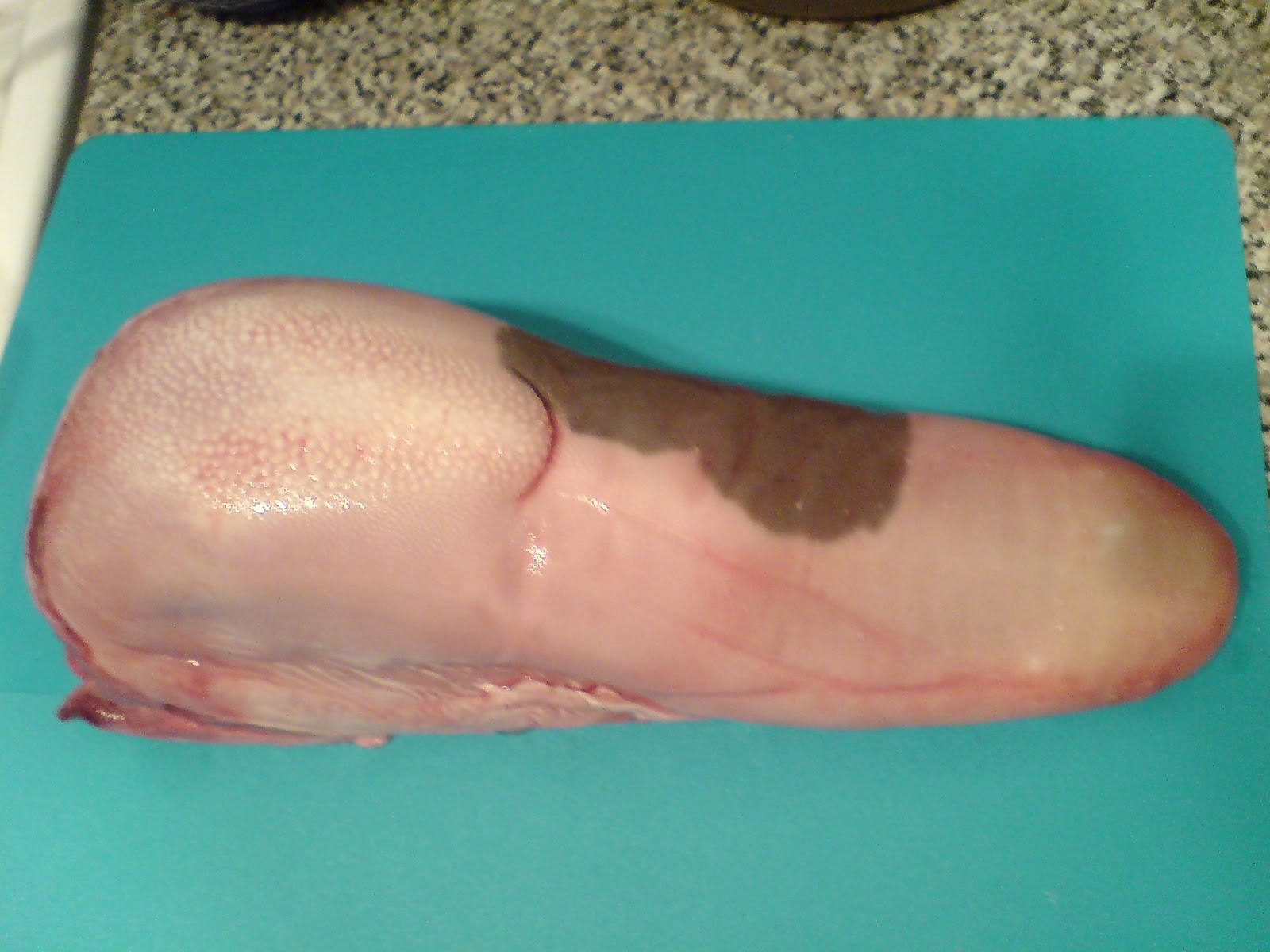


The tongue before brining

 Anyways, after you have soaked your tongue place in a stock pot and cover with cold water or a light stock. Bring it to the boil and skim any scum that appears at the water’s surface. Turn the heat down to the merest simmer. After half an hour, taste the water – if it is horribly salty, thrown the water away and start again. Add some stock vegetables: an onion studded with a couple of cloves and a chopped carrot and celery stick. Add also a bouquet garni and 12 crushed black peppercorns. Allow the whole thing to simmer for a total of 3 or 4 hours (don’t forget to include that first half hour!). The tongue is cooked when you can insert a skewer with ease.

The pressed but unsliced tongue
Remove the tongue from the water and allow it to cool slightly. Peel away the skin and remove any gristly bits from the thick end. The tongue is now ready to be pressed. Coil the tongue and place it in a 5 or 6 inch loose-bottomed cake tin with base removed. If you can’t get hold of one (I couldn’t) you could invest in a proper tongue press. I actually used a straight sided mixing bowl that I happened to have and it worked very well. Place the tin base on top (or something similar) along with a couple of tins of food and allow to cool and press for several hours or overnight. When cool, transfer to the fridge.


When you are ready to eat it, slice it thinly and serve with a salad and some horseradish sauce so says Lady Jane Griggers. If you want to be all Victorian about it ‘press the tongue into a slipper shape, and then decorate it with aspic jelly and bits and pieces’. However, The Grigson goes on to say: ‘I think we have lost sympathy with over-presented food of this kind: it always arouses my suspicious – I wonder what the caterer is trying to conceal.

FYI: the tongue is the only muscle in the body not attached at both ends.

#258 Boiled Ox Tongue: To Serve Cold. I’ve not had much experience of eating tongue, except the kind you get already sliced for sandwiches and always found it a little bit on the tasteless side and have never really cared for it. This was much better, though didn’t pack much of a flavour-punch; which was a shame because when I pulled it hot out of the stock, it smelt absolutely delicious. Perhaps I over-cooked it. Anyways, this tongue was wonderfully tender and moist due to its high fat content and gelatinous qualities. Nice, but I’m not doing back-flips: 5/10.

#225 Cockie-Leekie

And my lords and lieges, let us all to dinner, for the cockie-leekie is a-cooling.”

Sir Walter Scott, to his dinner guests

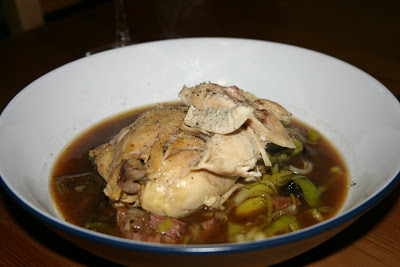
Cockie-Leekie, or Cock-a-Leekie, is a very Scottish dish, or so I thought. Apparently it turns up in several versions in Scottish and Welsh cook books and a rather complicated recipe in an English cook book where it is called Hindle Wakes. It appears in English food, but I haven’t done it yet.

So it is not necessarily exclusively Scottish. It is also not a soup. It’s a good, hearty and simple dish: beef, chicken, leeks and prunes all stewed together. All you need is some slow cooking time. Have a go and make it for a lazy Sunday dinner as I did. It serves at least 6 people:

Start off by placing a two-pound slice of stewing steak in the bottom of a deep stockpot. Cover with water and bring it to a boil slowly, skimming off any scum as it rises to the top. Simmer for an hour and hten season well with salt and pepper. Meanwhile trim three pounds of leeks and tie half of them in a bundle. When the hour is up place them in the pot. Simmer for a further half an hour before adding a whole chicken or capon and sit it on top of the beef (you can use a boiling fowl; if so, add it when you add the leeks). The cockie-leekie now needs to simmer gently for an hour and a half. Twenty minutes before it is ready remove the bundle of leeks and add a pound of prunes. Now slice the remaining leeks up and add those in the final five minutes. Easy.


To serve it, place some beef and a piece of chicken in large bowl and cover with the thick, dark and rich stock. A meal in itself, though I did some boiled new potatoes too.

#225 Cockie-Leekie. Really good food, especially for this time of year when all is miserable and wet outside. This is home-cooking at its simplest and finest. The stock produce from the beef and prunes was lovely and rich, but did not detract from the subtly-flavoured chicken. Really good one this one. 7.5/10.

#213 Boned Roast Sirloin

This Christmas – 2009 – was the year we did not have turkey. This was the first time ever, and I have to say it wasn’t missed (at least not by me, anyway). Instead it was roast pheasant and roast beef, not any roast beef though, but roast sirloin. Griggers says that if you cooking beef for a special occasion and you want to be sure of good beef, go for this cut. She suggests getting it from Harrods, but I didn’t go that far. Instead I went to a very good butcher’s shop in Pudsey, my home town, called Bentley’s. It’s won many an award so I thought I would mention them.

A roasting joint such as this needs little doing to it – place it in a roasting tin and season the fat with saltr and plenty of black pepper. Place in a very hot oven – turn the heat as high as possible and leave for 15 minutes, turn the oven down to 180⁰C and roast for 15 minutes a pound for rare meat. Serve with the usual horseradish etc.


FYI: I bought a meat thermometer so I could be absolutely sure of perfectly cooked meat. I did it medium, though I would have done it rare if it were just me eating it. If you have one then follow these temperatures: up to 60⁰C gives you rare beef, 60-70⁰C gives you medium and 70+⁰C gives you well-done beef.

FYI2: there is a common story about Henry VIII eating loin of beef at a banquet and thought it was so delicious that pronounced it ‘Sir Loin’. This is unfortunately a lot of nonsense, though I wish it were true. This cut of beef got its name is from the French sur loin, meaning above the loin.

#213 Boned Roast Sirloin. This was the best roast beef I’ve ever had in my life! It was as soft as butter and tasty and all the better for adding only salt and pepper. No messing about with extras here. It beat the rib of beef hands down. Absolutely gorgeous. Go cook some next time you have something special to celebrate – this is an order! 10/10

#207 Sussex Stewed Steak

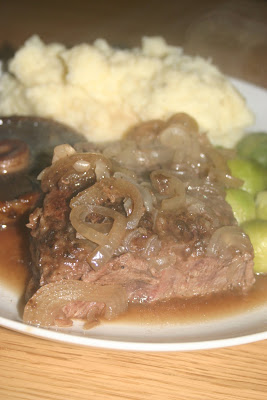
Stewed steak is one of the things that remind me of being a kid back home in Pudsey, Leeds. My Mum used to do stewed steak with dumplings sometimes and it was delicious. It’s odd, however, that I’ve never had it anywhere other then my Mum’s; nobody else seems to eat it. I don’t what it has to do with Sussex either. This recipe is pretty much exactly what my Mum did, except for two main differences: this uses one big piece of steak and has additional flavourings. This is a very easy recipe and perfect for these times of filthy weather that seems to keep your socks permanently soggy and your mind on sunnier times. Give it a go.

Start off with a nice two to two-and-a-half pound slice of either top rump or chuck steak. Make sure it is well trimmed. Season both sides well with salt and pepper and coat with flour. Place it a well fitting ovenproof dish, and cover with sliced onion; use a large one. Now add six tablespoons each of stout and port and two tablespoons of either mushroom ketchup or wine vinegar. Cover tightly with foil and place in an oven preheated to 140⁰C for three hours. That’s it! Serve with mashed potato and field mushrooms, says Griggers.


#207 Sussex Stewed Steak. This took me right back to my childhood. The delicious thin gravy with a hint of rich booze and wonderfully tender beef cooked slowly – it’s what rainy November evenings were made for. 8.5/10.

#205 Potted Tongue

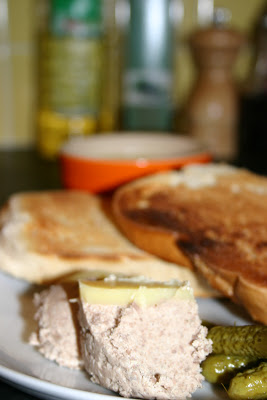
There are several recipes in English Food that involve tongue; a bit of the animal now much ignored by most, including me. It’s one of the few things I’ve never tried, so I thought I should make sure my first foray into tongue cookery a simple one. Potting is nice and easy as long as you have a food processor or blender, plus I always need sandwich fillings for work. It uses eight ounces of cooked tongue – this can be calf’s or ox tongue, pickled or fresh. The calf’s tongue that I got from Winter Tarn was exactly eight ounces in weight after it had been cooked and trimmed. However, if tongue is not your bag then you can use beef, salt beef, venison or any other game.

Chop the calf’s tongue and place in a blender or food processor – use a blender for a smooth finish, a food processor for a slightly coarse one – along with four or five ounces of clarified butter, some salt, pepper and mace (if you are potting a different meat, you could use a different spice or even a couple anchovy fillets). Blend until the right consistency and place in pots, making sure you pack them down well and leave flat surface. Pour more clarified butter over to form a seal.


#205 Potted Tongue. In Yorkshire, potted beef is still quite popular, but for me, the tongue did not work quite as well as I’d hoped. The tongue tasted okay when it had been cooked, but perhaps stronger tasting cured ox tongue would have been more appropriate. Oh well, never mind – you can’t win ‘em all. 4/10.

#202 Pressed Beef

A quickie this one.

I wanted to do a recipe from the cured meats section of the book as I haven’t done many of them and I didn’t want to start getting behind. This one appealed to me because it was similar to the salt beef recipe I had already done and I knew that the cold, pressed beef would keep me in sandwiches and snacks for the week, plus the cooking process would produce a nice stock which could be turned into a lovely soup. I also thought that you don’t really see salt beef these days in supermarkets etc, and then by total coincidence my workmates and I went to the very good café in the Whitworth Art Gallery (which makes up part of Manchester University’s campus) and what was on the menu? Salt beef sarnies! I may be some kind of soothsayer.

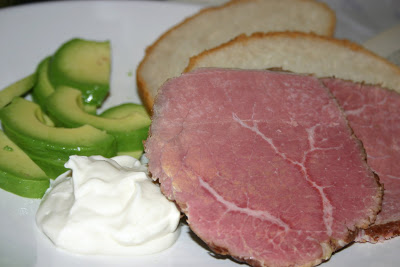
To make your own pressed beef you need a joint of silverside – go for somewhere between 2 and 3 ½ pounds in weight, I reckon. You can use either fresh or salted for this. If you want to do pressed salted beef, you can buy it from your butchers, but it is much better if you make your own. I did – follow the instructions on brining on this earlier post if you want to have a go. Next, you need to boil the beef joint – follow the instructions on this post here for how to do that (I love how the blog is becoming self-referential!) you can follow the same recipe if you’re using fresh beef too. Leave the beef to cool in the broth for a couple of hours before removing and wrapping well in cling-film or foil. It now needs to be pressed overnight; either use a tongue press or place it under some very heavy weights. I used an upturned loose-bottomed cake tin so I could precariously balance a cast-iron griddle pan, an earthenware jug and some tins of food on it with at least some attention to health and safety.


Next day, you can slice the beef as you need it. Make sandwiches using rye bread, pickled gherkins and horseradish sauce (I also added some mayonnaise). Alternatively serve with an avocado salad.

#202 Pressed Beef. This is absolutely delicious. So much more tasty and such better quality than any supermarket pre-sliced nonsense. I would really recommend trying the curing, cooking and pressing yourself, it’s doesn’t take much effort at all and the pay-off is great. The beef is firm and deliciously sweet and salty. The spices – particularly the mace – come through beautifully and compliment the beef so well without drowning out its flavour. 8.5/10.

#200 Steak, Kidney and Oyster Pudding

As promised, a dish that is more English that roast beef and Yorkshire puddings, at least I think so anyway. It may be because I’m a Northerner, but I also think (and I could be wrong here) that although it is very English, it hasn’t travelled to other countries as well as, say, roast beef. In other words, it’s a sort of hidden gem. I have been saving this one for number 200 for a while, though I did change my mind a fair few times.

The seemingly unusual ingredient here is, of course, the oysters. The recipe is surprisingly recent: it appears as a steak pudding in a book by Eliza Acton in 1845 and the kidney turns up in Mrs Beeton’s Household Management nearly fifteen years later. In those days folks living near the coasts were falling over oysters – they diminished however due to a combination of an increased population eating them and the increased pollution created by all those extra people. No one wants a shitty oyster. However, before this, they were cheap and the preferred alternative to the very pricey mushrooms that the posh gentry would have enjoyed. It was only since around the Second World War that mushrooms have been cultivated on a large scale, before that they acquired by foraging: limited and very seasonal. Of course, these days it is the mushrooms that are ten-a-penny, and the oysters that break the bank. That said, native oysters are in season at the moment and the ones I bought from Out of the Blue in Chorlton were just sixty pence each.

This pudding is a pretty posh all-out one; giant, full of rump steak, red wine and extra beef stock plus both mushrooms and oysters:

To begin, make the filling: cut two pounds of trimmed rump steak into one inch cubes and then slice a pound of ox kidney (or veal, if you’re being really posh), removing any fat or gristly bits on the way. Toss these in two tablespoons of seasoned flour. Chop a large onion and fry it gently in two ounces of butter until nicely softened, remove with a slotted spoon, turn up the heat and then hard fry the beef and kidney. When brown transfer to a casserole dish (or, if you have a cast-iron one that goes on the hob you can keep it all in there. Deglaze the pan (or casserole dish) with either a pint of beef stock, or half-and-half stock and red wine. Now slice 8 ounces of mushrooms and fry them in an ounce of butter. Add these along with the cooked onions and a bouquet garni to the meat. Cover with a lid and cook in the oven for 1 ½ hours at 140-150⁰C. You can do all this the day before if need be.

Next, open the oysters: Griggers suggests 18-24 oysters, though makes them an optional ingredient for the pudding. I went for a dozen as I didn’t want to go bonkers with the spending. Add them, plus their liquor to the meat. I’ve written about opening oysters before.

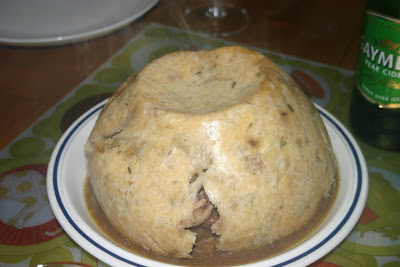
To make the suet pastry, use a knife to mix together 10 ounces of self-raising flour, a teaspoon of baking powder, ¼ teaspoon of salt, ground white pepper, ¼ teaspoon of thyme and 5 ounces of chopped fresh suet (use the packet stuff if you can’t get hold of it). Now add cold water little by little to the mix, stirring with the knife. Use the minimum amount of water that will bring the pastry together, using your hands towards the end. If it seems too wet, add more flour. There’s enough pastry to line a three pint pudding basin, so roll it out in a circle large enough and remove a quarter of it (you’ll use this later). This’ll make it easy to line the basin – use water as glue to stick down the ‘hem’. Spoon in the mixture and then roll out the reserved quarter into a circle to make the lid. Place this on top and fold any surplus edging over it and glue it with more water. Secure the lid if using a plastic basin, or cover with buttered, pleated foil secured with string. Place in a steamer and cook for one and a half hours; don’t let it boil dry. Turn it out onto a plate and serve immediately.


#200 Steak, Kidney and Oyster Pudding. The poshest pudding in the world! It was very, very good though. The beef and kidneys were very tender and the gravy was good and rich. The real revelation was the oysters – at first I wasn’t very sure about them, but it was a taste that was acquired very quickly. They provided a mysterious iodine tang to the whole thing. The original surf ‘n’ turf! The only thing I would change is the amount of pastry – there was barely enough to line the basin, making it split open when it was turned out! 9/10.

#181 Yorkshire Pudding

If one is having roast beef (or roast anything, for that matter) one simple has to have Yorkshire pudding. I have been using my own Yorkshire pudding recipe for years (it can be found on a previous entry) and I was not sure about someone else’s, even Griggers’.

In English Food, Griggers says to pour the batter, once made, into a roasting tray below the meat (see last entry). However, you can pour the batter into small trays. In Yorkshire, we make giant ones in sandwich tins and put our meat, veg and gravy inside. Other alternatives are to have them as a starter with a little gravy or with some sugar, or for afters with golden syrup or sweetened condensed milk pour over. The idea of the former being that you can fill your guests up with Yorkshire pudding, so they eat less meat later! That’s Yorkshire folk. It is, of course, also the batter required to make toad-in-the-hole (also on the blog!).

The first Yorkshire pudding recipe appears in 1737 in a book called The Whole Duty of Women and is pretty much unchanged, though it does state that it should be eaten with roast mutton. Now there’s a bombshell!

Before I give the recipe, I have two important instructions that Griggers doesn’t explicitly give: first, make your batter as early as possible, the night before if you can remember to; second, make sure your oven is very hot and that the fat used in the tray is very hot too. These two simple rules will help your Yorkshires to rise and rise.

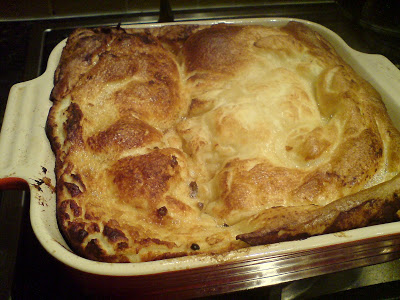
Start by making pouring half a pint each of milk and water into a jug. To make the batter, mix 8 ounces of flour and a pinch of salt in bowl. Make a well in the centre and crack three eggs inside plus some half-milk half-water mix. Mix everything together to make a thick paste. Add most of the water-milk until you have a creamy and pourable mixture (I used the whole lot). Leave the batter to settle. Preheat the oven to 200°C and place some fat (oil or dripping) in your tin and let it get good and hot. Pour the batter into the tin and give it 40 minutes to rise.


#181 Yorkshire Pudding. If you are doing it the traditional way in a single roasting tin, Griggers doesn’t say what size you should use – it turns out you should use a big one! Mine was too small so the batter was rather deep and so it didn’t crisp up properly. Some people like it like that, but I don’t. That said it did taste good from the beef fat dripping on top of it throughout cooking. Hmmmm. Tricky to mark. 3/10 I think, but that’s because they weren’t in the correct sized tray. I’m pretty sure they would score higher (though not as high as my own ones!).

#180 Roast Beef

It was Charlotte’s birthday last Sunday, so she got to choose a birthday meal. She chose well – in fact she chose the most British meal you could possibly imagine – Roast Beef and Yorkshire pudding. We British love our roast beef, and were very good at cooking it; the French called us rosbif, not to be rude, but out of respect, as we had the roasting of meat down to a fine art. In fact French chefs would come to Britain to learn the art of roasting on the spit. These days of course, we used our conventional oven to roast our meat, so technically we are making baked beef, not roast beef.

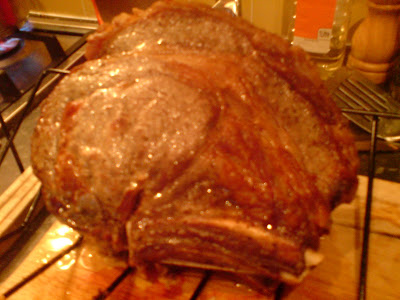
Roasting beef (or any other meat, in fact) is not hard as long as three simple rules are followed: buy good quality beef that has been hung for at least 21 days, season it well (especially if you are crispy fat fan), and roast it from room temperature – don’t go straight from fridge to oven. I bought a rib of beef from my new favourite butcher – Axon’s of Didsbury. A six pound monster that came to £30 – you may think this is expensive, but you get what you pay for and is enough to provide for six or seven people. Also, I have been making good meals from the leftovers: beef and oyster mushrooms in oyster sauce (I picked the mushrooms myself whilst walking in the woods!) and an oriental beef and noodle soup. So in the end, it actually pays to spend a bit more, as you get more out of it. Lecture over.

For roast beef, Griggers suggests either rib or sirloin on the bone with undercut. You need at least 5 pounds in weight. The first thing to do is to season you meat well with salt and pepper the night before. Keep in the fridge overnight by all means, but make sure you remove it from the fridge in plenty of time for it to get to room temperature. Preheat the oven to 200°C. Weight the meat and calculate the cooking time: 15 minutes per pound for rare, add an extra 20 minutes at the end for medium-well done. The joint needs to be able to sit on a rack inside the roasting tray in the oven, but first place the tray on its own with enough beef dripping to cover the bottom for five minutes before adding the joint and rack. If you are making Yorkshire puddings, you could make them in the traditional way of pouring the mixture into the roasting tin, or pour batter into trays if you prefer. Either way put them in 40 minutes before the end of cooking. When the time is up, remove the beef (keep the Yorkshires in, if need be) and allow it to rest for at least 20 minutes before serving and slicing. Place on a serving dish surrounded by cut-up pieces of Yorkshire pudding.


Whilst the beef is cooking, make the gravy by frying a sliced onion in some beef dripping with a teaspoon of sugar until it turns a deep brown. Add half a pint of beef stock and simmer for at least 20 minutes. Season and serve, or if you like a smooth sauce, strain it. Serve with roast parsnips, roast potatoes and horseradish sauce, plus some seasonal green veg.

#180 Roast Beef. I cooked my beef rare because it shows off the quality and taste of good meat, and very good it was too. The outside fat was crispy, and the inside was pink, juicy and tender – proper melt-in-the-mouth stuff. I give it 8.5/10 – as far as beef goes it’s just excellent, but roast lamb in the winner when it comes to red meat.

#162 Horseradish Sauce

To accompany the salt beef, I made this classic accompaniment, though it goes very well with smoked fish such as trout.

It’s very easy to make: lightly whip ¼ pint of double cream and stir in 2 tablespoons of grated horseradish, then season with salt, pepper and the juice of up to half a lemon. It’s important to just lightly whip the cream as the acids in the lemon make it much thicker. Griggers also make the point that the outside of the horseradish root is alot hotter than the centre, so if you like it milder, grate across the root, rather than down the side.

FYI: horseradish can be found growing wild in most places in Europe and has been cultivated by the Egyptians and Romans and, according to Greek Myth, Apollo was told by the Delphic Oracle that it was worth it’s weight in gold, though why I don’t know.

Again, no pic, sorry – my camera’s doing some funny things

#162 Horseradish Sauce – 6.5/10. This very pleasant and creamy, though lacked the punch I expected, even though I was pretty generous with the horseradish. It was ok, but I think I prefer a jar of proprietary horseradish sauce! Is this bad of me!?