*If you can’t get preserved ginger then use ginger preserve (i.e. ginger jam), or miss it out entirely and replace it with the chopped liver of the bird(s) and a heaped teaspoon of thyme.
Tag: chicken
#276 Giblet Gravy
#235 Lisanne’s Chicken with Mussels
We don’t know who Lisanne was/is, other than she was a mate of Griggers and that she made this recipe up on a whim whilst in France. The reason that it appears in English Food is that it is rather reminiscent of the old English recipes of cooking oysters with chicken. I have already done the steak, kidney and oyster pudding with great success, but the thought of a eating a chicken stuffed with mussels a little odd – and don’t forget the last mussel recipe I did was very odd. However, as we have discovered along the way, this damn book is full of surprises, so we shall see…
You need to get hold of a chicken that weighs around four or five pounds as well as a nice bag of fresh, live mussels that weighs around three or four pounds.
Begin by browning the chicken all over in some olive oil along with a large chopped onion and a chopped carrot in a flame-proof casserole. Add a bouquet garni (see here for some suggestions as to what you should put in it) and a quarter of a pint of dry white wine. Bring to a steady simmer and cook for 45 minutes. Meanwhile, open around two-thirds of the mussels in a very hot pan using another quarter pint of wine. Any mussels that remain closed should be discarded, Griggers says.* Pluck the mussels from their shells and carefully stuff them into the cavity of the now half-cooked chicken. Strain the cooking liquor from the mussels into the dish and tuck the remainder of the mussels all around the chicken. Season and cook for a further 30-45 minutes.

When the chicken is ready, remove it to a serving dish, scatter the mussels around it, and scatter chopped parsley all over it. Skim and strain the sauce into a sauceboat and eat with good bread – no vegetables required says Giggers, just a green salad to follow.
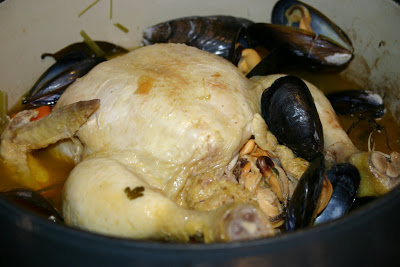
#235 Lisanne’s Chicken with Mussels. I must say I was very dubious about this one and continued to be dubious a few mouthfuls later. However, I put that down to the novel flavour combination because I soon realised it was very good! The chicken was beautifully succulent and the mussels tender, though cooking them this was gives the eater a real strong mussel-hit, but if you like your seafood, then certainly give this a go. The sauce made by the cooking liquor was divine. 7.5/10
*FYI: According to the telly programme QI, this is absolute nonsense and it is Jane Grigson who is to blame for this myth. The first mention of chucking out your un-opened mussels appears in Jane Grigson’s Fish Book and people have followed this advice evermore. However, there is actually no evidence that unopened mussels will poison you – in fact, you just as likely to be poisoned by a live mussel than a dead one. That said, I still chucked out my unopened ones!
#225 Cockie-Leekie
“And my lords and lieges, let us all to dinner, for the cockie-leekie is a-cooling.”
So it is not necessarily exclusively Scottish. It is also not a soup. It’s a good, hearty and simple dish: beef, chicken, leeks and prunes all stewed together. All you need is some slow cooking time. Have a go and make it for a lazy Sunday dinner as I did. It serves at least 6 people:
Start off by placing a two-pound slice of stewing steak in the bottom of a deep stockpot. Cover with water and bring it to a boil slowly, skimming off any scum as it rises to the top. Simmer for an hour and hten season well with salt and pepper. Meanwhile trim three pounds of leeks and tie half of them in a bundle. When the hour is up place them in the pot. Simmer for a further half an hour before adding a whole chicken or capon and sit it on top of the beef (you can use a boiling fowl; if so, add it when you add the leeks). The cockie-leekie now needs to simmer gently for an hour and a half. Twenty minutes before it is ready remove the bundle of leeks and add a pound of prunes. Now slice the remaining leeks up and add those in the final five minutes. Easy.

To serve it, place some beef and a piece of chicken in large bowl and cover with the thick, dark and rich stock. A meal in itself, though I did some boiled new potatoes too.
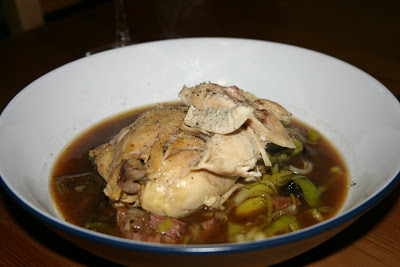
#225 Cockie-Leekie. Really good food, especially for this time of year when all is miserable and wet outside. This is home-cooking at its simplest and finest. The stock produce from the beef and prunes was lovely and rich, but did not detract from the subtly-flavoured chicken. Really good one this one. 7.5/10.
#210 Coarse Chicken Liver Pate
Hello there Grigsoners! I have had a brief hiatus from blogging of late – life has simply gotten in the way. I shall spare you the boring details. December has not been the productive month I hoped, but I did make this pâté. It was intended for the Evolution Group’s Christmas Party, but I was rather ill on the day and therefore had to eat this over several days afterwards. No mean feat seeing as it serves eight.
If you are thinking of having some pâté this Christmas, try making this one. The best thing about it is that you can make it around three days before you want to eat it. I am not going to make the glaringly obvious point that pâté is not English.
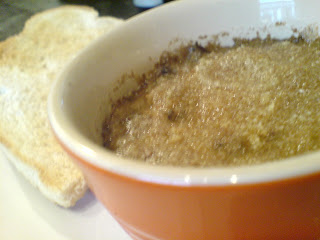
Start off by removing the gall bladders and stringy bits from 8 ounces of chicken livers. Keep aside half of the nicest looking ones and pass the rest through a mincer along with a small onion, a small clove of garlic and two rashers of streaky bacon. To the minced mixture, mix in 8 to 12 ounces of sausagemeat (the best thing to do is buy good sausages and peel them), a pinch each of thyme and oregano, some salt and some black and Cayenne peppers, plus 2 tablespoons each of sherry and brandy and a tablespoon of drained green peppercorns. When all is mixed in well, you can start putting the thing together in layers in an ovenproof pot, though you should taste the mixture first to check for seasoning (it sounds foul, but it really isn’t that bad). Start with some of the mixture, then half the reserved livers, then more mix, the rest of the livers, and a final layer of mixture. Cover with some back fat or pork skin and place in a roasting tin and pour in some boiling water. Place it in the oven for 45 minutes at 180⁰C, or until the pâté starts to come away from the edges of the pot. Once half cool, place some light weights on top and leave for two or three days before serving with toast or ‘good bread’.

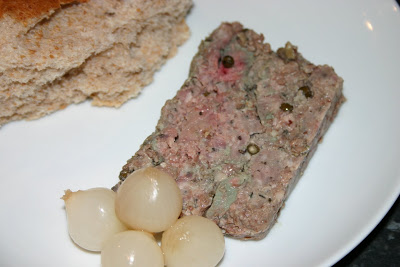
#210 Coarse Chicken Liver Pâté. This was delicious and couldn’t get enough of it. I happy munched my way through the whole thing over four days. The herbs were delicate in flavour and complimented the creamy livers well. The booze made it sweet and moist, but the peppercorns made the whole thing sublime. A really delicious recipe – never buy your pâté again and have a go at this one! 8.5/10
#209 Chicken and Leek Pie from Wales
During this rubbish weather (God, I am so English – all I do is talk about the weather) there is nothing like a good pie. The Farmers Market in Manchester Piccadilly Gardens just happened to be on as I was walking through and I saw a stall selling some very nice free range farm chickens and so I snapped one up. I then consulted the book for chicken recipes and decided on this. It seemed a little bit like the pork and apple pie I did a while ago in that there is no gravy or sauce per se but runny juices instead. I was slightly concerned about this as it was a major short-falling in the pork pie. Anyways, I have cook everything in this book whether I like it or not.
It is best to start this pie the day before you want to cook it, or at least in the morning. Start by placing a roasting or boiling chicken in a close-fitting pan along with a quartered, unpeeled onion, two tablespoons of chopped celery (a stalk, in other words), a bouquet garni and some salt and pepper. Place a close fitting lid on top, bring to a boil and simmer until cooked. The cooking time will be dependent upon the type of chicken you have – around 45 minutes for roasters, and at least an hour for boilers. Let the chicken cool in the stock (leave overnight if you want). Remove it and strip the carcass, cutting the meat into nice chunks. Skim the stock – if it seems a bit bland, add more seasoning or return the bones to the pot and simmer again. You could also reduce the stock after straining it too.

Arrange the pieces of chicken in a pie dish along with 4 ounces of sliced ox tongue that has been cut up. Next, wash, trim and slice a load of leeks – Griggers says eight in all, but I reckon that that it all depends on the size of your pie dish. Either way, blanch them for two minutes in salted water before draining and adding to the pie dish. Chop two tablespoons of parsley and sprinkle that over and then ladle the stock over the lot until it comes up about half way up the chicken and veg. Season well. Cover with shortcrust pastry (the amount will depend on the dimensions of your pie dish). To make sure you get a good seal, when you roll it out cut a strip of pastry and glue it around the rim of the dish with some beaten egg. Brush glued pastry with more egg and lay the pastry over. Press it down, make a central hole and brush the top with egg. Bake at 230⁰C for 20 minutes, then turn the oven down to 180-190⁰C for another 20. Allow to cool a little before you eat it. It had it with mash and peas.
#209 Chicken and Leek Pie from Wales. This was a really good pie – the stock was very flavoursome and ensured the chicken remained very moist. I’m not sure what the point of the tongue was though. It is also very nice cold – the stock cools to become a nice, rich jelly; though that kind of thing is not to everybody’s taste. Give it a crack! 7/10.
#199 Apple Sauce III
Eagle-eyed followers of the blog will notice that there has been no Apple Sauce I or II. In English Food there four recipes for apple sauce, so I thought it best to get the ball rolling. I’ve made this one first because it is not a sauce for pork, but for chicken. I had a very nice-looking free range chicken that I bought from the poulterer Peter D Willacy at Houghton Farmers Market, you see. He has no website, but you can call him in 01253 883470. The best thing about their chickens is that they come with giblets; not something you see these days, not even in good butchers. I’m hoping to buy a capon from them soon. This sauce can also be served with veal.
Anyways, if you are roasting a chicken this weekend, try this very easy creamy and usual hot apple sauce:
Core, dice and peel a pound of Cox’s pippin apples (or a good equivalent) and fry them in some clarified butter. (If you don’t clarify your butter first, it may burn. Melt it slowly in a pan, blot away any solids on the surface with some kitchen paper, then decant the liquid butter away, leaving behind any other solids that sank to the bottom.) When they have softened and turned a little golden, remove the apple pieces with a slotted spoon, leaving behind the buttery juices. Add six tablespoons of white wine (or cider) to the juices to deglaze and reduce it all well. Lastly, stir through six tablespoons of double cream and sharpen with a squeeze of lemon juice. Serve hot.

#199 Apple Sauce III. A strange one this one because the sauce is essentially stewed apples and cream, which in my book is a pudding. That said, it did go surprisingly well with the chicken as there are no strong flavours to drown out the subtle chicken. 5.5/10.
#165 Indian Soup
A soup “with a lively freshness and a spicy flavour” says Jane, just the ticket for a summer soup, it is also a thrifty soup as it requires left-over boiled rice and left over chicken bones and meat, of which I had both from the chicken curry I had made the previous night. It is basically an Indian-style version of chicken noodle soup and is, of course, about as Indian as Prince Phillip, but this is the 1970s so we shall allow it. Anyway, who cares as long as it tastes nice; and I had high hopes for it after the disappointing mulligatawny soup I had cooked previously.
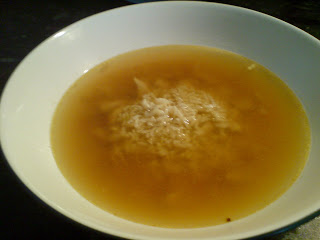
To start, bring 3 pints of beef stock, 2 large sliced onions, a large Bramley apple, a tablespoon of desiccated coconut, 2 teaspoons of curry powder and the bones from a chicken or game carcass (minus meat scraps) to the boil and simmer for an hour. There is no need to peel or core the apple, because the stock is then strained through muslin into another pan. The resulting cloudy stock now needs to be made clear – this is a two-stage process. First, use kitchen paper to blot off any fat that may have risen to the top; secondly, put over a moderate heat and whisk in two egg whites. Keep whisking for a few minutes and then leave to simmer for five more without stirring. The idea here is that as the egg whites cook they mop up any solids that make the soup cloudy. When ready, strain again; the result should be a lovely golden-brown and clear broth. Season it well with salt and both black and Cayenne peppers, plus a squeeze of lemon juice. Finally, add a few tablespoons of boiled basmati rice and the shredded scraps of meat.

#165 Indian Soup. Well, Griggers was right – it is a delicious soup, clear, spicy and fruity with a lovely tart finish supplied by the lemon and Bramley apple. It would make a perfect starter to a meal – not too filling and interesting in its flavours. However, it is a bit of a faff – it’s not something that can be thrown together and liquidised at the end of cooking, and although tasty, I’m not sure if it’s worth the effort (making a clear consommé is a tricky business). After weighting up the pros and cons, I’ll give it 6.5/10.
FYI: a simpler way to clarify a stock is to freeze it and to let it strain through muslin slowly overnight in the fridge. Obviously you need to remember to make the stock a couple of days before you want to use it, but it’s very easy indeed! It also gives a more clear stock too in my experience.
#147 Devilled Chicken Livers
A cheap treat. I love chicken livers, yet so many people seem to turn their noses up at them – I suppose it’s because it’s offal and folks are squeamish. It is silly though, since they are the main ingredient in pate. Any road, any local butcher should sell them very cheaply – I bought 250 grams for about £1.20 and they were prepared too, which reduced the amount of faffage later. If you buy them – do check they have had their bitter green fall bladders removed or the food will be ruined. This recipe appealed to me because of its simplicity, but also because of its ‘devilled’ (i.e., spiced) nature – a very Victorian way of cooking things (eggs and kidneys spring to mind). Devilling seems to be having a resurgence recently – the day after I cooked this, some chef on The Great British Menu competition that’s being shown on the BBC cooked devilled crab claws. Hopefully it will get popular again.
Have a go at this – it’s enough for 4 people as a starter.
Finely chop a medium-sized onion and fry it in 2 ounces of clarified butter gently. Whilst you wait for the onions to soften, chop up 8 ounces of chicken livers roughly, raise the heat and fry the livers quickly, do this for only 2 minutes, 3 at the most. This is why clarified butter is required – it doesn’t burn when you heat it as the ‘butter solids’ have been decantered off. I made my own by melting some butter gently, skimming off any scum from the top and decanting and solids away that had sunk to the bottom. Take the livers off the heat and add 2 teaspoons each of Worcester sauce and Dijon mustard, Cayenne pepper, 3 tablespoons of breadcrumbs, ¼ pint of whipping or double cream, and finally some salt and black pepper. Mix well and check your seasonings. If you like you devil a spicy one add more – I did! Divide between 3 or 4 ramekins and sprinkle with more breadcrumbs and melted butter. Bake at 190°C for 15 minutes and serve with toast.

#147 Devilled Chicken Livers – 9.5/10. I may change this to a 10/10 as it was a perfect starter. Absolutely delicious – the devil was fiery yet it was perfectly tempered with the cream and breadcrumbs. The big strong flavours had no chance of drowning out the rich creamy chicken livers. Brilliant stuff. I haven’t stopped thinking about since I made them, and my stomach is rumbling as I type. This is definitely a Grigson classic!
#106 Mulligatawny Soup
Whilst perusing the little fishmongers in Stockport, me and Charlotte spotted boiling chickens for sale. This is quite weird as I always keep my eye out for them and never see them, but the day before Charlotte requested Mulligatawny soup, but I said that we couldn’t do that, as we need a boiling fowl for it. Perhaps Charlotte is a lucky charm for the English Food project and me. Like some sort of leprechaun or troll.* I’m glad I now have a supply of boiling fowls as quite a few recipes require them. Good oh.
FYI: the word Mulligatawny comes from the Tamil, an Indian language, and means pepper water, and it came here in the Eighteenth Century.
This makes a big old load of soup, enough for 5 or 6 people:
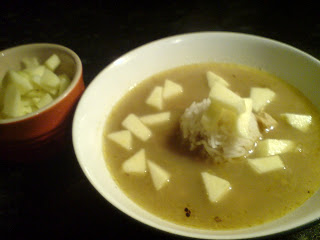
Begin by chopping the boiling chicken into pieces and brown it in 2 ounces of butter, along with a sliced onion. Now add 1 ½ tablespoons of curry powder – either mild, medium or hot (I went for medium, but added a pinch of chilli powder) – and 8 ounces of yoghurt, plus some salt. Fry all this until the yoghurt reduces and becomes a thick crust on the bottom the pan. Be careful not to let it burn though. Add 3 pints of water and let it all come to a simmer. Cook for around an hour and a half until the meat is falling off the bone. Pick the meat off the carcass and chop it up, if need be, retuning it to the pan and chucking out the bones. This is a good point to leave the soup overnight, so any chicken fat can be skimmed off easily. Melt another of butter in a separate small saucepan and add 4 cloves; apparently, the cloves soften after a few minutes if cooked gently and can be crushed with a spoon. This didn’t happen for me. Hey-ho. Add the juice of lemon and pour the butter mixture into the soup. Season with more salt if appropriate. Serve with some boiled rice and some chopped apple sprinkled on top.

#106 Mulligatawny Soup – 4.5/10. Not a bad soup, but decidedly average. When I first tried I thought it was surprisingly light and refreshing, but then as I tried it again, I decided I wasn’t sure. It sat in the fridge for a bit and I realised I wasn’t going to eat it, so it went off the bin. I think I was disappointed because it wasn’t what I expected. I’ve had Mulligatawny from a tin and was sure it contained some kind of red meat. Flicking through the book, I spotted another soup called Indian Soup, which looks a lot like what I thought Mulligatawny was.
*Joke