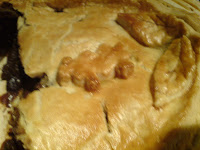
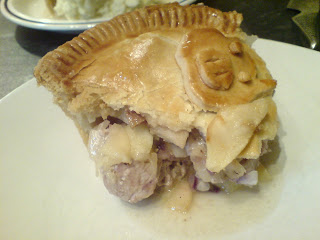
#209 Chicken and Leek Pie from Wales

During this rubbish weather (God, I am so English – all I do is talk about the weather) there is nothing like a good pie. The Farmers Market in Manchester Piccadilly Gardens just happened to be on as I was walking through and I saw a stall selling some very nice free range farm chickens and so I snapped one up. I then consulted the book for chicken recipes and decided on this. It seemed a little bit like the pork and apple pie I did a while ago in that there is no gravy or sauce per se but runny juices instead. I was slightly concerned about this as it was a major short-falling in the pork pie. Anyways, I have cook everything in this book whether I like it or not.

It is best to start this pie the day before you want to cook it, or at least in the morning. Start by placing a roasting or boiling chicken in a close-fitting pan along with a quartered, unpeeled onion, two tablespoons of chopped celery (a stalk, in other words), a bouquet garni and some salt and pepper. Place a close fitting lid on top, bring to a boil and simmer until cooked. The cooking time will be dependent upon the type of chicken you have – around 45 minutes for roasters, and at least an hour for boilers. Let the chicken cool in the stock (leave overnight if you want). Remove it and strip the carcass, cutting the meat into nice chunks. Skim the stock – if it seems a bit bland, add more seasoning or return the bones to the pot and simmer again. You could also reduce the stock after straining it too.


Arrange the pieces of chicken in a pie dish along with 4 ounces of sliced ox tongue that has been cut up. Next, wash, trim and slice a load of leeks – Griggers says eight in all, but I reckon that that it all depends on the size of your pie dish. Either way, blanch them for two minutes in salted water before draining and adding to the pie dish. Chop two tablespoons of parsley and sprinkle that over and then ladle the stock over the lot until it comes up about half way up the chicken and veg. Season well. Cover with shortcrust pastry (the amount will depend on the dimensions of your pie dish). To make sure you get a good seal, when you roll it out cut a strip of pastry and glue it around the rim of the dish with some beaten egg. Brush glued pastry with more egg and lay the pastry over. Press it down, make a central hole and brush the top with egg. Bake at 230⁰C for 20 minutes, then turn the oven down to 180-190⁰C for another 20. Allow to cool a little before you eat it. It had it with mash and peas.

#209 Chicken and Leek Pie from Wales. This was a really good pie – the stock was very flavoursome and ensured the chicken remained very moist. I’m not sure what the point of the tongue was though. It is also very nice cold – the stock cools to become a nice, rich jelly; though that kind of thing is not to everybody’s taste. Give it a crack! 7/10.
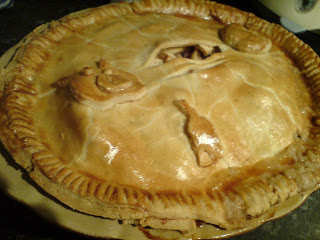
#156 Cheshire Pork and Apple Pie

I bought a nice new pie dish last week, so I thought I’d Christen it with a nice big pie for Sunday dinner. I decided upon this Cheshire Pork and Apple Pie because it needed to be pretty quick to do (no cooking of the filling beforehand) as I had to be in the lab in the morning. Plus there was a load of Cox’s Pippins in Unicorn in Chorlton – apparently the last of the stored apples from the previous autumn.

This is a very traditional pie – essentially meat stewed in liquid (in this case cider) under a pastry crust, and comes from Hannah Glasse. It is a little odd in that it has a double crust; I’d have no problems with it if it was cooked in a thick sauce. Surely the pastry lining the pie dish will just turn into a soggy mess? To pre-empt this, I used a previous trick of The Grigson – to place a baking sheet in the oven as it heats, so that when the dish is placed on it, the underside quickly cooks.

First of all make some shortcrust pastry using 10 ounces of plain flour and use two-thirds of it to line a 2 ½ pint capacity pie dish.

To make the filling you need to prepare your pork – you need 2 pounds of boned pork loin. Cut off the rind and trim away the fat with a sharp knife, then slice the loin and chop into chunks. Next peel, core and slice around 12 ounces of Cox’s orange pippins. Then mix 8 ounces of chopped onion together with 4 chopped rashers of cured, unsmoked bacon. Now layer the ingredients in the pie dish: half of the pork, then half of the apples, scatter them with some brown sugar and then sprinkle over half of the onion-bacon mixture. Season each layer with salt and pepper plus some grated nutmeg. Repeat with the remainder in the same fashion. Dot the top with around 2 ounces of butter and then pour on ¼ pint of dry cider. Cover with the remaining pastry sealing and glazing it with beaten egg. Make some fancy pastry decorations if you fancy. Bake for 20 minutes at 220°C, and then turn the oven down to 160°C for a further 45 minutes. Jane doesn’t indicate what to serve with it, but I went with mustard mash and some asparagus.

Check out the arts & crafts spectacular atop the pie!

Oink!

#156 Cheshire Pork and Apple Pie – after much deliberation on this one, I give it 5/10. I think it was pretty average – I wasn’t sure about the amount of liquid in the pie, which after my efforts to prevent it, still made the pastry soggy. I think, it could be easily improved, however by making a roux with the butter and some extra flour and using the cider to make a sauce. I think it would have made this okay effort into a very hearty one that would stick to your ribs, as we say in Yorkshire!

#149 Broad Town Mince Pie

This recipe is not seasonal at all, but I remembered it whilst having a look through my cupboards and came across the last half jar of mincemeat I made at Christmas. After having a peek inside and a quick taste, a realised that everything was still perfectly preserved – in fact it was a lot nicer with much better developed flavours. I consulted the book and lo! and behold! I had all the ingredients to make it. If you have half a jar of mincemeat in your cupboard and don’t know what to do with it, make this easy pud. It is very Christmassy with first its layer of boozy mincemeat and then a layer sweet almonds. I can find no reference to what this pudding has to do with Broad Town.


Make a quantity of shortcrust pastry using 8 ounces of flour and both lard and butter (I am now a total covert to adding lard to pastry…unless I’m cooking for vegetarians that is). Line an 8 inch tart tin with two-thirds of it and spread the half-jar of mincemeat evenly over the pastry base. Now make the almond layer – mix together 4 ounces each of caster sugar and ground almonds, then an ounce of melted butter, 2 egg yolks (one if large) and 2 tablespoons of cream. Dollop and spread the mixture best you can and cover the pie with the remaining pastry, brush with egg white and sprinkle with sugar. Bake for 15 minutes at 220°C, then turn the oven down and bake for a further 30 minutes at 180-190°C. Serve it hot or warm with cream – or, if it is near Christmastime, then add some brandy butter.

#149 Broad Town Mince Pie – 6/10. Good, but rich, pudding that is useful for doing away with the endings of a jar of mincemeat. I actually found I enjoyed it a lot more once cold the next day. Not a bad dessert, but it didn’t get any juices flowing; and it’s certainly not better than a good old mince pie.

#129 Dartmouth Pie

It was British Pie Week the other week – and I admit I was a bit tardy making a pie in time but better late than never, innit. The trouble was choosing a pie to make, after a quick flick through I went for this Dartmouth Pie (FYI: Dartmouth is in Devon, SW England). There’s two reasons for this; the meat in it is mutton and after the mutton broth and Lancashire hotpot I made I’ve really got into cooking with it. Secondly, the pie itself is interesting. It’s one of the very few survivors of medieval cuisine; they loved their meat mixed with fruit, sugar and spices. Traditionally, minced mutton is used, but you can use venison or chuck steak. The recipe in English Food is an updated version of this dish containing cubed mutton rather than minced – apart from that is not too far from the proper original one as far as I can see.


This pie serves four, but is quite rich so you could get away with five or six:

Trim some cubed shoulder of mutton well so that you end up with a pound of it in weight. Next, make a spice mix using a teaspoon each of black peppercorns and coriander seed, ½ a teaspoon each of ground mace and ground allspice and an inch length of cinnamon stick. Grind all the spices down – I use a coffee grinder for such things, if you don’t have one use a pestle and mortar. Salt the meat and brown it using 2 ounces of beef dripping in a pan that is ovenproof. Add the spices and fry them gently for a couple of minutes. Add 8 ounces of sliced onions and 1 ½ teaspoons of flour and give it good mix around. Add ½ pint of beef stock (Griggers says you can also use veal or venison stock; oh la-dee-dah!). Now the sweet element – stir in 2 ounces each of dried prunes, apricots and raisins; and to counteract the sweetness the juice and rind of a Seville orange (or, alternatively, a sweet orange plus lemon juice). She doesn’t say whether you chop up the rind or just add it to take out later. I chopped it up like you would for marmalade, but it did make the resulting sauce slightly too bitter; this was resolved by the addition of some sugar to taste later. Bring the mixture a simmer, cover and bake in a low oven – 140°C – for 2 hours (or more if you like). Taste and check for seasoning, transfer to a small pie dish and allow to cool; skimming any fat away that may appear.

Make a shortcrust pastry using 8 ounces of flour, 4 ounces of fat (I used half-lard, half-butter), salt and milk to bind. Cover the dish as normal and decorate the pie with the trimmings. Butters and I had fun making apricots, leaves and a wee sheep to go on it. Brush with beaten egg as a glaze and bake for 25-40 minutes at 220°C until the pastry is cooked and golden brown.

Check out the artwork

#129 Dartmouth Pie – 7.5/10. A very good pie indeed. Very sweet and rich but went brilliantly with some relatively bland mash and minty peas. The medieval flavours were not alien – I can see why this one survived (and others where fish is used instead of mutton didn’t). As I’ve mentioned before, the secret is the slow-cooking; the resulting meat was so tender, you hardly had to chew and the fruit had become a dark bitter-sweet mush. Lovely. If I owned a restaurant, I’d have it on the menu!

#116 Apple and Raisin Pie

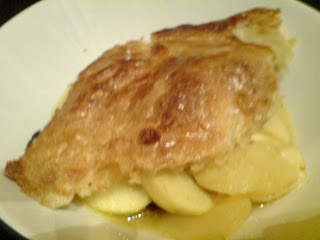
A good honest hotpot deserved a good honest pudding. I wanted a desert-version of a hotpot and went for this apple and raisin pie. This, people, is no ordinary apple pie – it is a buttered apple pie, very popular in the Seventeenth Century. It’s very easy to do, especially if you use bought puff pastry.

Peel, core and quarter 3 ½ pounds of Cox’s Orange Pippin apples and quarters the quarters into six and place in a bowl. Sprinkle over 4 ounces of caster sugar and the grated zest of half a lemon and mix. Melt 4 ounces of unsalted butter in a pan and pour over the apples and lastly 4 ounces of raisins. Mix again and place the apples and buttery juices into a large pie dish. Roll out some puff pastry and cut out a shape large enough to cover the dish. With the trimmings, roll out a thin length of pastry and glue it to the rim with egg white. Then using more egg white glue on the pastry lid and glaze with more egg white. Sprinkle the top with a little sugar and make a slit in the pastry so the steam can escape. Bake in a hot oven – around 220ºC – for 15-20 minutes, and then turn down to 160-180ºC and bake for a further 30-45 minutes until the apples are tender. Serve with lightly whipped cream.


#116 Apple and Raisin Pie – 9.5/10. This is the best apple pie I’ve ever made. The apples were still tart but swimming in a lovely sweet, rich buttery liquor that was the perfect balance. The raisins were very juicy and plump and the pastry crisp. Total genius. Go and make this pie right now, people!

#96 Apple Pie

Oh I have been a bit slack with adding entries of late. I do apologise; I still have written about the food I made last weekend! The dessert that finished off the hare was a nice apple pie. Charlotte brought round some windfall apples so it was the obvious choice really. This is very simple to make – the apples aren’t stewed beforehand or anything and you could even buy your own pastry if you wanted. It’s an English pie, which means there’s only pastry on the top so you don’t have to faff about with blind-baking a pastry base either. It’s all good.


Start off by peeling, coring and slicing a pound of cooking apples and 8 ounces of Cox Orange Pippins. Arrange these in a pie dish, mounding it up in the centre, sprinkling sugar as you go. Try the apples before you add the sugar; you don’t want it too sweet. Roll out 8 ounces of shortcrust pastry. Cut a strip off pastry and glue it to around the edge of the dish with water. Brush this pastry with more water and press the rest of the rolled-out pastry onto it. Brush the lid with water, sprinkle with sugar and make a couple of slits in theb centre so that the steam can escape. Bake at 220ºC for 15 minutes, then lower the temperature to 190ºC for another 30 minutes. Check with a knife that the apples are soft before you take it out though. Serve with double cream.

#96 Apple Pie 7/10. I love pie! This one is super-quick and easy. I’ve had better in the past, but they also require a lot more work. This is deffo the best way if you want to make one quickly.

#94 ‘To Make Mince Pies’

Well it’s the run-up to Christmas. I’ve already started on the Christmas cake and I’m feeding it with brandy every few days. As Lee, Charlotte, Kate and Pete were coming over for food, I thought it would be the perfect time to do a trial run of the traditional mincemeat I made a few weeks ago, so I made some mince pies.

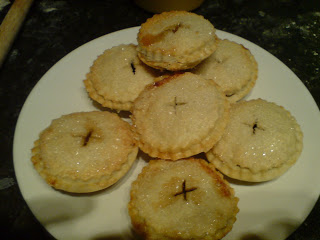
Jane Grigson gives instructions on how to make them. She says to use shortcrust pastry rather than puff pastry (unless you are eating them warm). I made pastry with half butter, half lard; I prefer it as it is more crisp and ‘short’. Whichever way you do it remember the flour:fat ratio is 2:1. Roll out pastry thinly and cut circles out with a scone-cutter to line small tart tins. Place a small teaspoon inside – don’t overdo it though, the fresh suet expands. Seal the top with another circle of pastry, gluing it on with some egg white. Make a cross in the middle and sprinkle with sugar. Bake for 20 minutes at 220ºC. Serve warm or cold.


#94 ‘To Make Mince Pies’ – 8/10. I really like the mincemeat. The meat is totally undetectable; but it, the fresh suet and the grated apple make the resulting pie-innards succulent and tasty, it’s not overly sweet either, which is good because you can eat more of them! Good old Mrs Beeton, where would we be without her! It’s been a while since I’ve had homemade mince pie and it brought back a lot of memories for me making them with my Mum. I am definitely getting in the Christmas spirit!

The Merchant of Hoghton

We had planned a big group outing to Hoghton Tower Farmers’ Market; me, Charlotte, Kate , Pete, Ange, Chris and their wee baby Evan. It’s to be found in Preston, Lancashire, and Ange has been raving about it for ages. I had my shopping budget of £35 and was hoping to fill the freezer with exciting stuff; in particular game.


We arrived slightly hungover from the night before and were immediately impressed – lots of stall selling absolutely everything! The range of meat and game was excellent, as was the cheeses, veg, pies, cakes and everything you could ever wish for.

For my 35 notes I came away with:
1. Smoked trout fillets
2. A hare
3. A brace of partridge
4. Smoked, cured streaky bacon
5. Pigeon and pea pie
6. Mutton pie
7. Corned beef pie
8. Chocolate-covered crystallised ginger
9. Banana Tea Loaf
10. Chocolate cake

Not bad I reckon. I’m particularly interested in the hare – there are a few recipes in English Food, and I’m thinking about cooking it as the 100th dish as it is fast approaching and I need something unusual and impressive. I was going to do an elaborate Victorian pheasant dish, but you need pheasant giblets and you need to order those apparently. The hand-raised mutton pie was the pie-highlight for me, I have to say, and it has gotten me enthused to cook some mutton dishes too.

Choosing my game.

We also had an ace laugh which is just what I needed, the best bit being me and Charlotte tasting some extra-mature Lancashire blue cheese…

Charlotte: This is really good.

Me: Really creamy, nice after taste. It tastes a bit like sick; but in a good way.

Charlotte: Yeah, not your own sick.

(Pause)

Charlotte: Err..like somebody else’s….?

(Hilarity ensues)

Ange’s Celtic aggression comes out at the mere weilding of sprouts.

#44 English Game Pie, #45 Cumberland Sauce


I invited Clive from work to help me finish off the last of the game I got from Bury Market last night in the form of (#44) English Game Pie. Looking through the ‘Stuffing, Sauces and Preserves’ chapter of English Food for something to go with game, I found (#44) Cumberland sauce. I’ve never had it before, and had no idea what it was. Everything was straight-forward, though the pie had lots of preparation. Anyways, here’s what I did…

The day before I simmered a brace of pheasants and a pigeon (essentially everything I had!) in a very light chicken stock along with a good seasoning and a bouquet garnei of parsley, bay leaves and thyme springs. Jane recommends between 2 and 4 birds. It took an hour and a half for the meat to become tender enough for me to pull the meat from the bone with relative ease. I cut the meat into chunks and kept them in a sealed tub topped up with the stock so it didn’t dry out over night and reserved the remaining stock.

Next day I arranged the meat in one large dish, and a smaller, as I made an extra one for my PhD supervisor too. Then hard-boiled and quartered three eggs and tucked them between the pieces of meat along with small rolls of grilled bacon (though not in yours Jason, don’t worry!), and chopped parsley. Next, I fried a large onion and about 8 ounces of mushrooms in 2 ounces of butter until they were golden. A tablespoon of flour was mixed in to the mushrooms and onions and stirred around so that the butter got absorbed, and then stock was added a ladelful at a time until a thick sauce had developed – about the thickness of double cream. Make sure the sauce is seasoned very well. It was simmered for about 5 minutes, and I added extra stock whenever the sauce thickened too much. The sauce was poured over the meat and then a puff pastry covered the pies. The large pie was cooked at 200 degrees for 20 minutes and then the oven was turned down to 170 for a final ten.

The Cumberland sauce was very easy. Make sure you make it in advance as it should be served cold. Whisk together a jar of redcurrant jelly and a teaspoon of Dijon mustard in a pan over a low heat. Meanwhile blanch the thinly pared peel of a lemon and an orange that have been cut into matchsticks for 5 minutes, then drain. Once the jelly has melted, add the peel, the juice of the two fruits, 5 tablespoons of port, plenty of black pepper and salt and ground ginger to taste (I used a scant teaspoon). Pour into sauce boat. Easy peasy.

FYI: Cumberland sauce is, in fact, German – the recipe was brought over with the House of Hanover in the late Eighteenth Century, and is named after George IV who was the Duke of Cumberland.

#43 English Game Pie – 10/10. This is my first full point dish I think! It was absoluely delicious. Although I’d never had it, there was something very familiar and comforting about it. It was also, for me, the epitome of English Food. The meat was beautifully tender, and he sauce had turned into a delicious gravy and the salty bacon added an extra dimension. The full flavour of the pheasant and pigeon coped very well with the rich Cumberland sauce…

#44 Cumberland Sauce – 8/10. A perfect complement to the game. Although it was very rich and sweet, the savory additions such as the pepper and mustard allowed you to add loads. All in all a fantastic meal!

#8 Chocolate Pie

The first Grigson for a bit. Although it’s no excuse I’ve been rather busy doing a PhD. I did the pie for dessert at Greg’s auntie’s. It was great to be baking again. My mum used to be a baker and me and my brother spent many an afternoon when we were little ‘helping’ mum make crumbles, turnovers and all sorts of stuff. As a grown-up, I find it extremely relaxing and therapeutic doing some baking as it takes me right back to those times. Anyway, enough of this schmaltz…

#7 Chocolate pie – a crust make from ground almonds, sugar and egg white blind-baked in the oven; an eighteenth century recipe apparently. Fill it with a ganache – nineteenth century recipe – top with sweetened whipped cream laced with rum. If I wasn’t following the recipes exactly, I would have missed out the rum – I’m not a fan of spirits in sweets. I’m glad I did though – I used dark rum (she didn’t say which type to use) and it was absolutely gorgeous! It was the richest dessert I think I’ve ever had. I’m writing this 4 days after making and eating it and I still feel pleasantly nauseous. My tastes are obviously changing; think I’ll put alcohol in everything. Gin and apple crumble or sambuca trifle anyone!?

Here’s what Greg says:
Chocolate pie chocolate pie! This is the best thing he’s made so far hands down. Dark chocolate, cream, booze, icing sugar sugar, almonds, it’s all your favourite things in one giant ganache of nauseating lurve. Despite what the book says about eat within one hour, we had some the next day and it had settled into a firmer lush cheesecake-like texture and was divine so don’t feel duty-bound to wolf the whole thing at once, not hat you could, it’s VERY rich. Sounds fairly easy to make but looks so impressive. Pics to follow. Yummmm. 5/5.

#8 Chocolate Pie: 4.5/5 – it’s got all the essential ingredients: crispy, nutty crust, loads of chocolate and a pint of cream. The best chocolate dessert I’ve had for ages – and that includes restaurants!