#216 Orange Sauce for Duck and Game

This is a sauce for any game and requires two things from The Freezer of Delights that have been sat there for a while: game carcasses for a game stock (see here for recipe) and two Seville oranges. It is very important that you save and bones and carcasses from your meat for stock-making at a later date. It is, of course, even more important that actually used the bloody things once you’ve saved them. I served this with the Mallards of Death.

Melt 1 ½ ounces of butter in a small saucepan and stir in a rounded tablespoon of flour. Stir and cook until the roux becomes golden brown. Now whisk in ¾ of a pint of game stock, bring to a boil, and then simmer for around 20 minutes. Whilst it is cooking away gently, pare thinly the rinds of two Seville oranges and slice them as thinly as possible (you can use an orange and a lemon if you can’t get Seville oranges). Add the rind along with the juice of the oranges to the sauce and cook for a further 3 or 4 minutes. Add up to a tablespoon of sugar and four tablespoons of port, plus the skimmed roasting juices from the meat. That’s it! Easy.


#216 Orange Sauce for Duck and Game. A really good sauce this one; tangy, bitter, fruity, rich and a lovely red-brown colour with just the right amount of freshness and tang to cut through the very strong meat. If you don’t like bitter foods, use a normal orange and a lemon and perhaps less pared rind. 7/10.

#199 Apple Sauce III

Eagle-eyed followers of the blog will notice that there has been no Apple Sauce I or II. In English Food there four recipes for apple sauce, so I thought it best to get the ball rolling. I’ve made this one first because it is not a sauce for pork, but for chicken. I had a very nice-looking free range chicken that I bought from the poulterer Peter D Willacy at Houghton Farmers Market, you see. He has no website, but you can call him in 01253 883470. The best thing about their chickens is that they come with giblets; not something you see these days, not even in good butchers. I’m hoping to buy a capon from them soon. This sauce can also be served with veal.

Anyways, if you are roasting a chicken this weekend, try this very easy creamy and usual hot apple sauce:

Core, dice and peel a pound of Cox’s pippin apples (or a good equivalent) and fry them in some clarified butter. (If you don’t clarify your butter first, it may burn. Melt it slowly in a pan, blot away any solids on the surface with some kitchen paper, then decant the liquid butter away, leaving behind any other solids that sank to the bottom.) When they have softened and turned a little golden, remove the apple pieces with a slotted spoon, leaving behind the buttery juices. Add six tablespoons of white wine (or cider) to the juices to deglaze and reduce it all well. Lastly, stir through six tablespoons of double cream and sharpen with a squeeze of lemon juice. Serve hot.


#199 Apple Sauce III. A strange one this one because the sauce is essentially stewed apples and cream, which in my book is a pudding. That said, it did go surprisingly well with the chicken as there are no strong flavours to drown out the subtle chicken. 5.5/10.

#177 Hollandaise Sauce

The fishmonger in the Arndale Centre in Manchester was selling sea bass for £1.50 each! What a bargain. I know that they’ve probably been dredged up by one of those massive trawler nets and by buying them I’ve surely helped seal the fate of several marine species, but ignorance is bliss so I won’t try to find out.

To go with the sea bass, I had samphire (see previous entry) and also made some hollandaise sauce. Not technically English, of course, but we’ve used it for so long in our cuisine it seems English – more English than, say mayonnaise anyway – and it is one of my favourite sauces. The trouble is, me and hollandaise has a chequered past; it’s a tricky sauce that is either amazing and delicious, or splits and is awful and goes in the bin. My success rate is around 50%. Griggers’ recipe is slightly different to the classic way of making it as it doesn’t use melted butter, but uses cubes of butter added gradually instead? Is this a foolproof recipe? We shall see…

FYI: hollandaise sauce first appeared as simply melted butter in eighteenth century France, but soon became the complex emulsion of butter and egg yolks we know and love and was added to the list of mother sauces of French cuisine by Escoffier in the early twentieth century (the others being béchamel, veloute, espangole and allemande).

This is the Griggers method (you can multiply up or down depending upon how much you need to make):

Begin by boiling down 3 tablespoons each of water and white wine vinegar and 10 crushed white peppercorns until just a tablespoon remains. Strain it into a bowl and allow to cool. Bring a pan of water to a simmer and place the bowl over it. Beat in three large egg yolks and beat in 6 ounces of unsalted butter bit by bit using a wire whisk. Do not over heat, or the eggs cook and the sauce splits. Season with salt and lemon juice.

#177 Hollandaise Sauce – 9/10. Well that was easy! This may be the fool-proof method I have been after (either that or it was a fluke). The sauce is beautifully rich, with a piquant tang of lemon and vinegar that cut through it so well that you easily drink a pit of the stuff. My only gripe is that this method doesn’t seem to make a very thick sauce, but that is being very nit-picky.

#170 English Salad Sauce

English salad sauce was used as a cheaper alternative to mayonnaise and other similar posh or tricky to make dressings. Nothing to be ashamed about, says Jane, and it comes from Eliza Acton – a cook that pops up again and again in English food, so I assumed it would be some kind of delicious sauce that would be akin to Heinz Salad Cream. In fact Charlotte and I were actually excited at the prospect. We shouldn’t have got excited though as it was pretty crap. However, as a bit of English food history, it is interesting; it’s unbelievable how much our palates have changed. By the way, the sauce is a basic sauce that can (and definitely should) be flavoured with extra ingredients: tomato ketchup, anchovies, or whatever. I went for capers as we were having it with salmon fishcakes.

Sieve two hardboiled egg yolks and stir in one raw yolk and season with salt, white and Cayenne pepper and ¼ teaspoon of sugar along with a teaspoon of water. Gradually mix in ¼ pint of double cream and whisk until thickened. Now flavour with a little lemon juice or a flavoured vinegar. Lastly, add any additional flavourings. Dress the salad with the sauce – don’t forget to slice the leftover egg whites to use in the salad.


#170 English Salad Sauce. Not what I was expecting at all. Quite runny and unsatifying, bland and boring. We made taste okay with the addition of lots of seasoning and a shed-load of capers. Definitely give this a miss, tartar sauce, salad cream or mayonnaise would have been the best thing to have. Oh well, you can’t win them all – 3/10.

FYI: Eliza Acton (1799-1859) was a cook and poet. She was the first person write a cook book for normal folk, anmd was the first to include cooking times and ingredients lists in her recipes. Years later Mrs Beeton based her much more popular book on Acton’s writings. Cheeky!

#162 Horseradish Sauce

To accompany the salt beef, I made this classic accompaniment, though it goes very well with smoked fish such as trout.

It’s very easy to make: lightly whip ¼ pint of double cream and stir in 2 tablespoons of grated horseradish, then season with salt, pepper and the juice of up to half a lemon. It’s important to just lightly whip the cream as the acids in the lemon make it much thicker. Griggers also make the point that the outside of the horseradish root is alot hotter than the centre, so if you like it milder, grate across the root, rather than down the side.

FYI: horseradish can be found growing wild in most places in Europe and has been cultivated by the Egyptians and Romans and, according to Greek Myth, Apollo was told by the Delphic Oracle that it was worth it’s weight in gold, though why I don’t know.

Again, no pic, sorry – my camera’s doing some funny things

#162 Horseradish Sauce – 6.5/10. This very pleasant and creamy, though lacked the punch I expected, even though I was pretty generous with the horseradish. It was ok, but I think I prefer a jar of proprietary horseradish sauce! Is this bad of me!?

#143 Boiled Leg of Mutton (or Lamb) with (#144) Caper Sauce

When Jane Grigson wrote English Food in the 1970s, she complained – quite rightly – that the general quality of lamb in England had declined rather. This was mainly due to the importation of cheap New Zealand lamb, which rendered mutton almost obsolete. These days things have changed and British lamb in a staple even in supermarkets and mutton is having a well-deserved comeback.

I popped into Manchester City Centre at the weekend and, by chance, the monthly farmers’ market was on so I had a little browse around the stalls and bought myself a leg of lamb from Bowland in Lancashire – a farm that outdoor-rears lamb, beef and pork. Here’s their website. The man at the fruit and veg stall spotted my purchase and commented that the best meat he’d ever had was from there. Great stuff. Now all I had to do was decide what to do with it and went for the boiled leg of lamb with caper sauce – mainly because it requires very little effort, but also because it is a very Victorian way of cooking meat and wanted to try it.

It’s well worth mentioning that caper sauce is also traditionally served with fish too, so if you’re a piscitarian, or whatever you fair-weather vegetarians like to call yourselves, you can try it with salmon or skate.

The original recipe asked for either a leg of mutton or of lamb – if you are to use lamb as I did, get hold of a real free-range one, otherwise it won’t stand up to the boiling.

Trim the leg of any large amounts of fat if it hasn’t been already and place the leg in a large pot with enough water to cover it. Add stock vegetables – 3 quartered carrots, 2 quartered parsnips, one quartered turnip and three whole onions (all peeled) – plus a very good seasoning with salt and pepper. Bring to the boil and turn down to a very low simmer and leave for 2 to 2 ½ hours depending upon size. Don’t dare to throw the stock away – use it make the caper sauce and with the leftovers, a soup (I did lamb and mint soup).

Whilst it is cooking you need to make a turnip puree as an accompaniment – also traditionally Victorian. Peel and slice 3 pounds of turnips and boil them in salted water until tender. Puree them in a blender, return to the pan and then whisk an ounce of butter into them. Next mix ¼ pint of double cream with a level tablespoon of flour and whisk this into the sauce. Cook the sauce until it thickens up slightly.

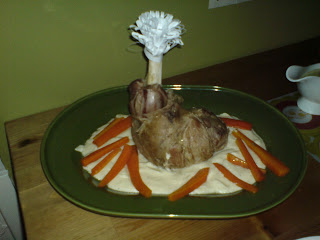
When the meat is cooked, remove it from the water, place it on a serving dish flat-side down and make a paper ruff (yes, a paper ruff!) to fasten around the shank for decoration. Spoon the turnip puree around the outside and scatter the quartered carrots over the puree.

Loving the ruff!
Serve it with caper sauce that has been made using the stock from the lamb.

For the sauce melt ½ an ounce of butter in a small saucepan and stir in a tablespoon of flour. Cook and stir for a few seconds before adding ¾ pint of the lamb or mutton stock (or indeed fish) bit by bit to avoid getting lumps. Simmer until it is the thickness of single cream. Season with salt and pepper and add an egg yolk that has been beaten with 2 tablespoons of cream and stir for a minute or two. Lastly add a generous tablespoon of drained and rinsed capers and ½ a tablespoon of chopped parsley. Serve immediately, says Griggers.

Sorry about the shite picture!

FYI: If you are looking for an alternative to capers – the flower bud of an Asian shrub, you can try using the buds of nasturtium, buttercup or marigold. I’ll stick to the original, though I think.

#143 Boiled Leg of Mutton (or Lamb) with (#144) Caper Sauce – 7.5/10. I really enjoyed this meal. It was so easy to cook, you could not go wrong with it, even if you’ve never cooked anything before in your life. The lamb was tasty and moist and not fatty as most of it had dissolved into the stock – I’m definitely going back to Bowland for my meat. The turnip puree was rather odd – unsurprisingly, it was quite bland and I suppose they were the bland carb element. I would’ve preferred mashed potato though. It’s very hard to mark the caper sauce separately as it is part of the dish. I really liked it – it was piquant and married with the lamb perfectly. The only way it could have been improved would be to chop the capers up first so that the sauce was very capery indeed!

#123 Bread Sauce

Ahhh! The bread sauce. A total necessity to go with roast pheasant (or with any roast game or poultry). You don’t get much a more English accompaniment to a roast dinner than this – though not many seem to have tried it, put off by the soggy bread aspect. Don’t you be put off, reader; the bread completely disintegrates to make a nice smooth sauce. Plus, the sauce is prevented from being at all gluey by the addition of butter or cream (or a mixture of the two). If you’ve never made it, have a go – it’s very easy and can be made ahead of time as long as you cover it in cling film to prevent a skin forming and you reheat it in a bowl over a pan of simmering water.

FYI: This is a very old recipe, bread sauces go back to Medieval times though stock was used as a base more often than milk. Thick sauces were required then because trenchers (plates made of dried bread) would have gone soggy otherwise. Sauces thickened with flour or eggs would not work for that as they would either glue or custard respectively!

OK, the recipe:

Begin by putting ¾ of a pint of whole or Jersey milk into a basin along with a small onion that has been halved and studded with 3 or 4 cloves. Place the basin over simmering water and keep the milk just below boiling point for as long as possible so that it can be infused with the flavours. Whilst that is going on use a food processor to make 4 ounces of white breadcrumbs. Take out the onion and cloves and whisk in the breadcrumbs until it is thick. The suace will thicken up after a few minutes, but if it’s a bit on the thin side make some more breadcrumbs and whisks them in. Season the sauce with mace or nutmeg (or both), salt, white pepper and a pinch of Cayenne pepper. Lastly, enrich the sauce with 1 ½ ounces of butter or 2 tablespoons of cream (or a bit of both). Pour into a ‘sauce tureen’ and add an extra sprinkle of Cayenne, says Griggers.

#123 Bread Sauce – 9/10. I loved this; creamy, rich, but not sickly at all. I’ve made it before, but this definitely the best recipe for it so far. The old fashioned spices really made it work for me.

#93 Mayonnaise

I want to clock up some Grigson recipes so that the 100th is something exciting before Christmas with a hare, otherwise it’ll be something boring like Welsh rarebit or something. The first of these is mayonnaise. Surprised it’s in there, really; I know we all use it, but it’s not English. Who am I to judge? Apparently, in 1861 Mrs Beeton, took it as read that mayonnaise was well established here. Funnily enough, I’ve never actually made my own mayonnaise and only ever bought it from the supermarket and wasn’t sure what to expect. If you haven’t, have a go – it’s dead easy. I don’t know what the fuss is about getting the yolks and oil to emulsify and not split; just don’t rush it, and you’ll be fine…

Beat 3 egg yolks with a whisk along with a teaspoon of Dijon mustard (English is way too strong for this) and a dash of lemon juice or white wine vinegar. When they start to thicken slowly add ½ pint of groundnut or olive oil (I actually used both at a ratio of about 4:1). Add the oil drop by drop as you whisk at first. If you’re wrist begins to ache take a little rest. You can be braver with the oil as you get to the half way mark. When all is added, season with salt and pepper and extra lemon or vinegar if needed. Easy!


FYI: No-one is really sure of the origin of the name – there are two theories; first, says Larousse Gastronomique, is that it is a popular corruption of moyeunaise, derived from the very old French word moyeu, which means yolk of egg. Or it came from mayennaise after Charles de Lorraine, duke of Mayenne, famous for taking the time to eat his chicken with cold sauce before being defeated in the Battle of Arques. What a trouper. I prefer the second story.

#93 Mayonnaise – 6/10. Not disappointed as such, but unprepared, I think the right word might be. Home-made mayonnaise is absolutely nothing like shop-bought. They are incomparable. This mayonnaise was rich and slightly bitter in flavour and not good when I dipped my finger in to check for seasoning. However, when I tried it out on my favourite sandwich – mature Cheddar, picked beetroot and mayonnaise, I changed my mind and thought it was very good. I just think I’m too used to the bland old Hellman’s to be a convert…Is that wrong?

#44 English Game Pie, #45 Cumberland Sauce


I invited Clive from work to help me finish off the last of the game I got from Bury Market last night in the form of (#44) English Game Pie. Looking through the ‘Stuffing, Sauces and Preserves’ chapter of English Food for something to go with game, I found (#44) Cumberland sauce. I’ve never had it before, and had no idea what it was. Everything was straight-forward, though the pie had lots of preparation. Anyways, here’s what I did…

The day before I simmered a brace of pheasants and a pigeon (essentially everything I had!) in a very light chicken stock along with a good seasoning and a bouquet garnei of parsley, bay leaves and thyme springs. Jane recommends between 2 and 4 birds. It took an hour and a half for the meat to become tender enough for me to pull the meat from the bone with relative ease. I cut the meat into chunks and kept them in a sealed tub topped up with the stock so it didn’t dry out over night and reserved the remaining stock.

Next day I arranged the meat in one large dish, and a smaller, as I made an extra one for my PhD supervisor too. Then hard-boiled and quartered three eggs and tucked them between the pieces of meat along with small rolls of grilled bacon (though not in yours Jason, don’t worry!), and chopped parsley. Next, I fried a large onion and about 8 ounces of mushrooms in 2 ounces of butter until they were golden. A tablespoon of flour was mixed in to the mushrooms and onions and stirred around so that the butter got absorbed, and then stock was added a ladelful at a time until a thick sauce had developed – about the thickness of double cream. Make sure the sauce is seasoned very well. It was simmered for about 5 minutes, and I added extra stock whenever the sauce thickened too much. The sauce was poured over the meat and then a puff pastry covered the pies. The large pie was cooked at 200 degrees for 20 minutes and then the oven was turned down to 170 for a final ten.

The Cumberland sauce was very easy. Make sure you make it in advance as it should be served cold. Whisk together a jar of redcurrant jelly and a teaspoon of Dijon mustard in a pan over a low heat. Meanwhile blanch the thinly pared peel of a lemon and an orange that have been cut into matchsticks for 5 minutes, then drain. Once the jelly has melted, add the peel, the juice of the two fruits, 5 tablespoons of port, plenty of black pepper and salt and ground ginger to taste (I used a scant teaspoon). Pour into sauce boat. Easy peasy.

FYI: Cumberland sauce is, in fact, German – the recipe was brought over with the House of Hanover in the late Eighteenth Century, and is named after George IV who was the Duke of Cumberland.

#43 English Game Pie – 10/10. This is my first full point dish I think! It was absoluely delicious. Although I’d never had it, there was something very familiar and comforting about it. It was also, for me, the epitome of English Food. The meat was beautifully tender, and he sauce had turned into a delicious gravy and the salty bacon added an extra dimension. The full flavour of the pheasant and pigeon coped very well with the rich Cumberland sauce…

#44 Cumberland Sauce – 8/10. A perfect complement to the game. Although it was very rich and sweet, the savory additions such as the pepper and mustard allowed you to add loads. All in all a fantastic meal!

#23 French Dressing

Now I know what you’re going to say; French Dressing isn’t very English. Back when English Food was written, we had one type of dressing and it was this recipe. (My sister used the exact same one herself, though not from Grigson.) Now, of course we have millions, so they are definitely part of the English way of eating. And if you don’t agree: tough tits it’s in the book and I have to make at some point anyway.

The reason that I’ve made it in the middle of January is because I need to eat something fresh with actual vitamins. Christmas was too indulgent. I may have gout. So it’s salads for me. I got a brilliant panini sandwich press thing for Christmas and have been having healthy sarnies and salads. Ta Ma!
Crush a clove of garlic into a bowl or a clean jar and add a quarter teaspoon of sugar, a teaspoon of French mustard, a tablespoon of wine vinegar, five tablespoons of olive oil and some salt and ground pepper. Give it a good mix or shake and you are done. I know it looks like someone’s vommed in a jar, but it’s very nice reallly. No, really!

#23 French Dressing 7/10. It’s the one we all know and love, but there’s more exciting ones out there.