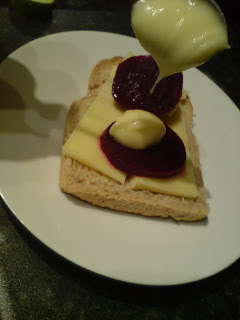
#170 English Salad Sauce

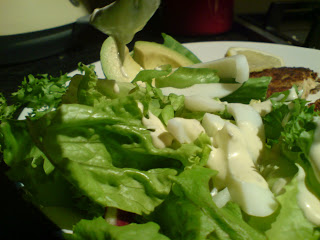
English salad sauce was used as a cheaper alternative to mayonnaise and other similar posh or tricky to make dressings. Nothing to be ashamed about, says Jane, and it comes from Eliza Acton – a cook that pops up again and again in English food, so I assumed it would be some kind of delicious sauce that would be akin to Heinz Salad Cream. In fact Charlotte and I were actually excited at the prospect. We shouldn’t have got excited though as it was pretty crap. However, as a bit of English food history, it is interesting; it’s unbelievable how much our palates have changed. By the way, the sauce is a basic sauce that can (and definitely should) be flavoured with extra ingredients: tomato ketchup, anchovies, or whatever. I went for capers as we were having it with salmon fishcakes.

Sieve two hardboiled egg yolks and stir in one raw yolk and season with salt, white and Cayenne pepper and ¼ teaspoon of sugar along with a teaspoon of water. Gradually mix in ¼ pint of double cream and whisk until thickened. Now flavour with a little lemon juice or a flavoured vinegar. Lastly, add any additional flavourings. Dress the salad with the sauce – don’t forget to slice the leftover egg whites to use in the salad.


#170 English Salad Sauce. Not what I was expecting at all. Quite runny and unsatifying, bland and boring. We made taste okay with the addition of lots of seasoning and a shed-load of capers. Definitely give this a miss, tartar sauce, salad cream or mayonnaise would have been the best thing to have. Oh well, you can’t win them all – 3/10.

FYI: Eliza Acton (1799-1859) was a cook and poet. She was the first person write a cook book for normal folk, anmd was the first to include cooking times and ingredients lists in her recipes. Years later Mrs Beeton based her much more popular book on Acton’s writings. Cheeky!

#162 Horseradish Sauce

To accompany the salt beef, I made this classic accompaniment, though it goes very well with smoked fish such as trout.

It’s very easy to make: lightly whip ¼ pint of double cream and stir in 2 tablespoons of grated horseradish, then season with salt, pepper and the juice of up to half a lemon. It’s important to just lightly whip the cream as the acids in the lemon make it much thicker. Griggers also make the point that the outside of the horseradish root is alot hotter than the centre, so if you like it milder, grate across the root, rather than down the side.

FYI: horseradish can be found growing wild in most places in Europe and has been cultivated by the Egyptians and Romans and, according to Greek Myth, Apollo was told by the Delphic Oracle that it was worth it’s weight in gold, though why I don’t know.

Again, no pic, sorry – my camera’s doing some funny things

#162 Horseradish Sauce – 6.5/10. This very pleasant and creamy, though lacked the punch I expected, even though I was pretty generous with the horseradish. It was ok, but I think I prefer a jar of proprietary horseradish sauce! Is this bad of me!?

#143 Boiled Leg of Mutton (or Lamb) with (#144) Caper Sauce

When Jane Grigson wrote English Food in the 1970s, she complained – quite rightly – that the general quality of lamb in England had declined rather. This was mainly due to the importation of cheap New Zealand lamb, which rendered mutton almost obsolete. These days things have changed and British lamb in a staple even in supermarkets and mutton is having a well-deserved comeback.

I popped into Manchester City Centre at the weekend and, by chance, the monthly farmers’ market was on so I had a little browse around the stalls and bought myself a leg of lamb from Bowland in Lancashire – a farm that outdoor-rears lamb, beef and pork. Here’s their website. The man at the fruit and veg stall spotted my purchase and commented that the best meat he’d ever had was from there. Great stuff. Now all I had to do was decide what to do with it and went for the boiled leg of lamb with caper sauce – mainly because it requires very little effort, but also because it is a very Victorian way of cooking meat and wanted to try it.

It’s well worth mentioning that caper sauce is also traditionally served with fish too, so if you’re a piscitarian, or whatever you fair-weather vegetarians like to call yourselves, you can try it with salmon or skate.

The original recipe asked for either a leg of mutton or of lamb – if you are to use lamb as I did, get hold of a real free-range one, otherwise it won’t stand up to the boiling.

Trim the leg of any large amounts of fat if it hasn’t been already and place the leg in a large pot with enough water to cover it. Add stock vegetables – 3 quartered carrots, 2 quartered parsnips, one quartered turnip and three whole onions (all peeled) – plus a very good seasoning with salt and pepper. Bring to the boil and turn down to a very low simmer and leave for 2 to 2 ½ hours depending upon size. Don’t dare to throw the stock away – use it make the caper sauce and with the leftovers, a soup (I did lamb and mint soup).

Whilst it is cooking you need to make a turnip puree as an accompaniment – also traditionally Victorian. Peel and slice 3 pounds of turnips and boil them in salted water until tender. Puree them in a blender, return to the pan and then whisk an ounce of butter into them. Next mix ¼ pint of double cream with a level tablespoon of flour and whisk this into the sauce. Cook the sauce until it thickens up slightly.

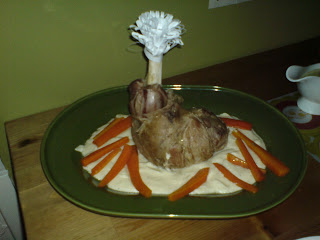
When the meat is cooked, remove it from the water, place it on a serving dish flat-side down and make a paper ruff (yes, a paper ruff!) to fasten around the shank for decoration. Spoon the turnip puree around the outside and scatter the quartered carrots over the puree.

Loving the ruff!
Serve it with caper sauce that has been made using the stock from the lamb.

For the sauce melt ½ an ounce of butter in a small saucepan and stir in a tablespoon of flour. Cook and stir for a few seconds before adding ¾ pint of the lamb or mutton stock (or indeed fish) bit by bit to avoid getting lumps. Simmer until it is the thickness of single cream. Season with salt and pepper and add an egg yolk that has been beaten with 2 tablespoons of cream and stir for a minute or two. Lastly add a generous tablespoon of drained and rinsed capers and ½ a tablespoon of chopped parsley. Serve immediately, says Griggers.

Sorry about the shite picture!

FYI: If you are looking for an alternative to capers – the flower bud of an Asian shrub, you can try using the buds of nasturtium, buttercup or marigold. I’ll stick to the original, though I think.

#143 Boiled Leg of Mutton (or Lamb) with (#144) Caper Sauce – 7.5/10. I really enjoyed this meal. It was so easy to cook, you could not go wrong with it, even if you’ve never cooked anything before in your life. The lamb was tasty and moist and not fatty as most of it had dissolved into the stock – I’m definitely going back to Bowland for my meat. The turnip puree was rather odd – unsurprisingly, it was quite bland and I suppose they were the bland carb element. I would’ve preferred mashed potato though. It’s very hard to mark the caper sauce separately as it is part of the dish. I really liked it – it was piquant and married with the lamb perfectly. The only way it could have been improved would be to chop the capers up first so that the sauce was very capery indeed!

#127 Banana Chutney

Thus far I have enjoyed making the preserves in English Food and was very much in the mood to make a new one – the Banana Chutney was selected as I had all the ingredients other than the masses of bananas in already, plus it seemed like a no-brainer; no faffing about with pectin and sugar thermometers here!


Begin by slicing up 12 bananas and simmering them in ½ a pint of cider (or white wine) vinegar until the bananas are cooked and mushy. Stir in 8 ounces of sugar and allow to cool. Next stir in 2 medium onions that have been finely sliced, 4 ounces of finely chopped sultanas, an ounce of curry powder (whatever strength you like), ½ teaspoon of cinnamon, a pinch of Cayenne pepper, and salt – and salt well; chutneys should be salty, add up to 3 teaspoons. Cover the bowl or pan with Clingfilm and allow to stand for 12 hours. Taste and check for seasoning again before potting in sterilised jars and store somewhere cool.

#127 Banana Chutney – 5.5/10. Nice and sweet; Griggers says to serve with ham, salt pork and chicken, but I had it in a cheese sandwich and it was very nice, though it was quite dry – I prefer chutneys to have a bit of sauce to them. If I were to make itagain, I would add more vinegar and sugar and would also cook the curry powder out too in a little oil before adding the bananas and vinegar at the start (but what do I know).

#123 Bread Sauce

Ahhh! The bread sauce. A total necessity to go with roast pheasant (or with any roast game or poultry). You don’t get much a more English accompaniment to a roast dinner than this – though not many seem to have tried it, put off by the soggy bread aspect. Don’t you be put off, reader; the bread completely disintegrates to make a nice smooth sauce. Plus, the sauce is prevented from being at all gluey by the addition of butter or cream (or a mixture of the two). If you’ve never made it, have a go – it’s very easy and can be made ahead of time as long as you cover it in cling film to prevent a skin forming and you reheat it in a bowl over a pan of simmering water.

FYI: This is a very old recipe, bread sauces go back to Medieval times though stock was used as a base more often than milk. Thick sauces were required then because trenchers (plates made of dried bread) would have gone soggy otherwise. Sauces thickened with flour or eggs would not work for that as they would either glue or custard respectively!

OK, the recipe:

Begin by putting ¾ of a pint of whole or Jersey milk into a basin along with a small onion that has been halved and studded with 3 or 4 cloves. Place the basin over simmering water and keep the milk just below boiling point for as long as possible so that it can be infused with the flavours. Whilst that is going on use a food processor to make 4 ounces of white breadcrumbs. Take out the onion and cloves and whisk in the breadcrumbs until it is thick. The suace will thicken up after a few minutes, but if it’s a bit on the thin side make some more breadcrumbs and whisks them in. Season the sauce with mace or nutmeg (or both), salt, white pepper and a pinch of Cayenne pepper. Lastly, enrich the sauce with 1 ½ ounces of butter or 2 tablespoons of cream (or a bit of both). Pour into a ‘sauce tureen’ and add an extra sprinkle of Cayenne, says Griggers.

#123 Bread Sauce – 9/10. I loved this; creamy, rich, but not sickly at all. I’ve made it before, but this definitely the best recipe for it so far. The old fashioned spices really made it work for me.

#114 Quince, Medlar, Sorb or Crab Apple Jelly

The quinces I bought the other day were beginning to look a bit sad and I needed to use them up with something. I really like quince, so quince jelly was the obvious choice – making a few jars of this would mean I would still be eating them way beyond their season had ended.

By the way, this recipe can be followed as is but with medlars, sorbs or crab apples, so if you are lucky enough to know where their might be some growing near you try this jelly.

Begin by scrubbing clean your quinces and chop them roughly along with the same weight in Bramley apples. Do not peel or core them – that is where the pectin resides that will set the jelly. Place the fruit in a pan and barely cover them with water. Simmer the fruit until they have become a pulp (I used a potato masher to help the quinces along).

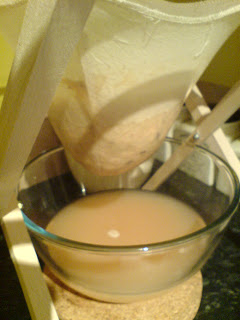
Place the pulp in a jelly bag suspended over a bowl – if you don’t have one, use a muslin-lined sieve instead. Leave the pulp to drip dry – this takes a while, a few hours at least, overnight if you’ve done loads. Measure the volume of liquid and pour into a heavy-based pan and add a pound of sugar for every pint of liquid. Boil this mixture until this has reached setting point (read the recipe for marmalade for more info on this) and pour into sterilised jars.

Quince jelly can be used like any fruit jelly, but is typically an accompaniment to cheeses, game and turkey.


#114 Quince Jelly – 6.5/10. A nice conserve, but I perhaps more apple than I should have, as the quince flavour is not super strong and is sweeter than I’m used to. That said, I used as jam and I think it’ll be a lot better with some game or cheese. Also, the recipe’s very good as I got four jars of jelly from just two quince!

#109 Quince Comfits

I went into Unicorn in Chorlton, Manchester to stock up on my favourite seasonal fruit and vegetables – this time of year they are quince, Jerusalem artichokes and Seville oranges. Once I’d bought them, it was a quick trawl through the book to see what I could do with them. The one recipe that didn’t require me to buy anything extra, other than was in my store cupboard, was quince comfits; all they need is water and sugar.


FYI: A comfit is a sugary sweet, rather like a pastille, that go way back In fact, quince comfits were made as part as Henry IV’s coronation banquet in 1399. This is a fact that I’m still in awe of. Get some made if you find some quinces and have a rare medieval treat!

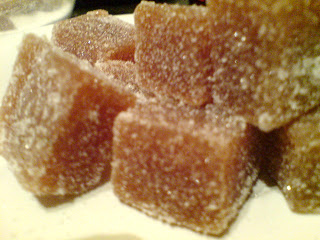
Scrub the fluffy stuff that coats the quince’s skins, wash them thoroughly, and chop roughly. Put them in a pan with around an inch of water and simmer them, covered, until they are very soft. This takes a while as they are so hard, so keep a check on them and add extra water if need be to prevent them boiling dry. Once they are very soft, pass them through a sieve and weigh the pulp. Return it to the pan and add an equal weight of sugar. Bring it to the boil and allow to simmer, pop and bubble for up to half an hour. Make sure you stir it often to prevent it catching. It is ready when the mixture comes away from the sides as you stir. Pour the mixture into Swiss roll tins or sandwich tins that have been lined with greaseproof paper. Now you have to be patient – the mixture has to be dried slowly in a very low oven (less than 50ºC) or in the airing cupboard for a few days. Cut it into squares and shake the sweets in a tub of caster sugar to coat them. Hey Presto: Medieval sweets!

Griggers reckons they’re really good melted on grilled pork chops.


#109 Quince Comfits – 7/10. I love quince. I think they’re my second favourite fruit after the raspberry. Their wonderfully perfumed toffee flavour really does come across in these little sweets. I don’t really go for sweets like this usually, but these are good and have the added interest of being eaten by a medieval king!

#88 Christmas Pudding: Part 2, #102 Brandy Butter

The next most most exciting thing about Christmas dinner after the turkey, is probably the flaming Christmas Pudding. I had already made the puddings back in November, so now it was time to steam them for the big day. The pudding needs steaming for three hours, so you need to put it on in good time. However, that is the only thing you need to do, other than checking to see if the pan has boiled dry, so all is good. Turn the pudding out onto a serving dish and warm up some brandy either in a metal ladle or a small saucepan and light it (it won’t light unless you warm it first). Turn off the lights and pour it over the pudding. If this fails to impress the family, throw them out into the cold, cold winter street and tell them to come back when they’ve got some Christmas cheer. Serve with brandy butter, cream or custard.


To make brandy butter (or hard sauce, as it used to be called), cream 4 ounces of butter, when you’ve done that, beat in 4 ounces of icing sugar, 1 1/2 tablespoons of brandy, some freshly grated nutmeg and a squeeze of lemon juice, if you like. Allow to set in the fridge. Make this in advance – I made it a few days before the big day.

#88 Richard Boston’s Guinness Christmas Pudding – 3.5/10. Pretty disappointing this pudding was. It tasted really good, but was extremely stodgy and soft. I think I’ll use half breadcrumbs, half flour next time.

#102 Brandy Butter – 6.5/10. Nice, but very rich indeed. Think I prefer good old custard.

#101 Parsley and Lemon Stuffing

A turkey wouldn’t be a turkey without stuffing. This is the one Griggers suggests to have with turkey. It contains no sausagemeat, so it’s quite light and the lemon and parsley flavour cuts through the richness of all the other roast items on your Christmas dinner. It’s also choc-full of butter, so it helps keep the turkey nice and succulent.


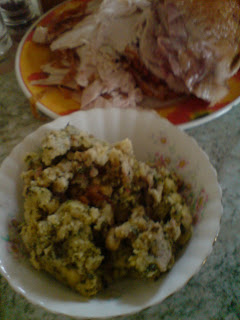
Begin by cutting the crusts off a large white loaf of bread and blitz it in a food processor until it becomes crumbs. Lay the crumbs on a large baking tray and allow them to dry out in a cool oven – you don’t want them to brown so 80ºC will be enough. Weight out 8 ounces of the crumbs (freeze the rest) and put in a large bowl and mix in the zest of two lemons and the juice of one, a bunch of chopped parsley, a teaspoon of chopped thyme, a teaspoon of dried marjoram, 8 ounces of creamed butter, 3 eggs and a good seasoning. Mix the ingredients with your hands and stuff the main cavity of the turkey with it. You probably won’t use it all, so freeze the rest in balls so you can put them in the cavity of chickens for your Sunday Roast.

#101 Parsley and Lemon Stuffing – 7/10. A nice fresh and light tasting stuffing. I reckon it’ll go better with chicken than with turkey.

#93 Mayonnaise

I want to clock up some Grigson recipes so that the 100th is something exciting before Christmas with a hare, otherwise it’ll be something boring like Welsh rarebit or something. The first of these is mayonnaise. Surprised it’s in there, really; I know we all use it, but it’s not English. Who am I to judge? Apparently, in 1861 Mrs Beeton, took it as read that mayonnaise was well established here. Funnily enough, I’ve never actually made my own mayonnaise and only ever bought it from the supermarket and wasn’t sure what to expect. If you haven’t, have a go – it’s dead easy. I don’t know what the fuss is about getting the yolks and oil to emulsify and not split; just don’t rush it, and you’ll be fine…

Beat 3 egg yolks with a whisk along with a teaspoon of Dijon mustard (English is way too strong for this) and a dash of lemon juice or white wine vinegar. When they start to thicken slowly add ½ pint of groundnut or olive oil (I actually used both at a ratio of about 4:1). Add the oil drop by drop as you whisk at first. If you’re wrist begins to ache take a little rest. You can be braver with the oil as you get to the half way mark. When all is added, season with salt and pepper and extra lemon or vinegar if needed. Easy!


FYI: No-one is really sure of the origin of the name – there are two theories; first, says Larousse Gastronomique, is that it is a popular corruption of moyeunaise, derived from the very old French word moyeu, which means yolk of egg. Or it came from mayennaise after Charles de Lorraine, duke of Mayenne, famous for taking the time to eat his chicken with cold sauce before being defeated in the Battle of Arques. What a trouper. I prefer the second story.

#93 Mayonnaise – 6/10. Not disappointed as such, but unprepared, I think the right word might be. Home-made mayonnaise is absolutely nothing like shop-bought. They are incomparable. This mayonnaise was rich and slightly bitter in flavour and not good when I dipped my finger in to check for seasoning. However, when I tried it out on my favourite sandwich – mature Cheddar, picked beetroot and mayonnaise, I changed my mind and thought it was very good. I just think I’m too used to the bland old Hellman’s to be a convert…Is that wrong?