#333 Lamb’s Head and Barley, with Brain Sauce

My-oh-my! Where do I start with this one!? It is quite possible the most infamous recipe in the whole book. I must say it didn’t seem as daunting as it did when I first spotted it after I had decided to cook the whole book.
Lamb’s head was once rather popular – in particular during the nineteenth century. According to Grigson, Queen Victoria’s chef was a fan. Why has it that in the last few decades it has just simply disappeared from our food culture? It did hang on in Northern England and Scotland and it was one of Jane Grigson’s favourite meals and she emphasises that it is not “ungenteel…or even savage food”.
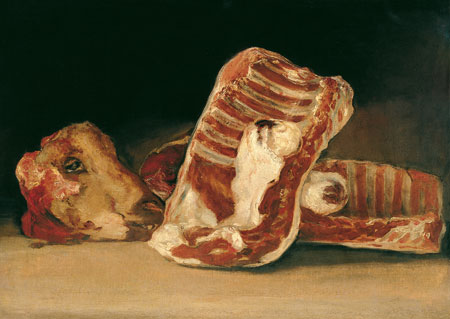
Still Life with Sheep’s Head
by Francisco de Goya (c.1808-12)

Mrs Beeton gives a recipe for leek soup that requires a sheep’s head and also describes how to “dress a sheep’s head” with a very similar recipe to Jane’s, though the barley is replaced with oats (as it is in the Scottish fashion). And if lamb’s head with brain sauce makes your stomach turn, I found a recipe in Elizabeth Raffald’s 1769 book The Experienced English Housekeeper for lamb’s head and purtenances, which, to you and I, are the innards. Calf’s head was also very popular; it was the main ingredient in mock turtle soup, for example. So the heads of sheep, calf and, of course, wild boar have been enjoyed for centuries in pretty well-to-do houses, so they can’t be that bad, can they..?

If you are thinking of cooking this receipt, first of all you need to find somewhere that’ll sell you a lamb’s head. I managed to get hold of one opportunistically at Global Foods in St Louis. There they were, just piled up in the freezer aisle. It is very important that you find an organic or halal butcher, then you can be sure that the animal was fed only what lambs should. The prion that causes scrapie is a concern with lamb that comes from the high-intensive farms, or at least it was. You also need to find some guests willing to eat it. Three brave souls – Anna, Vincent and Michelle – came to certainly the most unusual Sunday dinner I’ve ever had…

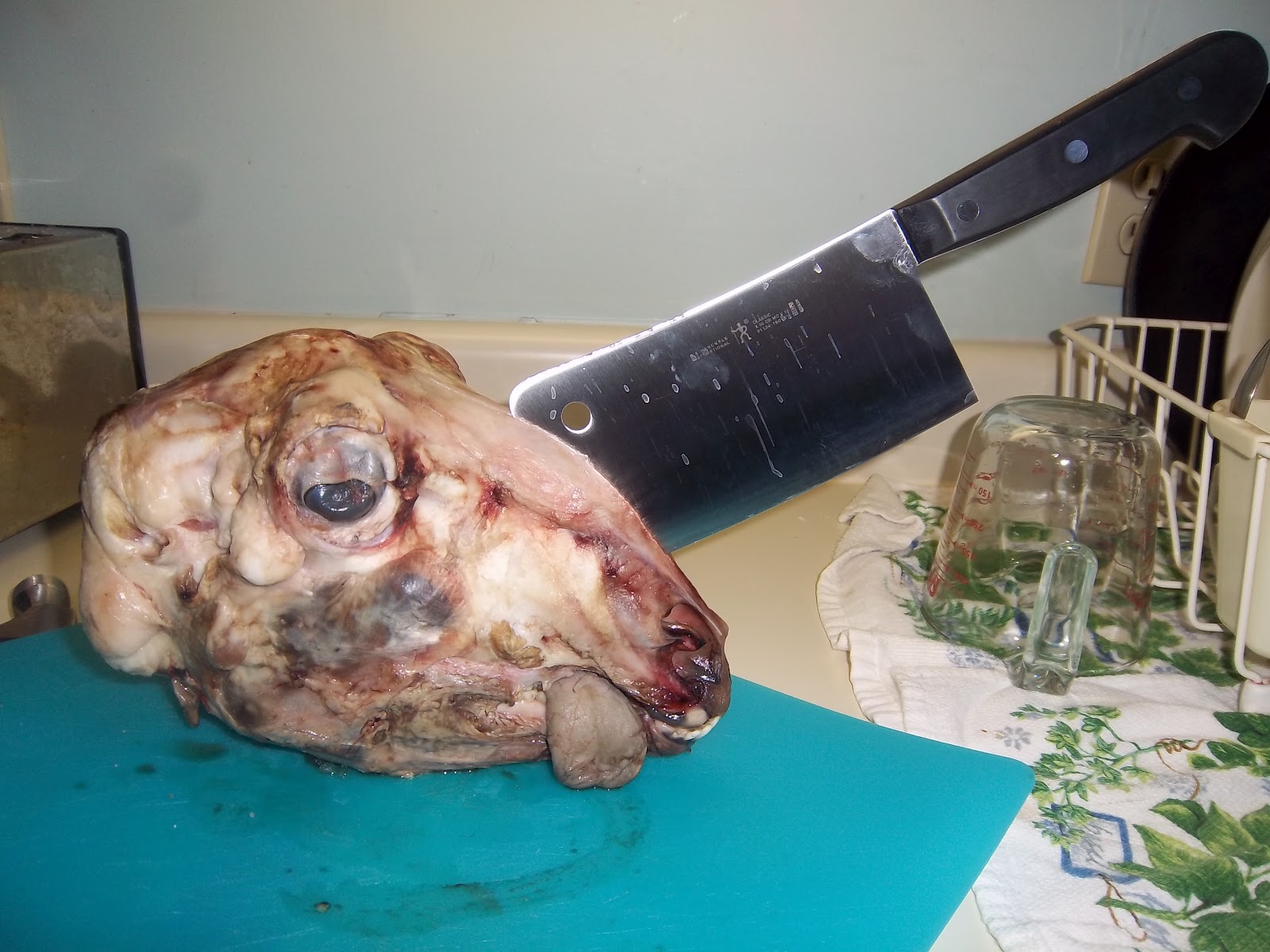
“Ask the butcher to clean and split the head…” starts Jane with this one. I wasn’t lucky enough to have a butcher on hand so I had to do this myself with a meat cleaver and a hammer. It took a fair few whacks and cracks before it split, but I got there in the end. I felt a little like Jack Nicholson in The Shining. Carefully remove the brain and keep it one side, whilst you soak the head in salted water for an hour before rinsing it and placing it in a pot.
Pour enough water to cover and bring to the boil slowly, skimming any grey scum that rises as you go. Now add the following: a bouquet garni that includes a good sprig of winter savory (which was the most difficult ingredient to find!); an onion studded with 3 cloves; 2 carrots and a parsnip, both peeled and halved, a small peeled turnip, a trimmed and cleaned leek, 8 ounces of pearl barley and a good seasoning of salt and pepper – at least a tablespoon of salt is required I would say. Let the broth tick away slowly on a bare simmer for 1 ½ hours.

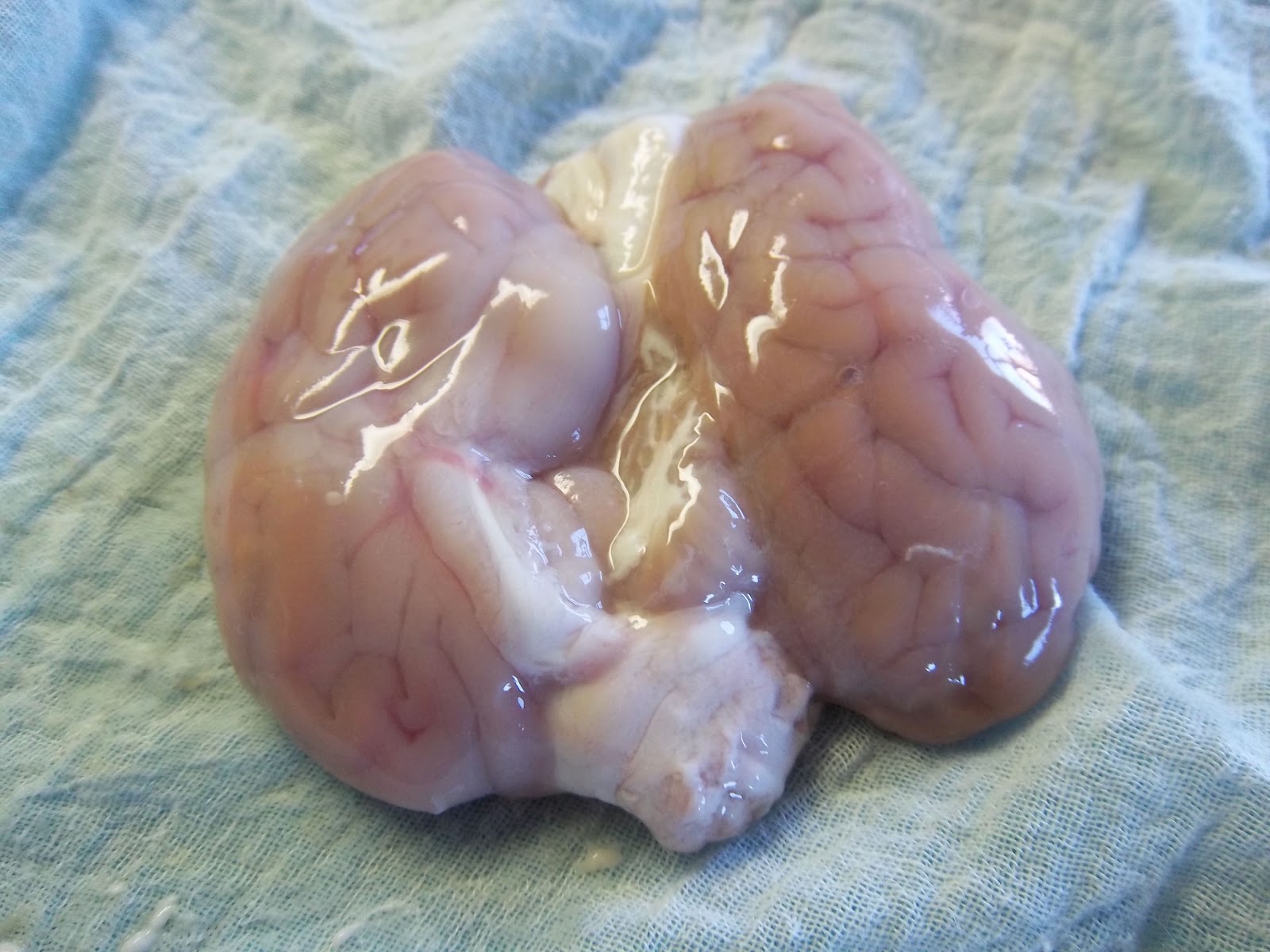
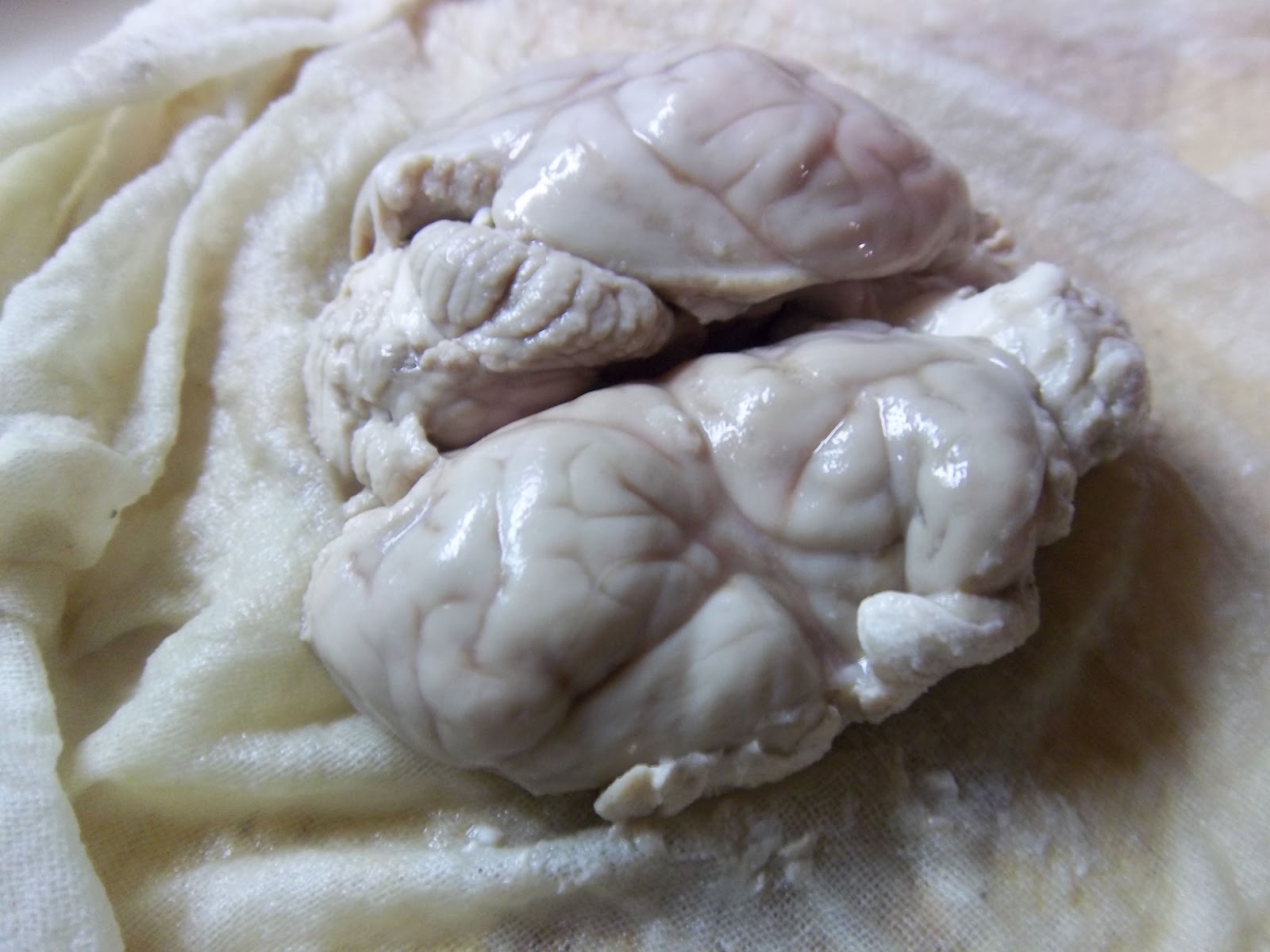
Whilst the broth bubbles, prepare the brain ready for the sauce. Begin by carefully removing the loose membranous net of blood vessels and placing the brain in salted water for 30 minutes. Remove it from its brine onto a square of muslin and tie it up. Place the brain in with the head and let it poach for 10 minutes. The brain will now be cooked and become firm, unwrap it and chop the brain.
It is quite homogenous with no gristly bits, so don’t worry. Now make a simple béchamel sauce by melting an ounce of butter in a saucepan. When it bubbles, stir in an ounce of flour and cook for two minutes before gradually whisking in ¼ pint of milk. Thin the sauce to an appropriate consistency with some lamb stock from the pot and let it simmer for at least 10 minutes, adding more stock if it gets too thick. Stir in the chopped brain and some parsley if you wish. Season and add a squeeze of lemon juice.

When the head is cooked, remove it from the pot and start having a good rummage around to find the meaty bits. I couldn’t find very much to be honest. There were two cheeks containing some good moist meat and the tongue of course. Apart from that, it was slim pickings. I thought perhaps there might be some edible palate as I knew ox palate was popular in the eighteenth century. The only other place I found some was at the base where head meets neck. Anyway, serve up what meat you can extract on a plate or bowl and surround with some of the barley along with some rolled grilled rashers of bacon and some lemon quarters and pour the sauce into a sauceboat.

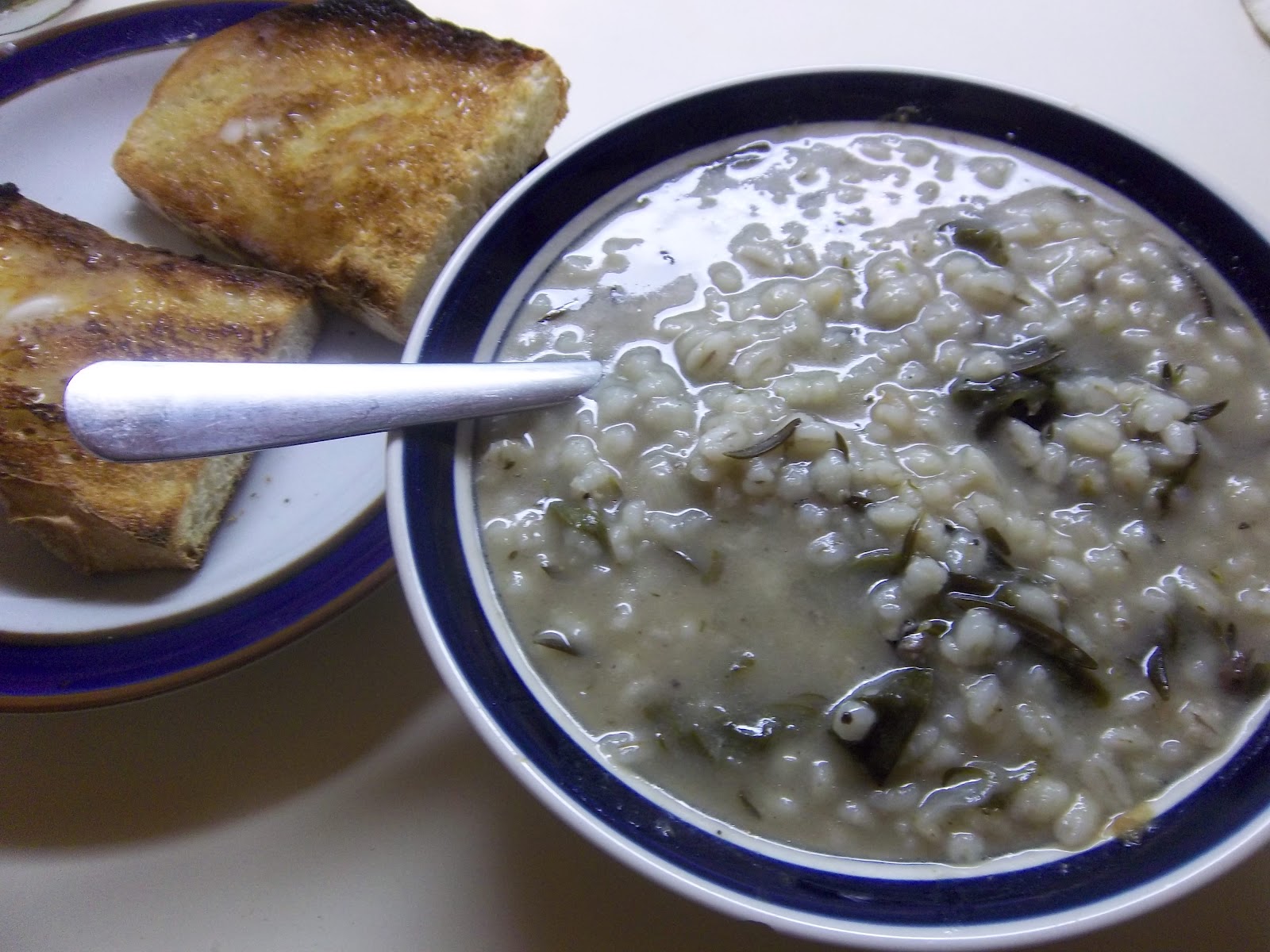
The stock makes “a marvellous soup”. If you want to be in the true peasant style, serve it as the starter. Jane recommends saving it for another meal; “[l]amb soup, then lamb’s head, is too much of a good thing.” I have five tubs of it in my freezer…

#333 Lamb’s Head and Barley, with Brain Sauce. Making this is in no way as macabre as you might expect, except for the part with the cleaver and hammer that is. There was very little meat, but what there was tasted delicious and was very tender and the barley broth was hearty. The brain sauce was also good – the brain itself was tender with a certain firmness that was quite appealing and had a very mild kidney or liver flavour. I think it could have done with a touch of Cayenne pepper. So overall, not bad at all, though the amount of meat was disappointing. The soup left over is delicious but needs a touch of sugar, as lamb and mutton broths often do… 6.5/10.

#317 Skuets

This is an old recipe made up of sweetbreads, bacon and mushrooms grilled on skewers. Indeed, the work skuet is a corruption of the word skewer. The recipe first pops up in the literature in The Compleat Housewife by E Smith (a Lady) first published in 1729. Here’s her recipe from the 1753 edition:

Take fine, long, and slender skewers; then cut veal sweet-breads into pieces like dice, and some fine bacon into thin square bits; so season them with forc’d-meat, and then spit them on the skewers, a bit of sweet-bread, and a bit of bacon, till all is on; roast them, and lay them round a fricasy of sheep’s-tongues.

Chef to kings: Antoine Carême

Forced meat is simply meat mixed with other ingredients to ‘force’ it to go further. I made forcemeat balls a while back (click here for the post). The recipe given here is a jazzed-up version from French chef Antoine Carême’s 1833 book L’art de la cuisine franҫaise au dix-neuvième siècle. According to Grigson, he praises it as an excellent English dish. Jane suspects he found out about it when he lived and worked in London as the Prince Regent’s chef. The changes he made were simple: lose the forcemeat, add some nice mushrooms and serve with bread sauce (see here for recipe) as well as some crunchy browned breadcrumbs.

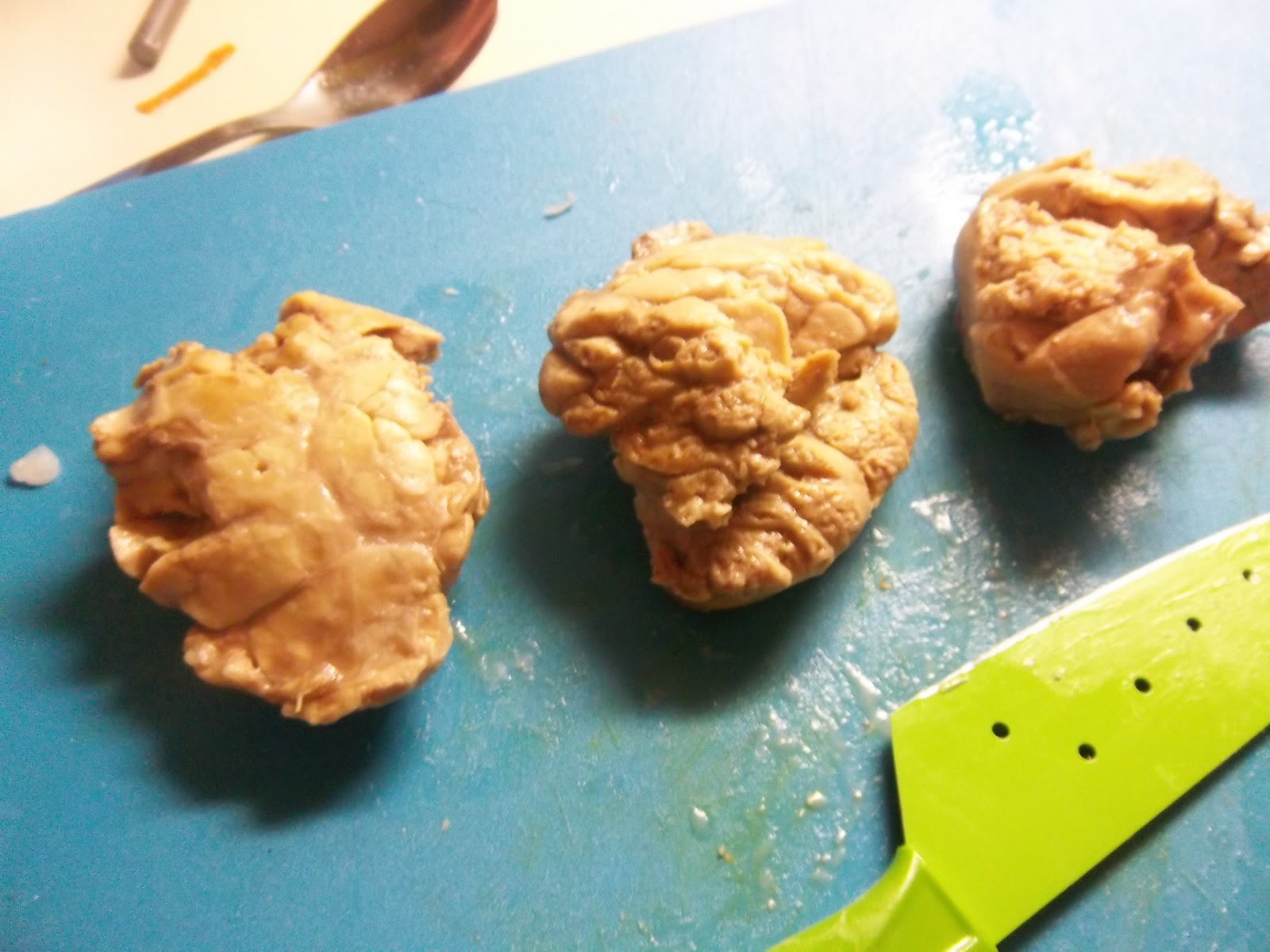
Sweetbreads are not the easiest of cuts to get hold of these days: I remember speaking to a butcher in Houston who said he came by them sometimes, but if I wanted some, I would have to buy a whole ten pound tray. I was tempted but declined. What if I didn’t like them? Well I am glad I didn’t because I spotted a pack of frozen calves’ sweetbreads in Whole Foods whilst buying some other bits and bobs. I do love that shop.


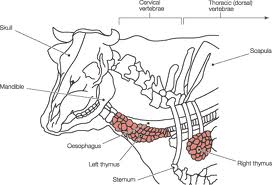
For those that are not aware, sweetbreads are a type of offal and come from the thyroid gland, situated around the throat, of either calves or lambs. The thyroid, or thymus, gland produces the hormone thyroxin which is involved in the proper regulation of metabolism. Hyperthyroidism is a common disease where the sufferer produces too much, causing very high metabolism and, as a consequence, is rather skinny. I had a cat with it once. Other glandular organs are also sold as sweetbreads such as the pancreas, the sublingual glands of the tongue, the parotid gland of the cheek and also the testicles, though ‘throat’ sweetbreads are by far the commonest. Why are they called sweetbreads? Well, they are sweet because they taste richer and sweeter compared to meat, and they are bread because the old English word for flesh is bræd. I assume the bread that we get in loaves carries the name it does because Jesus said bread was his flesh during the Last Supper (I’m surprised he didn’t put anyone off).

Diagram showing the position of the thyroid, or thymus, glands

Sweetbreads were once very, very popular, but have now died a death. Though, like many of the old forgotten cuts of meat, there is a slight resurgence. I had never eaten them, but certainly wasn’t nervous about eating a big gland; I just always worry that the reason people don’t choose to eat them anymore is because they taste bad.

This recipe makes enough for four people:


Begin by preparing a pound of veal or lamb sweetbreads. To do this, dissolve a tablespoon of salt in some water and soak them for around an hour. Rinse them, place in a saucepan and cover with chicken or veal stock and mix in a couple of teaspoons of either lemon juice or wine vinegar. Bring to a boil and allow them to simmer until they go from pale pink to a whitish opaqueness.

In the case of veal sweetbreads, this took about 15 minutes. Remove the sweetbreads and allow to cool a little before removing any membranes or gristly bits. You must be careful here – Jane makes a point of mentioning this and she was right – don’t let too much of the sweetbread come away with the membranes. If using lamb sweetbreads, be extra careful, as you’ll end up with nothing! Press the sweetbreads by pressing a plate on them until they cool.

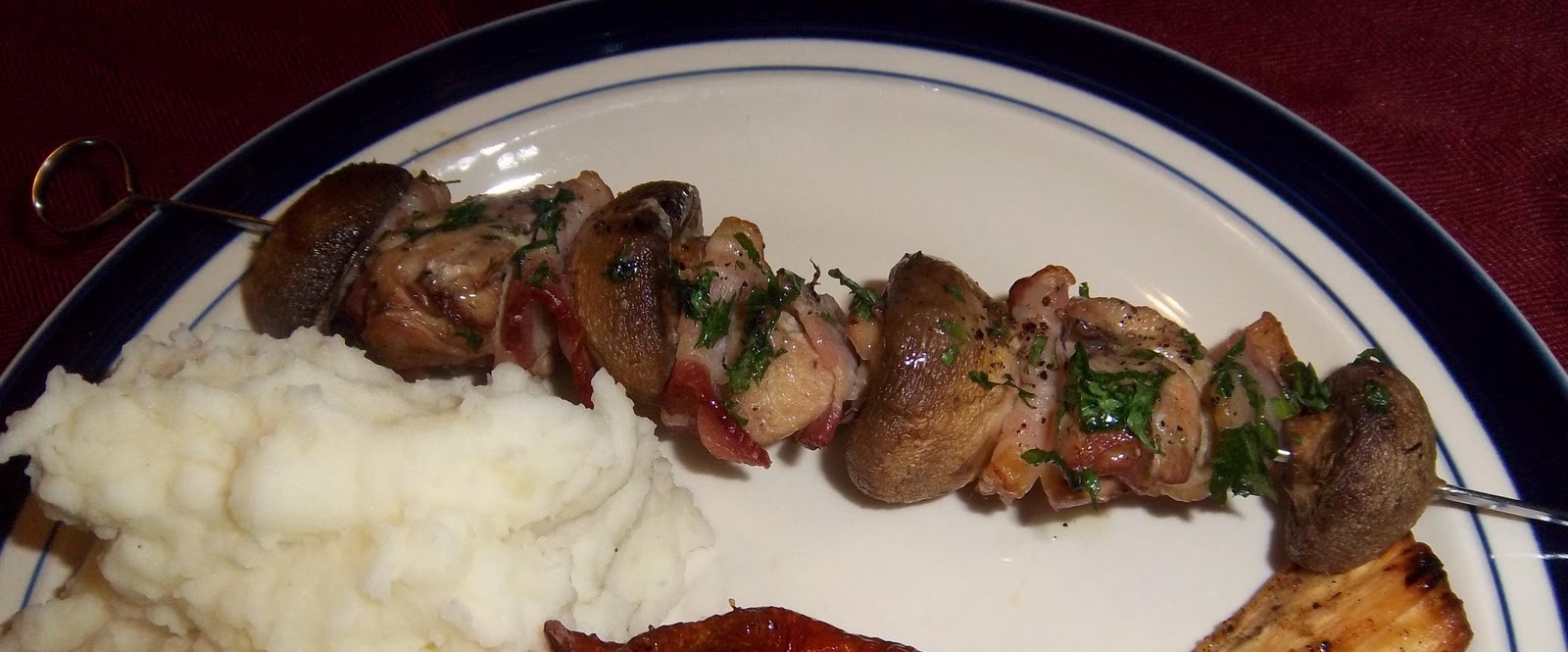
Turn the grill on to a medium heat. Whilst it warms up you can construct your skuets: cut the sweetbreads into chunks – 12 good sized cubes is best – cut around 8 rashers of streaky bacon to square shapes and brush any dirt from 16 medium-sized mushrooms. Take a skewer and add a mushroom, some bacon, a piece of sweetbread, a bit of bacon, a mushroom etc. I used four mushrooms and three pieces of sweetbread per skewer each separated with some bacon. Make four skuets in all.

Brush them with melted butter and grill them, turning occasionally for about 15 minutes. Whilst they are cooking, fry some breadcrumbs in butter until brown and crisp.

Serve with some of the browned crumbs and bread sauce as well as some nice vegetables.

#317 Skuets. What a revelation these turned out to be. A really good meal and the sweetbreads were by no means gross. They were very tender and sweet, and tasted faintly of oysters. I put this down to the fact there must be a lot of iodine in sweetbreads as it is required for them to function properly. The salty bacon and the juicy grilled mushrooms complemented it very well. The crumbs lent a nice bit of crunch and bread sauce is always welcome in my book. All-in-all a very good meal. 8.5/10

#306 Mint Sauce

Ah, mint sauce. I love mint sauce, but have never actually made it myself. Mint sauce is, of course, the sauce to go with roast lamb, especially during the summer months. Though, I remember as a child when I used to go swimming with my Dad on a Sunday to Morley Swimming Baths, I always had a chip butty smothered in mint sauce straight afterwards.

The piquant sauce goes so well with fatty or rich foods. St Hildegarde, a German spiritualist nun of the early Middle Ages, said this of mint: “Like salt, when used sparingly, it tempers foods…[M]int, added to meat, fish or any other food, gives it a better taste and is a good condiment; it warms the stomach and ensures good digestion.”

I reckon that this is true, and by adding somesweetness and mild vinegar, you can get away with using it more than sparingly.
St Hildegard (1098-1179) depicted having a nice sit down
Griggers emphasizes that this sauce must be made with freshly boiled water and wine vinegar, not malt as it is far too harsh. We always used malt vinegar in our house when ‘diluting’ the thick sauce that came out of a jar. Let’s see how the proper stuff tastes like…
Chop up enough mint leaves to fill a measuring jug to the quarter-litre mark. Add three tablespoons of boiling water, stir and let the mint infuse into the water. When it is just warm, stir in three level teaspoons of sugar and four tablespoons of wine vinegar (any kind, though I went with red, as that’s all there was!). Stir to dissolve the sugar and add more sugar of vinegar if you like. I found the amounts given to be right on the button, myself.
#306 Mint Sauce. Excellent, excellent excellent! Sweet, sour and wonderfully aromatic. I am never, ever going to buy mint sauce again. Go and make some. 10/10

#305 Guard of Honour

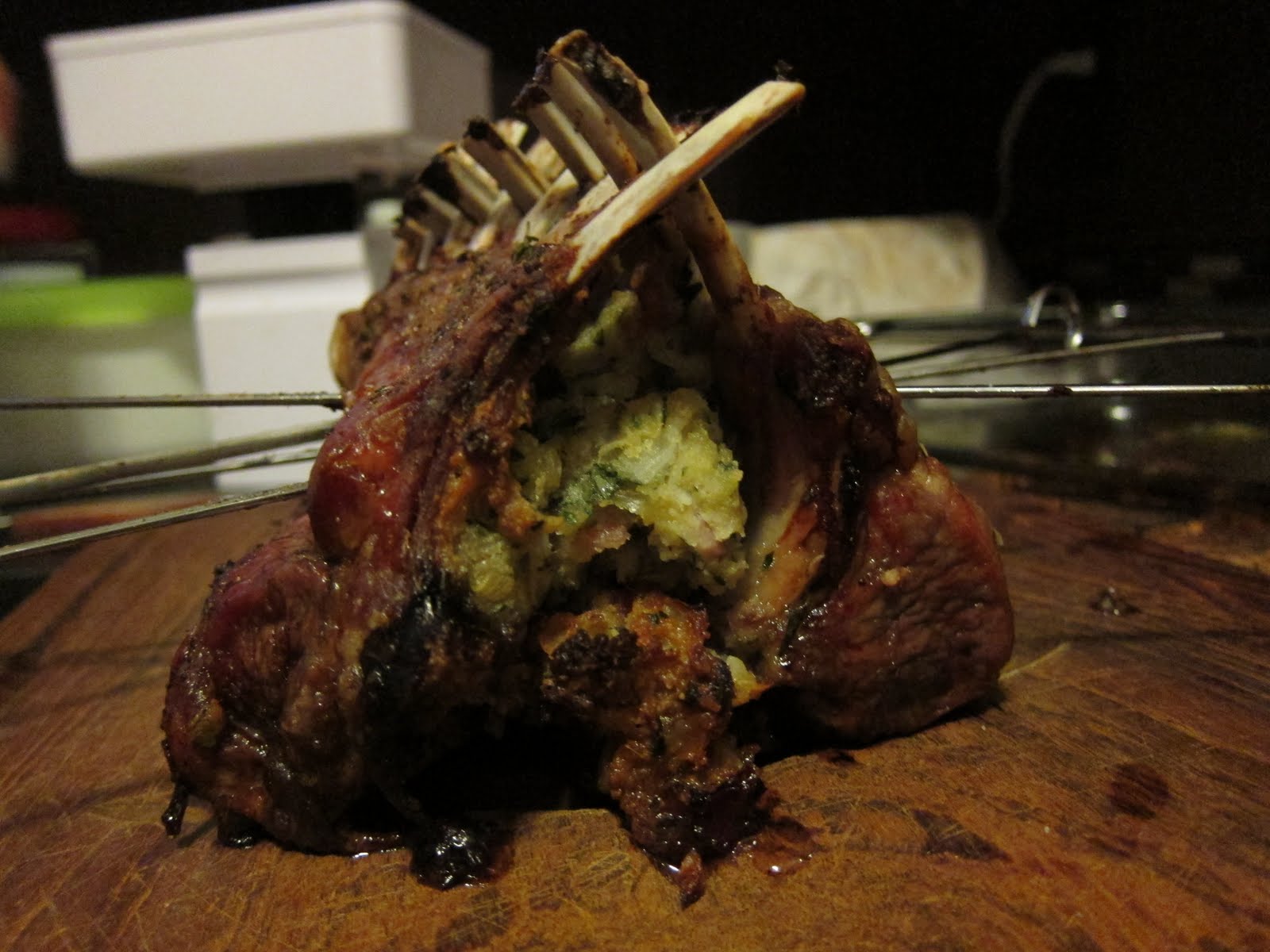
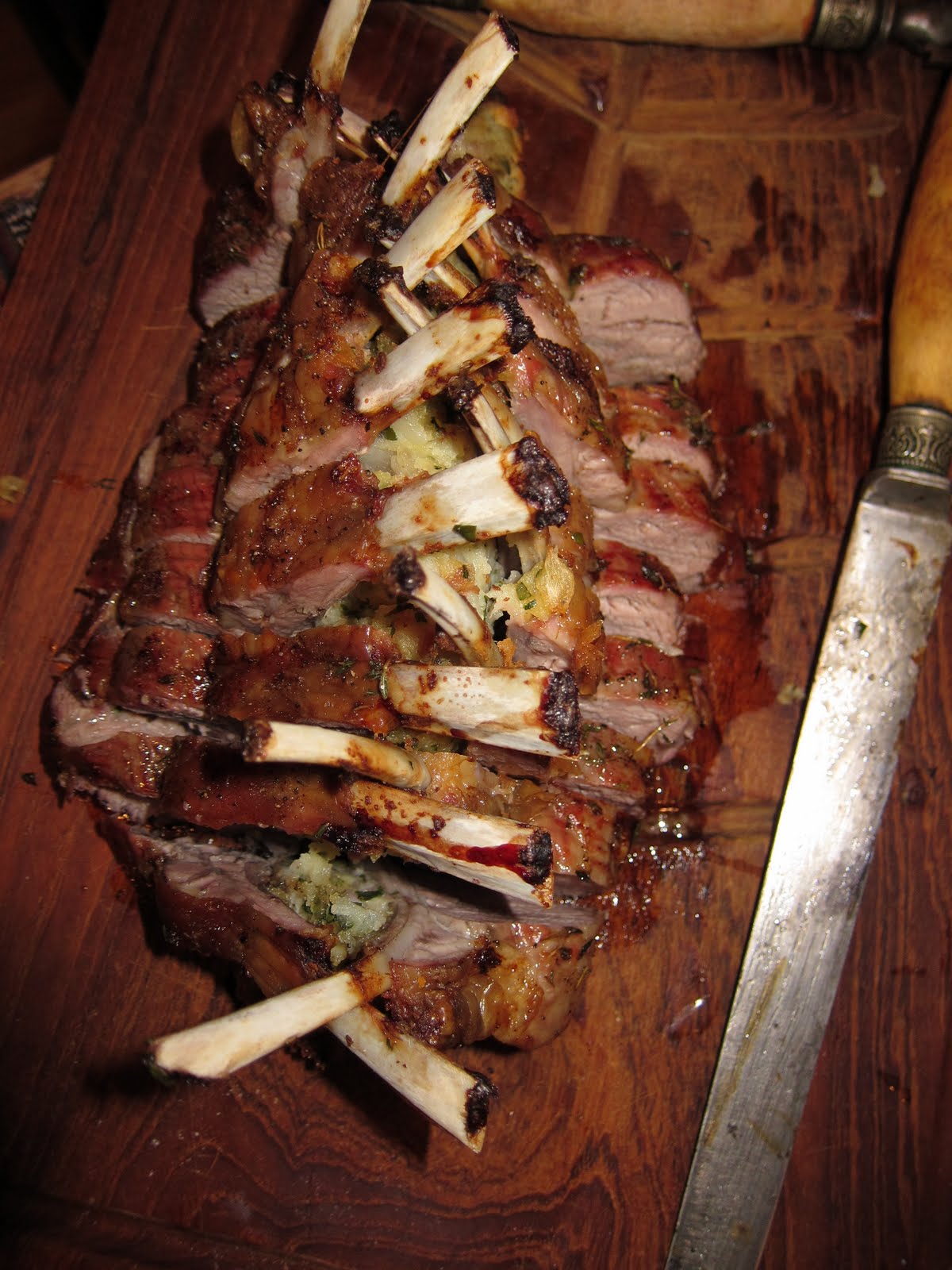
For the meaty part of the dinner party I mentioned a couple of posts ago, I thought I would attempt a Guard of Honour. For those of you not in the know, a Guard of Honour is an attractive way of presenting roast rack of lamb by taking two racks and sitting them upon a roasting tray so the rib bones ‘bristle like a military row of crossed stakes’. The Guard can then be stuffed if you like. Jane likes, as this recipe includes the herb stuffing that I have made a few times now.

I did a little research on this dish, assuming it would be a very old one, but was surprised to find that I could only find relatively contemporary recipes, with none cropping up even in the nineteenth century. Odd.

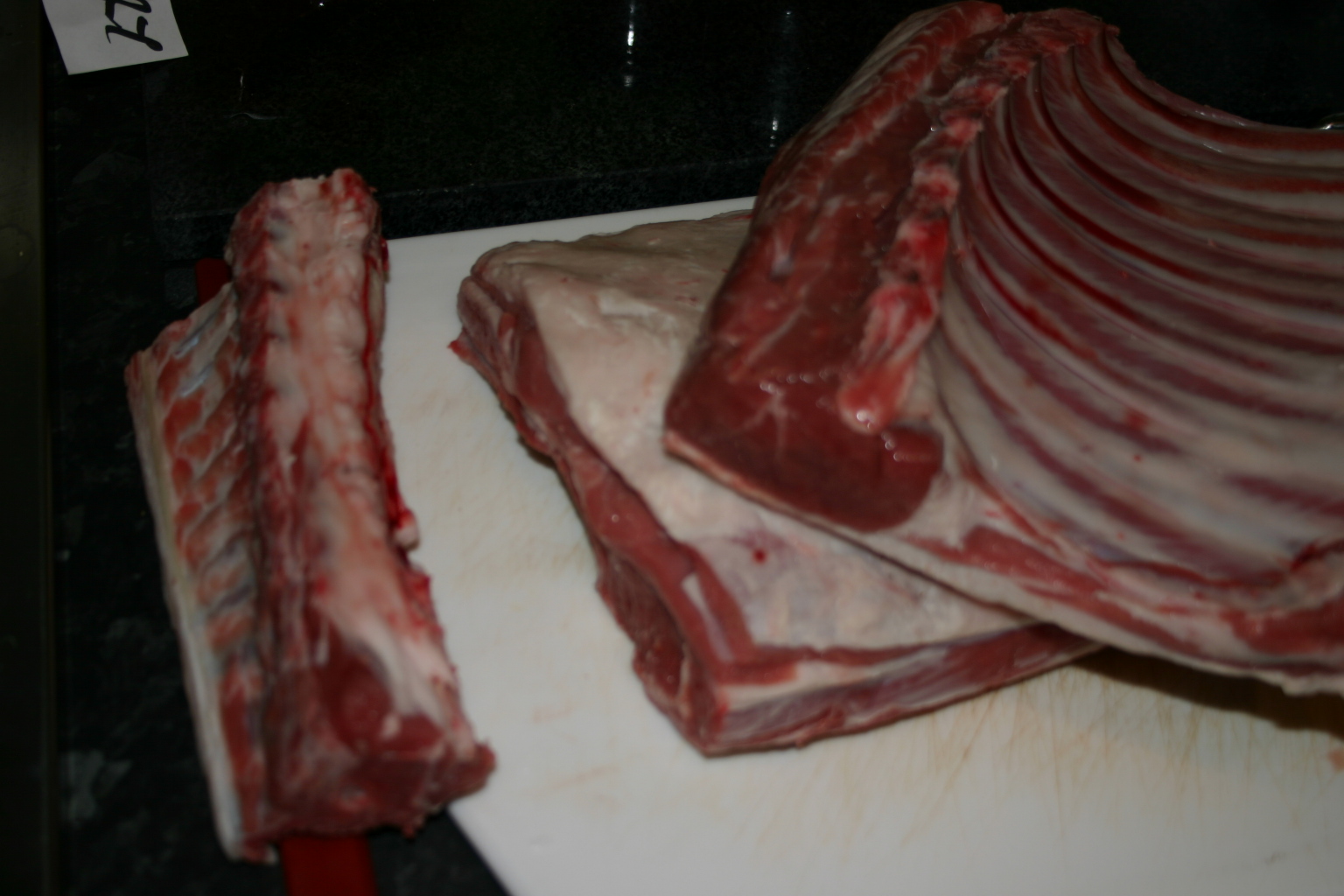
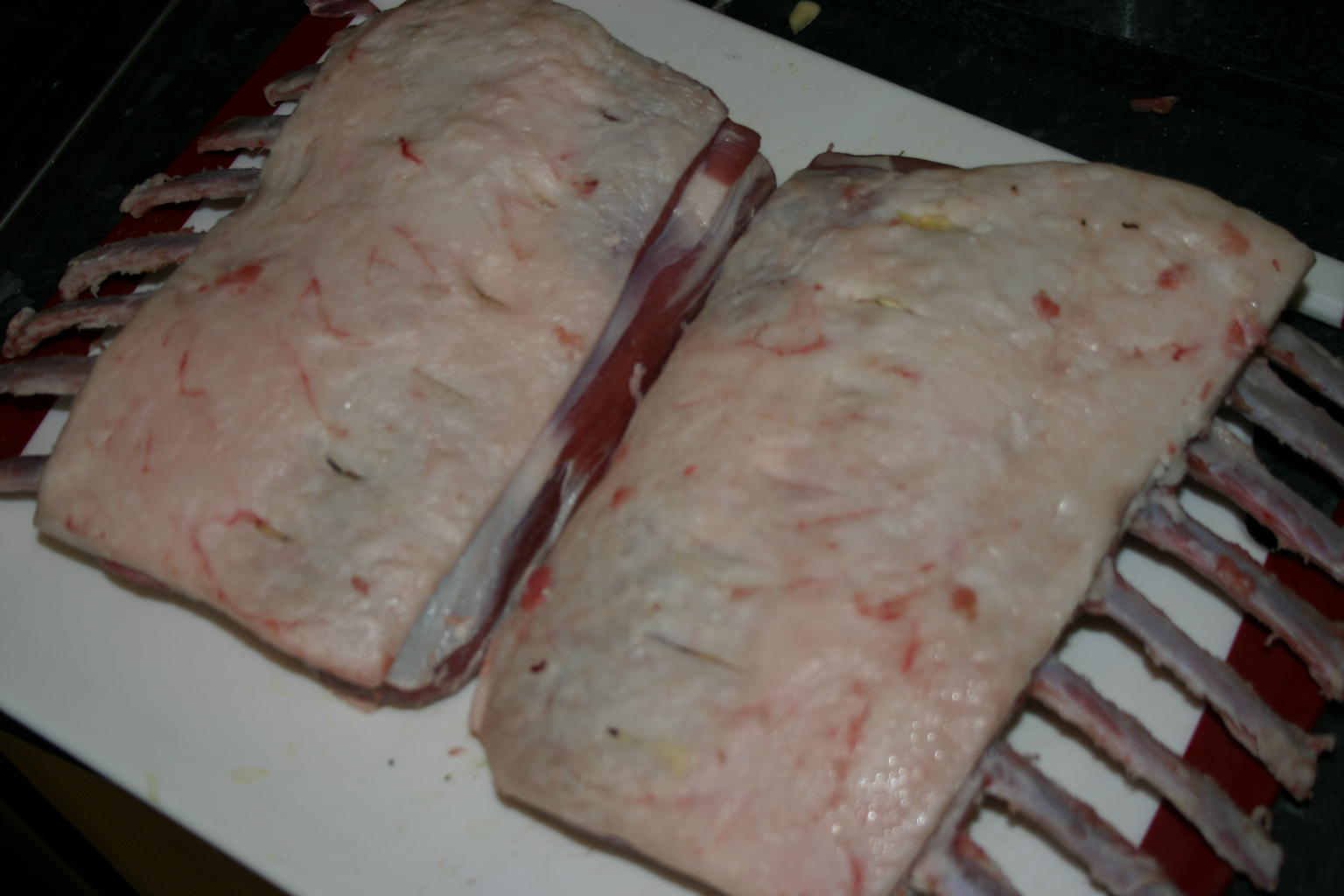
Griggers recommends buying a whole best end of neck of lamb and to ask the butcher to split it in two down the backbone and to get it chined between each rib so that you can carve the joint easily later. To chine is to cut the backbone. If this wasn’t done, you’d have some thick bits of bone to wrestle with. Ask him to leave on the long bones of the ribs. This part is a rather difficult thing to achieve in America for a couple of reasons. First, the joint called a best end of neck means nothing and second, lamb is generally imported from New Zealand and pre-butchered, at least in part. It’s quite easy though to get hold of a couple of matching racks and to simply not have the extra-long bones.

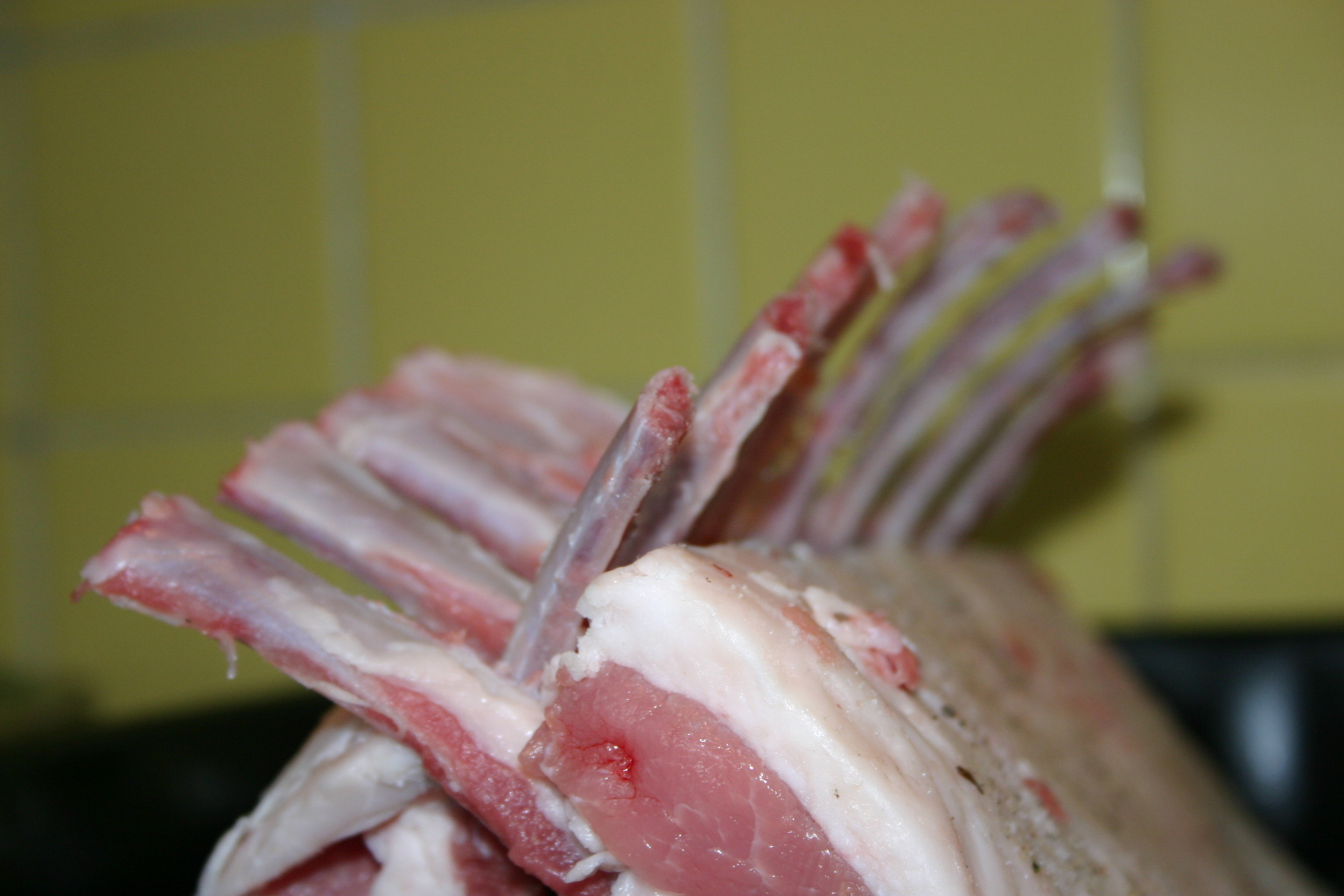
To make a Guard of Honour, take your two racks of lamb and scrape the skin and fat from the very thin part of the chops to expose the bones, then score the fat on the chops and rub in salt, pepper and rosemary or thyme into it (I went with thyme). Stand the joints up and allow the ribs to cross over each other. Fix them in place with skewers. The cavity within can then be filled with herb stuffing. I found the easiest way to do this was to turn the joint upside down, opening it up, so that the most stuffing possible could be added. (Thanks for taking the photos, Joan!)

Turn it the right way up and press the sides together gently, scraping away any escaped bit of stuffing. Check the security of your skewers and place on a roasting tin.

Roast in a preheated oven for 1 ½ hours at 190°C (375°F). Note that this means that the meat will be well-done.

The meat can be carved, after a period of resting, nice and neatly, giving two chops per person.

Serve your roast lamb with any of the trimmings Jane suggests here. She does mention that the stuffed tomatoes recipe goes very well with Guard of Honour, but I wanted to do other things…

#305 Guard of Honour. I really liked this. I did make it because I was in the mood for lamb. Usually I like my lamb pink, but the delicious herb stuffing helped to keep the well-done meat moist and flavourful. I must admit it wasn’t quite as impressive as it should have been because I couldn’t give the precise instructions to the butcher in the preparation of the joint. I think I shall do some of the more tricky lamb recipes back in Blighty. This is only a little complaint of course and the recipe was very good indeed. 8.5/10

Griggers advises us on what to eat with roast lamb….

The next recipe from English Food will be roast lamb. Not as popular as it was as a roast meat these days, but easy to come by. Jane Grigson in her wisdom gives us a list: ‘Things to go with Roast Lamb’. I thought I’d give the list in full. Hopefully as I cook through the Lamb & Mutton section of the Meat, Poultry & Game chapter, I’ll try them all. Some I’ll have to as they are also offical recipes, others I have inadvertantly tried as parts of other dishes and such. Anyways, here’s the list:

Mint sauce (summer)
Redcurrant or medlar jelly (winter)
Laverbread, heated with orange and lemon juice
Young peas and young potatoes cooked with mint
Asparagus
French beans
Spinach
Cauliflower
Purple sprouting broccoli
Chestnuts and Brussels sprouts
Chestnut puree
Onion sauce (2 recipes for that thus far)
Roast potatoes
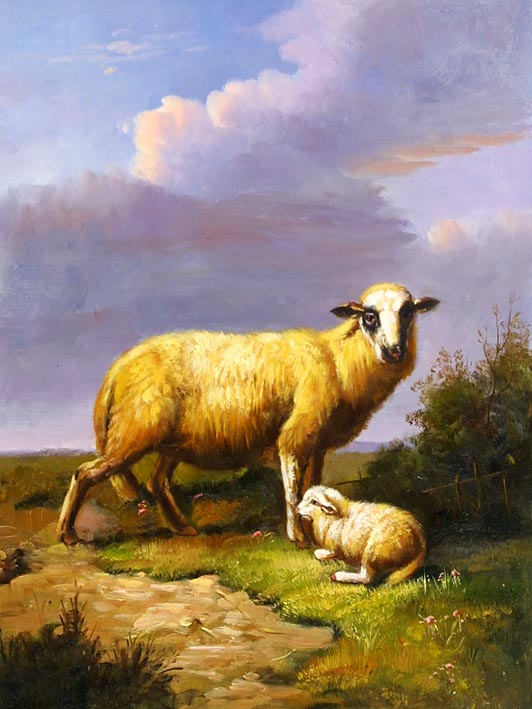
Mutton and lamb in oil-on-canvas form

#299 Leg of Lamb Stuffed with Crab


For the 300th recipe I got a few people round to mine for a little dinner party. Number 300 would hopefully be impressive and I wanted to do something for #299 that would be impressive too and this recipe certainly sounded the part. I also wanted something that dated in the eighteenth or nineteenth centuries, again to match receipt 300.

A recipe for a leg of lamb stuffed with ‘a forcemeat containing the meat of a crab or lobster … [with] a little grated lemon peel, and nutmeg‘, appeared in The London Art of Cookery by John Farley (1811), so it has a decent history, though this kind of food has very much fallen out favour in England. However, one particular chef gave it a breath of new life in the 1970s. A chap called Guy Mouilleron came up with the recipe that appears in English Food and therefore here in the blog, after some French chefs who were working in London were having a right good-old laugh at the English’s eating habits. “Fancy” one of them said “they even eat lamb with crab!” Chef Mouilleron thought it sounded like a good idea and conjured up a recipe. It’s funny that every British (and Irish!) person I’ve spoken to about this recipe has thought it just a bizarre as those French chefs.

There’s no need to be freaked by this combination though, says Jane, meat was often ‘piqued’ with fish all the time to give it extra flavour; the idea is not to impart a fishy flavour though, but a mysterious deliciousness. This is true as I already knew after one the great recipes from the blog – steak, kidney and oyster pudding. Meats are also cooked with anchovies a lot too, especially lamb and that cornerstone of English cuisine, the Melton Mowbray pork pie. It seems these things are being lost because of the Englishman’s squeamishness of all things fishy in general.

It is strange to me that Americans – or, at least, Houstonians – don’t really eat that much lamb and getting hold of a full, large leg of lamb with the bone in isn’t really possible in Houston’s otherwise comprehensive supermarket meat sections. However, I did manage to get hold of one very easily from the very good Pete’s Fine Meats on Richmond Avenue.

Pete’s Fine Meats, Houston TX

The recipe also calls for crab meat of course. You can boil your own (see here for instructions) or buy one preboiled. Do not, says Griggers, buy frozen meat as it had lost most of its flavour. However, here in America, where folks like seafood, it is very easy to get hold of freshly picked crab meat in supermarkets, so if you are in the USA, there is no need for you to sit and spend thirty minutes picking the meat from a crab’s carapace. God bless America for making the recipe a little easier for yours truly.

If you fancy the idea of this combination, here’s how to make it:

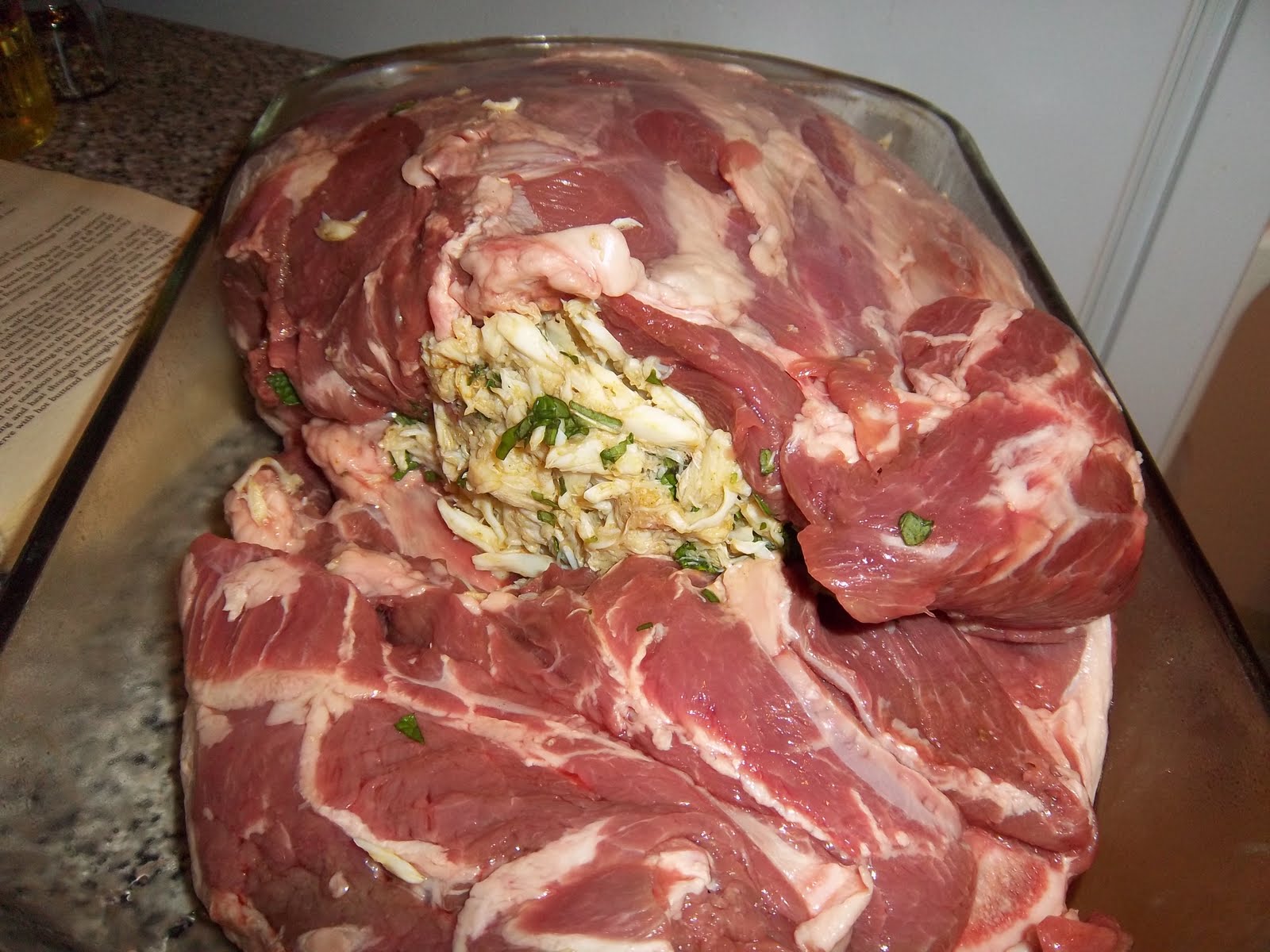
Start off by tunnel-boning a large leg of lamb. This is not that difficult to do – I followed the instructions here and it took just five or ten minutes to do. Use the bones to make half a pint of lamb stock (see here for recipe). Season the inside and outside of your leg.

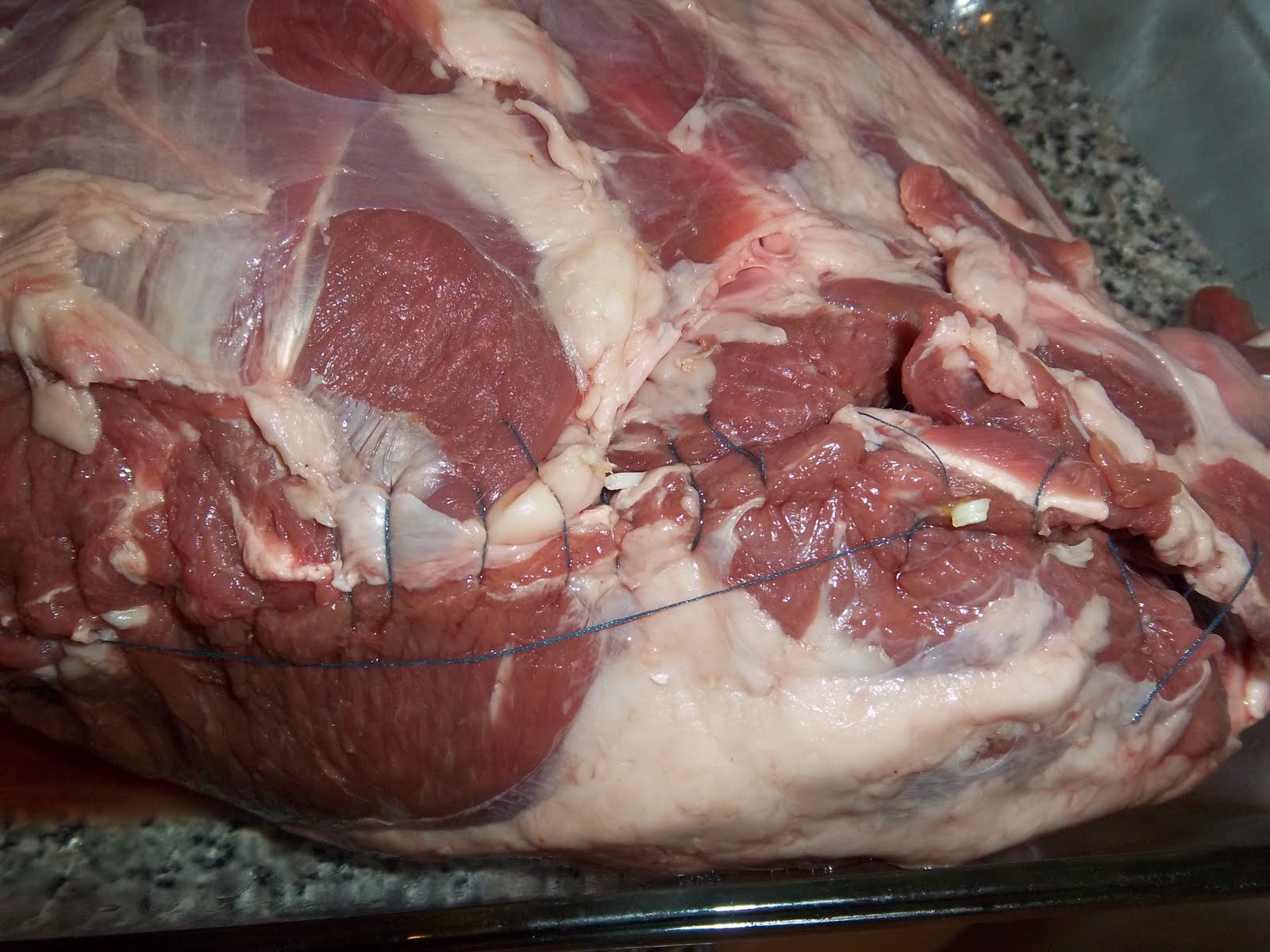
Next, make the stuffing. You need eight to ten ounces of crab meat; either buy it fresh if you can or get hold of a crab weighing around one-and-a-half pounds. To the crab meat, mix in half a teaspoon of curry powder, a tablespoon of fresh mint and three egg yolks. Season with salt and pepper. Stuff the cavity with the crab and sew up the lamb at both ends with a stout needle and some thick thread. All this can be done in advance, of course.
Preheat your oven to 180°C (350°F). Chop equal amounts of onions and carrots, enough to cover the bottom of a roasting tin, as well as a large celery stick. Season well and place the lamb on top. Cover with a double layer of foil (if you have a self-basting tin, you can use that instead) and roast in the oven for two hours. Take the roasting tin out of the oven and place the lamb on another tin and put back in the oven to crisp up.
For the accompanying sauce, put the tin with the vegetables on the hob and bring to a simmer, cooking for five minutes. Now add the lamb stock and half a pint of dry white wine. Make sure you scrape off any of the burnt bits from the surface of the roasting tin. They are the best bits. Strain the sauce into a saucepan, skim away any fat and then stir in a quarter of a pint of double cream and a teaspoon of curry powder.
Place the meat on a large serving dish (don’t forget to take out its stitches!) and surround it by buttered noodles and pour the sauce into a sauce boat. Griggers didn’t say what vegetables to serve with it, so I served green beans, my own personal favourite lamb accompaniment.
#299 Leg of Lamb Stuffed with Crab. Well I wanted something that looked impressive and it this definitely looked the part. The meat was very good as was the minty and fresh tasting stuffing, though the sauce was a little bland. It wasn’t bad or anything, it just didn’t pack the punch that I expected it to. If I were to cook it again, I would simmer that sauce right so it became concentrated before adding the cream and curry powder. My expectations were also raised because the lamb section of the book has been so very good thus far. That said, roast lamb can never be bad in my opinion, so I give it a 7/10.

A Lamb Stock Recipe

Tomorrow I cook the 300th blog recipe – a dessert, but for #299 I am going to do a lamb dish which requires lamb stock. You don’t see lamb stock cubes in the USA very much so you can’t cheat if you need it for a recipe so I thought this might come in useful for anyone who may need it. It is adapted slightly from the book a Celebration of Soup by Lindsey Bareham. Unless Jane Grigson gives a specific recipe for stock, I always turn to this book to give me a helping hand.

Start with getting around a pound to a pound-and-a-half of lamb bones – I used the bones from the leg of lamb I am using for recipe #299 (I shan’t tell you what it is yet). The bones need to be broken in half at least, so wrap any in a teatowel and give them a good whack with a hammer until there is a snap. Put the bones in a roasting tin and place in a hot oven – around 200° (400°F) for around twenty minutes. Place the bones in your stock pot, drain off any fat and deglaze the roasting tin with half a pint of water. Pour the water in the pot and add a further two pints of water. Bring to a boil, skim and allow to simmer gently partially covered for an hour.

Meanwhile, peel and chop an onion and a carrot and chop a stick of celery. Put these in the roasting pan along with a little oil and roast until nicely brown. When ready, add them to the pot along with six peppercorns and some herbs – parsley stalks, a couple of bay leaves, a sprig or two of rosemary, some mint stalks etc. This will depend upon what the stock is for. If you are not sure, just put in your favourite herbs and spices.

Allow to simmer for a further ninety minutes then strain the stock. Let the stock cool completely before skimming it for fat. You can reduce it to make it stronger if you like, but I would recommend only adding salt once you have reduced the stock as it might end up too salty. You can add, but you can’t take away Grigsoners!

#277 Hazelnut Stuffing for Poultry and Lamb

I mentioned in the last post that people don’t make their own gravy anymore, well the same goes for stuffing. I have to admit, I don’t often make stuffing for roast poultry normally, though I have for the blog before. Every time I do, it comes out delicious and is always better than even the poshest pre-made supermarket pap. So I thought I was well overdue making some (which I think is also called dressing in the USA, non..?).
This one, I thought looked interesting – with its earthy hazelnuts and piquant-sweet preserved ginger; just the thing for a climate that is never really wintry. After all, the main reason that I haven’t cooked more food like this in Houston is because it is so bloody hot all the time and I don’t necessarily want roast meats. Anyways, this one seemed good and light and reasonably summery.
Griggers makes a point of highlighting the quality of hazelnut required for the recipe – pre-roasted and chopped hazelnuts are fine, she says, but you really want some slow roasted whole Italian ones from Avellino near Vesuvius, where they have been grown since Roman times. I’ll just pop over and fetch some. I couldn’t get those of course, but I did get Roman ones, so that pretty good I reckon, bearing in mind where I am!

Julian of Norwich with Hazelnut. For some reason.
If you want to be truly old-school, you can use cobnuts, which can still be found growing around the southern counties of England, in particular Kent. FYI: cobnuts were the original nut used in the game of conkers before the horse chestnut was introduced into Britain.
Stuffing is the easiest thing in the world to make. To start chop a large onions and soften it in two ounces of butter – keep it on a medium heat with a lid to prevent to browning. Once cooked, add the following ingredients in the following order: four ounces of fresh breadcrumbs; two ounces of toasted, chopped hazelnuts; four knobs of preserved ginger*, chopped; grated rind of half a lemon; the juice of a lemon; one large beaten egg; salt and pepper; and two tablespoons of chopped parsley. Now you can use the stuffing for whatever you like. If this is for turkey, you may need to double, or even treble the amounts given here.
If you are using it to stuff a bird, make sure you weigh it after it has been stuffed so you can include the extra weight in the cooking time.  Also, it is best to stuff the neck end rather than the cavity, as the stuffing doesn’t go stodgy; just loosen the skin and stuff it in, securing it all by folding the neck skin under the bird. Any left can go into the cavity – but only pack it loosely.

*If you can’t get preserved ginger then use ginger preserve (i.e. ginger jam), or miss it out entirely and replace it with the chopped liver of the bird(s) and a heaped teaspoon of thyme.

#277 Hazelnut Stuffing for Poultry and Lamb. Absolutely delicious and definitely the best stuffing so far in the book! It was sweet and earthy and the nuts had gone wonderfully soft and translucent, giving out their flavours into the rest of the mixture. The lemon and ginger lifted it all very well and stopped it from being too heavy. This is going into my everyday repertoire. 9/10.

#263 Stuffed Tomatoes

A quickie, this one…
So as I mentioned in my last post I made a couple of vegetable sides from English Food for Joan and Dave’s Thanksgiving party. That is not to say that these recipes from the Vegetables chapter are in any way vegetarian and these stuffed tomatoes are no exception. They are pretty easy to do aswell. Take twelve tomatoes and cut off their tops. Scoop out their centres and chop them up, removing any seeds first. Turn the tomatoes upside down to drain. Meanwhile, make a batch of herb stuffing – I’ve made it before as a recipe in its own right (get it here) and add the chopped centres to the mixture. Spoon them into the tomatoes and replace their little hats. Place on a baking sheet cook alongside whatever you might be having for dinner. In our case it was, of course, turkey. The temperature doesn’t really matter; just don’t leave them in so long that they just collapse. Griggers reckons that they would go well with lamb too.
#263 Stuffed Tomatoes. I liked these, though I’m not sure if everyone agreed. The stuffing was good though wasn’t as flavoursome as the last time I made it, but it was still good and did compliment the tomatoes. The tomatoes here are very good though – they actually taste of tomatoes and aren’t just the green chlorosed lumps we typically find in British supermarkets. 6/10.

#243 Spiced Welsh Mutton ‘Ham’

Well hello there! No I haven’t died on you or anything. I’ve just been uber-busy with my thesis writing and hardly had time to do any Grigson-related cookery. Here’s is one that I actually did a couple of weeks ago but haven’t been able to tell you about.

The cured meats from the book have all been pretty successful and this one sounded nice and easy, plus would keep me in butties for the foreseeable future. I wasn’t sure how it was going to turn out because we don’t really cure lamb to make ‘ham’ do we? Unless I’ve been missing something all these years.

Anyway, here’s how to make to your spiced lamb ‘ham’:

First of all select your leg of lamb or mutton – you need one that weights about 6 pounds. Place it in a large pot or tub that has a well-fitting lid and rub it all over in a spiced salt mixture for curing. To make the spiced salt, mix together 4 ounces of dark brown sugar, 8 ounces of sea salt, ½ ounces of saltpetre, an ounce each of crushed black peppercorns and allspice berries, plus a heaped teaspoon of coriander seeds. Make sure you rub it in well, ensuring you get down between meat and bone. Keep it in the tub in a cool place and turn it over every day, rubbing in the juices and spices for 14 days.

Then, rinse any excess spices away from the surface of the leg and place in a large pot and cover with water. Bing slowly to a simmer and cook as gently as possible with the lid on for 3 ½ hours. Let the lamb cool in the water for a couple of hours, remove it and, wrap it in clingfilm or greaseproof paper and let it finish cooling under a weight. It keeps in the fridge for ages as long it is wrapped up or kept in Tupperware. Griggers says that if you have a smokehouse nearby that will let you put the cured but uncooked leg in, then do so! I haven’t, so I didn’t!


#243 Spiced Welsh Mutton ‘Ham’. This was a revelation! I do not know why we don’t cure mutton and lamb anymore. Absolutely delicious. The lamb meat was succulent and flaky just like corned beef and the spices cut through the richness of the fat. Best cured meat so far. 8.5/10