#233 Devonshire Squab Pie

Here’s a slightly odd recipe, as a many from Devonshire appear to be. This squab pie contains no squabs (i.e. baby pigeons), but lamb instead. It is a mystery how it got its name – Griggers suggests that the meat has changed over the years, but the name has stuck. That’ll do for me. This is a simple enough pie to make, though the ingredients are odd: lamb, apples, prunes, spices all topped off with a dollop of clotted cream. Hmmm.

This is easy to make; a simple case of layering up ingredients in a deep pie dish. Start off by removing the meat from a whole best end of neck of lamb. If this seems too much of a chore, just buy about 1 ½ pounds of neck fillet from the butcher instead. Now peel, core and slice two pounds of dessert apples – Cox’s pippins are Jane’s suggestion, but russets and braeburns to well in these sorts of things too – slice two medium onions thinly and chop around 16 prunes. Next, mix a level teaspoon of ground allspice and cinnamon along with half a grated nutmeg in a ramekin or small cup. Layer up the meat, onions, apples and prunes, seasoning the layers with the spices and salt and black pepper as you go. Now pour over a quarter of a pint of lamb stock (use the bones from the best end of neck to make it, otherwise a stock cube!). Cover with a nice thick layer of shortcrust pastry, brush with egg and bake for 30 minutes at 200⁰C, and then turn down the oven to 160⁰C and bake for a further 45 minutes. Serve with clotted cream.


#233 Devonshire Squab Pie. This pie did not turn out to be as weird as expected. You could identify each ingredient in it, and they all stood out whilst complimenting each other very well. However, I think the pie would have been much improved had the lamb been coated in flour and browned a little first so that the flavour was more intense and a thick gravy produced. Several of these pies seem to have very runny sauces. Obviously tastes have changed. The big surprise was that the clotted cream went very well. Although it did make me feel like I was eating my main and pudding all at the same time. A good recipe that could be very easily improved. 6/10.

Warm Lamb’s Fry Salad

Well #200 was now upon me, so I got a few folks round to join me in scoffing it. The trouble was I couldn’t do starter from the book – otherwise that would be the big 200, and I didn’t want some little starter to be it. However, I decided that the food would have a theme: offal. All three courses would have some offal as part of it. You see, I knew that I had some lamb’s fries in the freezer that I bought a while ago from the Cheshire Smokehouse and this seemed like the perfect time to cook them. After a little internet research, I found that they weren’t that difficult to cook, it seemed that you could treat them the same as scallops. I decided on a warm salad. I just hoped they weren’t awful, and that people weren’t going to be squeamish.

It has been a while since I put one of my own recipes on here…

For six:

Heat some cooking oil in a frying pan until nice and hot. Throw in two cloves of garlic and a good pinch of chilli flakes. As soon as the garlic starts to brown, throw in seven sliced and previously seasoned lamb’s fries. Quickly stir fry them for around two or three minutes only, and then season with more salt and pepper if required plus a little sugar and a squeeze of lemon juice. Stir through some dressed spinach leaves and serve immediately. I forgot to take a picture. Oopsey!

The lamb’s fries were okay – very tender and rather bland. It was quite difficult to get excited by them. I think I’d would rather have had something bizarre and shocking, than something that was just okay. At least everyone that came can say they’ve tried them. And I can say that when I do testicles, they melt in your mouth! (F’nar!)

#191 Lamb with Plums

It was Butters’ birthday the other week, so naturally I did a bit cooking. He requested lamb as that is his favourite meat. This one is an interesting one – a leg of lamb pot roasted with wine and plums. Butters was a bit disappointed that it wasn’t a roast, you just can’t please some people, can you? I wanted to do this one because it used plums and they are in season and are nice and cheap to boot. I’m quite a fan of the English habit of eating rich meat with fruit; we have gotten out of this habit recently though. Another important thing: it’s also nice and easy.

Start off by browning a leg of lamb all over in butter. If it is very fatty, it would be a good idea to trim any excess off – it’ll prevent the dish becoming too greasy. Place the joint in a large ovenproof casserole and add two glasses of red wine, ten plums (leave them whole), a medium chopped onion, a chopped clove of garlic and a quarter teaspoon each of ground cinnamon and allspice (or nutmeg). Cover with the lid and place in an oven preheat to 200⁰C for around two hours. Remove the lamb, and keep it warm. Skim any fat from the juices in the casserole and pass it through a sieve to make a smooth sauce. Reheat it and add sugar – one or two teaspoons should do, you don’t want it too sweet, plus some extra spices if you like. Pour some sauce over the lamb, and serve the remainder in a jug or gravy boat. Griggers is strict with the accompaniments: “Potatoes are the only vegetable to serve with lamb cooked in this way.” That’s us told.


#191 Lamb with Plums. This was a really delicious, simple recipe. The lamb turned out to be very succulent and the tart, spicy plum sauce was really delicious. I’m not about just having spuds with it though, I like a bit of green with my tea. 8/10.

#188 Ragout of Lamb

Another bargain from Orton Farmers’ market – a nice leg of lamb for a tenner. I love lamb, I do. Griggers actually half-inched this one from a chap called Michael Smith. I don’t know who he is. Anyway, I wanted to do this one because I got to use to use up a massive punnet of tomatoes that I also got from the market. This recipe is not worth making with those crappy old chlorosed supermarket thingies. Get some proper ones; if you grow them yourself, alls the better. It’s a nice recipe this one, a nice summery stew.

You need 2 pounds of leg of lamb that has been cubed for this recipe. If you get the butcher to bone it, don’t forget to ask for the bone – you’ve paid for it, make some stock out of it! Shake the cubed meat in a bag along with two tablespoons of well-seasoned flour. Brown them in a pan with a couple of tablespoons of vegetable oil. Place the browned lamb in a casserole and then brown 2 diced carrots and half a head of celery that has also been diced in the pan. When done add those to the casserole. If you have a casserole that can go straight onto the hob, then you can do it all in one. Now add ½ teaspoon of Cayenne pepper, 2 crushed garlic cloves, a sprig of rosemary and the grated rind of a lemon to the meat and vegetables and pour over 1 ¼ pints of chicken stock. Bake in the oven for 1 ½ hours at 190⁰C.

At the mid-way point, you need to add around 18 caramelised spring or pickling onions. To make them prepare the onions: leave about 2 or 3 inches of green stalk on the spring onions. If it’s pickling onions, you are using, just peel them. Melt ½ an ounce of butter in a pan and add the onions, plus 1 ½ teaspoons of sugar. Cook until caramelised, making sure they all get coated and browned evenly.


The final stage of this recipe is to cook the tomatoes lightly – they are used as a topping: peel the tomatoes, halve them, scoop out the seeds and dice them up. Melt ½ an ounce of butter in a saucepan and cook the tomatoes lightly. Take the ragout out of the oven, skim it of fat, check for seasoning, place it in a bowl and place the tomatoes on top. Scatter with chopped basil. Serve with a baked potato.

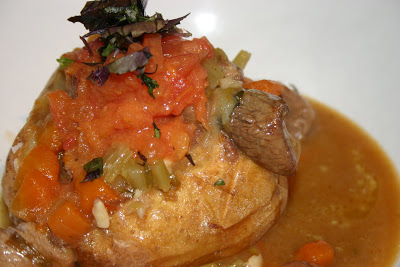
#188 Ragout of Lamb. A really nice stew this one; the meat was beautifully tender and the chicken stock, tomatoes and basil really lifted and made it light and summery – it’s a shame we have no actual summer to speak of. The onions collapse into sweet, sweet mush too. Great stuff – 7.5/10.

#176 Samphire

I came across some marsh samphire in the fishmongers the other week – I had been looking for it previously and thought I would have to go to extreme lengths to get hold of it – I bought it, just in case I never came across it again. Luckily, Griggers mentions in English Food that samphire can be successfully frozen by blanching briefly and then popping into the freezer.

Samphire grows on the salty soil near the sea, and marsh samphire grows in salt marshes. The word samphire is a corruption of the French Saint Pierre, the patron saint of fishermen. He was obviously looking after them by providing the coastal veg. Samphire comes/came under several names: sea asparagus, glasswort (it was used in glass production), crab grass and frog grass. Keep a look out for it when you are near the sea – rock samphire grows well on Dover cliffs, but collecting it is a precarious activity – ‘a dreadful trade’, according to Shakespeare in King Lear. Best stick to the marshes, if you want to try and collect your own.

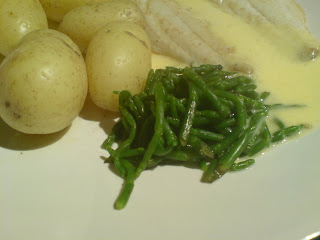
Samphire is dealt with in two ways: pickling or boiling. Boiled samphire is generally served as a vegetable with fish or lamb or with a hollandaise sauce (which I did, along with some pan-fried sea bass). To do this, boil rapidly in unsalted water until tender, this should be just five minutes. Drain and serve.


#176 Samphire. 5/10. It seems that the blanching and freezing technique is not as successful as indicated by Griggers; they were unfortunately left all soggy and not at all crisp and tender. The flavour however, was good; salty and sweet with a mild taste of ocean ozone. I think that I shall try it again but without freezing it this time.

#175 Shoulder of Lamb with Rice and Apricot Stuffing

A dish with a Middle Eastern or North African influence, it seems like a very tame version of a lamb tagine with its spices, nuts and dried fruit, that has been very Anglicised. These days, we don’t need our food tempered down to suit our bland tastes; we like our foreign foods to taste traditional. However, as always new foods get invented, reinvented or modified dependent upon the country you are in and it is certainly no bad thing (think, chicken tikka masala and spaghetti Bolognese). This is a simple recipe that is excellent for a Sunday roast in the summertime – it required very little attention as you can make the stuffing, stuff the lamb and bung it in the oven whilst you go out for a nice walk or sit in the sun.

Also: I bought the lamb from Axon’s of Didsbury, South Manchester – it was of very good quality indeed, as was the pork ribs and sausages we bought too. If you are ever in the area, make sure you visit. They make their own sausages and also butcher veal – very rare these days. The man was very friendly and even gave us some extra pork ribs free. I think they may be my new favourite butcher.

To begin with, you need to make the stuffing. Boil 8 ounces of long grain rice in salted water until cooked. Drain it and put it in a bowl. Mix in 4 ounces of dried apricots ( you may need to soak them first), 2 tablespoons of seedless raisins, 2 tablespoons of slivered almonds, half a teaspoon each of ground coriander, cinnamon and ground ginger, plus plenty of salt and black pepper.

Now get the lamb ready – you will need a boned unrolled shoulder of lamb. Lay it out, season it, and then stuff it with some of the rice mixture. The best way to do this is to put the stuffing where the bones used to be. Grigson says to sew up the pocket where the bones were, but I found that I didn’t need to. Roll up the shoulder and secure it well with two or three pieces of twine. Weigh the lamb and place it in a roasting tin and brush it with melted butter. Season it well. Roast at 190°C for 30 minutes per pound plus an extra twenty minutes. When cooked, remove from the roasting tin and let it rest on a serving dish. Put the tin over the hob and add the remainder of the rice stuffing. Turn it around in the juices and let it reheat. Spoon it around the lamb and serve. We had it with a green salad dressed with a simple vinaigrette.


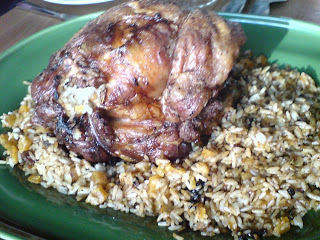
#175 Shoulder of Lamb with Rice and Apricot Stuffing – 9/10. Although I slightly mocked the dumbing down of flavour for the English palette, I found this recipe brilliant – it was simple, yet there were massive returns. The lamb fat was crispy on the outside and the meat beautifully tender within and the rice gave a sweet-sour flavour that cut through the rich lamb very well. It’s very difficult to knock this – especially when you have bought it from such a reputable butcher as Axon’s.

#150 How to Cure Meat in Brine

Well here we are – 150 recipes in. I didn’t realise I was at this milestone until yesterday – unfortunately it’s not some magnificent feast, in fact it’s really a recipe as such, and I can’t really give it a rating (at least not yet).

Jane Grigson has quite a few recipes that require salting and brining, so I thought I’d better start to get to grips with this completely ignored section of the book, by making roast ham from start to finish as the best way for me to get started, though I’ll discuss that in a separate post – this one is just concerned with brining generally.

I’ve been doing a bit of reading on the subject of brining and it seems a bit of a lost art – there’s not much information about the history of it or how to do your own curing by the method. Obviously it’s gone out of favour to some degree because it is a method of preservation first and foremost, and now with frozen and refrigerated meats on tap these days we don’t have to do such things. However, brining also lends good flavour – we all like good ham, gammon or salt beef – so you would think it popular (seeing as it’s easy too). The thing is that it is time-consuming, and we can all just pick some up ready brined or ready roasted meat, but one thing I read was that for many wet-cured meats, the wet-cure part of the process is missed out! These days they are cured with nitrating bacteria – nitrates help preserve things – resulting a lack of flavour. I’m certainly not insinuating that this method is ubiquitous, but I reckon most supermarkets (and many butchers) use it.

Brine contains three magic ingredients that help preserve meat: salt, sugar and saltpetre. The first two do so because they are in huge quantities in the brine, and can affect the normal osmotic pressures of cells – both animal and microbe. Salts and sugar enter the cells, and water rushes out in an attempt to equal the concentrations inside and outside of the cells. This results in the death of the microbes and the preservation of the meat. Saltpetre (or potassium nitrate) is antibacterial and also gives the meat a pleasing pink colour (it is what makes corned beef so pink, for example). Aside from these three ingredients there are several herbs and spices that improve the flavour of the meat.

FYI: In days of yore, saltpetre was produced by pouring stale urine to huge haystacks where it would drain and crystallise. Yum!!

To make the brine, start off by cleaning a tub or bucket with a close-fitting lid and a plate that will comfortably fit inside with soda crystals. I used a six litre Tupperware tub with a handle. Do not use a metal tub as it may react with the salt or saltpetre. Allow them to drip dry. Whilst you’re waiting for that, make the brine: To a large stockpot or similar add 5 pints of water, 12 ounces each of sea salt and brown sugar and an ounce of saltpetre. This is the basic mixture, but now you need some aromatics (all of which are optional): 1 level teaspoon of juniper berries, a small piece of grated nutmeg, a bay leaf, 3 sprigs of thyme, a level teaspoon of black peppercorns and 4 cloves, Grigson says, but anything you like in that goes with the meat you are brining. Bring to a rapid boil and skim off any scum should there be any. Allow to cool in the pot. Once cool, strain it into your cleaned tub. Place in the joint of meat and keep it submerged in the brine with the plate you washed earlier. Place in a cool cupboard or pantry – though don’t allow it to go below 4°C. The length of time it sits there now depends upon the type of meat and the reason you are brining it (see your recipe, or below, for guidelines). When it is done remove with some clean tongs.

The brine won’t last indefinitely – it may grow mould on it’s surface, which some people say just to skim off. The reason is; the amount of salt depletes every time you use it. For a corrective dose, boil 1 ¾ pints of water with 7 ounces each of salt and sugar and a heaped dessertspoon of juniper berries. Let it cool and add it to the skimmed brine. You could of course just make more from scratch.

Pork leg joint magically being tranfomed into ham

Brining times:
To convert shoulder or leg of pork into ham, or for pork loin: 3 to 10 days
Pig trotters and halved heads: 24 hours
Small tongues (e.g. pig): 36-48 hours
Large tongues (e.g. ox): 5 days
Duck (minus giblets): 36-48 hours
Beef silverside or brisket: 7-10 days
Lamb or mutton shoulder, leg and loin: 7-10 days.

The meat needs to be cooked by boiling – check the cooking water is not too salty after about 5 minutes cooking. If it is change the water and start again. If it’s okay, then add your stock vegetables or whatever the recipe requires.

However, if you are making a roast joint for Sunday lunch, try popping the joint in brine overnight to season it.

So there you have it – hopefully all works out and it doesn’t taste completely foul. My fingers are crossed that it ends up being worth the effort.

#143 Boiled Leg of Mutton (or Lamb) with (#144) Caper Sauce

When Jane Grigson wrote English Food in the 1970s, she complained – quite rightly – that the general quality of lamb in England had declined rather. This was mainly due to the importation of cheap New Zealand lamb, which rendered mutton almost obsolete. These days things have changed and British lamb in a staple even in supermarkets and mutton is having a well-deserved comeback.

I popped into Manchester City Centre at the weekend and, by chance, the monthly farmers’ market was on so I had a little browse around the stalls and bought myself a leg of lamb from Bowland in Lancashire – a farm that outdoor-rears lamb, beef and pork. Here’s their website. The man at the fruit and veg stall spotted my purchase and commented that the best meat he’d ever had was from there. Great stuff. Now all I had to do was decide what to do with it and went for the boiled leg of lamb with caper sauce – mainly because it requires very little effort, but also because it is a very Victorian way of cooking meat and wanted to try it.

It’s well worth mentioning that caper sauce is also traditionally served with fish too, so if you’re a piscitarian, or whatever you fair-weather vegetarians like to call yourselves, you can try it with salmon or skate.

The original recipe asked for either a leg of mutton or of lamb – if you are to use lamb as I did, get hold of a real free-range one, otherwise it won’t stand up to the boiling.

Trim the leg of any large amounts of fat if it hasn’t been already and place the leg in a large pot with enough water to cover it. Add stock vegetables – 3 quartered carrots, 2 quartered parsnips, one quartered turnip and three whole onions (all peeled) – plus a very good seasoning with salt and pepper. Bring to the boil and turn down to a very low simmer and leave for 2 to 2 ½ hours depending upon size. Don’t dare to throw the stock away – use it make the caper sauce and with the leftovers, a soup (I did lamb and mint soup).

Whilst it is cooking you need to make a turnip puree as an accompaniment – also traditionally Victorian. Peel and slice 3 pounds of turnips and boil them in salted water until tender. Puree them in a blender, return to the pan and then whisk an ounce of butter into them. Next mix ¼ pint of double cream with a level tablespoon of flour and whisk this into the sauce. Cook the sauce until it thickens up slightly.

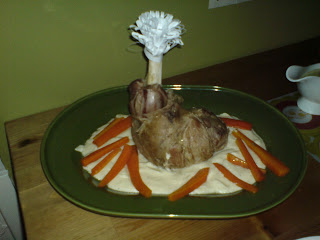
When the meat is cooked, remove it from the water, place it on a serving dish flat-side down and make a paper ruff (yes, a paper ruff!) to fasten around the shank for decoration. Spoon the turnip puree around the outside and scatter the quartered carrots over the puree.

Loving the ruff!
Serve it with caper sauce that has been made using the stock from the lamb.

For the sauce melt ½ an ounce of butter in a small saucepan and stir in a tablespoon of flour. Cook and stir for a few seconds before adding ¾ pint of the lamb or mutton stock (or indeed fish) bit by bit to avoid getting lumps. Simmer until it is the thickness of single cream. Season with salt and pepper and add an egg yolk that has been beaten with 2 tablespoons of cream and stir for a minute or two. Lastly add a generous tablespoon of drained and rinsed capers and ½ a tablespoon of chopped parsley. Serve immediately, says Griggers.

Sorry about the shite picture!

FYI: If you are looking for an alternative to capers – the flower bud of an Asian shrub, you can try using the buds of nasturtium, buttercup or marigold. I’ll stick to the original, though I think.

#143 Boiled Leg of Mutton (or Lamb) with (#144) Caper Sauce – 7.5/10. I really enjoyed this meal. It was so easy to cook, you could not go wrong with it, even if you’ve never cooked anything before in your life. The lamb was tasty and moist and not fatty as most of it had dissolved into the stock – I’m definitely going back to Bowland for my meat. The turnip puree was rather odd – unsurprisingly, it was quite bland and I suppose they were the bland carb element. I would’ve preferred mashed potato though. It’s very hard to mark the caper sauce separately as it is part of the dish. I really liked it – it was piquant and married with the lamb perfectly. The only way it could have been improved would be to chop the capers up first so that the sauce was very capery indeed!

#115 Lancashire Hotpot

Last week I took the afternoon off work to go shopping with Butters to Cheshire Oaks to spend money I don’t have. One of the main reasons I wanted to go was Butters had been told that there was a Le Crueset shop there. I love Le Crueset stuff but it is tres expensive, so I had a total geek boner about going to the factory outlet shop.

After about an hour of decision-making, I went for a large round casserole and a big mixing jug. With the casserole I knew exactly how I was going to christen it – with a Lancashire Hotpot. I’ve had hotpots before, but in the form of ready meals, which, if I remember, had tomato in it. Real Lancashire hotpot is very simple – one of those dishes involving lots of sliced potatoes and onions that seem to come in an amazing variety. It’s also rather like an Irish stew.

It looked nicer in real…

FYI: Lancashire Hotpots were traditionally made in large, deep dark glazed brown pots that were given to the baker to put in his oven whilst people went to work so they collect on their way back.

FYI2: Although hotpot usually contains potato, onion, lamb and kidneys, people have put in black pudding, sweetbreads, mushrooms and oysters. So if you have any of those to hand pop them in.

This is enough for 6 people:

Start off by thinly slicing a pound of onions and 2 pounds of peeled potatoes. Next trim any large bits of fat from best end of neck lamb chops; you’ll need between 8 and 12 depending upon thickness. When at the butches try to get about 6 lamb’s kidneys. Depending on your butcher, they may or may not be prepared – make sure the tough outer membrane has been peeled away, and slice in half lengthways and cut out their central tough, white centres. Layer up the potatoes, then onions, then meat and offal, seasoning as you go. Make sure you leave enough spuds so you can arrange them nicely on the top. Pour enough water to reach halfway up the pot and then brush the potatoes with some melted butter. Place the lid on the casserole and bake at 200-240ºC for 30 minutes, and then turn the oven down to 140ºC for about 2-2 ½ hours. Take the lid of for the final 30-45 minutes so that the top can crisp up. Serve with boiled or pickled red cabbage.

#115 Lancashire Hotpot – 6.5/10. Very nice and hearty grub that is simple yet effective. Not used to cooking with lamb, but am loving how simple this is. Also I’d forgotten how nice kidneys are – I’ve not had them in years. It’s definitely something I’d make again, but it would have to contain something more than just lamb. Plus it’s very cheap – the meat came to £6 at the butchers in the Arndale Centre. Bargain!

#84 Shepherd’s Pie

The second of the classics I’m trying to work through. Spoilt for choice for the next one. Thinking maybe a Lancashire Hotpot. Any suggestions, let me know. Anyways, my old mate Paddy was staying over, and he asked for a Shepherd’s Pie, and a Shepherd’s Pie, he got. According to Grigson, you can use either lamb or beef – I always thought that a Shepherd’s Pie contained lamb and a Cottage Pie had beef. We went for beef on Paddy’s request, as it’s the least fatty. One ingredient I found though – white wine. Never heard of that in a Shepherd’s pie, and I must admit I had reservations.

Chop a large onion and three cloves of garlic and stew them until soft in 3 tablespoons of oil. Raise the heat under the hob and add a pound of minced beef (or lamb), stir until browned. Next add a tablespoon of tomato puree, a ¼ of a pint of white wine, and ¼ of a pint of beef stock, keeping a few tablespoons in reserve. Slake 3 heaped teaspoons of cornflour in the reserved stock and add this to the beef. Season well with salt, and very well with pepper. I don’t understand it when people say that they don’t add salt when they’re cooking; it just all tastes so bland. Plus I don’t add anywhere near as must as the pre-made supermarket meals. Rant over. Simmer this for about 10 minutes and spoon off any surplus fat. Whilst simmering, boil 2 to 2 ½ pounds of potatoes (Grigson says boil them in their skins, but I skim-read the recipe and didn’t spot that sentence and peeled mine). Mash the spuds with 3 ounces of butter and up to ½ pint of milk (depending upon how sloppy you like it). Season the potato well too, readers. Pour the meat into a casserole dish and pile on the potatoes. Run a fork through the top so as to add texture to the spuds and so they crisp up nicely. Sprinkle over an ounce of grated Cheddar and a tablespoon of grated Parmesan. Bake for 10 minutes at 200ºC, and then turn the oven down to 180ºC and bake for a further 45 minutes.

Stodge-a-rama

#84 Shepherd’s Pie 8.5/10. The secret ingredient of a Shepherd’s Pie, it seems, is white wine. It enriches the whole thing without making it too rich, as red wine would do. It’s a bit frivolous, I know, but you could swap the wine for more stock if you liked.