#165 Indian Soup

A soup “with a lively freshness and a spicy flavour” says Jane, just the ticket for a summer soup, it is also a thrifty soup as it requires left-over boiled rice and left over chicken bones and meat, of which I had both from the chicken curry I had made the previous night. It is basically an Indian-style version of chicken noodle soup and is, of course, about as Indian as Prince Phillip, but this is the 1970s so we shall allow it. Anyway, who cares as long as it tastes nice; and I had high hopes for it after the disappointing mulligatawny soup I had cooked previously.

To start, bring 3 pints of beef stock, 2 large sliced onions, a large Bramley apple, a tablespoon of desiccated coconut, 2 teaspoons of curry powder and the bones from a chicken or game carcass (minus meat scraps) to the boil and simmer for an hour. There is no need to peel or core the apple, because the stock is then strained through muslin into another pan. The resulting cloudy stock now needs to be made clear – this is a two-stage process. First, use kitchen paper to blot off any fat that may have risen to the top; secondly, put over a moderate heat and whisk in two egg whites. Keep whisking for a few minutes and then leave to simmer for five more without stirring. The idea here is that as the egg whites cook they mop up any solids that make the soup cloudy. When ready, strain again; the result should be a lovely golden-brown and clear broth. Season it well with salt and both black and Cayenne peppers, plus a squeeze of lemon juice. Finally, add a few tablespoons of boiled basmati rice and the shredded scraps of meat.
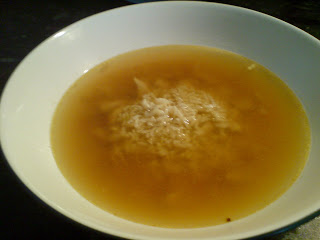

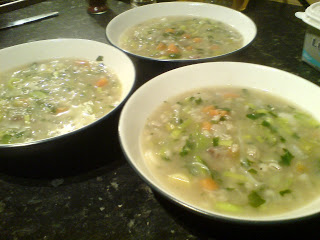
#165 Indian Soup. Well, Griggers was right – it is a delicious soup, clear, spicy and fruity with a lovely tart finish supplied by the lemon and Bramley apple. It would make a perfect starter to a meal – not too filling and interesting in its flavours. However, it is a bit of a faff – it’s not something that can be thrown together and liquidised at the end of cooking, and although tasty, I’m not sure if it’s worth the effort (making a clear consommé is a tricky business). After weighting up the pros and cons, I’ll give it 6.5/10.

FYI: a simpler way to clarify a stock is to freeze it and to let it strain through muslin slowly overnight in the fridge. Obviously you need to remember to make the stock a couple of days before you want to use it, but it’s very easy indeed! It also gives a more clear stock too in my experience.

#107 Chestnut and Apple Soup

I’m a chestnut fan, but I’ve not ever cooked with them, except for roasting. In fact I’ve only ever eaten them roasted or in a pork stuffing. I spotted some in the greengrocers and thought I’d have a go at this soup. The soups in English Food have been great (with the exception of the Mulligatawny Soup); and what I really like about them all so far is the simplicity – absolutely no faffing about. This one is no different. Give it a go if you see some chestnuts.

This makes enough for 6:

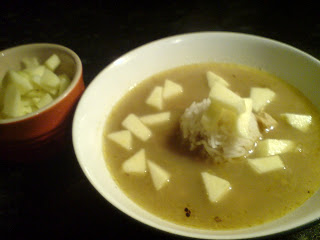
This soup requires a pound of chestnuts, and the first job is to pierce either end of each and every one with a sharp knife. Plunge them into boiling water for 10 minutes. Use a tea towel to grasp onto them with one hand and a sharp knife to remove their softened shells with the other and discard any bad ones; don’t worry if they are not whole. Keep them in the hot water as you peel them to keep the shells soft. Simmer the chestnuts along with one stick of celery in 3 ½ pints of light beef stock for 20 minutes. In the mean time, peel, core and slice two Cox’s Pippin apples. Simmer the apples in 2 ounces of butter until they soften, seasoning well with black pepper. Add the apple and juices to the stock and liquidise the whole thing until smooth. Return it to the pan, check for seasoning, and stir through 4 fluid ounces of single cream. Don’t let the soup boil if you are retuning it to the heat. Serve the soup with croutons fried in butter.


FYI: if you are lucky enough to know where there is a sweet chestnut tree, you can make shampoo from cooking up the leaves and peel.

#107 Chestnut and Apple Soup – 6.5/10. A very nice creamy-pale soup. Rich, yet light at the same time. I would certainly recommend this one; it would make a very good first course. Two apples didn’t really make it taste that much of apples, so it loses some marks for that – I would do three.

#106 Mulligatawny Soup

Whilst perusing the little fishmongers in Stockport, me and Charlotte spotted boiling chickens for sale. This is quite weird as I always keep my eye out for them and never see them, but the day before Charlotte requested Mulligatawny soup, but I said that we couldn’t do that, as we need a boiling fowl for it. Perhaps Charlotte is a lucky charm for the English Food project and me. Like some sort of leprechaun or troll.* I’m glad I now have a supply of boiling fowls as quite a few recipes require them. Good oh.

FYI: the word Mulligatawny comes from the Tamil, an Indian language, and means pepper water, and it came here in the Eighteenth Century.

This makes a big old load of soup, enough for 5 or 6 people:

Begin by chopping the boiling chicken into pieces and brown it in 2 ounces of butter, along with a sliced onion. Now add 1 ½ tablespoons of curry powder – either mild, medium or hot (I went for medium, but added a pinch of chilli powder) – and 8 ounces of yoghurt, plus some salt. Fry all this until the yoghurt reduces and becomes a thick crust on the bottom the pan. Be careful not to let it burn though. Add 3 pints of water and let it all come to a simmer. Cook for around an hour and a half until the meat is falling off the bone. Pick the meat off the carcass and chop it up, if need be, retuning it to the pan and chucking out the bones. This is a good point to leave the soup overnight, so any chicken fat can be skimmed off easily. Melt another of butter in a separate small saucepan and add 4 cloves; apparently, the cloves soften after a few minutes if cooked gently and can be crushed with a spoon. This didn’t happen for me. Hey-ho. Add the juice of lemon and pour the butter mixture into the soup. Season with more salt if appropriate. Serve with some boiled rice and some chopped apple sprinkled on top.


#106 Mulligatawny Soup – 4.5/10. Not a bad soup, but decidedly average. When I first tried I thought it was surprisingly light and refreshing, but then as I tried it again, I decided I wasn’t sure. It sat in the fridge for a bit and I realised I wasn’t going to eat it, so it went off the bin. I think I was disappointed because it wasn’t what I expected. I’ve had Mulligatawny from a tin and was sure it contained some kind of red meat. Flicking through the book, I spotted another soup called Indian Soup, which looks a lot like what I thought Mulligatawny was.

*Joke

#103 Mutton and Leek Broth

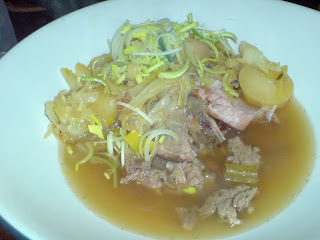
After the success of the Welsh Cawl last month and since it’s been fookin’ freezing of late I thought I’d try something similar – Mutton and Leek Broth. All very much in the same vein. I’ve never cooked mutton before and only eaten once or twice. Plus Grigson says it is “magnificent”. The recipe calls for scrag end of neck, which I managed to get hold of from Frost’s in Chorlton (what would I do without them?); as it’s a cheap cut this soup is really good for those on a budget: 1 ½ pounds for four quid. If you can’t get mutton, you can use lamb. Ask your butcher to chop it up for you as it’s a bit of a hack-saw job.

FYI 1: the neck of a lamb/sheep/veal calf is split into three sections: scrag end nearest the head, which is mainly bone. This is a good thing for broths as it imparts flavour to make a delicious stock. Apparently scrag end is an old fashioned term, and we say ‘round end of neck, presumably because scrag end doesn’t sound too appetising. There’s mid-neck or middle neck and best end of neck too – I’m sure I will get to them in some other recipe.

FYI 2: mutton applies to sheep that have more than two permanent incisors in wear, usually over ayear old.


For 6-8:

Like many soups and stews that involve cooking joints and bones up, it’s best to cook it the day before, also the pearl barley requires soaking time so keep this all in mind.

Start by rinsing and soaking 4 ounces of pearl barley in water for four hours. Do some light housework in the meantime, or maybe just watch a film in between. Drain the barley and put it in a large saucepan or stockpot. Trim off any excess fat from the meat (keep any big chunks and freeze them and use for Singin’ Hinnies, which I’ll be cooking very soon) and add the chunks to the pot along with 4 pints of water. Bring it to the boil and simmer it gently for an hour before adding the vegetables: 5 ounces of diced carrot, 4 of diced turnip, a stalk of chopped celery, a chopped leek and 5 ounces of chopped onion. Season with salt and pepper at this point too. Let the broth simmer for at least another hour until the meat is falling off the bones. Cut the meat up and return it to the pot and discard the bones. Skim any fat from the soup – this is the point to leave it over night; solidified fat is much easier to remove. Bring back to the boil and correct the seasoning with salt, pepper, sugar and cayenne pepper. Be quite liberal with the sugar and salt. Slice a second leek thinly and add to the broth along with some chopped parsley and turn off the heat; the residual heat will cook the leek. Serve with granary bread and butter.

#103 Mutton and Leek Broth – 6.5/10. A nice soup that needed a lot of seasoning to make it delicious. I really liked the mild mutton flavour and the pearl barley, but expected it to be much more flavourful. That said, because the batch I made was so big I was still eating it three days later and it did get better as time went by.

#98 Cawl

Butters and I went for a nice walk around Chorlton Water Park and the Mersey Valley. We lucky in that it wasn’t totally pissing it down with rain, as the weather has not been good of late. It was still pretty chilly though so I wanted to make something simple, nourishing and warming for when we got back. I plumped for the Welsh soup, Cawl (pronounced “cowl”, according to Griggers). Cawl is simply Welsh for soup, but it’s far from a light soup-starter; it’s a meal in one. I assume it’s a peasant dish; it is simple in its ingredients and methods, is cheap, and requires time to make it well. It’s basically the Welsh equivalent of Irish stew or Cock-a-leekie. What I like about this one is that the meat is cooked as a joint and sliced at the end and served with the vegetables and soup. To be really Welsh, marigold flowers can be added as a garnish, but I thought that was going a bit too far…

These measures make loads of Cawl – enough for 6 to 8 people.

Start off by browning your meat in some beef dripping; you need pounds altogether, either beef brisket of shin of beef, but best is to use one pound of beef and a pound of smoked hock, gammon or bacon. I went for brisket and a giant piece of smoked bacon. When browned, put in a large saucepan or stockpot. Next, brown 2 sliced onions and 3 carrots, parsnip, turnips or some swede cut into chunks; a mixture is best. Once they are browned, add them to the meat and cover with cold water, add salt and two stalks of chopped celery. Bring to the boil slowly, skimming off any scum that may rise to the surface. Add a bouquet garni (I used parsley, thyme and bay), sea salt and pepper to season, turn to a very low heat and simmer for at least three hours. I actually did all this the day before, so that we didn’t have to wait very long to eat when we got back.


About half an hour before you want to eat, add a pound of small potatoes (or larger ones cut up), and ten minutes before add a small white or green cabbage that has been sliced. When the potatoes are cooked the soup is ready. Finely slice 2 or 3 leeks and sprinkle them on top of the soup; the heat of the soup will cook them. Remove the joints and slice them up, putting some of each kind in each bowl, along with some of the veg and stock.

#98 Cawl – 7/10. A delicious, warming and beautifully clear soup. The meat was falling apart and the smoked bacon gave the whole thing a really delicious flavour. Definitely one of the best soups so far. This will become a staple winter dish, I think.

#80 Oxtail Soup

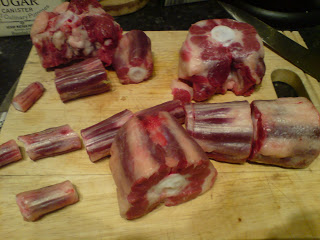
My favourite soup; at least when it comes to tinned Heinz variety. I have made it before, but it was quite an elaborate recipe with loads of ingredients. This one is more basic. It is very tasty, but heed Jane’s advice: don’t buy a skinny little oxtail. I asked for the biggest one they had. However, if you are not reasonably surprised by the size of your butcher’s oxtail, err on the side of caution and buy two. I didn’t do that, and so the flavour was perhaps not as rich as it could have been. It was remedied however, by adding some of that beef stock concentrate, but I did feel like a bit of a cheat! Ask the butcher to chop up the tail and trim the fat off.

I got the oxtails from W H Frost in Chorlton – a very good butcher. I chatted to the man briefly and he mentioned that he could pretty much get anything I want in as long as I order it in plenty of time. Good man! The butcher in Levenshulme is good for the basics, but it’s nice to see there’s somewhere I can get the weird and (not so) wonderful stuff.

I would recommend to giving it a try. If you’re not used to strange cuts or offal, then this is the place to start. It’s not particularly gory and the meat is pleasantly beefy. However, you need to start it the day before you want to eat it.

From this….

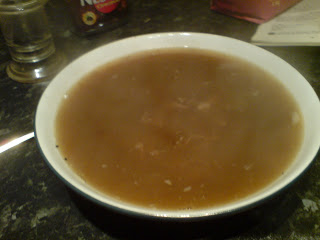
…to this!

The day before:
Start off by removing any surplus fat from the tail that the butcher didn’t quite get rid of. Chop three stalks of celery, stud an onion with three cloves and slice a small turnip and a carrot. Next, melt 2 ounces of butter in a large pan and brown the meat and vegetables. This takes about 10 minutes as there’s quite a lot of stuff in the pan. Don’t be coy; have the heat quite high, as you don’t want the vegetables to stew. Give a stir now and again. Meanwhile make a bouquet garni – I used 2 bay leaves, a sprig of thyme some parsley stalk (all fresh, but kept in the freezer). When sufficiently browned, add the bouquet along with 4 pints of water and a teaspoon of peppercorns and season with salt. Bring to the boil, cover and simmer gently until the meat is coming away from the bones. This took around four hours. Strain the beefy stock you have created into a bowl and allow to cool. You can discard the veg, but I ate them! The final job is to pick the meat from the bones and plop the meaty chunks back into the soup. Refrigerate the soup over night.

On the day:
Much easier! You’ve done the hard work. Using a spoon, skim off the fat that has risen to the surface and solidified. Reheat the soup to simmering point and add 5 tablespoons of port. This makes all the difference. Don’t dare miss it out. Check the seasoning, you can be pretty bold I reckon. If it is not beefy enough, cheat as I did and add a small amount of stock concentrate.


#80 Oxtail Soup – 7.5/10. Even though I cheated, it is still a beautiful soup. The simple combination of a well-flavoured stock, chunky beef and the sweet port wine is addictive!

#69 Watercress Soup

The third and final soup I made for my recovery. I love the peppery taste of watercress and certainly don’t eat it enough. I thought that watercress soup would be a bit bland, but it is not. Don’t freeze it though, it goes a bit weird. I had mine at work and it didn’t look too appetising (see pic), it does look (and taste) better freshly made. It’s another easy soup, especially if you have a blender, though everything can be run through a vegetable mill or ricer. Chicken stock is probably best, though Grigson says you can use water, but vegetable stack is probably better, I reckon.

FYI: Watercress is one of only three indigenous vegetables we have in Britain (the other two are samphire and kale). It’s strange how none of them are regularly eaten.

Freezing your watercress soup results in something that resembles pond water – beware!

Start off by dicing a pound of potatoes and slicing an onion. Soften these in a covered saucepan in a little water until soft – keep an eye on it, as you will have to top it up a couple of times. Measure out 2 ½ pints of chicken stock before attempting to blend the potatoes as you may need to some of it to add. Add the liquidised potatoes along with the rest of the stock to the pan and reheat without boiling. Chop 2 small bunches of watercress and stew them in butter for around minutes and add them to the soup. Season with salt, pepper and nutmeg and add two tablespoons of cream to enrich it.

#69 Watercress Soup: 5/10. OK, but I prefer watercress as a salad leaf I think. It has a nice texture to it and the pepperiness does come through, though is hampered by the fact it is cooked.

#68 Carrot and Tomato Soup

This one is very similar to the tomato soup I made last month, and has almost the same ingredients. I used beef stock rather than vegetable stock this time, which really brings out the flavour of the tomatoes, so unless you’re vegetarian go for the beef!

Soften 8 ounces of sliced carrots and a medium-sized, chopped onion in 2 ounces of butter. Add 8 ounces of peeled and chopped tomatoes and 1 3/4 pints of stock and gently simmer until the carrot is cooked. Liquidise and pass through a sieve to remove seeds before returning to the pan. Season with salt and pepper and add 1/4 pint of single cream and some chopped chives.

Soup 7/10; attractiveness 1/10.

#68 Carrot and Tomato Soup – 7/10. Really delicious. Sieving it and adding cream made it really silky and smooth, which is important when you can hardly open your mouth. It freezes brilliantly too.

#67 Green Pea Soup

This one’s a cracker. It’s basically pea and ham soup as it uses ham stock. Grigson gives the option of using chicken stock, and I suppose you could use vegetable stock, but it will not be in any way as delicious as ham. Use peas in any form – fresh, frozen or dried. I went for frozen as I’ve always got them in the freezer, and I reckon they’re better than fresh, unless you happen to grow them yourself. The Grigson also gives a vegetarian version which swaps the bacon for the heart of a Cos lettuce, a small handful of spinach and half a shredded cucumber. The stock is swapped for water.


Start off by softening a chopped, medium onion in 2 ounces of butter until soft and golden, but not brown. Next add two rashers of smoked streaky bacon that have been chopped to. Fry for a couple of minutes and then add 1 3/4 pints of light ham stock and 8 ounces of peas and simmer until cooked. Liquidise and add more water or stock if it’s too thick. Re-heat, season and stir in some chopped parsley.

#67 Green Pea Soup – 8.5/10. A lovely warming soup. It was the first thing I ate when I got back from the hospital and is certainly my favourite soup from English Food thus far. Get it made!

#60 Tomato Soup

I still haven’t make anything since I got back, however I did do (#60) Tomato Soup before I left for France. I think it’s important to use fresh tomatoes in this, as tinned have a taste of their own, that although very good, are not suitable. I bought tomatoes on the vine and kept them on the windowsill so that they got nice and ripe and, er, tomatoey. Even then I still had to add extra sugar and tomato puree. Anyways, it was nice to have a cream of tomato soup that wasn’t from a tin.

Soften 3 ounces of chopped carrot, 2 ounces of onion and a garlic clove in two ounces of butter, and then add a pound of peeled tomatoes that have been halved. (To peel them, put them in a bowl of boiling water for 30 seconds and the skins just slip straight off.) Add 1 1/4 pints of stock – chicken, beef or vegetable (I did veg). Bring to the boil and simmer until everything’s cooked through – about 15 minutes. Test the carrot, as it is this that takes the longest. Liquidise the soup and push it through a sieve leaving behind the tomato pips. Now the important bit: the seasoning. Add salt and pepper as you normally would, but also add some sugar and around 2 teaspoons of tomato puree, if the tomatoes need it. Also add some freshly-grated nutmeg; I think it makes all the difference. Boil 1/4 pint of single cream and add the soup mixture. When you are just about to serve it, sprinkle over some chopped parsley. Serve with bread, or maybe a giant crouton.


The Grigson says that you can serve it cold: Chill the soup before adding cold cream.

#60 Tomato Soup: 7/10. A really good, light summery soup. It wasn’t packed with tomato flavour, but it was delicious. I’ll certainly do it again.