#104 Wiltshire Lardy Cake

I’ve heard of the lardy cake and once saw someone making one on telly. I remember thinking that it looked pretty marvellous. For those of you that have never heard of lardy cakes, they’re basically a sweet sticky bun, but instead of enriching it with butter, lard is used; it’s layered along with sugar and mixed fruit through white bread dough. These ingredients meld together to make a moist, sticky and very rich teatime treat. It is quite possibly the least healthy thing I’ve ever cooked, and Jane Grigson reckons it’s on the “skinny side”!
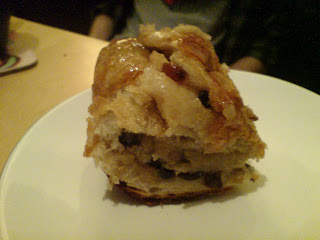

Start off by making some bread dough using a pound of flour (follow this method if you don’t have your own recipe, but adjust amounts accordingly). Whilst you’re waiting for it to rise, measure out 6 ounces of lard and chop it up, 6 ounces of mixed dried fruit, 2 ounces of mixed peel and 6 ounces of granulated sugar. Once the dough had risen, and you’ve knocked it back, roll it out into a long oblong and spread the first two thirds of it with a third of the lard, fruit, peel and sugar. Fold this into thirds and press or tuck the ends under, give it quarter turn and roll out the dough again. Repeat this process two more times so that all the fruit and sugar are used up. Place the rolled up dough in a large tin that is oblong or square in shape and let the dough prove. Bake for 35-45 minutes at 220ºC. Turn it out onto a plate so that the sticky side is facing up and so that the lard can soak through the bread. Serve warm or cold.

#104 Wiltshire Lardy Cake – difficult to score this one; we tried it warm and it’s either 9/10 or 2/10. It’s tastes really sweet and is beautifully sticky with lovely plump juicy raisins, but has the bizarre savoury meatiness of the lard. I think if I were to cook it again, it would have to be even more skinny than Griggers’ measurements. However, once it was cool, it did taste less, er, meaty. Give it a go – easy and cheap to make, so I think I’ll go with a final score of 7/10.
#97 Welsh Light Cakes

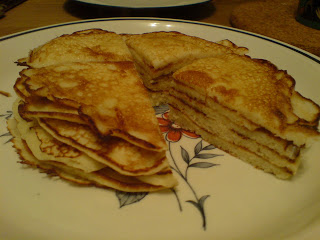
For breakfast the next day, Charlotte and I wanted something hot and homely and went down the pancake route. I spotted this one as Charlotte is half-Welsh so I thought it befitting. These are great they’re made from a thickish bubbly batter that contains cream of tartare and soured cream – two secret ingredients. They’re served in quite an American fashion – piled up high with slices takes out of them. Get the made – they’re easy, so you get back much more than you put in!

Beat together 6 rounded tablespoons of plain flour, 2 of sugar and 3 of soured cream along with a pinch of salt and 3 eggs until smooth. Next, mix together ½ teaspoon of bicarbonate of soda and a rounded tablespoon of cream of tartare with 4 tablespoons of water. Quickly add it to the batter and stir in enough milk or buttermilk to make a batter that’s “not too thick” – a tricky one when you’ve no frame of reference; I think the consistency of thick double cream.


Now heat up a frying pan or griddle and add a little oil. Coat the pan and pour off any excess. Ladle a small amount in the centre of the pan to make small pancakes. Don’t swirl them around like crepes, they should be thick. After a minute or two flip it over and cook for another minute. Pile them up on a plate, spreading each one with butter. Serve in wedges with something nice and sweet – maple syrup or, as we used, golden syrup.

#97 Welsh Light Cakes or Pancakes – 9/10. Officially my favourite pancake. I know you can make crepes with normal average store-cupboard ingredients, but these are something special. Light, fluffy and slightly sour in taste, they went perfectly with the sweet golden syrup. Whenever anyone stays over, these will be made for breakfast every time. Me and Charlotte liked them so much we made seconds! Oink!

#94 ‘To Make Mince Pies’

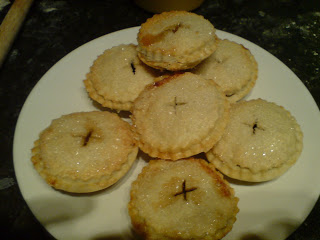
Well it’s the run-up to Christmas. I’ve already started on the Christmas cake and I’m feeding it with brandy every few days. As Lee, Charlotte, Kate and Pete were coming over for food, I thought it would be the perfect time to do a trial run of the traditional mincemeat I made a few weeks ago, so I made some mince pies.

Jane Grigson gives instructions on how to make them. She says to use shortcrust pastry rather than puff pastry (unless you are eating them warm). I made pastry with half butter, half lard; I prefer it as it is more crisp and ‘short’. Whichever way you do it remember the flour:fat ratio is 2:1. Roll out pastry thinly and cut circles out with a scone-cutter to line small tart tins. Place a small teaspoon inside – don’t overdo it though, the fresh suet expands. Seal the top with another circle of pastry, gluing it on with some egg white. Make a cross in the middle and sprinkle with sugar. Bake for 20 minutes at 220ºC. Serve warm or cold.


#94 ‘To Make Mince Pies’ – 8/10. I really like the mincemeat. The meat is totally undetectable; but it, the fresh suet and the grated apple make the resulting pie-innards succulent and tasty, it’s not overly sweet either, which is good because you can eat more of them! Good old Mrs Beeton, where would we be without her! It’s been a while since I’ve had homemade mince pie and it brought back a lot of memories for me making them with my Mum. I am definitely getting in the Christmas spirit!

#87 Mrs Beeton’s Traditional Mincemeat

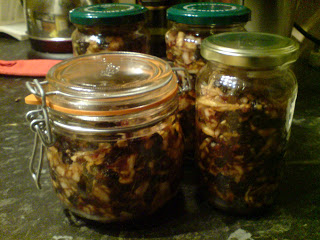
Christmas is coming, and I am going traditional on your ass. First thing to be made is Mrs Beeton’s Traditional Mincemeat. According to Griggers it is better than any modern mincemeat. The main difference is that there is proper fresh suet and actual meat in it. She reckons that when she makes this recipe, the mince pies get eaten double-quick. Well we’ll see. Getting hold of fresh suet is easy, the butcher in Levenshulme sold me 2 and-a-half pounds of it for only a quid! Bargain! Also, I got the chance to use the mincer attachment for my Kitchen Aid for the first time; it was very good, and now I intend to mince everything. I like a good mince, I do (but you probably knew that already…). I haven’t had the chance to eat any yet, but it’s very easy to make, as long as you have the ability to stir.

The amounts are quite big in the recipe, so I’m giving you what I did which is half of Good Lady Beeton’s instructions:

Mix together 8 ounces of seedless raisins, 12 ounces of currants, 6 ounces of minced, lean rump steak, 12 ounces of fresh, chopped suet, 8 ounces of dark brown sugar, 1 ½ ounces of dried mixed peel, ¼ grated nutmeg, 12 ounces of apples that have been peeled, cored, and grated and the zest and juice of half a lemon. When all has been incorporated, mix in 2 ½ fluid ounces of brandy. Spoon the mincemeat into sterilized jars. (To sterilise jars, place jars and lids in oven set to 110°C for 35 minutes). This recipe made enough for four big jars. Leave for at least two weeks…


FYI: Mincemeat recipes go back as far as the Fifteenth Century, and pretty much any meat was used for mincemeat – Sixteenth Century recipes use heart or mutton and bone marrow instead of suet. It’s probably one of the few surviving Elizabethan dishes still made today.

…to be continued.

#86 Walnut Cake

We all went up to Cumbria to visit Frances and James last weekend. It was also Dean’s birthday, so I thought I’d make a cake. On asking him what cake he’d like, he said ‘anything, as long as it’s not from that bloody book of yours’. Well that’s just lovely, isn’t it? I think he’s expecting brains and gonads in every recipe. After giving many alternative suggestions and turning them down, he eventually went for a walnut cake. Where did I find a recipe? You know! It’s a good cake too, for a walnut cake – the icing is a complete faff though. If you can’t be bothered to do the icing, do butter cream instead.

For the cake:
Cream together 5 ounces of butter with 6 ounces of sugar; beat in 2 beaten eggs, then 8 ounces of sifted self-raising flour, 3 ounces of coarsely chopped walnuts and 4 dessertspoons of milk. Lastly, add half a teaspoon of vanilla essence (or use vanilla sugar instead of normal sugar). Line an 8 inch cake tin, add the mixture and bake for 1 to 1 ¼ hours at 180°C. Test with a skewer, and when ready turn out onto a cake rack and allow to cool.

For the icing:
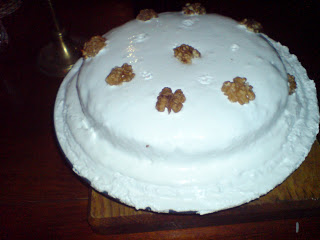
A bit tricky this bit…Stir a ¼ of a pint of water and a pound of sugar lumps in a pan under a low heat until the sugar gas dissolved. Raise the heat and add a generous pinch of cream of tartar. Boil the syrup until it has reached the soft-ball stage which is 120°C; easy if you have a sugar thermometer, which I don’t. Alternatively, as it boils, carefully remove a teaspoon-full of syrup and drop it into small cold water. Fish out the blob of sugar, and if it is soft but can form a ball between your fingers, you are done. You mustn’t stir the syrup as it boils; this reduces the temperature, causing the sugar to crystallise, resulting in total disaster. It takes a few minutes, so in the meantime, whisk two egg whites until stiff in an electric mixer, and when the syrup is ready pour it into the egg whites with the electric mixer on full-whack. Keep mixing until it has nearly set and then add a teaspoon of vanilla essence. You should have a lovely smooth meringue icing. Spread this over the cooled cake with a palette knife and decorate with some walnut halves.

It is very important to wait until the icing has nearly set – I didn’t and it went everywhere!

Not a wedding hat, but in fact, a cake.

#86 Walnut Cake – 6.5/10. Certainly an above-average cake as far as walnut cakes go. Not normally a big fan really. I think it may have been nicer with some coffee-flavoured butter cream instead of the posh icing, but that’s just me.

#83 Almond Fingers

The almond finger. A Mr Kipling favourite I think. I recently decided, since there is no such thing as a bad cake, that if I am to avoid a severe sugar and carbohydrate addiction that I should never buy a cake again; if I want one, I’ll just have to bloody-well bake one meself. I remember liking these as a student, and my Mum used to make them when I was little, so I thought I’d give Grigger’s recipe a go. Griggers reckons that the difference between the flavour of the commercial ones and the home-made. Also, I was off to my mate Stuarty’s flat, and thought it would be nice to bring round something home-baked. People don’t do that kind of thing these days do they? We had a grand old night playing Guitar Hero and getting sloshed.


The recipe is in two stages: First of all you need to make a sweet pastry for the base. Cream together 4 ounces of softened butter and 3 heaped tablespoons of icing sugar. Next, beat in an egg, then a tablespoon of lemon juice, and 8 ounces of plain flour. Wrap the pastry in cling film and let it rest in the fridge for an hour, or the freezer for 20 minutes if rushed for time, as I was. Roll out the pastry into a lined 7 x 11 inch Swiss roll tin. Don’t worry if it breaks up – sugary pastry always does – just fill in any holes with spare bits. Lastly, spread a thin layer of apricot jam over the pastry and phase one is complete!

Now make the filling: Cream together 5 ounces of softened butter with the same weight of vanilla sugar (make your own), beat in 2 eggs, then a heaped tablespoon of flour, 4 ounces of ground almonds and lastly, 2 tablespoons of dark rum. Spread this evenly over the sweet pastry and sprinkle over 2 ounces of slivered almonds. Bake at 180ºC for 35-40 minutes.

#83 Almond Fingers. 7.5/10. Jane was right; much better than any bought nonsense. The whole remains very moist, almost like a cookie. I feel that I was a bit too tipsy to appreciate it, I hear Stuart was still eating them a couple of days after, so they can’t have been bad.

#81 Northumbrian Wholemeal Scones

Another venture into yeast cookery. This one uses fresh yeast; a new one on me. It’s much better than the dried stuff. Also, I have a giant bag of stone-ground flour left over from Doris Grant’s Loaf the other month, and what with the credit crunch and the whole of the Western World going into liquidisation, it’s best I try to be a bit frugal. Also, I have finished the no carb diet I was on, and so the other reason I went for this recipe is that it uses proper organic brown flour with all the bits and wheatgerm and everything inside, and that must be better than white bread. In fact, my house is a white carb-free zone from now on (unless it’s in a recipe for the blog, natch). Oh, I bought the yeast from the Barbakan deli in Chorlton – an excellent bakery, probably the best in Manchester – for only 20p per 100 grams. I thought I may as well use what the best use. I hear that supermarkets with bakeries within will give you it for free.

I have no idea what make these scones particularly Northumbrian. Ideas anyone?


Here’s what to do…

Makes about 12 scones.

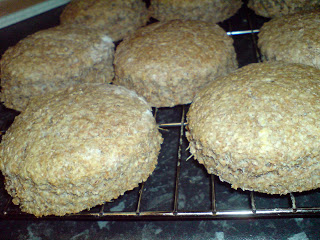
Mix 1 ½ pounds of stone-ground wholemeal flour with a teaspoon of salt, rub in 2 ounces of chilled lard (I used hands here rather than the mixer for a change) and make a well in the middle. Mix ¼ pint of milk with ¼ pint of boiling water and pour about a teacup full of it into dish or small bowl and stir in a tablespoon of golden syrup. Fork in an ounce of fresh yeast into the syrup mixture and allow it to froth up. This is much quicker than the dried stuff, it took only 10 minutes in my cold kitchen! Tip it into the flour along with the rest of the water-milk mixture. Be careful though, don’t add it all at once; you need a ‘soft but not sloppy dough’ says Griggers. I actually needed a little more. Put some clingfilm over the top of the bowl so it doesn’t dry out and let the Sacchromyces do its work until the dough as doubled in size. Roll out the dough, keeping it fairly thick, and cut out rounds with a scone cutter. Place scones on a baking tray, cover again and allow to prove. When they’ve risen again, brush them with milk and bake for 15-20 minutes at 220ºC.

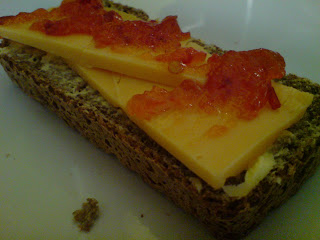
#81 Northumbrian Wholemeal Scones – 7/10. Griggers suggests eating them hot with butter and honey. And so right she is. Bloody marvellous. They are just as good as normal scones. They’re not sweet, but a lovely malty flavour instead. I also had some the next day for a quick tea – split two and grilled them with cheese on. I’ve frozen the rest to keep me in a constant supply.

#79 Carrot and Hazelnut Cake

Right. I promise that October shall be much more eventful in the world of The Grigson than September. It was my turn to do the cake for Evolution Group at University, so I’ve been given a good kick up the arse.

A favourite of the group is carrot cake, and there is a recipe in English Food – though it’s very different to the American carrot cake. It’s made without using fat, like a Genoese spoge to make it light and has the added bonus of having hazelnuts in it. Couldn’t resist not sandwiching it with American-style cream cheese filling.

FYI: Carrots have been used for desserts quite a lot in England. Mrs. Beeton had a sweet, chewy carrot tart in her book; it was revived as mock apricot tart during rationing in the Second World War, if I remember rightly (not that I was in WWII, you understand).

Separate four eggs and add to the yolks to the bowl of a food mixer along with 4 ounces of caster sugar. Whisk them together until pale and frothy. This takes a while so meanwhile finely grate 4 ounces of carrots and blitz 2 ounces of toasted hazelnuts in a food processor (or, heaven-forbid, chop them by hand!). Fold these into the eggy mixture along with 4 ounces of sifted, plain flour. Next, whisk the egg whites until stiff. Slaken the mixture by stirring in a third of the whites and then fold in the rest. Spoon the mixture into two greased and papered 9 inch cake tins and bake at 190ºC for anywhere between 15 and 25 minutes. They’re ready when the sponge springs back pressed lightly. Cool on wire racks.

To make the filling, beat together 8 ounces of full-fat soft cheese with 5 ounces of softened unsalted butter, once incorporated, beat in 4 tablespoons of icing sugar and a teaspoon of vanilla extract. Use this to sandwich the cakes together. Dust the whole thing with icing sugar, if you please.


#79 Carrot and Hazelnut Cake – 8/10. A success. Every seemed to like it. Much less dense than a typical carrot cake. I could only have a tiny wee sliver since I’m meant to be on a carb-free week this week, but I had to taste it for the blog, didn’t I!?

#78 Doris Grant’s Loaf

I was “working from home” the other day and therefore needed to procrastinate heavily; been making a poster for the Faculty of Life Science Research Symposium and though there’d be fewer distractions at home where there’s the internet, telly and the kitchen. I thought I’d have another stab at bread recipe and the last one was very nice, but I rushed it rather. Then I remembered Doris Grant’s Loaf – I had bought some stone-ground wholemeal flour specifically for the recipe, but had totally forgotten about it. I’m trying to get fit at the moment and so trying to cut down on white carbs, so this one was right up my street, plus Griggers says that as long as you can read and measure you can make this bread as it requires no kneading. I’m not too sure about that, but it is easy and certainly a welcome change.

Add 1 ½ level tablespoons of dried yeast to 1 ½ rounded teaspoons of dark Barbados sugar (you can use honey, but I like burnt liquorice taste you get off molasses) and whisk in 1 ½ tablespoons of blood-heat water in a small bowl. Leave yeast to active and foam, which takes 20-30 minutes. I found that placing the bowl in a larger one filled with warm water sped the whole process up. While that’s happening weight out 1 ½ pounds of stone-ground wholemeal flour into a large bowl and mix in a teaspoon of salt. If (like me) you don’t have somewhere warm like an airing-cupboard, but the flour in an over at the lowest temperature possible and let it warm through. When the yeast is ready, make a well in the flour and pour in the frothy mixture and slowly pour in one pint of blood-heat water, mixing thoroughly with your hands (no need for mixers, here!). The dough should be quite sticky, though you may find you don’t need all the water. Split the mixture between a large and a small loaf tin that have been greased and allow the dough to rise for about 45 minutes (I put it back in the still-warm oven). Bake for 40 minutes at 200°C.


FYI: Doris Grant was a very popular post-war cook and suggested this recipe as an alternative to the ‘national loaf’, which I can imagine flaccid and tasteless (though probably no way near as bad as our standard supermarket loaves these days).

#78 Doris Grant’s Loaf – 8/10. On my first slice, I thought I’d messed it up as it is not a light fluffy loaf, but quite heavy and mealy like soda bread. After another slice, I was hooked, and managed to eat most it to myself! Griggers suggests slicing it thinly with smoked salmon, but I’m not really a fan, so I had butter, farmhouse Cheddar and chilli jam. Go out and make this!!

#72 Madeira Cake

I made a Madeira cake because it seemed refined – one should drink a glass of Madeira wine with it as one reclines for a mid-morning treat, apparently. It’s basically a slightly lemony sponge cake and is pretty D.R.Y., hence the excuse of drinking wine with, I expect. I’d only had it with a cup of tea, but either is pretty good. Drinking cake with wine is very much a nineteenth century idea, partaken by middle-class ladies, the cake itself has nothing directly to do with the island.


Cream 6 ounces of butter and the same of sugar until light and fluffy. Sift 9 ounces of flour and half a teaspoon of baking powder into a separate bowl. Next, stir in 4 large eggs one at time, adding a small amount of flour between each egg to avoid them splitting the mixture. Once incorporated, stir in the rest of the flour and the grated rind of half a lemon. Pour the mixture into a lined or greased 8 inch cake tin. Bake at 180°C for anywhere between 50 minutes and 1 ½ hours, depending on your oven’s idiosyncrasies (I’m still getting used to mine). Half-way through the cooking time, place two strips of lemon zest on the centre of the cake. To test if it’s cooked, stab it with a skewer. When it’s ready let it cool for about 10 minutes before tuning out onto a wire rack.

#72 Madeira Cake – 7/10. I really liked this cake. I usually prefer something with a bit of cream or icing, but in combination with the sweet Madeira wine, it is really lovely. How refined!