#113 Muffins

After the reasonable success of the crumpets, I thought I should carry on the bread theme and use up some more of the yeast. I didn’t even have to look through; I knew straight away that I wanted muffins – the second best breakfast carb after the crumpet… Don’t be confused between these muffins and American muffins – they are two very different beasts. I suppose in America our muffins are called English muffins, non?

Muffins are halfway between crumpets and bread – they are made with soft dough using strong flour and are cooked gently on the hob, rather than in the oven. They’re easy to do, but do require a bit of time and energy to knead them properly… It is worth putting in a bit of effort as it make the dough nice and elastic and therefore fluffier when cooked.

This recipe makes 12 muffins:

Start off by creaming ½ an ounce of yeast in 4 tablespoons of warm water, then warm ½ pint of whole milk and an ounce of butter in a pan until they reach blood heat. Meanwhile crack an egg into a bowl and give it a brief whisk, and pour in the warm milk into it, whisking thoroughly.

Weigh out a pound of strong plain white flour and empty it into a warm bowl (or better, warm the flour and bowl together on a low heat in the oven). Make a well in the centre and pour in the yeast and the milk-egg mixture, along with a teaspoon of salt. Mix together thoroughly, adding more flour or water if required. You want a soft dough, but not one that is sticky. Knead the dough for 5 to 10 minutes, place it, cover it and allow the dough to rise to at least double it’s volume.

Roll out the dough to ½ inch thickness and cut out rounds with large pastry cutters or whatever (I used crumpet rings). Knead the trimmings together and roll them out too, so you get as many muffins as possible from the mixture. Let them rise a little.

Put a heavy-based pan on a low heat and brush it lightly with lard or oil and fry them gently. Griggers says they should expand into something like a “puffball fungus”, and if you leave them to rise slightly they will. Turn them over after around 7 minutes and cook the other side.
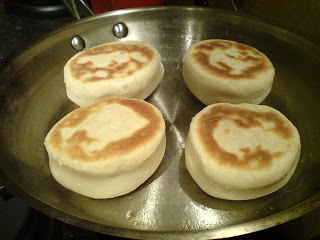

Apparently, you should toast muffins whole – they should never be cut, but torn, adding butters as you go. Either way, eat them with lots of salted butter.

#113 Muffins – 7/10. I really liked these – it was easy to make them nice and light as the low heat made them almost impossible to overcook. The result is light and fluffy muffins that eat very well, very hard to get wrong, I think, and you should give them a go. They freeze well too…

#110 Elizabeth David’s Crumpets

Charlotte and I have been very excited about the prospect of making our own crumpets for a while – just how do you get all the hole in!? We were to find out. The recipe is actually one by Elizabeth David – a very influential food writer, who wrote a book on yeast cookery. It’s making recipes like this – really stoically English fayre that I would never have thought of cooking myself. They are very easy – you need to buy some rings to cook them in as the batter is reasonably runny. If you don’t have one / can’t be arsed buying one, don’t worry, as you can ladle mixture straight into the pan and let it spread out to produce a pikelet which you don’t seem to be able to buy anywhere other than Yorkshire.


This recipe made us a baker’s dozen of crumpets:

Start off by warming a pound of plain flour through in the oven. Whilst your waiting for that warm up a pint of whole milk, 2 tablespoons of flavourless oil and a teaspoon of sugar to blood heat. Take out 3 tablespoons of the warmed milk and fork it through half an ounce of fresh yeast and let it thicken and become creamy. Make a well in the centre of the flour and add the yeast mixture, a tablespoon of salt and the remaining milk and beat the mixture – 5 minutes by hand, or about 3 with an electric beater. Cover the mixture and allow to rise and double in bulk – this is quite rapid with fresh yeast. Knock the mixture back and add ¼ pint of warmed water that has had a very generous pinch of bicarbonate of soda dissolved in it. Beat the mixture well and let it sit a rise again for around half an hour.


Grease a griddle or heavy-based frying pan and the crumpet rings with lard. Place the rings in the pan and pour in mixture two-thirds of the way up. Allow to fry very gently until the top is covered with holes and the surface is no longer liquid. Turn the crumpets over so they cook and colour on the other side. Allow them to cool and toast them, serving them with plenty of melted butter.

#110 Elizabeth David’s Crumpets – 6.5/10. The score I’ve given these crumpets may be changed later. The reason for this is that their consistency was rather soft and doughy, however they were piping hot throughout with no raw flour taste, so I’m not whether they are mean to be like that or whether they are undercooked. Consistency aside, they did taste absolutely delicious, so when I get the chance, I’m going to try them again…

#104 Wiltshire Lardy Cake

I’ve heard of the lardy cake and once saw someone making one on telly. I remember thinking that it looked pretty marvellous. For those of you that have never heard of lardy cakes, they’re basically a sweet sticky bun, but instead of enriching it with butter, lard is used; it’s layered along with sugar and mixed fruit through white bread dough. These ingredients meld together to make a moist, sticky and very rich teatime treat. It is quite possibly the least healthy thing I’ve ever cooked, and Jane Grigson reckons it’s on the “skinny side”!


Start off by making some bread dough using a pound of flour (follow this method if you don’t have your own recipe, but adjust amounts accordingly). Whilst you’re waiting for it to rise, measure out 6 ounces of lard and chop it up, 6 ounces of mixed dried fruit, 2 ounces of mixed peel and 6 ounces of granulated sugar. Once the dough had risen, and you’ve knocked it back, roll it out into a long oblong and spread the first two thirds of it with a third of the lard, fruit, peel and sugar. Fold this into thirds and press or tuck the ends under, give it quarter turn and roll out the dough again. Repeat this process two more times so that all the fruit and sugar are used up. Place the rolled up dough in a large tin that is oblong or square in shape and let the dough prove. Bake for 35-45 minutes at 220ºC. Turn it out onto a plate so that the sticky side is facing up and so that the lard can soak through the bread. Serve warm or cold.

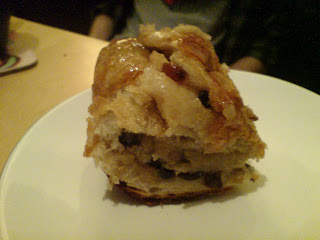
#104 Wiltshire Lardy Cake – difficult to score this one; we tried it warm and it’s either 9/10 or 2/10. It’s tastes really sweet and is beautifully sticky with lovely plump juicy raisins, but has the bizarre savoury meatiness of the lard. I think if I were to cook it again, it would have to be even more skinny than Griggers’ measurements. However, once it was cool, it did taste less, er, meaty. Give it a go – easy and cheap to make, so I think I’ll go with a final score of 7/10.

#78 Doris Grant’s Loaf

I was “working from home” the other day and therefore needed to procrastinate heavily; been making a poster for the Faculty of Life Science Research Symposium and though there’d be fewer distractions at home where there’s the internet, telly and the kitchen. I thought I’d have another stab at bread recipe and the last one was very nice, but I rushed it rather. Then I remembered Doris Grant’s Loaf – I had bought some stone-ground wholemeal flour specifically for the recipe, but had totally forgotten about it. I’m trying to get fit at the moment and so trying to cut down on white carbs, so this one was right up my street, plus Griggers says that as long as you can read and measure you can make this bread as it requires no kneading. I’m not too sure about that, but it is easy and certainly a welcome change.

Add 1 ½ level tablespoons of dried yeast to 1 ½ rounded teaspoons of dark Barbados sugar (you can use honey, but I like burnt liquorice taste you get off molasses) and whisk in 1 ½ tablespoons of blood-heat water in a small bowl. Leave yeast to active and foam, which takes 20-30 minutes. I found that placing the bowl in a larger one filled with warm water sped the whole process up. While that’s happening weight out 1 ½ pounds of stone-ground wholemeal flour into a large bowl and mix in a teaspoon of salt. If (like me) you don’t have somewhere warm like an airing-cupboard, but the flour in an over at the lowest temperature possible and let it warm through. When the yeast is ready, make a well in the flour and pour in the frothy mixture and slowly pour in one pint of blood-heat water, mixing thoroughly with your hands (no need for mixers, here!). The dough should be quite sticky, though you may find you don’t need all the water. Split the mixture between a large and a small loaf tin that have been greased and allow the dough to rise for about 45 minutes (I put it back in the still-warm oven). Bake for 40 minutes at 200°C.


FYI: Doris Grant was a very popular post-war cook and suggested this recipe as an alternative to the ‘national loaf’, which I can imagine flaccid and tasteless (though probably no way near as bad as our standard supermarket loaves these days).

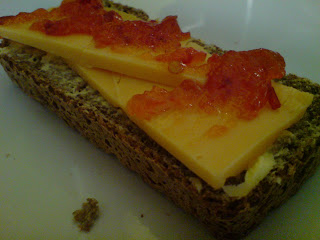
#78 Doris Grant’s Loaf – 8/10. On my first slice, I thought I’d messed it up as it is not a light fluffy loaf, but quite heavy and mealy like soda bread. After another slice, I was hooked, and managed to eat most it to myself! Griggers suggests slicing it thinly with smoked salmon, but I’m not really a fan, so I had butter, farmhouse Cheddar and chilli jam. Go out and make this!!

#75 Lockets Savoury

Now that it is late summer many English orchard fruits are at their best. This recipe uses pears, and it’s very important to use good ripe ones; if you do buy those rock hard types that can be used as blunt weapons, just let them ripen on a sunny windowsill. I don’t really eat that many pears, and certainly don’t cook with them often; I’m not sure why because I really like their sweet aromatic flavour. If you are like me and haven’t cooked with pears, then start with this one as it’s very simple yet effective – basically pears and Stilton cheese on toast. Why it is called Lockets Savoury I have no idea.

This recipe is for one person, so just multiply up depending on how many you need:

Start by toasting two slices of white bread and cutting off the crusts. Place the toast in a baking dish. Rinse some water cress and place it over the toast in a good layer. Peel, core and thinly sliced a pear (I used Comice) and place the slices on top of the watercress – no need to be neat! Finally thinly slice 2 ounces of Stilton cheese and place it evenly over the slices. Bake for 10 minutes at 175°C, and grate plenty of black pepper on top before serving.

#75 Lockets Savoury – 6.5/10. A delicious and quick dinner or tea. Warming the pars makes them even more aromatic and sweet than usual, which contrasts beautifully with the Stilton, plus the toast and watercress remain intact and don’t go soggy. However, I wonder how much better it is than just some pears, Stilton, salad and some good biscuits. There’s not much in it I reckon.

#71 Rolls Filled with Cheese and Tomato Paste

Next up for the picnic – Rolls Filled with Cheese and Tomato Paste. A perfect thing to take out on trips etc., reckons the Grigson; and she is correct! Looking at the recipe, I though it was a bit of a faff to prepare, when you could just have a cheese and tomato buttie. Jane suggests using bridge rolls – I have no idea what they are, but small baguettes seem to do the same job.

Greg sneaking in sarnie before dinner

For six: Slice 6 small baguettes in half longways and scoop out as much of the bread from inside as possible without creating any holes in the bread; breadcrumb the scooped-out bread in a food processor. Next, chop a small onion very finely, and soften gently in 2 ounces of butter. Chop up three skinned tomatoes and add to the mixture – you may want to add a tablespoon of tomato puree and some sugar at this point, unless you grow your own tomatoes, or live in Spain. Simmer the mixture for about 15 minutes, until all is quite thick. Whisk in the egg and keep stirring until the sauce thickens even more – don’t let it boil or the eggs will scramble. Take off the heat and stir in 2 ounces of grated Cheddar cheese, and the breadcrumbs – don’t add them all at once, you may not need them all. Season with salt and pepper and stir in a tablespoon of chopped parsley. Fill the rolls with the paste along with a layer of something green – lettuce, watercress, or whatever.

Geek-a-rama!

#71 Rolls Filled with Cheese and Tomato Paste – 6.5/10. They are certainly bizarre but very good, at first I wasn’t sure if I liked them, but as I scoffed away as I walked about, I decided that I did. Though I’m not sure if a ‘normal’ cheese and tomato sarnie is better. They went oddly well with lagers that Jono brought along.

#59 Electric Dough Hook Bread

Since as there’s about a million different bread recipes in this Goddam book, I thought I’d better have a crack at some bread-making; I’m also trying to write a paper at the minute and therefore needed a reason to procrastinate. I’ve made bread before but it’s always been a bit arduous and not worth it, since the end result resembles a washing-up sponge in both colour and texture. I thought I’d better start at the start and make a white loaf – (#59) Electric Dough Hook Bread is the piss-easy way to do it, apparently, and if you are wanting to supply your family with home-made bread every day, says, Jane, this is the way to do it:


Measure out 3/4 of a pint of warm water and put half in the bowl of your mixer along with 2 level tsp of dried yeast and 1 of sugar. To the remaining half, add 2 tsp of salt and 4 tbs of lard or oil – Jane says olive oil is the best thing, so that’s what I did. After about 20 minutes the yeast becomes all frothy as it activates and gets going. My kitchen was quite cool, so it would probably only take 10 in a warmer one, I reckon. The salty water was then added along with 1 1/2 pounds of white flour (though you could do a combination of wholemeal and white). Put the dough hook attachment onto your mixer and turn it on low and let the dough form around the hook. When it’s all come together, you can turn the speed up a little, but it only takes about 5 minutes in all – don’t overwork it says Jane, or else!! Next put some Clingfilm over the top of the bowl and wait for the dough to double in size. I have no airing cupboard, so to speed up the process I hugged the bowl and watched telly, allowing my body heat to increase the yeast metabolism.


When that’s done, knock-back the dough by punching it to let all the air out. Roll a pound of the dough into a thick sausage shape and put in a small loaf tin, and pout the rest in a large one. Cover with cling film again – brush it with oil to stop the dough sticking – and allow to prove, i.e. let the dough rise a second time, until it is over the sides of the tins. This takes ages if your kitchen is cool – but don’t worry it will eventually.

Bake at 230 degrees C for 30 minutes, then take the loaves out of their tins and turn them upside down, so the crusts can crisp up. Put the loaves back in the tine and brush the tops with milk to make them shiny. Cool them by laying then across the tins. Phew!


#59 Electric Dough Hook Bread – 8/10. It was a foolproof recipe and it tasted lovely – really (I know it sounds stupid) bready. The flavour of the yeast made it I think. It was quite dense, but I think that was my fault for not letting it prove for long enough. I had a piece still warm with butter on, which I think is the best way to have home-made bread. You certainly don’t need to bother with fillings when bread is this tasty. If only I have time to make for myself every day!

Stocking Up, #36

Popped to Chorlton yesterday in the hope of buying some exciting things from Unicorn etc. and wasn’t disappointed! Seville oranges are still in season – get making marmalade peeps – and broad bean have come in. Will make some nice desserts and soups. I’m looking forward to seeing how the new seasonal produce changes over the coming months. Also got hold of the ingredients for bread-making. I was hoping to do hot cross buns, but I think they may be a bit advanced so I’m starting at the start of the bread section in Ms. Grigson’s book. Also, I’m going to try my hand at ice cream making this week, now that my ice-cream maker is fixed. Hurrah! I also need to get my finger out re: meats. Need to get hold of a veal knuckle. Any ideas anyone? W H Frost in Didsbury sells veal, but has run out of said knuckle! Also I have prepared (#36) Vanilla sugar. It simply involved putting four vanilla pods and a bag of caster sugar in a storage jar. I just need to do a recipe with it in. I also hear that a teaspoon of vanilla sugar in warm milk is nice as a bedtime drink. I also need to add my own recipes that I’ve been doing; haven’t done that in a while…