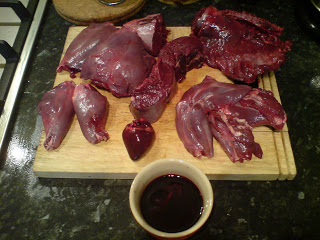
#122 Roast Pheasant

The Roast Pheasant was obviously the star of the meal – not just because it is a meat we don’t eat enough of, but also from my point of view because to tick it off I had to do lots of accompanying dishes, so some organisation was required. If you want to have a go, you can have as many of the elements as you wish, though try to do as many as possible as they do go so very well together as a dish. The trickiest part was getting hold of pheasant giblets – however, the nice game butcher at the Farmers’ Market got me them when I asked. Make a point of ordering them as they are routinely thrown away. So, the roast pheasant is made up of five individual parts:

1. The pheasants themselves
2. The game chips
3. The giblet gravy
4. The browned crumbs
5. The bread sauce (dealt with separately as #123).
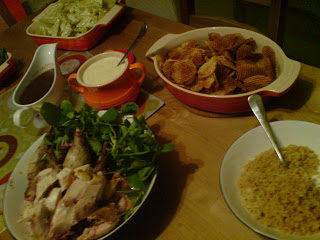

Most of this can be made in advance and reheated, that which is not, is easy and quick to prepare and will not keep you from your guests for very long.

To prepare the brace of pheasants, begin by removing the giblets and setting them aside for later on. Stuff each bird with 2 ounces of butter, plus the liver (make sure you remove the green bitter gall bladder) and a good seasoning with salt and pepper, then lay a thin sheet of back pork fat over them that is large enough to cover the beasts and legs. Secure the back fat by tying string around the pheasants. Place them in a roasting tin and set aside for when you want to roast them – they should be roasted at 190°C for 20 minutes per pound plus an extra 10 minutes. You calculate this for the heaviest bird; in my case 2 pounds, so 50 minutes in all. For the final 10 minutes of cooking, remove the back fat and dust the breasts lightly with seasoned flour. Remove from the oven and allow to rest. I did this just before the guests arrived so that the birds could rest as the leek tarts were cooking. To serve it, I removed the legs, then sliced the breast meat and placed on a bed of watercress.
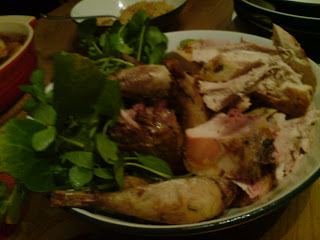
When the birds were prepared, I started on the gravy: first place the giblets (minus livers) in a saucepan along with a sliced carrot, a sliced onion and a bouquet garni and enough light beef stock to cover everything generously. This was simmered gently for two hours before being finished off later (see below). Next job was to get the game chips sorted. Game chips are basically crisps cut very thinly on a Chinese mandolin using the ridged blade to produce a lattice, or gaufrette, pattern. Peel 1 ½ pounds of firm potatoes. Put the mandolin at its thinnest setting and slice downwards, turning the potato a quarter-turn as you bring it back up to make the next slice to get the lattice effect. Put the chips into a large bowl of water to remove starch and then dry thoroughly. Deep fry in batches at 200°C until golden brown, and drain on kitchen paper and salt them well. This can be re-heated in the oven whenever you need to use them.

Once the starters had been eaten, I put the game chips in the oven and got to work on the buttered crumbs and rest of the giblet gravy. For the crumbs, 3 ounces of stale white breadcrumbs were fried gently for 5 or 10 minutes in 1 ½ ounces of butter until golden. They were placed in a serving dish and kept warm with the game chips. For the gravy, the stock with all the lovely the giblet flavours poured into the roasting tin. The stock was boiled hard and all the nice sticky bits that were found on the bottom of the pan were scraped off. When reduced, a glass of port was added, there was a quick seasoning, and the gravy was strained into a sauce boat.

So that there was a bit of green, also served some peas and green peas, but also Bread Sauce (as instructed) and (#124) Creamed Celery – Grigson says that either celery or mushrooms should be eaten with roast pheasant.

#122 Roast Pheasant – 9.5/10. What a brilliant meal! It was well worth the effort, I cannot fault it in any way really, and will definitely make it again, though maybe not with all the required elements. The pheasant was juicy and just-cooked, the gravy was beautifully rich and luscious, the breadcrumbs provided a nice crunchy texture and the game chips were tasty, some crunchy and some soggy in the gravy and bread sauce. For me, pheasant is the king of the game birds, and after this, it is going to be very difficult to knock it off the top spot.

FYI: to be a bit thrifty, I made soup from the carcasses and left over veg and trimmed celery etc and it was lovely – I’ll put a recipe up for it. I am never chucking out a carcass again!

An Eighteenth Century Feast

I’ve got a bit of catching up to do – this weekend was a Grigson frenzy; 5 in one day!! I had been toying with doing a reasonably elaborate meal – and in particular the roast pheasant that appears in the book. It was meant to be the 100th recipe but I couldn’t get hold of pheasant giblets, but look and ye shall find.

So basing a meal around this I came up with a loose theme – the Eighteenth Century. It was quite a time-consuming set of recipes, but none are particularly complex. Plus I had lots of help from my sous chefs Iain (Butters) and Charlotte (Charmolian). Also, in the times of the credit crunch, the whole meal was actually pretty good value, so it won’t burn a hole in your pocket. Anyways, here it is:

~Starter~


Little Leek Tarts served with a rocket salad (the latter, my own addition, obviously)

~Main Course~

Brace of Roasted Pheasants


Served with: Game chips, green vegetables, buttered crumbs and a rich giblet gravy

Accompanied by: Creamed celery and bread sauce

~Dessert~


Whim-Wham


Not a mean feat, but we started well ahead of time so that we never seemed rushed, plus much of this could be made in advance. Paddy, Kate and Pete came over, so there were no heirs and graces and if anything did go wrong it wouldn’t matter (nothing did!). So if you fancy making any elements of this meal, I shall naturally be adding the recipes alongside any wee factoids I may find over the next couple of days.

#108 Partridge with Chestnuts and Cabbage

When I made the chestnut soup the other day, I made sure that there was enough spare to make this dish. I had bought a brace of partridge from the Farmers’ Market a couple of months ago waiting for some chestnuts to turn up. I had never eaten partridge before, but I know it is a highly-prized game bird. This is a very easy dish to cook – a very good introduction to game, if you haven’t cooked it before.


Here’s what to do with a brace of the little birdies:

Brown the partridge and 6 ounces of chopped streaky bacon in 1 ½ ounces of butter. When done, transfer the to a casserole dish and brown18 pickling onions, or 9 shallots, and add them to the dish too. Next, take a glass of dry white wine and deglaze the pan with it, making sure all the nice stuck-down bits come away from the pan’s base and pour over the birds. Add a little beef stock so that the liquids comes around half-way up the partridges. Cover and cook in a moderate oven – around 150ºC. Grigson now says to take out the birds when ‘almost done’. I had no idea when this would be and thought it would be slightly less than the pigeon I once did, but I was wrong. Take them out after around 45 minutes (I cooked them for 2 ½ hours!) and remove the birds. Add some Savoy cabbage that has been blanched for 10 minutes and lay it out in the dish. Return the birds. Now add 6 ounces of chestnuts that have been pricked, boiled for 15 minutes and then peeled. Cook for a further 45 minutes, or less if the meat comes easily away from the bones. I realised that they were already done at this point and didn’t leave the chestnuts in long enough. According to Larousse Gastromonique partridge shouldn’t take any more than 1 ½ hours to cook.

Finally, arrange the chestnuts, cabbage and onions or shallots on a dish with the birds on top and allow them to rest. Meanwhile, reduce the liquor from the dish by boiling it down hard to concentrate the flavours. This final step is very important. Serve with boiled potatoes.


#108 Partridge with Chestnuts and Cabbage – 7.5/10. A very delicious meal – everything went so very well together and the partridge was pale with a nice gamy flavour that was not overpowering at all. The dish should be a 9 really I think, as the birds were overdone and a little dry and the chestnuts not cooked enough, but hey-ho that’s my fault, not Grigson’s.

#95 Stewed Hare with Forcemeat Balls

I was going to leave the hare that I bought at the Farmers’ Market the other weekend for the 100th recipe, but I thought since a few people were coming over I’d cook it. There are a few recipes in the book, but I went for Stewed Hare with Forcemeat Balls. It’s relatively straightforward. Don’t be scared if you’ve never eaten hare, if you are too squeamish however you can use 6 pigeons or 3 pounds of stewing venison instead. Don’t be scared either of cooking game – all you need is a bit of patience; long, slow cooking is required, but it’s easy enough, get the thing simmering away and you can do whatever you want whilst waiting for it to cook.

FYI: please don’t all go out and order a hare from your butchers – they have had a decline in recent decades. I only bought mine because it just happened to be at the game stall. Check out the Hare Preservation Trust website for more details.


The trickiest part of this dish is the preparation of the hare itself; unless you have a good butcher who’ll joint it for you, you’ll have to do it yourself. I’m not going to go through how to do it here, but here’s a link to the River Cottage guide to jointing a rabbit, which is the same principle. I have to say: make sure you invest in sturdy knives, including a meat cleaver, otherwise it’ll be very tricky to do. Also keep any blood and the liver for thickening the stew with later. (Also, don’t tell anyone about that bit, as it may be one step too far for some folk.)

Before jointing

After jointing

Once jointed, turn the pieces of hare in plenty of seasoned flour and brown them well along with one chopped onion and 8 ounces of chopped streaky bacon in 3 ounces of lard (yes, you COULD use oil, but what’s the point in that!?) in a large stockpot or casserole. Add a teaspoon of chopped thyme, a tablespoon of chopped parsley and half a bay leaf to the pot along with enough stock to just cover everything; use either game stock or beef stock, I used half-and-half of each. Charlotte and I added the heart too; seemed silly to waster it since we were using the liver and blood too. Let the whole thing simmer gently until the meat comes away from the bone easily – around 2 or 3 hours. Now add 6 tablespoons of port and a large tablespoon or two of redcurrant jelly along with some salt and pepper and the dish is done! Use a tablespoon of flour slaked with some hot stew liquor to thicken the stew, or use the blood and mashed liver. Don’t let it boil if using blood, as it will curdle not unlike egg yolks in over-cooked custard. Charlotte and I spent a while removing bones from the meat though, so people didn’t have to worry about bones.

Now that’s done, make the forcemeat balls (named forcemeat as you are making a small amount of meat go very far – peasant food, innit?). In a bowl mix together 4 ounces of fresh breadcrumbs, 2 ounces of chopped suet, a tablespoon of chopped parsley, a teaspoon of thyme, the grated rind of half a lemon, 2 ounces of finely chopped bacon, a large egg and some salt and pepper. Form the mixture into balls of around an inch in diameter and fry them until golden in more (yes, more!) lard.

I served it all up with boiled potatoes and peas.

#95 Stewed Hare with Forcemeat Balls – 7/10. The more game I eat, the more I feel I’ve been missing out! I’m always slightly tentative about game, but this is another corker! The stew was rich and thick; hare is very gamy, but the port and redcurrant jelly helped cut through it. Given the chance, I’ll be cooking the remaining hare recipes. The surprise star though was the forcemeat balls – Grigson suggests making them for soups, so if you don’t fancy the hare, make the meatballs! The heart tasted surprisingly nice too…

Can’t Cook…Won’t Cook…

There are several ingredients in English Food that I have assumed that I won’t be able to cook, at least not in England. But watching television last night, it seems I can.

The Supersizers Go… Is a series showing off the eating habits of the English through the ages and last night they went Victorian. The presenters are a bit self-indulgent but it’s good mindless TV. Giles Coren and Sue Perkins tucked into giant game pies, calf’s ears, jellies, plum duffs, bad curries, croquettes, offal, offal and offal. It seems that English really food comes into its own here – many of Jane Grigson’s recipes are very similar to the dishes cooked then; in fact it was her daughter, Sophie that did the cooking. The main ingredients were butter and brandy, it seems, but it was all very restrained and frugal. Unless your very rich, or it was Christmas.

FYI: The Christmas as we know it now was invented in the Victorian era, courtesy of Queen Victoria, Prince Albert and Charles Dickens

One of things that really surprised me was the amount of game that our presenters were allowed to eat. One of the dishes contained snipe – I assumed that there are too rare to shoot these days, but obviously not. Searching on the web, I find that all the game birds that Jane Grigson lists in the game section of the tome are still legal game, including ptarmigan and wigeon. The other big surprise was that one meal’s centrepiece was a boiled calf’s head with the brain served in a garlic butter sauce. I thought that due to the BSE crisis, bovine brains couldn’t be eaten any more. It seems that I am wrong. It also seems that they taste vile. It also seems that I will be able to do the calf brain recipes. Damn.

On Channel 4 later that evening was Gordon Ramsay’s effort, The F-Word. I’m never sure whether I like the programme, yet I seem to watch it every week. This week he was fishing for elvers – baby eels – in Somerset. There is one recipe that uses elves in English Food, and I thought, as I have studied eels and elvers in the past that because elves numbers had dropped by 98 percent it would no longer be legal to fish for them, that they would be protected or something. Well, you have to have a special licence, but you can fish for them. If you want to buy them, they’ll set you back up to £525 a kilo. It took him 4 hours to collect enough for three measly portions. I know that the reason for the drop in numbers is not known, but surely fishing the remaining few is not going to help. I know I won’t be a part of it.

So it seems that there isn’t anything I can’t cook, but some things I won’t.

#44 English Game Pie, #45 Cumberland Sauce


I invited Clive from work to help me finish off the last of the game I got from Bury Market last night in the form of (#44) English Game Pie. Looking through the ‘Stuffing, Sauces and Preserves’ chapter of English Food for something to go with game, I found (#44) Cumberland sauce. I’ve never had it before, and had no idea what it was. Everything was straight-forward, though the pie had lots of preparation. Anyways, here’s what I did…

The day before I simmered a brace of pheasants and a pigeon (essentially everything I had!) in a very light chicken stock along with a good seasoning and a bouquet garnei of parsley, bay leaves and thyme springs. Jane recommends between 2 and 4 birds. It took an hour and a half for the meat to become tender enough for me to pull the meat from the bone with relative ease. I cut the meat into chunks and kept them in a sealed tub topped up with the stock so it didn’t dry out over night and reserved the remaining stock.

Next day I arranged the meat in one large dish, and a smaller, as I made an extra one for my PhD supervisor too. Then hard-boiled and quartered three eggs and tucked them between the pieces of meat along with small rolls of grilled bacon (though not in yours Jason, don’t worry!), and chopped parsley. Next, I fried a large onion and about 8 ounces of mushrooms in 2 ounces of butter until they were golden. A tablespoon of flour was mixed in to the mushrooms and onions and stirred around so that the butter got absorbed, and then stock was added a ladelful at a time until a thick sauce had developed – about the thickness of double cream. Make sure the sauce is seasoned very well. It was simmered for about 5 minutes, and I added extra stock whenever the sauce thickened too much. The sauce was poured over the meat and then a puff pastry covered the pies. The large pie was cooked at 200 degrees for 20 minutes and then the oven was turned down to 170 for a final ten.

The Cumberland sauce was very easy. Make sure you make it in advance as it should be served cold. Whisk together a jar of redcurrant jelly and a teaspoon of Dijon mustard in a pan over a low heat. Meanwhile blanch the thinly pared peel of a lemon and an orange that have been cut into matchsticks for 5 minutes, then drain. Once the jelly has melted, add the peel, the juice of the two fruits, 5 tablespoons of port, plenty of black pepper and salt and ground ginger to taste (I used a scant teaspoon). Pour into sauce boat. Easy peasy.

FYI: Cumberland sauce is, in fact, German – the recipe was brought over with the House of Hanover in the late Eighteenth Century, and is named after George IV who was the Duke of Cumberland.

#43 English Game Pie – 10/10. This is my first full point dish I think! It was absoluely delicious. Although I’d never had it, there was something very familiar and comforting about it. It was also, for me, the epitome of English Food. The meat was beautifully tender, and he sauce had turned into a delicious gravy and the salty bacon added an extra dimension. The full flavour of the pheasant and pigeon coped very well with the rich Cumberland sauce…

#44 Cumberland Sauce – 8/10. A perfect complement to the game. Although it was very rich and sweet, the savory additions such as the pepper and mustard allowed you to add loads. All in all a fantastic meal!

#33 Stewed Pigeons in Foil

The first of the game dishes made with the produce from my trip to Bury Market. I’ve not had woodpigeon before, and wasn’t too sure if it would be too gamey. I have tried to cook it before but it was so tough it was inedible. My mate John came over for tea and I thought I’d try and do (#33) Stewed Pigeons in Foil. It seemed easy; all was required was time. One pigeon is required per person. Brown the pigeon in butter, breast only, using a hot pan. Allow them to cool. Meanwhile cut pieces of foil large enough to encase the pigeons individually, and spread softened butter over the centre of each piece. Place the birds in the centre and make a parcel with one end still open so you can add the flavourings. Into the cavity add a large knob of butter, thyme, pepper, a slug of brandy, finely chopped onions, a tablespoon of lemon juice, and one of beef stock. Make sure all is sealed well, place on a baking tray and cook for three hours in a low oven. The breasts were removed and seasoned well. It was served with mashed potato and celeriac and the juices from the pigeons (Grigson’s orders). I added some purple sprouting broccoli for something green.

This is definitely the most cheffy looking dish I’ve made so far. It certainly looked the part. The wood pigeon was very tender and moist – it came away from the bone easily. The flavour is very much like liver, in that it’s quite metallic, and it’s got a slightly grainy texture. The mash was divine – used the ricer that I bought for the first time, and will never go back to mashing! – the celeriac and parsley gave in a herby, perfumed taste. Absolutely brilliant! What’s more, eating game is totally sustainable food – even if we all went vegetarian tomorrow, we’d still have to shoot them as part of woodland management (same goes for deer, pheasant, etc…)

FYI: according to the BBC, the wood pigeon is the most common bird in the UK http://news.bbc.co.uk/1/hi/uk/4646685.stm

#33 Stewed Pigeons in Foil. 9.5/10 – I cannot believe how nice this dish was. Can’t wait to do more game recipes!

Bury Market

Greg and I went to Bury Market for the day on Saturday. I’m apologising in advance for the lack of photos. We both forgot to take them because we were so cold. I managed to get hold of some ingredients for some more recipes,along with some nice produce too. The cheese stall there is one of the best you’ll ever go to; Greg and I scoffed a load of it last night night – Yorkshire Blue, a nice young goat’s cheese, and a lovely mature farmhouse cheddar. It shits on anything you can get in a supermarket, no matter how many ‘Extra special’ stickers, or whatever they put on them. I also got some game – pigeon and pheasant – so hopefully there’ll be some nice things coming my way! I love pheasant, but have never had pigeon – I once tried to cook one by roasting it, and it was so tough I couldn’t eat it. The Grigson says to never roast a pigeon. I have seen the error of my ways.

I also got myself a black pudding – a must if you go to Bury, as it is the place where the best are made. I also got white pudding, which I’ve never had before. I’m saving them for when I have NO visitors!