#205 Potted Tongue

There are several recipes in English Food that involve tongue; a bit of the animal now much ignored by most, including me. It’s one of the few things I’ve never tried, so I thought I should make sure my first foray into tongue cookery a simple one. Potting is nice and easy as long as you have a food processor or blender, plus I always need sandwich fillings for work. It uses eight ounces of cooked tongue – this can be calf’s or ox tongue, pickled or fresh. The calf’s tongue that I got from Winter Tarn was exactly eight ounces in weight after it had been cooked and trimmed. However, if tongue is not your bag then you can use beef, salt beef, venison or any other game.

Chop the calf’s tongue and place in a blender or food processor – use a blender for a smooth finish, a food processor for a slightly coarse one – along with four or five ounces of clarified butter, some salt, pepper and mace (if you are potting a different meat, you could use a different spice or even a couple anchovy fillets). Blend until the right consistency and place in pots, making sure you pack them down well and leave flat surface. Pour more clarified butter over to form a seal.


#205 Potted Tongue. In Yorkshire, potted beef is still quite popular, but for me, the tongue did not work quite as well as I’d hoped. The tongue tasted okay when it had been cooked, but perhaps stronger tasting cured ox tongue would have been more appropriate. Oh well, never mind – you can’t win ‘em all. 4/10.

Preparing and Cooking a Calf’s Tongue

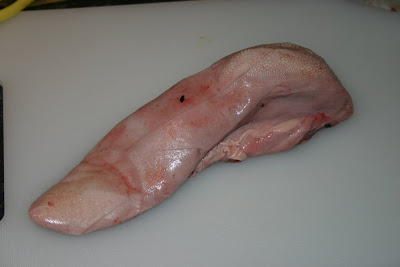
Jane Grigson describes how to cook and prepare ox tongue in some detail in English Food as well as providing several recipes. Most use pickled ox tongue, but for some it is not specified and I had a calf tongue to use. Many recipes require a cooked, boiled tongue (including the next recipe), but there is no guidance on the preparation of calf tongue. I did a bit of reading and came up with my own method which I am now imparting upon you good people, natch.

The tongue before cooking

Start by soaking the tongue for six hours, changing the water a couple of times. Place it in a closely-filling pan with some cold water to just cover along with an onion studded with two cloves, a chopped carrot, a stick of celery, a bay leaf, a sprig of time, a bay leaf, some crushed peppercorns and a teaspoon of salt. Bring slowly to boil, skimming away any grey foam that may rise. Turn the heat as low as possible, cover, and simmer gently for an hour (I erred on the side caution and cooked it for best part of an hour and a half, but it was definitely over-cooked). Remove the tongue and as soon as it is cool enough to handle, peel the skin away and cut away any gristly bits and blood vessels. The tongue can then be used as required in your recipe.

#204 Minced Veal and Eggs

Here is another recipe from Alexis Soyer – the first celebrity chef and all-round (though slightly pompous) good guy. I have mentioned him before in previous posts. I thought I would try this recipe as a test for the veal I bought from Winter Tarn. This seemed like a good mid-week meal as it is quick to cook that seemed nice and satisfying; just what one needs of a Wednesday in rainy Manchester.

Begin by chopping a small onion and a clove of garlic and softening them in a generous ounce of butter. Once soft, turn up the heat to brown them slightly and then add 8 ounces of minced veal. Fry until it has browned slightly. Now add some seasonings, herbs and spices: a rounded teaspoon of salt, half a teaspoon of black pepper, a pinch each of cinnamon and nutmeg and a teaspoon of thyme leaves. Next stir through a heaped teaspoon of flour and when that has browned slightly pour in a quarter of a pint of milk (full fat if you can!). Simmer very gently for fifteen to twenty minutes until the mince has become soft and unctuous in its now creamy sauce. Whilst that is happening poach an egg and fry a slice of bread per person. Taste the veal and add more seasonings and ‘sharpen it’ with some lemon juice or white wine vinegar.


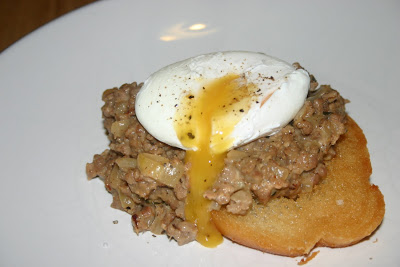
Place a slice of fried bread on each plate, then a helping of the veal and finally a poached egg on top.

#204 Minced Veal and Eggs. What seems like a bizarre recipe turned out to be absolutely delicious, the delicate milky veal melds perfectly with the milk in the sauce and the fried bread and poached eggs added to the comfort food kick that I really required. Great stuff. Give it a go; quick and easy. 8/10.

Veal or no Veal?

Eating veal has something of a stigma these days; it is considered cruel by many. In English Food it appears quite often, either in veal recipes or as part of other recipes that you perhaps would not expect, for example, giblet gravy and chicken pie. Jane writes rather a long introduction to her Meat chapter discussing the problems of mass meat production and the decline of meat quality as well as those suppliers that try to produce good quality products. Nowhere in the introduction does she mention veal – beef, yes, at length, but not veal. I can only assume that in her opinion veal was always a good meat product (she has a poor opinion on the state of almost every other meat, and quite rightly). Indeed, it probably was, but certainly not from the poor veal calves’ point of view.

Rearing veal calves was notoriously cruel, and lumped together with fois gras production. The problem being that calves were kept in tiny darkened rooms to keep their meat white and tender. This practise is still common in many counties but is not allowed in the UK. Veal produced in British farms have a much higher standard in animal welfare; calves can eat grass after weaning and walk in the fields to produce rose veal – so-called due to the pale pink colour of the meat. This is obviously a good thing; I cannot see how anyone (vegetarians aside) can have issues with this. It is the same as eating lamb after all. For more information about the prevention of cruelty to animals in farms see the Farm Sanctuary website.
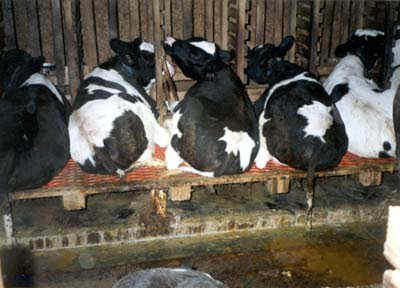

Veal production like this is still allowed in many countries

The point I would like to make is that NOT eating veal is cruel, or at least disrespectful. The dairy industry wants female cows for milk. Cows do not simply just produce milk all the time – which many people seem to think – like any mammal, they produce milk when they have given birth (or about to give birth) to calves. Female calves are a good thing for future milk production, but the poor old males are surplus to requirement and are generally killed. What a complete waste! A waste of food and a waste of life! People seem to coming round to the idea – even Marks and Spencer have a line in rose veal!
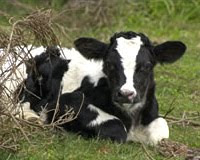
All British rose veal is produced with welfare in mind

I intend to tackle some of the veal recipes in the book – I have been biding my time because I want a good supplier. I believe I have found one too: Winter Tarn in Cumbria is an organic farm that produces cheese but have recently started selling veal though they don’t really mention it on their website. They attend many regional farmers’ markets. The quality of the meat is very good, and most importantly, I think, they don’t charge the Earth like many other organic veal suppliers seem to think they can do. Check out their website here.

My consignment arrived the other day, stewing veal, minced veal, tongue, kidney, liver and bones for stock. Not all of the items are for recipes from English Food, the offal is essentially just to cook anyway – veal offal is highly prized, but I have never tried it, so I seized the opportunity.
I shall keep you informed of my progress, natch.

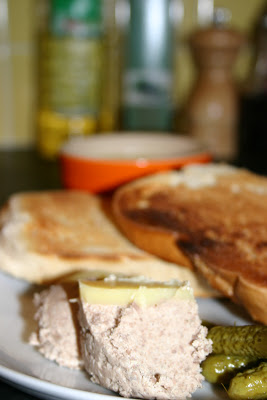
#199 Apple Sauce III

Eagle-eyed followers of the blog will notice that there has been no Apple Sauce I or II. In English Food there four recipes for apple sauce, so I thought it best to get the ball rolling. I’ve made this one first because it is not a sauce for pork, but for chicken. I had a very nice-looking free range chicken that I bought from the poulterer Peter D Willacy at Houghton Farmers Market, you see. He has no website, but you can call him in 01253 883470. The best thing about their chickens is that they come with giblets; not something you see these days, not even in good butchers. I’m hoping to buy a capon from them soon. This sauce can also be served with veal.

Anyways, if you are roasting a chicken this weekend, try this very easy creamy and usual hot apple sauce:

Core, dice and peel a pound of Cox’s pippin apples (or a good equivalent) and fry them in some clarified butter. (If you don’t clarify your butter first, it may burn. Melt it slowly in a pan, blot away any solids on the surface with some kitchen paper, then decant the liquid butter away, leaving behind any other solids that sank to the bottom.) When they have softened and turned a little golden, remove the apple pieces with a slotted spoon, leaving behind the buttery juices. Add six tablespoons of white wine (or cider) to the juices to deglaze and reduce it all well. Lastly, stir through six tablespoons of double cream and sharpen with a squeeze of lemon juice. Serve hot.


#199 Apple Sauce III. A strange one this one because the sauce is essentially stewed apples and cream, which in my book is a pudding. That said, it did go surprisingly well with the chicken as there are no strong flavours to drown out the subtle chicken. 5.5/10.

#194 Almond Soup (White Soup)

Yes, another soup…

This recipe is the very first one that appears in English Food. Although it may seem rather odd nowadays, it is one of the most historical recipes there is. Almond soup, or almond milk as it was originally called goes right back to the Middle Ages. It was made with almonds, onions, wine and spices. More recently, it diverged into two completely separate dishes: almond soup and blancmange.

Griggers reckons that one of the reasons (apart from it tasting good) that it’s remained popular is because the ingredients are easy to come by; most being found about the house. Well, it is popular no longer – I’d heard of it, but only vaguely. Not all the ingredients are easy to come by these days either – the main reason I’ve only got round to making this now is that I managed to finally get hold of the veal knuckle required for the stock.

I always really enjoy making these sorts of recipes in the book – I don’t even mind if they’re not that nice – it’s just interesting cooking and tasting these old, old recipes. I’ve said it before, but it is great that such books like English Food exist, it’s also great to see that many of these unfashionably historical recipes are tasty and interesting. Does this one fit into that category though..?


To make the soup, you need to start the day before and get on with the task of stock-making. Start off by placing a small gammon hock (I made one myself in the brine tub!) and a good meaty veal knuckle that has been cut into three pieces in a large pan or stockpot. Add four pints of cold water and slowly bring to the boil; the slower you do this, the clearer the stock will be. When it does come to the boil, skim away any scum and add a quartered onion, a quartered carrot, four chopped celery sticks, a teaspoon of lightly-crushed peppercorns, two blades of mace, a bay leaf and a tablespoon – no, I didn’t misread the book, tablespoon – of salt. Bring back to the boil and then turn the heat right down so that the stock simmers gently away for four hours. Strain and chill overnight and skim the fat off the top. Bring back to the boil and reduce the stock until there is around 2 ½ pints remaining. Alternatively, if you simply cannot be arsed with all of that, use a light beef stock!

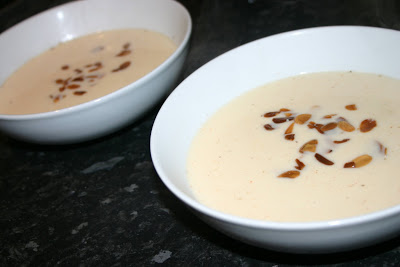
For the soup, place 2 ounces of blanched almonds and an ounce of white bread (crusts removed) into a blender along with a couple of ladlefuls of stock and liquidise the lot. Push the gloop through a sieve into the reduced stock. Turn the heat off under the pan. Next, beat an egg yolk into ¼ each of double cream and soured cream and whisk it into the soup, reheat, making sure the stock is not boiling, to prevent the egg from cooking and curdling. Now season with white pepper, salt (!), Cayenne pepper and lemon juice. Serve with fried croutons or fried almonds.

#194 Almond Soup (White Soup). Certainly not one for those on a low salt or low fat diet. It was very salty and rich. I assume that the tablespoon of salt listed in the ingredients is a typo since a ham hock is also used for the stock. I’m not convinced that I actually liked this soup, it was certainly nicer the next day when the flavours had time to develop. It’s certainly a posh soup, but I think it could’ve been improved by using a less salty stock. Perhaps after all this time-biding, it would have been better if I’d simply used a light beef stock as suggested in the recipe. 4.5/10.

#187 Soyer’s Clear Vegetable Soup

I am still trying to count the pennies at the minute and this recipe was designed to be cheap to make as it is from Alexis Soyer’s book Shilling Cookery for the People (1845). I’ve mentioned Soyer before in the blog – he was a French chef who wanted to help the people and the book was one way. He was also a pioneer – he helped develop cooking on gas and ovens with adjustable temperatures. Anyway, I did baulk at this recipe: shilling cookery with veal in it!? However, I was wrong; I managed to get hold of a veal knuckle to make the soup for just 25 pence from the Orton Farmers’ Market. Bargain. You may have some reservations about eating veal, but these days you really don’t need to – I’ll discuss that in a later entry though.

I love how the book has two vegetable soup recipes and neither even entertain being vegetarian! Brilliant. We love Griggers!

To make this soup you need to begin by making a veal stock: You need to get hold of 2 pounds of veal knuckle – it seems that they are quite easy to get hold of as long as your butcher sells veal in the first place. Ask the butcher to chop it into small pieces – I couldn’t as I was at the market and had to do it myself which was a nightmare to do. Place the knuckle pieces in a large pan along with 2 ounces of butter; 2 ounces of chopped, lean unsmoked bacon; 3 teaspoons of salt; ½ teaspoon of ground black pepper; 6 ounces of sliced onion; and ¼ pint of water. Bring the water to a boil and stir the ingredients for around 10 minutes. An opaque whitish stock is created. Now add a further 4 ½ pints of water and bring to a boil, then skim, then simmer for 45 minutes. Strain the stock when cooked. You can do all this in advance, of course.

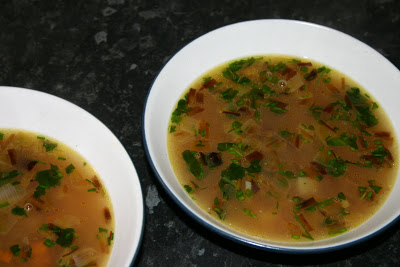
For the soup itself you need to dice some vegetables: around 8 ounces of turnip, Jerusalem artichokes or carrot, or a mixture; plus 3 ounces of mixed onion, leek and celery. Melt 2 ounces of butter or dripping in a pan and add the diced vegetables along with 2 teaspoons of sugar. Stir them until they caramelise and, when ready, add 3 pints of the stock. Simmer until the vegetables are tender. Lastly, stir through 2 tablespoons of chopped parsley or chives, or both. Serve with brown bread and butter.


#187 Soyer’s Clear Vegetable Soup. This was an unusual soup; I can’t decide if I liked it or not. I was a very thin soup that wasn’t hearty at all, so it didn’t fill any gap in my stomach! It was saved by the sweet vegetables and their caramelised coating that darkened the soup and made look quite attractive. Not sure if I’d make it again though – 5/10.

Stocking Up, #36

Popped to Chorlton yesterday in the hope of buying some exciting things from Unicorn etc. and wasn’t disappointed! Seville oranges are still in season – get making marmalade peeps – and broad bean have come in. Will make some nice desserts and soups. I’m looking forward to seeing how the new seasonal produce changes over the coming months. Also got hold of the ingredients for bread-making. I was hoping to do hot cross buns, but I think they may be a bit advanced so I’m starting at the start of the bread section in Ms. Grigson’s book. Also, I’m going to try my hand at ice cream making this week, now that my ice-cream maker is fixed. Hurrah! I also need to get my finger out re: meats. Need to get hold of a veal knuckle. Any ideas anyone? W H Frost in Didsbury sells veal, but has run out of said knuckle! Also I have prepared (#36) Vanilla sugar. It simply involved putting four vanilla pods and a bag of caster sugar in a storage jar. I just need to do a recipe with it in. I also hear that a teaspoon of vanilla sugar in warm milk is nice as a bedtime drink. I also need to add my own recipes that I’ve been doing; haven’t done that in a while…