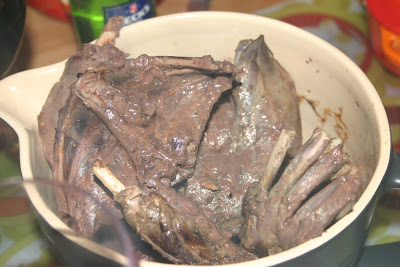
#235 Lisanne’s Chicken with Mussels

We don’t know who Lisanne was/is, other than she was a mate of Griggers and that she made this recipe up on a whim whilst in France. The reason that it appears in English Food is that it is rather reminiscent of the old English recipes of cooking oysters with chicken. I have already done the steak, kidney and oyster pudding with great success, but the thought of a eating a chicken stuffed with mussels a little odd – and don’t forget the last mussel recipe I did was very odd. However, as we have discovered along the way, this damn book is full of surprises, so we shall see…

You need to get hold of a chicken that weighs around four or five pounds as well as a nice bag of fresh, live mussels that weighs around three or four pounds.

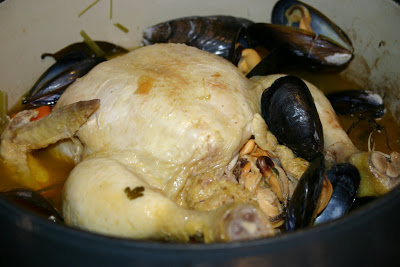
Begin by browning the chicken all over in some olive oil along with a large chopped onion and a chopped carrot in a flame-proof casserole. Add a bouquet garni (see here for some suggestions as to what you should put in it) and a quarter of a pint of dry white wine. Bring to a steady simmer and cook for 45 minutes. Meanwhile, open around two-thirds of the mussels in a very hot pan using another quarter pint of wine. Any mussels that remain closed should be discarded, Griggers says.* Pluck the mussels from their shells and carefully stuff them into the cavity of the now half-cooked chicken. Strain the cooking liquor from the mussels into the dish and tuck the remainder of the mussels all around the chicken. Season and cook for a further 30-45 minutes.


When the chicken is ready, remove it to a serving dish, scatter the mussels around it, and scatter chopped parsley all over it. Skim and strain the sauce into a sauceboat and eat with good bread – no vegetables required says Giggers, just a green salad to follow.

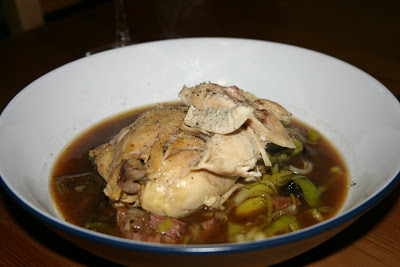
#235 Lisanne’s Chicken with Mussels. I must say I was very dubious about this one and continued to be dubious a few mouthfuls later. However, I put that down to the novel flavour combination because I soon realised it was very good! The chicken was beautifully succulent and the mussels tender, though cooking them this was gives the eater a real strong mussel-hit, but if you like your seafood, then certainly give this a go. The sauce made by the cooking liquor was divine. 7.5/10

*FYI: According to the telly programme QI, this is absolute nonsense and it is Jane Grigson who is to blame for this myth. The first mention of chucking out your un-opened mussels appears in Jane Grigson’s Fish Book and people have followed this advice evermore. However, there is actually no evidence that unopened mussels will poison you – in fact, you just as likely to be poisoned by a live mussel than a dead one. That said, I still chucked out my unopened ones!

#233 Devonshire Squab Pie

Here’s a slightly odd recipe, as a many from Devonshire appear to be. This squab pie contains no squabs (i.e. baby pigeons), but lamb instead. It is a mystery how it got its name – Griggers suggests that the meat has changed over the years, but the name has stuck. That’ll do for me. This is a simple enough pie to make, though the ingredients are odd: lamb, apples, prunes, spices all topped off with a dollop of clotted cream. Hmmm.

This is easy to make; a simple case of layering up ingredients in a deep pie dish. Start off by removing the meat from a whole best end of neck of lamb. If this seems too much of a chore, just buy about 1 ½ pounds of neck fillet from the butcher instead. Now peel, core and slice two pounds of dessert apples – Cox’s pippins are Jane’s suggestion, but russets and braeburns to well in these sorts of things too – slice two medium onions thinly and chop around 16 prunes. Next, mix a level teaspoon of ground allspice and cinnamon along with half a grated nutmeg in a ramekin or small cup. Layer up the meat, onions, apples and prunes, seasoning the layers with the spices and salt and black pepper as you go. Now pour over a quarter of a pint of lamb stock (use the bones from the best end of neck to make it, otherwise a stock cube!). Cover with a nice thick layer of shortcrust pastry, brush with egg and bake for 30 minutes at 200⁰C, and then turn down the oven to 160⁰C and bake for a further 45 minutes. Serve with clotted cream.


#233 Devonshire Squab Pie. This pie did not turn out to be as weird as expected. You could identify each ingredient in it, and they all stood out whilst complimenting each other very well. However, I think the pie would have been much improved had the lamb been coated in flour and browned a little first so that the flavour was more intense and a thick gravy produced. Several of these pies seem to have very runny sauces. Obviously tastes have changed. The big surprise was that the clotted cream went very well. Although it did make me feel like I was eating my main and pudding all at the same time. A good recipe that could be very easily improved. 6/10.

#228 Spiced Salt Beef

This is a posh recipe; this cured beef is produced by Harrods by the wheelbarrow-load every Christmas. It’s an old recipe that was revived by Elizabeth David and Griggers helpfully imparts it to us. Good girl. This uses a dry cure mix rather than brine like I’ve done before (see this post). It’s a lot easier than a wet cure as there’s no messing about making the brine itself, so if you’re thinking about curing your own meat, this is good place to start. It’s a good idea to use good quality sea salt, not crappy table salt. Good salt is not only a preservative, but also lends good flavour. Very important for this sort of thing.

You need to start by buying your beef – a piece of silverside between 2 and 6 pounds should be okay. Place the beef in a clean tub (that comes with a clean lid!) and rub 3 ounces of dark brown sugar into it. Fit the lid on tightly and leave in a cool place for 2 days. Next, make the spiced salt mixture using 4 ounces of good sea salt, a heaped teaspoon of saltpetre and an ounce each of crushed peppercorns, allspice berries and juniper berries. Use a spice grinder or coffee grinder to break up the spices if you have one, otherwise use your pestle and mortar and some elbow grease. Now rub this mixture into the beef well and leave for another nine days, rubbing the salt mix and any juices into the beef and turning it every day.

To cook the beef, rinse off any spice by running it briefly under the tap. Place the beef in a tight-fitting lid with around 8-10 fluid ounces of water. Pack shredded suet over the top surface of the beef to hep keep in the moisture as it cooks. To doubly ensure that minimal moisture is lost from the beef cover the pot with a double layer of foil before putting the lid on. Place in an oven heated to 140⁰C for 45 minutes per pound, or 50 minutes per pound if the joint is small. Remove from the oven and allow to cool for three hours before removing the lid and foil. Wrap the joint is some greaseproof paper and place a three pound weight on it and allow it press overnight. Slice it thinly and use it for sandwiches et cetera.


#228 Spiced Salt Beef. This may have been the best cured meat thus far; it was certainly the easiest. The spice-salt mixture comes across very obviously but does not take over. It keeps well in the fridge for a while if wrapped in clingfilm too. Try it in a sandwich with cucumber and horseradish sauce. Great stuff. 8.5/10.

#225 Cockie-Leekie

And my lords and lieges, let us all to dinner, for the cockie-leekie is a-cooling.”

Sir Walter Scott, to his dinner guests

Cockie-Leekie, or Cock-a-Leekie, is a very Scottish dish, or so I thought. Apparently it turns up in several versions in Scottish and Welsh cook books and a rather complicated recipe in an English cook book where it is called Hindle Wakes. It appears in English food, but I haven’t done it yet.

So it is not necessarily exclusively Scottish. It is also not a soup. It’s a good, hearty and simple dish: beef, chicken, leeks and prunes all stewed together. All you need is some slow cooking time. Have a go and make it for a lazy Sunday dinner as I did. It serves at least 6 people:

Start off by placing a two-pound slice of stewing steak in the bottom of a deep stockpot. Cover with water and bring it to a boil slowly, skimming off any scum as it rises to the top. Simmer for an hour and hten season well with salt and pepper. Meanwhile trim three pounds of leeks and tie half of them in a bundle. When the hour is up place them in the pot. Simmer for a further half an hour before adding a whole chicken or capon and sit it on top of the beef (you can use a boiling fowl; if so, add it when you add the leeks). The cockie-leekie now needs to simmer gently for an hour and a half. Twenty minutes before it is ready remove the bundle of leeks and add a pound of prunes. Now slice the remaining leeks up and add those in the final five minutes. Easy.


To serve it, place some beef and a piece of chicken in large bowl and cover with the thick, dark and rich stock. A meal in itself, though I did some boiled new potatoes too.

#225 Cockie-Leekie. Really good food, especially for this time of year when all is miserable and wet outside. This is home-cooking at its simplest and finest. The stock produce from the beef and prunes was lovely and rich, but did not detract from the subtly-flavoured chicken. Really good one this one. 7.5/10.

#222 Guinea Fowl Braised with Mushrooms

The poultry section of English Food has not been tackled much; I don’t know why, because I’m a big fan of poultry. Anyways, walked through the Arndale Market in Manchester City Centre, I spotted that the butcher had some Guinea fowl – not something you really see these days out of specialist poulterers, so I thought I should snap one up as I had the opportunity (I also bought some corn-fed chickens so that I can address the lack of poultry recipes tackled later).

Guinea fowl is very popular in France, but are not so in Britain these days, though they were once considered very nutritional and perfect food for invalids, so why for a nation of sickly pasty folk, we don’t eat them by the bucketful I don’t know. In Burkina Faso, braised Guinea fowl are given to women that have just given birth. So there you go; prolong your life with a Guinea fowl dinner.

This recipe serves 3 to 4 people: Start by browning a Guinea fowl all over in butter and then placing it in a reasonably tight-fitting casserole dish breast down and dot it with two further ounces of butter. Now finely chop a medium-sized onion and sprinkle it around the sides of the bird and season. Cover tightly with lid or foil and bake for 30 minutes at 190⁰C. Meanwhile, slice 12 ounces of mushrooms and season them with salt, pepper and lemon juice (why Griggers says to do this now, I do not know), and when the 30 minutes is up, turn the fowl breast-side up and tuck the mushrooms in down the sides. Replace the lid and bake for another 40 minutes, taking the lid off for the final ten, so that the Guinea fowl can brown. Allow everything to rest for 20 minutes, then remove the bird and cut into eight pieces: two thighs, two drumsticks and four pieces of breast. Dish them up with the mushrooms and pour over the remaining buttery gravy. Serve with potatoes or bread.

My lens steamed up, sorry!

#222 Guinea Fowl Braised with Mushrooms. This was the first time I’d eaten it, and it did not disappoint. The flesh tasted like a very rich chicken and was a little gamey; so something between a chicken and pheasant (in fact, Griggers says that all Guinea fowl and pheasant recipes are interchangeable). Briasing it in butter made the meat extremely moist and succulent, the slightly earthy mushrooms offsetting it all very well. Great stuff – and easy 8/10.

#219 Jugged Hare

I’d heard of jugged hare before and had always assumed that ‘jugging’ meant that some strange spices were added, but it simply means that it is cooked in the jug. The idea being that the hare can cook away in the jug that is, in turn, in a pan of simmering water. The way of cooking goes back to when people had to cook over their hearths. Jugged hare therefore has gone out of fashion because we make it into a casserole or stew (as in this recipe here) in the oven. I bought the hare from Shaw meats a few months ago and had had it stowed away in the freezer for quite a while, so it was perfect as the main course of my emptying-the-cupboards themed dinner party. Here’s how to jug a hare (or a large rabbit).

First joint your hare, and if you like lard it with some bacon fat or pork back fat. It is wise to do this if the hare is not a youngling. If any blood that drains off, keep it in a bowl (in fact, if you can get the butcher to keep the blood when hanging the hare, even better), rub the hare with salt, black pepper and Cayenne pepper and place the pieces in a large stoneware jug along with an onion that has been studded with three cloves, a bouquet garni (I used, parsley, bay, rosemary and pared lemon peel), and four ounces of butter. Cover with foil and tie securely and tightly with string. Place the jug in a roasting tin half-filled with boiling water, put it on the heat and bring to a simmer and then cook on the hob or in the oven for three hours.

When cooked, remove the pieces and allow them to rest while you make the gravy. Strain the juices (there will be a surprisingly large volume) in a sauce pan and add a quarter of a pint of red wine, a chopped anchovy and a pinch more of Cayenne pepper. Bring to a simmer and thicken: either with a beurre manié made from half an ounce of butter and a tablespoon of flour mashed together and added in knobs, or by adding the blood of the beast (don’t let the sauce boil though, otherwise it’ll will go like pink scrambled eggs). The blood I had reserved was only a small amount so I popped it in at the end. Lastly, add a squeeze of lemon juice. Griggers suggests serving it with fried bread, but I went with game chips (see here), forcemeat balls (see here) kale and ‘Carrots from 1599’ (see the next entry, when I get round to writing it).


This pic makes the hare look rather unappetising, but it did look good in real life!

#219 Jugged Hare. A really good hearty winter stew this, the hare was very well-flavoured and gamey and the gravy was really delicious – very dark and very rich. Although it was good, it wasn’t as good as the hare stew I did last winter, which had a much more complex flavour. Still, it deserves an above average 6.5/10.

#215 Mallard

As mentioned, the freezer is being emptied of its long-sequestered goodies. First up is this roast mallard. I also found a couple of Seville oranges in there too so I thought I’d do a classic orange sauce too (see the next post, when I get round to writing it!).

I had never tried mallard before but I love duck so I was looking forward to this, I have to say. I took them out of the freezer and allowed them to defrost overnight. On preparing them I found that they smelt pretty – er – ripe, which was a wee bit concerning, but I continued. The instructions are very straight forward if you want to tackle roast mallard: inside the bird, put in some butter, seasoning and herbs; outside, season with salt and pepper. You don’t need any butter or back fat to protect the birds as they have a layer of fat anyway. According to Jane, they should be roasted rare, so they only require 30 minutes at 200⁰C. When ready, allow to rest for fifteen minutes, carve and serve. I did game chips (see the entry on roast pheasant) and Savoy cabbage along with an orange sauce as suggested by the lady herself. You could make a gravy from the juices and a spoonful of bitter marmalade or an orange salad.

The fowl stench of death

#215 Mallard. These birds were definitely over-hung. They smelt and tasted of death and had gone well past the gamey stage. As I have frame of reference, I’m not sure if they naturally taste like that anyway. I doubt it though. Char and Clive seemed to find this okay, but it was rather too much for me and I couldn’t face a leg. That said, the hanging made the meat very tender and succulent. The next day the kitchen smelt like dead and rotting animals. 3.5/10.

FYI: the hanging of meat – in particular game – is required for the meat to become tender and tasty. Whether it is 28 days for beef, or just 2 to 3 days for small game. Pheasant, for example, is tough and pretty tasteless before hanging. However, people cross the line between well-hung and rotten. Brillat-Savarin – the Eighteenth century gastronome and lawyer – didn’t consider pheasant to be fit for consumption until it was “in a state of complete purification”, according to Larousse Gastronomique.

#213 Boned Roast Sirloin

This Christmas – 2009 – was the year we did not have turkey. This was the first time ever, and I have to say it wasn’t missed (at least not by me, anyway). Instead it was roast pheasant and roast beef, not any roast beef though, but roast sirloin. Griggers says that if you cooking beef for a special occasion and you want to be sure of good beef, go for this cut. She suggests getting it from Harrods, but I didn’t go that far. Instead I went to a very good butcher’s shop in Pudsey, my home town, called Bentley’s. It’s won many an award so I thought I would mention them.

A roasting joint such as this needs little doing to it – place it in a roasting tin and season the fat with saltr and plenty of black pepper. Place in a very hot oven – turn the heat as high as possible and leave for 15 minutes, turn the oven down to 180⁰C and roast for 15 minutes a pound for rare meat. Serve with the usual horseradish etc.


FYI: I bought a meat thermometer so I could be absolutely sure of perfectly cooked meat. I did it medium, though I would have done it rare if it were just me eating it. If you have one then follow these temperatures: up to 60⁰C gives you rare beef, 60-70⁰C gives you medium and 70+⁰C gives you well-done beef.

FYI2: there is a common story about Henry VIII eating loin of beef at a banquet and thought it was so delicious that pronounced it ‘Sir Loin’. This is unfortunately a lot of nonsense, though I wish it were true. This cut of beef got its name is from the French sur loin, meaning above the loin.

#213 Boned Roast Sirloin. This was the best roast beef I’ve ever had in my life! It was as soft as butter and tasty and all the better for adding only salt and pepper. No messing about with extras here. It beat the rib of beef hands down. Absolutely gorgeous. Go cook some next time you have something special to celebrate – this is an order! 10/10

#212 Bradenham Ham

Well here it is, Merry Christmas, everybody’s having fun. Well we are here in Pudsey, Leeds because – as for most of the UK – we are having a proper white Christmas.

Hope all of you are having a good one.

The plan this year is to not have a turkey, but three different meats: ham, beef and pheasant. We all decided as a family to not do turkey, but now the time is here there are some that are having a bit of a complain. Well tough tits – you should have piped up at the time.

So the the first to report is the Bradenham ham from Dukeshill. I actually did this for Christmas Eve dinner and that’s why it is being reported to you good fellows.

Bradenham ham is apparently the best of the dry cured hams – so good in fact that the Queen has it every year herself. It’s quite pricey, but it is Christmas.

The story of the creation of the Bradenham cure is that the Lord of Bradenham invented it in 1781 – so it is pretty old – but his butler took umbrage saying he had invented it and nicked the recipe. What a card. Anyways, he stowed the recipe to Dukeshill and they still make it today. It is dry cured for 3 months in a briny bath of spice, molasses and cochineal of all things.


The hams can be bought whole or in halves. I went for the half ham as the whole one is absolutely huge and I had to buy a huge pan for the half one anyway. Griggers gives instructions for a whole ham so I had to go for the cooking times give by Dukeshill themselves.

Start off by soaking the ham in cold water for 2 days (Griggers reckons four, but since mine is half the size, I went with Dukeshill method. Put the ham in a large pot and cover with water. Add half a jar of mollases and half a hanful of pickling spices (double up, if a whole ham). Bring slowly to a bare simmer and then turn very low on the hob and allow to keep ticking over for 20 minutes per pound.

When done, remove tentatively from the opt and remove the black skin. Cover the sticky fat with breadcrumbs and bake in a medium oven until they go nice and brown. Allow to cool. Serve the ham sliced with nice mustard or Cumberland sauce.

#213 Bradenham Ham. Absolutely delicious; very salty and very sweet. The spices are sublime. When you eat it, your mouth waters. Alot. It may be pricey, but it is worth it. The only problem was that because I bought a half ham, some meat – rather than skin – was exposed to the water and dried out a little. However, anything behind fat or around bone was deliciously moist. If you buy one and you don’t want a whole one, buy an already cooked one instead, I reckon. 8.5/10.

I have more to report over the rest of the festive period. Hope you are all having a great time and eating good food.

FYI: to make your own pickling spice mix use: 2 teaspoons each of black peppercorns, allspice berries, coriander seeds, cloves, mace as well as two dried chillies and two pieces of dried ginger.

#210 Coarse Chicken Liver Pate

Hello there Grigsoners! I have had a brief hiatus from blogging of late – life has simply gotten in the way. I shall spare you the boring details. December has not been the productive month I hoped, but I did make this pâté. It was intended for the Evolution Group’s Christmas Party, but I was rather ill on the day and therefore had to eat this over several days afterwards. No mean feat seeing as it serves eight.

If you are thinking of having some pâté this Christmas, try making this one. The best thing about it is that you can make it around three days before you want to eat it. I am not going to make the glaringly obvious point that pâté is not English.

Start off by removing the gall bladders and stringy bits from 8 ounces of chicken livers. Keep aside half of the nicest looking ones and pass the rest through a mincer along with a small onion, a small clove of garlic and two rashers of streaky bacon. To the minced mixture, mix in 8 to 12 ounces of sausagemeat (the best thing to do is buy good sausages and peel them), a pinch each of thyme and oregano, some salt and some black and Cayenne peppers, plus 2 tablespoons each of sherry and brandy and a tablespoon of drained green peppercorns. When all is mixed in well, you can start putting the thing together in layers in an ovenproof pot, though you should taste the mixture first to check for seasoning (it sounds foul, but it really isn’t that bad). Start with some of the mixture, then half the reserved livers, then more mix, the rest of the livers, and a final layer of mixture. Cover with some back fat or pork skin and place in a roasting tin and pour in some boiling water. Place it in the oven for 45 minutes at 180⁰C, or until the pâté starts to come away from the edges of the pot. Once half cool, place some light weights on top and leave for two or three days before serving with toast or ‘good bread’.


#210 Coarse Chicken Liver Pâté. This was delicious and couldn’t get enough of it. I happy munched my way through the whole thing over four days. The herbs were delicate in flavour and complimented the creamy livers well. The booze made it sweet and moist, but the peppercorns made the whole thing sublime. A really delicious recipe – never buy your pâté again and have a go at this one! 8.5/10