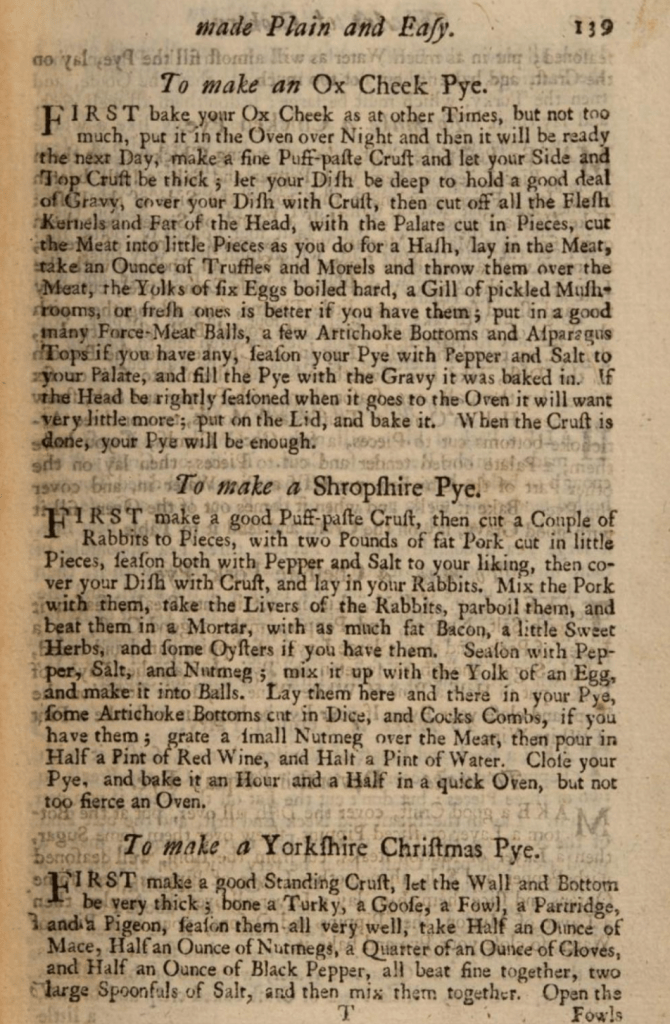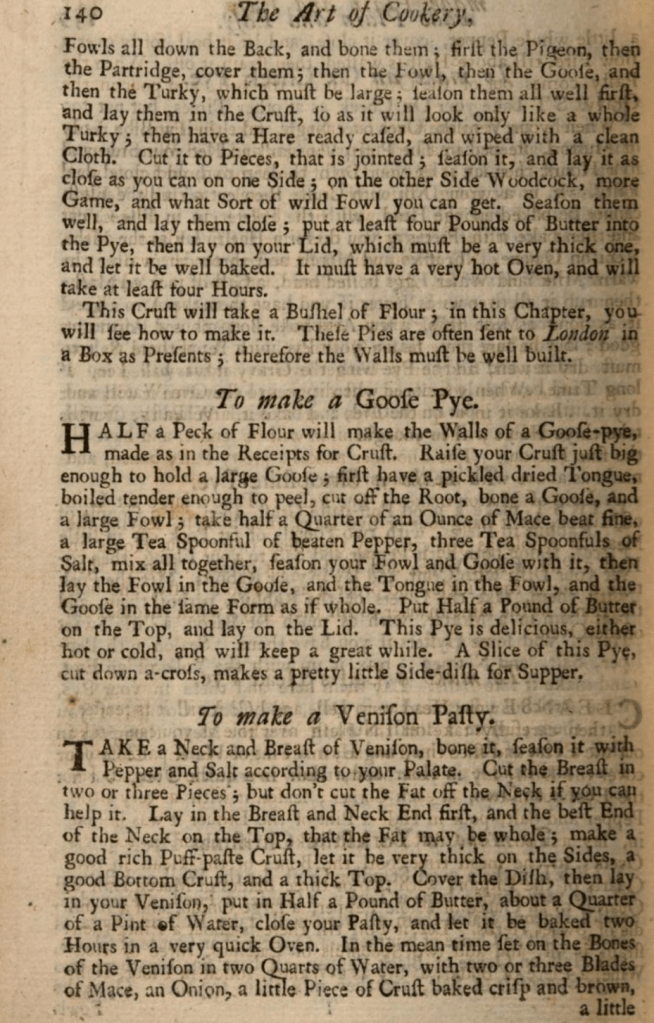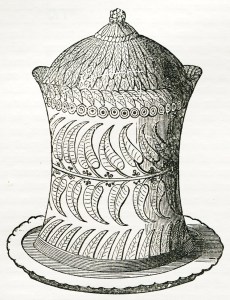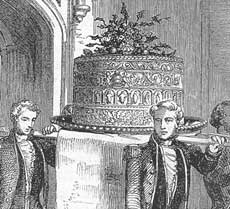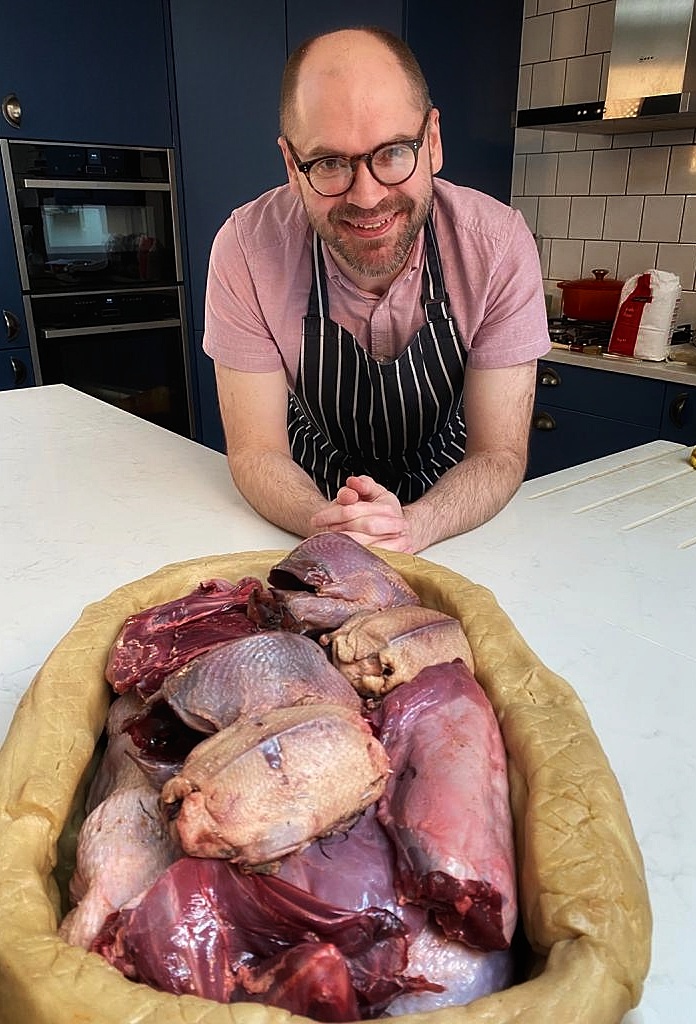
And so here we have my interpretation of Hannah Glasse’s Yorkshire Christmas Pye I made for the Channel 5 show Our Victorian Christmas (click here for part 1: history) Before I go on though, I found that the Christmas pye sequence had to be cut out for time – the show having to be cut down last minute to just one episode of an hour’s length. Boo!
I am still in the episode though: I also made Wassail and did a few to-camera bits about Victorian Christmas food. It’s on Channel 5, 9pm, 22 December (I’ll post a link when one becomes available).
Ingredients:
1 turkey
1 goose
1 chicken
1 partridge
1 woodpigeon
2.5 kg salted butter
1 hare
A selection of oven-ready small game e.g. woodcock, grouse, teal, snipe
2 eggs
Spice mix:
15 g each ground mace, nutmeg and black pepper
8 g ground cloves
50 g salt
Hot water pastry. Approximately 15 batches of the following:
500 g plain flour
500 g strong white bread flour
1 tsp salt
350 g lard
350 ml boiling water
First make the hot water pastry: mix the flours and salt in a bowl, then place lard and boiling water in a saucepan, put on a low heat and let the lard melt – don’t let it boil as it might erupt, so be careful. As soon as the lard has melted, make a well in the centre and pour in the water and fat. Mix with a wooden spoon to make a dough. As soon as it is cool enough to handle, knead slightly. Cover and cool. This can be done a couple of days in advance – simply store in the fridge.

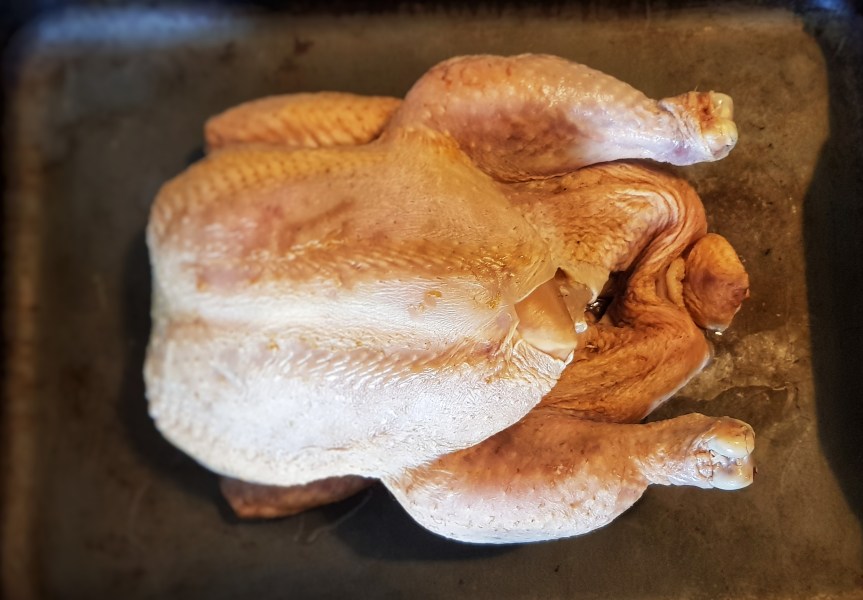
Using a very sharp knife and poultry shears bone the turkey, goose, chicken, partridge and woodpigeon. Begin by cutting out the birds’ spines with the shears, then cut away from the carcass. Don’t worry about keeping the drumstick or even thigh meat of the partridge or wood pigeon.
Lay out the birds cut side up, then make the spice mix by mixing together the ingredients and scatter it over the birds. Now wrap the partridge around the woodpigeon, so that the pigeon fills the cavity inside the partridge, making the partridge look whole. Wrap the chicken around the two birds and so on until you have what looks like a whole goose, albeit a somewhat gory one. Refrigerate.

Now make the base of the pie. Line a large baking tray with greaseproof paper. Knead together two or three batches of pastry and roll out, making sure you flour your worktop. The pastry needs to be 5 or 6 cm thick. To get dimensions, use the whole goose as a template: it needs to fit inside snugly and there needs to be a border wide enough to build up a 5 to 6 cm thick wall. I built up the sides by rolling thick bricks of pastry and glued them on by cross-hatching the pastry and brushing with water. Then I smoothed the pastry. I needed a final height of around 30 cm. If possible, refrigerate to firm up the pastry.

Sir the 5 birds in the pie, then joint the hare (ask your butcher to do this) and tuck in pieces, along with your small game: I used 2 grouse and 2 teal, but snipe and woodcock would also work. Scatter over any remaining spice mix and then pile on large cubes of salted butter, tucking it inside and between the game.
Roll a lid with more pastry, cut a large steam hole and place on top of the pie. Decorate with a pastry rose and leaves. Glaze with egg wash.
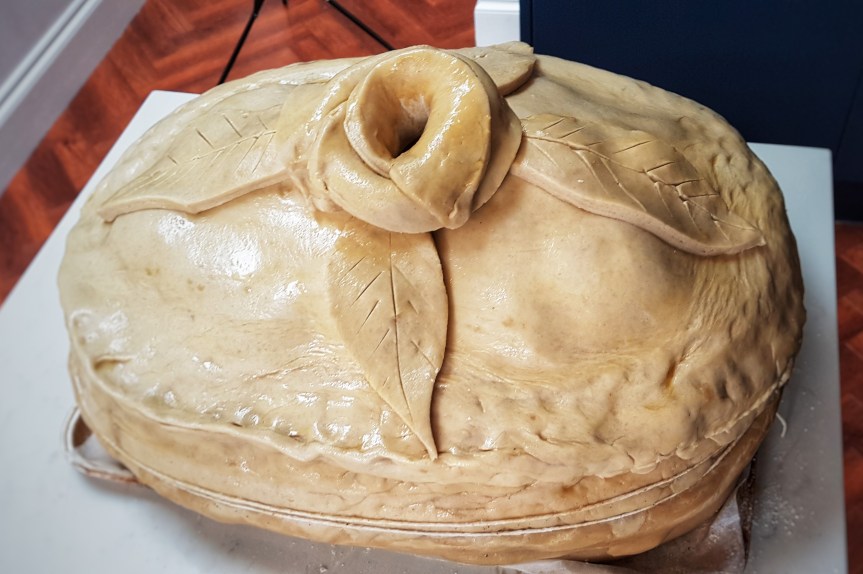
If you can allow the pastry to firm up in the fridge or somewhere cool. Preheat the oven to 230°C.
It needed two people to get the pie safely in the oven. It’s important to have a high heat at first, so the pastry can seal up. My pie started to collapse as the front and leak butter because the heat couldn’t get round. (I found out later that that was prevented by tying card or metal around the pie, rather like a corset, keeping things from oozing out.)
It took 8 hours to cook the meat inside to a safe temperature – a meat thermometer should read 74°C. The pastry will be very black by this point – remember it isn’t for eating, it is for protection.
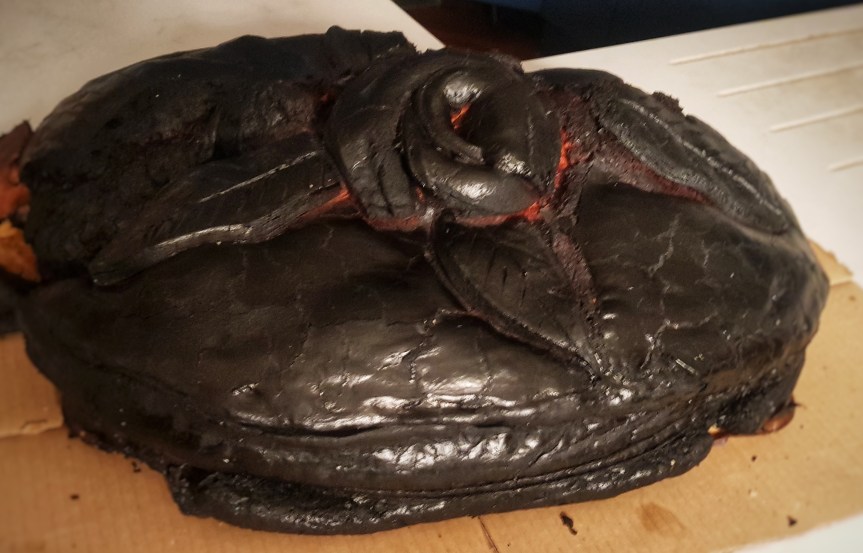
We let it cool for a little while, packed it up and drove to a local restaurant so we could place it their walk-in fridge. The next morning it was whisked away – not by coach or train, but by car.
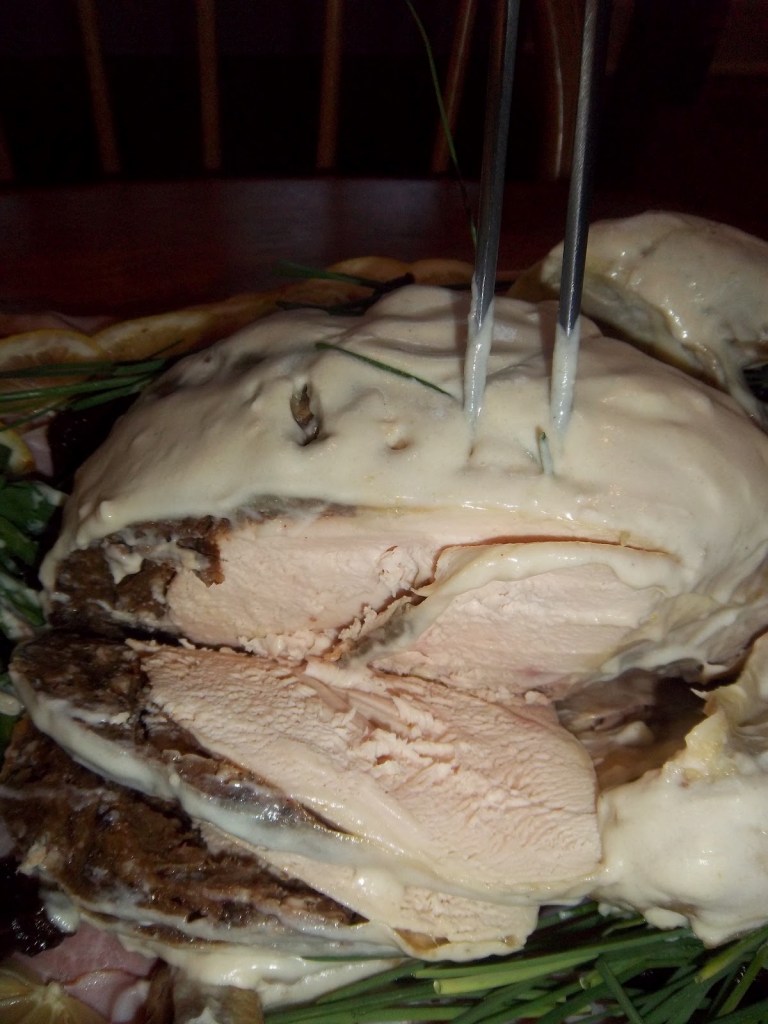
#445 To Make a Yorkshire Christmas Pye. A recipe I really thought I would ever cook, and what an experience! In all it took me 5 days (on and off) to make the pie. When it started to collapse in the oven I thought all was lost, but when we took it out of the oven, I saw the side closest to the back of the oven was absolutely fine. I just wish I could have tried some of the contents: the poor old bits of game on the top got a bit blackened, but the 5 birds together looked well protected. I don’t know how it turned out, and I can’t seem to get a photo of the contents. I am going to attempt this again one day, but I shall use a different recipe. My score? It’ll have to be a ?/10!
If you like the blogs and podcast I produce, please consider treating me to a virtual coffee or pint, or even a £3 monthly subscription: follow this link for more information.