Veal or no Veal?

Eating veal has something of a stigma these days; it is considered cruel by many. In English Food it appears quite often, either in veal recipes or as part of other recipes that you perhaps would not expect, for example, giblet gravy and chicken pie. Jane writes rather a long introduction to her Meat chapter discussing the problems of mass meat production and the decline of meat quality as well as those suppliers that try to produce good quality products. Nowhere in the introduction does she mention veal – beef, yes, at length, but not veal. I can only assume that in her opinion veal was always a good meat product (she has a poor opinion on the state of almost every other meat, and quite rightly). Indeed, it probably was, but certainly not from the poor veal calves’ point of view.

Rearing veal calves was notoriously cruel, and lumped together with fois gras production. The problem being that calves were kept in tiny darkened rooms to keep their meat white and tender. This practise is still common in many counties but is not allowed in the UK. Veal produced in British farms have a much higher standard in animal welfare; calves can eat grass after weaning and walk in the fields to produce rose veal – so-called due to the pale pink colour of the meat. This is obviously a good thing; I cannot see how anyone (vegetarians aside) can have issues with this. It is the same as eating lamb after all. For more information about the prevention of cruelty to animals in farms see the Farm Sanctuary website.
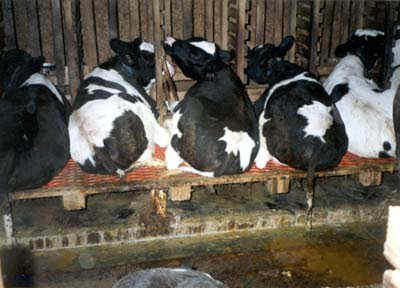

Veal production like this is still allowed in many countries

The point I would like to make is that NOT eating veal is cruel, or at least disrespectful. The dairy industry wants female cows for milk. Cows do not simply just produce milk all the time – which many people seem to think – like any mammal, they produce milk when they have given birth (or about to give birth) to calves. Female calves are a good thing for future milk production, but the poor old males are surplus to requirement and are generally killed. What a complete waste! A waste of food and a waste of life! People seem to coming round to the idea – even Marks and Spencer have a line in rose veal!
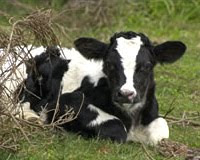
All British rose veal is produced with welfare in mind

I intend to tackle some of the veal recipes in the book – I have been biding my time because I want a good supplier. I believe I have found one too: Winter Tarn in Cumbria is an organic farm that produces cheese but have recently started selling veal though they don’t really mention it on their website. They attend many regional farmers’ markets. The quality of the meat is very good, and most importantly, I think, they don’t charge the Earth like many other organic veal suppliers seem to think they can do. Check out their website here.

My consignment arrived the other day, stewing veal, minced veal, tongue, kidney, liver and bones for stock. Not all of the items are for recipes from English Food, the offal is essentially just to cook anyway – veal offal is highly prized, but I have never tried it, so I seized the opportunity.
I shall keep you informed of my progress, natch.

Christmas is Becoming…

Yes I know it is only the beginning of November, but it is time to seriously think about starting to get some of the Christmas fayre ordered or made! I love Christmas, and I love making the cakes and mincemeat and everything. It definitely brings out the best in me.

Today I made the Christmas Cake (recipe here) – a definite Grigson favorite; it’ll be the third year in a row I will have made the one from the book. Around a week before Christmas, I’ll be making the marzipan and royal icing too (recipes here).

Also, later this week, I shall be making the mincemeat for the mince pies. Last year, I made a traditional Mrs Beeton recipe, but I’m going to make the other recipe in English Food this time – orange mincemeat.

After discussion with the family, we have decided to not do a turkey this year. Instead we are going to have roast beef (recipe here), roast pheasant (recipe here) and a Bradenham ham. I ordered that two weeks ago from their website. I am organised!

I shall be adding the recipes as I do them of course. Why not have a crack at one or two yourself? You know you wanna…

Ho ho ho!

How to Make Game Stock

This is a recipe for a good game stock – it is a modified version of one that appears in Lindsey Bareham’s very excellent book A Celebration of Soup. If you have some game carcasses left over from a meal, turn them into stock – you can either freeze the stock, or the carcasses, for whenever you need them. You don’t need many either – I managed to make a pint of good stock from a single woodcock carcass.
The amount of vegetables and spices etc indicated here will do for up to 4 small birds or 2 larger ones. You may want to increase or decrease the amount of water added though – don’t forget, you can reduce a stock so you can be quite liberal with the water. If you want to make more, you can just increase the ingredients.

First chop the carcass(es) and place them in an ovenproof casserole dish and roast them in the oven for 20 minutes at 200⁰C. Remove them and add a little wine – red or white is fine – or a little water to deglaze the dish. Add some chopped stock vegetables: a carrot, an onion, a celery stick, 2 tomatoes and one or two cloves of garlic. Return to the oven for a further 5 to 10 minutes. Now add a spring of rosemary, a bay leaf, five or six peppercorns and between one and two pints of water, depending on the amount of stock you want. It also depends on the birds being used – small partridges, woodcock or grouse produce a stronger stock than, say, pheasant. The stock needs to be cooked uncovered for at least two hours very gently; you can do this on the hob or in a low oven. Strain the stock, reduce if required, season with salt, then skim after it has been allowed to cool. Easy peasy.

#203 Partridge

One of the good things about my favourite fishmonger, Out of the Blue, is that – like any good fishmonger – they supply game during the season. It’s very well priced there and I picked up a couple of partridges for just £2.50 each. Great stuff. I’ve already done a stewed partridge recipe from the book. As well as specific recipes, Griggers goes through each game species with some advice on how to cook them. Here is what she says about partridge:

Roast: 30 minutes, 220⁰C;
Inside: chopped liver, chopped onion and butter, mushrooms chopped and stewed in butter;
Serve with: bread sauce, etc as for pheasant (see this recipe);
Braised: with chestnuts and cabbage and white wine (see this recipe).

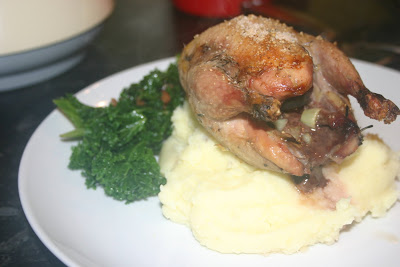
So roast them I did. I filled them with onion and butter (the fillings used for game are there more to prevent them drying out than anything else, really). Before roasting I did make sure they were well-seasoned. To serve I thought I’d add some mashed potatoes – the bland creaminess goes well with strong metallic-scented game – and some kale with fried bacon lardons stirred through them. Lastly I made a sweet rich sauce from half a pint of strongly-flavoured game stock made from a woodcock carcass (see next entry, if I pull my finger out and write it!), a tablespoon of redcurrant jelly and the deglazed juices from the roasting pan (I used some port do to the deglazing).


#203 Partridge – 6/10. I liked the partridge, the leg meat was very gamey and the breast meat milder; a good combination. I am assuming that they were our own indigenous grey partridges because of their small size and strong flavour (there are two species in the UK, the other being the slightly larger and introduced red-legged partridge). There was a surprisingly large amount of meat on these little birds and one was certainly enough per one person. I would certainly recommend trying them if you haven’t before, though I’d go for the braised recipe rather than this roasted one.

#202 Pressed Beef

A quickie this one.

I wanted to do a recipe from the cured meats section of the book as I haven’t done many of them and I didn’t want to start getting behind. This one appealed to me because it was similar to the salt beef recipe I had already done and I knew that the cold, pressed beef would keep me in sandwiches and snacks for the week, plus the cooking process would produce a nice stock which could be turned into a lovely soup. I also thought that you don’t really see salt beef these days in supermarkets etc, and then by total coincidence my workmates and I went to the very good café in the Whitworth Art Gallery (which makes up part of Manchester University’s campus) and what was on the menu? Salt beef sarnies! I may be some kind of soothsayer.

To make your own pressed beef you need a joint of silverside – go for somewhere between 2 and 3 ½ pounds in weight, I reckon. You can use either fresh or salted for this. If you want to do pressed salted beef, you can buy it from your butchers, but it is much better if you make your own. I did – follow the instructions on brining on this earlier post if you want to have a go. Next, you need to boil the beef joint – follow the instructions on this post here for how to do that (I love how the blog is becoming self-referential!) you can follow the same recipe if you’re using fresh beef too. Leave the beef to cool in the broth for a couple of hours before removing and wrapping well in cling-film or foil. It now needs to be pressed overnight; either use a tongue press or place it under some very heavy weights. I used an upturned loose-bottomed cake tin so I could precariously balance a cast-iron griddle pan, an earthenware jug and some tins of food on it with at least some attention to health and safety.


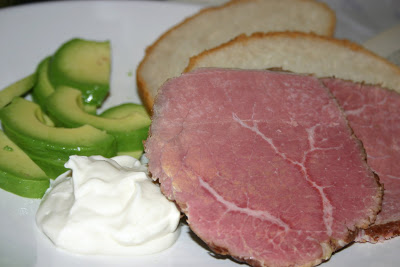
Next day, you can slice the beef as you need it. Make sandwiches using rye bread, pickled gherkins and horseradish sauce (I also added some mayonnaise). Alternatively serve with an avocado salad.

#202 Pressed Beef. This is absolutely delicious. So much more tasty and such better quality than any supermarket pre-sliced nonsense. I would really recommend trying the curing, cooking and pressing yourself, it’s doesn’t take much effort at all and the pay-off is great. The beef is firm and deliciously sweet and salty. The spices – particularly the mace – come through beautifully and compliment the beef so well without drowning out its flavour. 8.5/10.

#201 Tea Cream

A good dessert to make if people are round because you can make it a couple of days in advance.

The tea in question for this tea cream recipe is green gunpowder tea. Green tea is a strange thing – I don’t ever drink it because it tastes of a combination of washing-up water and seaweed. Bleurgh. However, having it with cream and sugar did appeal slightly more; cream and sugar never taste bad, now do they!?

FYI: green tea comes from the same plant as our more familiar ‘black’ tea (e.g. PG Tips, Tetley, etc), but is unfermented thus retains its natural green colour, as opposed to black tea which turns its dark colour due to oxidisation during fermentation. Green tea is popular in China and Japan as we all know – but also in Muslim counties where it is forbidden to drink fermented tea. How bizarre. Anyone know why this is?

To make this tea cream mix together half a pint each of double and single cream in a jug. Pour around three-quarters of it into a small saucepan along with two tablespoons of sugar and an ounce of green gunpowder tea. Slowly bring to a boil, though keep on tasting it as you don’t want the tea to be ‘over-stewed’. Pour the hot cream into a bowl through a sieve. Taste again; if too strong add more cream. Use either a packet of powdered or five leaves of leaf gelatine to make the cream set. It’s best to follow the instructions on the packet at this point but generally you dissolve the powdered stuff in a little hot water and stir it into the cream, or soak leaf gelatine in cold water until soft and stir into the still-hot cream. Pour the whole lot into a mould – buy a fancy one if you can, I did. Cover with cling-film, allow to cool and then place in the fridge until needed. Turn it out onto a plate – you will need to dip the mould in hot water briefly to help loosen the jelly, I left it in too long and it went a little liquid around the edges. Serves five or six.


#201 Tea Cream. A funny one this one. I really liked the creaminess of the ‘jelly’, but the tea taste – though strong when hot, diminished greatly when chilled so I couldn’t really tell it was there. I certainly liked it enough to give it a second go at some point though. It did look very good in its fancy shape. 6/10.

#200 Steak, Kidney and Oyster Pudding

As promised, a dish that is more English that roast beef and Yorkshire puddings, at least I think so anyway. It may be because I’m a Northerner, but I also think (and I could be wrong here) that although it is very English, it hasn’t travelled to other countries as well as, say, roast beef. In other words, it’s a sort of hidden gem. I have been saving this one for number 200 for a while, though I did change my mind a fair few times.

The seemingly unusual ingredient here is, of course, the oysters. The recipe is surprisingly recent: it appears as a steak pudding in a book by Eliza Acton in 1845 and the kidney turns up in Mrs Beeton’s Household Management nearly fifteen years later. In those days folks living near the coasts were falling over oysters – they diminished however due to a combination of an increased population eating them and the increased pollution created by all those extra people. No one wants a shitty oyster. However, before this, they were cheap and the preferred alternative to the very pricey mushrooms that the posh gentry would have enjoyed. It was only since around the Second World War that mushrooms have been cultivated on a large scale, before that they acquired by foraging: limited and very seasonal. Of course, these days it is the mushrooms that are ten-a-penny, and the oysters that break the bank. That said, native oysters are in season at the moment and the ones I bought from Out of the Blue in Chorlton were just sixty pence each.

This pudding is a pretty posh all-out one; giant, full of rump steak, red wine and extra beef stock plus both mushrooms and oysters:

To begin, make the filling: cut two pounds of trimmed rump steak into one inch cubes and then slice a pound of ox kidney (or veal, if you’re being really posh), removing any fat or gristly bits on the way. Toss these in two tablespoons of seasoned flour. Chop a large onion and fry it gently in two ounces of butter until nicely softened, remove with a slotted spoon, turn up the heat and then hard fry the beef and kidney. When brown transfer to a casserole dish (or, if you have a cast-iron one that goes on the hob you can keep it all in there. Deglaze the pan (or casserole dish) with either a pint of beef stock, or half-and-half stock and red wine. Now slice 8 ounces of mushrooms and fry them in an ounce of butter. Add these along with the cooked onions and a bouquet garni to the meat. Cover with a lid and cook in the oven for 1 ½ hours at 140-150⁰C. You can do all this the day before if need be.

Next, open the oysters: Griggers suggests 18-24 oysters, though makes them an optional ingredient for the pudding. I went for a dozen as I didn’t want to go bonkers with the spending. Add them, plus their liquor to the meat. I’ve written about opening oysters before.

To make the suet pastry, use a knife to mix together 10 ounces of self-raising flour, a teaspoon of baking powder, ¼ teaspoon of salt, ground white pepper, ¼ teaspoon of thyme and 5 ounces of chopped fresh suet (use the packet stuff if you can’t get hold of it). Now add cold water little by little to the mix, stirring with the knife. Use the minimum amount of water that will bring the pastry together, using your hands towards the end. If it seems too wet, add more flour. There’s enough pastry to line a three pint pudding basin, so roll it out in a circle large enough and remove a quarter of it (you’ll use this later). This’ll make it easy to line the basin – use water as glue to stick down the ‘hem’. Spoon in the mixture and then roll out the reserved quarter into a circle to make the lid. Place this on top and fold any surplus edging over it and glue it with more water. Secure the lid if using a plastic basin, or cover with buttered, pleated foil secured with string. Place in a steamer and cook for one and a half hours; don’t let it boil dry. Turn it out onto a plate and serve immediately.


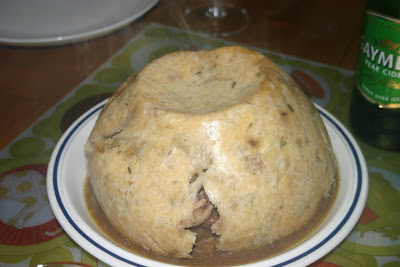
#200 Steak, Kidney and Oyster Pudding. The poshest pudding in the world! It was very, very good though. The beef and kidneys were very tender and the gravy was good and rich. The real revelation was the oysters – at first I wasn’t very sure about them, but it was a taste that was acquired very quickly. They provided a mysterious iodine tang to the whole thing. The original surf ‘n’ turf! The only thing I would change is the amount of pastry – there was barely enough to line the basin, making it split open when it was turned out! 9/10.

Warm Lamb’s Fry Salad

Well #200 was now upon me, so I got a few folks round to join me in scoffing it. The trouble was I couldn’t do starter from the book – otherwise that would be the big 200, and I didn’t want some little starter to be it. However, I decided that the food would have a theme: offal. All three courses would have some offal as part of it. You see, I knew that I had some lamb’s fries in the freezer that I bought a while ago from the Cheshire Smokehouse and this seemed like the perfect time to cook them. After a little internet research, I found that they weren’t that difficult to cook, it seemed that you could treat them the same as scallops. I decided on a warm salad. I just hoped they weren’t awful, and that people weren’t going to be squeamish.

It has been a while since I put one of my own recipes on here…

For six:

Heat some cooking oil in a frying pan until nice and hot. Throw in two cloves of garlic and a good pinch of chilli flakes. As soon as the garlic starts to brown, throw in seven sliced and previously seasoned lamb’s fries. Quickly stir fry them for around two or three minutes only, and then season with more salt and pepper if required plus a little sugar and a squeeze of lemon juice. Stir through some dressed spinach leaves and serve immediately. I forgot to take a picture. Oopsey!

The lamb’s fries were okay – very tender and rather bland. It was quite difficult to get excited by them. I think I’d would rather have had something bizarre and shocking, than something that was just okay. At least everyone that came can say they’ve tried them. And I can say that when I do testicles, they melt in your mouth! (F’nar!)

November

Well here we are in November, would you believe. When did this happen? I still keep thinking that 2009 happened recently, and now it is nearly over. November, though not full of vibrant fruit and vegetables, is still chock-packed with many of my favourites: the apples and pears are in abundance, and there are many, many varieties. Game is now probably at its very best now. I have bought some hare and mallard already for recipes this month, but at the game stall at the Farmers market at Hoghton there was grey squirrel. I didn’t buy any, but maybe next time.

FYI: The game man, who does allsorts of fantastic stuff, and has been very good to me by getting pheasant giblets for me. His company is called Shaw Meats and they are doing five-bird roasts for Christmas as well as other exciting things. He’s based in Cumbria, but does deliver. Check out the website.

Vegetables: Jerusalem artichokes, beetroot, brussels tops, cabbages, cardoons, carrots, celeriac, celery, chard, chicory, endive, spring and winter greens, kale, kohlrabi, leeks, lettuce, onions, parsnips, potatoes, pumpkins and squashes, salsify, swede, turnips.

Fruit: apples, medlars, pears, quince, raspberries.

Wild greens and herbs: nettles, watercress.

Wild flowers and fruits: rosehips, sloes

Fungi and nuts: chestnuts, hedgehog fungus, horse mushrooms, oyster mushrooms, walnuts, blewits.

Fish and shellfish: cod, crab, lobster, mackerel, mussels, oysters, prawns, scallops, sea bass, sprats, squid, whiting.

Game: goose, grey squirrel, grouse, hare, mallard, partridge, pheasant rabbit, woodpigeon.

#199 Apple Sauce III

Eagle-eyed followers of the blog will notice that there has been no Apple Sauce I or II. In English Food there four recipes for apple sauce, so I thought it best to get the ball rolling. I’ve made this one first because it is not a sauce for pork, but for chicken. I had a very nice-looking free range chicken that I bought from the poulterer Peter D Willacy at Houghton Farmers Market, you see. He has no website, but you can call him in 01253 883470. The best thing about their chickens is that they come with giblets; not something you see these days, not even in good butchers. I’m hoping to buy a capon from them soon. This sauce can also be served with veal.

Anyways, if you are roasting a chicken this weekend, try this very easy creamy and usual hot apple sauce:

Core, dice and peel a pound of Cox’s pippin apples (or a good equivalent) and fry them in some clarified butter. (If you don’t clarify your butter first, it may burn. Melt it slowly in a pan, blot away any solids on the surface with some kitchen paper, then decant the liquid butter away, leaving behind any other solids that sank to the bottom.) When they have softened and turned a little golden, remove the apple pieces with a slotted spoon, leaving behind the buttery juices. Add six tablespoons of white wine (or cider) to the juices to deglaze and reduce it all well. Lastly, stir through six tablespoons of double cream and sharpen with a squeeze of lemon juice. Serve hot.


#199 Apple Sauce III. A strange one this one because the sauce is essentially stewed apples and cream, which in my book is a pudding. That said, it did go surprisingly well with the chicken as there are no strong flavours to drown out the subtle chicken. 5.5/10.