#275 Pears in Syrup

“Your old virginity is like one of our French withered pears: it looks ill, it eats dryly.” Bertram, As You Like It


What a great quote. Shakespeare was such a bitch.

This is an old, old recipe that Griggers herself has updated rather. In Medieval times a variety of pear called Wardens were used that were rock hard and required an hour’s cooking beforehand. These days, we use eating pears so it’s a lot quicker to make. It is best though to use unripe pears for this, though it doesn’t really matter what kind.

I chose to do this recipe as the dessert to a vegan meal I cooked with my good friends Danny and Eric. I was quite surprised that there was anything vegan in the book! In fact, of the remaining desserts this was the only one.

A some of you may know, one of my gripes is picky eaters. Vegetarianism and veganism don’t come under that term ofr me though. I think making a moral stance against eating animals or using the products of animals certainly has a lots of merit. Not eating honey is a bit stupid though. Anyway, what IS annoying is veggies who ARE picky. I mean, what is the point of restricting your diet if you don’t like most stuff anyway. Luckily noone fell into that category this night!

It’s an easy recipe that can be done well in advance.
Start by peeling, halving and coring the pears – you will need one per person according to Jane. Pop them in a pan in a single layer and pour over enough red wine to cover them. Add too, two tablespoons of sugar, a cinnamon stick and a good pinch of ground ginger. Cover them and bring to a simmer until they are nice and tender. This takes a good 25 minutes, but the time will depend on the variety and ripeness of the pears used. Remove the pears with a slotted spoon and keep warm whilst you boil down the wine until you get a nice slightly syrupy sauce. Add more sugar if you like. Pour over the pears and allow to cool. No need to serve anything else with them.

[If you don’t want to use wine, it can be adapted – swap the wine for water and the cinnamon for a split vanilla pod and add one sliced quince for every two pears cooked. Cook the fruit slowly to achieve a honey scented deep red sauce.]
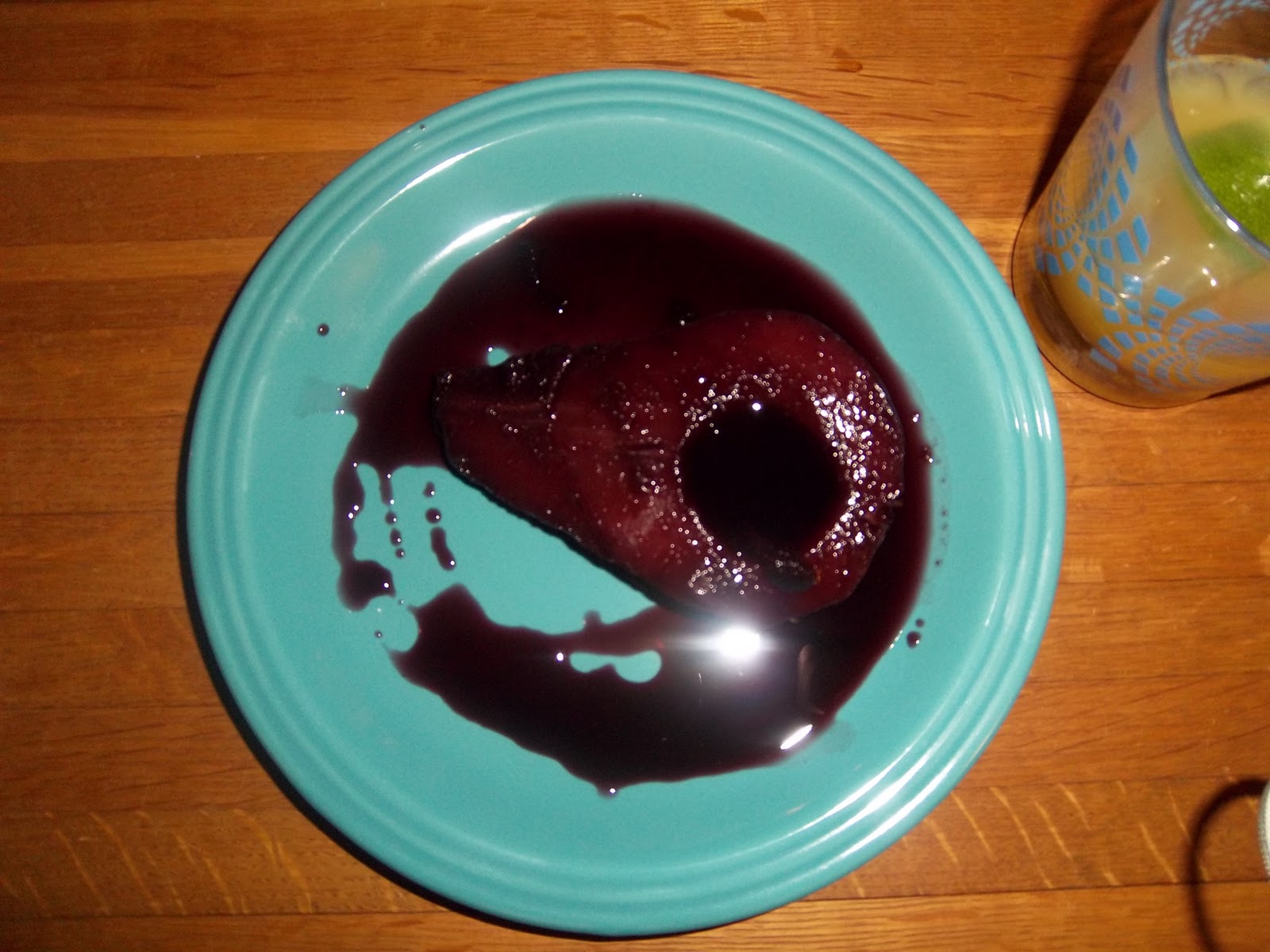
#275 Pears in Syrup. This was a really good dessert. I’d actually put this one off because I expected to dislike it, but was totally wrong. The concentrated red wine sauce wasn’t heavy or sickly like I thought it would be, but light and refreshing. It must have been the pears and the spices that lightened the whole affair. That said, we could only manage half a pear each. The pudding looked quite impressive too with the dark, almost indigo sauce and the creamy-white pear flesh inside. Great stuff. 8/10.

#273 Fifteenth-Century Apple Fritters (Fretoure owt of Lente)

I do so love the old, old recipes within English Food. I do so also love anything deep-fried, so I knew I’d like this one. A tricky thing about doing some of the apple receipts in this book is that most of them ask for Cox’s Orange Pippins which are not freely available here in Texas. However, I have found an excellent replacement for those sour and slightly soft little darlings; the Macintosh apple. So from now on any American Grigsoners can do the recipes almost as Jane intended. In fact they are so similar that I think they might have been selectively bred from Cox’s.
Although just a simple recipe to us now, this must have been a pretty expensive dessert to make because of the addition of black pepper and saffron. However, these old recipes don’t exactly reflect what commoners ate in the fifteenth century – the only recipes that were written down were those chefs that could read, and that meant chefs to the King and the like. Commoners couldn’t read or write and so those sorts of recipes are much more difficult to get hold of!
I imagine Richard III probably tucked into these the day before the Battle of Bosworth Field, well actually, Henry Tudor, since he was the one that won the thing…
Peel and core six Orange Pippins and slice them thickly. Place in a bowl with a liqueur glass of brandy and a good sprinkling of sugar. Let them steep for a few hours, making sure they all get turned in the sweet brandy. Meanwhile, make the batter. Start by pouring three tablespoons of nearly-boiling water over a pinch of saffron and let it steep. Measure out four ounces of flour and mix in one whole egg and the yolk of another (save the white for later on) along with a tablespoon of oil or clarified butter. Measure out half a pint of milk and mix around half of that in too. Strain the saffron liquid into the batter and add more milk if it’s too thick along with a three gratings from the black pepper mill. Lastly, whisk the egg whites and fold that into the batter. Dip the apples in the batter and fry in oil until nice and golden brown. Serve it forth with some sugar sprinkled over it. I plopped on some lightly whipped double cream too.
#273 Fifteenth-Century Apple Fritters (Fretoure owt of Lente). These were a great end to the lobster that Danny and I cooked. The dessert was very easy too –good if people are round; you don’t want anything complex. The batter was really nice and light due to the egg white, though I couldn’t really taste the spices. No matter, because it was still a great pud! 7/10.

#269 Elizabeth David’s Everlasting Syllabub

I made this syllabub to end to the little meal Hugh and I cooked for Maartin and Ninja. I’d had a feeling no one had tried one before as they have gone out of fashion rather. I’d only had one in my life before.
Syllabubs were very popular up until recently. Originally they were simply a mixture of ales or cider mixed with milk or cream, which was probably like a boozy curds-and-whey. The more solid, whipped and ever-lasting syllabubs first appeared in the seventeenth century, according to Griggers, although both were kinds were obviously eaten because recipes for both appear in the Experienced English Housekeeper by Elizabeth Raffauld from 1769 (I have recently got hold of a copy of it).
The recipe in English Food, is from a pamphlet called Syllabubs and Fruit Fools, written by the great Elizabeth David, but I thought I’d give this one from Elizabeth Raffauld too, you know, for those of you who want to keep it real. And have your own cow….
“To make a Syllabub under the cow
Put a bottle of strong beer and a pint of cider into a punch bowl, grate in a small nutmeg and sweeten it to your taste. Then milk as much milk from the cow as will make a strong froth and the ale look clear. Let it stand an hour, then strew over it a few currants well washed, picked, and plumped before the fire. Then send it to the table.
Brilliant. Sounds awful.
Anyway, here the recipe from Ms David:
This serves four to six. Bear in mind that you have to start this one the day before you want to serve it.
To a small bowl, add 4 fluid ounces of white wine or sherry (I went with wine, as sherry seemed a bit too rich), 2 tablespoons of brandy and the pared rind and juice of a lemon. Cover the bowl and let the flavours infuse together overnight. Strain everything into a large bowl and dissolve into the liquor two ounces of caster sugar. Next slowly mix in half a pint of double cream and grate in some nutmeg. Whisk the syllabub until it almost reaches the stiff peak stage so it is still a little floppy. Don’t over-whip it. There’s nothing worse than over-whipped cream; it goes all weird and cloying. You have been warned. Spoon onto glasses or ramekins and cover with foil or cling film. Leave them somewhere cool. Sir Kenelm Digby in 1669 recommends ‘[a] tiny sprig of rosemary or a little twist of lemon peel’, so I pared some thin pieces of lemon peel and let those stand in sugar overnight too as a traditional garnish. I served them with those little caramelised biscuits you get with coffee, I forget their name.
#269 Elizabeth David’s Everlasting Syllabub. Quite a boozy affair, this dessert, and I have never really got used to alcoholic puds, we just do eat them these days. However, as far as those kinds of desserts go, this was a good one, and nothing like the awfulness that was the Whim-Wham. The lemon and the fact it was a whipped dessert made it feel lighter than it was. Hugh ended up scoffing loads of them and made himself sick. Oh dear. I can’t scoff, cos I did exactly the same with the Whim-Wham. 6/10.

#264 A Coronation Doucet

He was as ful of love and paramour
As is the hyve ful of hony sweete:
Wel was the wenche with hym myghte meete.
                             The Cook’s Tale, The Canterbury Tales
There are recipes in English Food that get me very excited indeed and this is one of the most exciting. This doucet – which means something sweet – is a custard tart that was served up at Henry IV’s coronation, alongside fritters, and candied quince (which I made quite a while ago, see here). Also on the banquet table were ‘curlews and partridges and quails and rabbits and small birds of many kinds’. Posh folk around this time would put pretty much anything into a sweet tart. It didn’t matter as long as there was sugar in it so they could show off how rich they were. A particular favorite was fish. Vile.
The Coronation of Henry IV
A custard tart may seem rather a plain dish, but remember this was October 1399 and this tart was laced with saffron and honey which were very prized ingredients. Indeed, it may have been sweetened with sugar too – which then would have cost a small fortune.
Henry IV spent most of his reign trying to prevent various plots against his own life – this was because the previous ruler, Richard II (some guy called Shakespeare wrote a play about him) went on a crusade and while he was away Henry began a military campaign to take Richard’s land and effectively earned the right to the crown. Richard wasn’t best pleased when he got back, but before he got the chance, he was thrown in the tower and starved to death. No curlews or partridges for old Dicky-boy. Henry IV also legalized the burning of heretics.  Read more on the lovely Henry here.
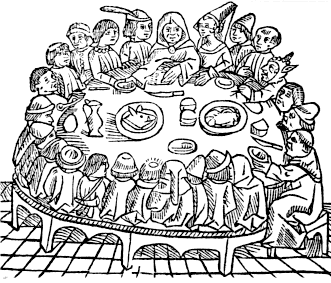
Canterbury Tales Woodcut, 1484
Not all was bad though. It was during this time that modern English was born. It was quite a strange thing – prior to these years all the texts were written in Latin and then, seemingly out of nowhere, English appeared all fully-formed. One of the key texts that shows this off is ‘The Canterbury Tales’ by Geoffrey Chaucer, who was present at the coronation. Also, Henry’s address was the first to be given in English. So this really was a key part of English history. This is why cooking food from this book can be so exciting – a chance to have a real glimpse into history. You can read books, go look at paintings, or walk around a magnificent cathedral, but EATING something that people once ate has some other connection; a personal connection that can only be achieved with food.
Anyways, I have wittered on enough. Time for the recipe…
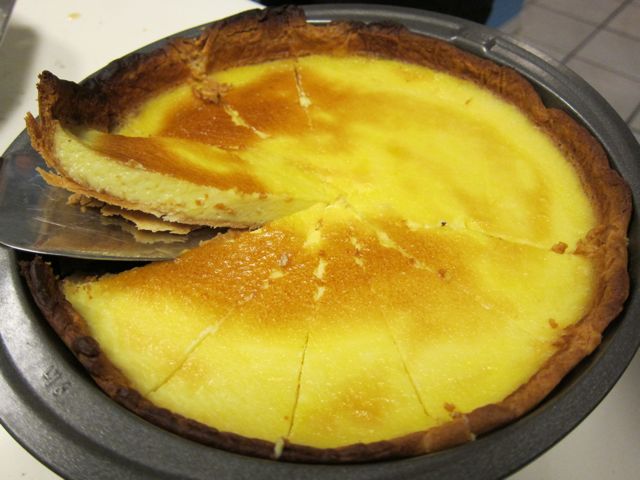
Blind bake some shortcrust pastry in a 9 inch tart tin – about 20 minutes at 180°C (350°F) should do it. Cover with baking parchment. Use baking beans to keep the pastry supported otherwise it will collapse and be a disaster. Remove the beans and paper for a final five minutes so that it can crisp up a little (at this point I lost track of time and slightly overdid mine, oopsey. Whilst it is baking, make the filling: In a saucepan bring 12 ounces of double cream and 3 ounces of Channel Island milk alongside a decent pinch of saffron and a tablespoon of either honey or sugar to a boil. It’s important to note that the creams are measured by weight, not fluid ounces. Whilst they are coming to a boil, beat together 2 eggs and 2 egg yolks in a bowl. When the creams boil, pour them over the eggs whisking as you go. Add more sugar/honey if you want – I added about three tablespoons of honey in all. Pour through a sieve into the blind-baked pastry case and bake at 180°C (350°F) until set – around 15-20 minutes.

The slightly over-done Coronation Doucet

#264 A Coronation Doucet. O! I loved cooking this. And I loved eating it too. It wasn’t even that nice; but the experience was so exciting. The custard was not very sweet, unlike what we are used to these days, but then in ye olden times there were no proper courses so sweet and savoury were not kept separate like nowadays. The saffron came across quite strongly too. I think if the sugar or honey was piled in, it wouldn’t have seemed out of place. This was the third recipe I did from the book for Thanksgiving, so I am not sure how my American chums found it (hopefully I will find out in the comments…). Scores? Hmmm, well probably a 4/10 for actual flavour, 10/10 for geeky excitement

#253 Payn Pur-Dew (1420)

I haven’t done a historical recipe for a while, so I thought that my first recipe in this new country should be an old English one. It comes from the French pain perdu, which means lost bread, in other words smothered bread. It’s a French recipe but it obviously goes very far back in English history as this recipe proves. It’s from 1420 and is transcribed straight from the source, although Griggers doesn’t say what the source is! To put this into historical context, Henry V is the King of England and so he will have indulged himself on these in banquets; indeed, the inclusion of sugar in the recipe made it very regal. In the fifteenth century, honey would have been used as a sweetener. Eventually this dessert morphed into Poor Knight’s of Windsor – of which there are two recipes in English Food and I will try and do them soon so we can compare and contrast. Anyways, here is the recipe:

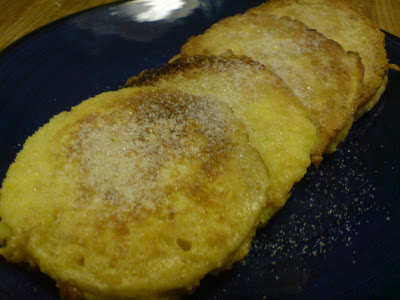
Take fair yolks of eggs, and separate them from the white, and drawn them through a strainer, and take salt [a pinch] and cast thereto; then take fair bread, and cut in round slices; then take fair butter that is clarified, or else fresh grease, and put in a pot, and make hot; then take and wet well the slices in the yolks, and put them in a pan, and so fry them up; but be ware of them cleaving to the pan; and when it is fried, lay them on a dish, and lay plenty of sugar thereon, and then serve forth.


I used clarified butter – not sure what is meant by grease, I suppose the author meant lard or dripping. It is important to clarify the butter, otherwise it and the bread will burn. The word fair in the recipe means fresh; so the quality of ingredients was important in medieval times just as nowadays. Griggers suggests using brioche should you have it. I didn’t.

FYI: Payn per-dew is also called French toast sometimes, but in the north of England I know it as ‘eggy bread’ and it is not just the yolks but the whole egg plus some milk is used. Slices are fried in a little oil and eaten with a scraping of tomato sauce or brown sauce and is certainly not a pudding!

#253 Payn Pur-Dew (1420). A simple and historical recipe that is a wee bit bland by our modern tastes. I think that in the 1420s it would have been an exciting dish, but I prefer it made with the whole egg and some milk to make it less rich and serve as a savoury rather than a sweet. It might have been better with syrup or honey on it instead; something with a bit of heady flavour. So, all-in-all it was okay, but not amazing. 4/10.

#249 Isle of Wight Pudding

Oh it HAS been a while, hasn’t it? I have been so very busy with getting ready for my move to Houston, I haven’t had the time to tell you all about the food I’ve been cooking. I have arrived in Texas now, by the way but haven’t really had much of a chance to explore the place, in fact I still have a bit of jet-lag. I shall fill you in about Houston soon, I’m sure.

Back in England it is blackberry season and those brambles that are so annoying and prickly for the rest of the year finally earn their keep. This recipe uses them, and so it was a great chance to try something that isn’t blackberry and apple pie (nice though it is). I made this in Derby visiting Simon and Rachel and the farm they are trying to set up as a cooperative eventually. They also keep bees and I used some of their delicious honey for this recipe too. If it isn’t blackberry season any soft fruit will do.


First make a shortcrust pastry with 8 ounces of flour and 4 of fat (butter, lard, or a mixture) plus cold water and roll it out into an oblong shape. Spread 4 fluid ounces of runny honey over the pastry and then sprinkle 8 ounces of blackberries over it. Roll up the dough so that it makes a sort-of Swiss roll, tucking the pastry under at the edges. Place in a small ovenproof dish and pour over 4 fluid ounces of single cream. Bake at 200⁰C for 45 minutes. Serve with thick cream.

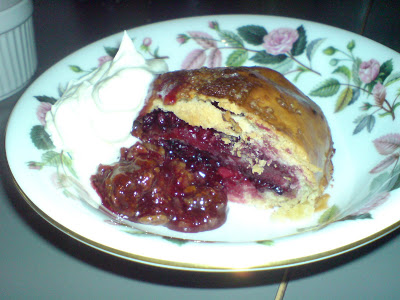
#249 Isle of Wight Pudding. A really good pud this one, and cheap too! The best thing about it was that the juices from the berries plus the honey and cream heat up to form a delicious toffee sauce. The top goes very dark and forms a good crust, though it doesn’t make the dessert look very pretty. Give it a go – quick and simple. 7/10

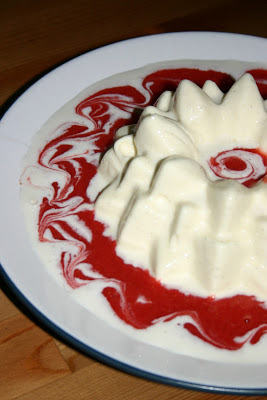
#245 Coconut Cream with Strawberry Sauce

This is a dessert that I had been looking forward to making for a while – I was just waiting for strawberry season. What could possibly not be delicious about strawberries, coconuts and cream?? Griggers doesn’t say anything about where it comes from; whether it was modern at the time of writing or if it has a good stoic history in the annals of English cookery. Scroll down to the picture, though, and you have to assume it’s probably from the Fanny Craddock School rather than the Alexis Soyer School.

It’s a little bit of a faff this one and the coconut cream needs to be made well in advance because it contains gelatine and that needs to set. To make it, bring ¼ pint of single and soured cream slowly to a boil along with a split vanilla pod and 4 ounces of desiccated coconut and 7 fluid ounces of water. Let the mixture simmer for 10 minutes and let it cool down until ‘tepid’. Pass through a sieve and add either powdered or leaf gelatine dissolved in 6 tablespoons of water; follow the instructions in the packet and make enough for a pint of liquid in total. Also add a good tablespoon of grated creamed coconut and add sugar and lime juice to taste. Griggers says: “the citrus juice is an enhancer, it should not be identifiable”. Pop the cream in the fridge and allow to cool and reach an ‘egg white consistency’. At this point, fold in ½ pint of whipping cream that had been whipped stiffly. Pour the whole mixture into a lightly-oiled decorative jelly mould and allow to set. To turn it out, dip the mould in hot water briefly before upturning it.

The strawberry sauce is much easier. Hull a pound of strawberries, keeping the nicest ones behind for decoration, and liquidise the rest with the addition of some icing sugar to sweeten. Pour the sauce around the coconut cream and “dispose of the strawberry halves in a decorative manner”. Or else.

#245 Coconut Cream with Strawberry Sauce. Oh, I had looked forward to this one for so long; I should have learned by now that some of these desserts are just plain rubbish. And this one definitely fits into that category. The coconut cream was pretty tasteless bearing in mind the number of what should be delicious ingredients that made it up. Next time, strawberries and cream will be served. 3/10.

#236 Baked Almond Pudding II

The eagle-eyed among you will realise that I haven’t done Baked Almond Pudding I. It was a toss-up between the two. Almond puddings are not something I think of as English and yet there are two in here. This is one custardy in consistency and other is cakey. We were in a custard mood.

What is good about the recipe is that I get to use a new ingredient – bitter almond extract. Not something you can get hold of that easily, and I got mine from an internet site, though cake decorating shops will sell it too, I expect. This pudding is very easy to make, simply a case of mixing some ingredients in a bowl:

Mix together 4 ounces of melted butter, 4 ounces of ground almonds, a few drops of bitter almond essence, 4 large eggs, the zest and juice of half a lemon, a glass of sweet sherry, 4 ounces of sugar and a pint of single cream. Pour the whole thing into an ovenproof dish – the shape doesn’t matter, but you need to make sure the mixture is around 1 ½ inches in depth. Bake at 190⁰C for around 45 minutes so that the centre is still wobbly.


#236 Baked Almond Pudding II. “A marvellous pudding” says the Grigson, and I very much agree. It was very light in flavour and texture bearing in mind the rich ingredients. The almond essence gave it a lovely aromatic hit. It was really good cold the next day – the slightly crumbly texture of the almonds made it very similar to the filling in a Yorkshire curd tart (one of my own personal favourite desserts, though I’ve not done the recipe from the book yet). Yep, marvellous, 8.5/10.

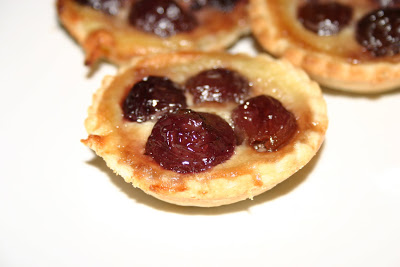
#221 Cherry Tarts

At the end of the summer, I bought a whole crate of cherries for just a few pounds toward the end of the season. Dutifully I stoned them all and froze them and then promptly forgot I ever had them. That was until I looked in the freezer and discovered them again, and since I am trying to use up everything in there, I thought I would make good use of them as a dessert.

Cherry season is pretty much a non-event in Britain these days, unless you live in cherry country – Kent. Almost all the cherries sold in markets and supermarkets are imported and finding home-grown cherries is nigh-on impossible. I certainly could find any here in Manchester.

Cherries have been enjoyed since the times of Ancient Greece, where they were considered only really worth eating raw, where they served as diuretic. In fact there is a detox diet that requires the poor dieter to put away a kilo of cherries a day; I like cherries, but not that much. Cherries did not become popular during – and therefore were only cultivated from – the Middle Ages. It was then that the cherry harvest became a part of European festival and a symbol of all that is good in summertime. Luckily in the day of the domestic deep freeze, we can save our cherries and enjoy them whenever we like, though they best eaten or cooked fresh really.

Anyways, that’s enough schpiel! Try these dainty little cherry tarts – they are essentially mini-clafoutis with a pastry base.

Start by making some sweet shortcrust pastry by rubbing three ounces of flour into five ounces of plain flour and two tablespoons of icing sugar. Bring the dough together with a large egg yolk and a tablespoon of lemon juice. If it is still a little dry, then add some cold water or milk. Allow to rest for at least 30 minutes in the fridge. Meanwhile, stone around a pound and a half cherries. Roll out the pastry thinly – as sweet pastry is very soft, it is worth rolling it out on some cling film of greaseproof paper – cut out 18 circles to line some small tart tins. Place a closely-packed layer of cherries in each little tart and then make the sweetened custard filling: whisk together a quarter of a pint of double cream, two eggs and three ounces of caster sugar. Pour a scant tablespoon of each of the cherry tarts and then bake for 15-20 minutes at 230⁰C until the custard browns and is set. Eat hot or warm.

#221 Cherry Tarts. A good and simple dessert to make, though the frozen cherries were perhaps not as good as fresh ones. Maybe the best to use would be morellos. Mine were a little insipid. That said you can’t go far wrong with the sweet pastry and custard elements to this pud. I’m sure you could use any fruit. I bet some lightly-stewed rhubarb pieces would be delicious. 5.5/10, though with good cherries, it would have been at least an 8/10, I reckon.

#201 Tea Cream

A good dessert to make if people are round because you can make it a couple of days in advance.

The tea in question for this tea cream recipe is green gunpowder tea. Green tea is a strange thing – I don’t ever drink it because it tastes of a combination of washing-up water and seaweed. Bleurgh. However, having it with cream and sugar did appeal slightly more; cream and sugar never taste bad, now do they!?

FYI: green tea comes from the same plant as our more familiar ‘black’ tea (e.g. PG Tips, Tetley, etc), but is unfermented thus retains its natural green colour, as opposed to black tea which turns its dark colour due to oxidisation during fermentation. Green tea is popular in China and Japan as we all know – but also in Muslim counties where it is forbidden to drink fermented tea. How bizarre. Anyone know why this is?

To make this tea cream mix together half a pint each of double and single cream in a jug. Pour around three-quarters of it into a small saucepan along with two tablespoons of sugar and an ounce of green gunpowder tea. Slowly bring to a boil, though keep on tasting it as you don’t want the tea to be ‘over-stewed’. Pour the hot cream into a bowl through a sieve. Taste again; if too strong add more cream. Use either a packet of powdered or five leaves of leaf gelatine to make the cream set. It’s best to follow the instructions on the packet at this point but generally you dissolve the powdered stuff in a little hot water and stir it into the cream, or soak leaf gelatine in cold water until soft and stir into the still-hot cream. Pour the whole lot into a mould – buy a fancy one if you can, I did. Cover with cling-film, allow to cool and then place in the fridge until needed. Turn it out onto a plate – you will need to dip the mould in hot water briefly to help loosen the jelly, I left it in too long and it went a little liquid around the edges. Serves five or six.


#201 Tea Cream. A funny one this one. I really liked the creaminess of the ‘jelly’, but the tea taste – though strong when hot, diminished greatly when chilled so I couldn’t really tell it was there. I certainly liked it enough to give it a second go at some point though. It did look very good in its fancy shape. 6/10.